Exploring Hebei's Yan Zhao Landscapes – Shijiazhuang and Baoding Tour
Hebei is a place where dazzling historical culture and magnificent mountain-and-river scenery complement each other perfectly.
Before the pandemic, I had wanted to take a self-guided tour around Beijing within Hebei. This time, on a whim, I decided to just go—to see more of the world while I still have the energy and vitality.
For this trip, I first set my sights on Shijiazhuang and Baoding.
Day 1: On a sweltering morning, boarded a north-bound train.
Arrived at Shijiazhuang Railway Station in the afternoon. Since my hotel was opposite the Hebei Museum, I dropped my luggage and hurried over to visit.
The Hebei Museum is a national first-class museum. The famous Changxin Palace Lamp is one of its most treasured exhibits. With so many cultural relics and limited time, I rushed through exhibitions such as "Hebei in the Stone Age," "Shang Civilization in Hebei," "Heroic Elegies: Stories of Yan and Zhao," and "Masterpieces of the Great Han: The Mancheng Han Tombs."
In the evening, I took a taxi to Minzu Road Wanli Pedestrian Street. The driver mentioned the nearby Zhengtai Square. At Zhengtai Square, you’ll find the Shijiazhuang Liberation Monument inscribed by Marshal Nie Rongzhen himself, as well as the Zhengtai Hotel and the Great Stone Bridge (a provincial-level key cultural relic protection unit). Here, you can learn about the city that grew around the railway—a place where the railway came first, then the Zhengtai Hotel, and finally Shijiazhuang.
Day 2: Rented a car and officially started the free-and-easy tour.
Stopped at the Dingzhou service area on the Beijing–Hong Kong–Macau Expressway.
Arrived at noon in Baoding, the former capital of Hebei Province.
In the hot summer, for easy sightseeing, I booked hotels near some scenic spots.
After dropping off luggage and a short rest, I began my Baoding city tour in the afternoon.
Guangyuan Garden (a National Key Cultural Relic Protection Unit)
It’s a north-south building complex dominated by single-storey structures, blending Eastern and Western architectural styles. From a distance, it looks somewhat cubic, like a small medieval European castle. Originally the Right Guard Office and Judicial Office of the Daning Dusi during the Ming Dynasty, it later became the residence of Cao Kun and now serves as the Baoding Local Chronicles Museum.
Zhili Governor-General's Office (a National Key Cultural Relic Protection Unit)
Built in the 7th year of Yongzheng's reign (1729) in the Qing Dynasty, it is the most completely preserved provincial government office of the Qing Dynasty in China. There’s a saying: "One governor’s yamen reflects half of Qing history."
Baoding Catholic Church
First built in the 24th year of Guangxu’s reign (1901) by French missionaries.
Ancient Lotus Pond Garden (a National Key Cultural Relic Protection Unit)
First built in the 22nd year of Genghis Khan’s reign (1227) in the Yuan Dynasty, it reflects the characteristics of gardens across the Yuan, Ming, and Qing dynasties. It’s a classical garden that integrates landscape, temporary imperial palace, and academy, combining the beauty of both northern and southern Chinese gardens.
In the evening, I dined at Baoding Huiguan to savour Hebei specialties.
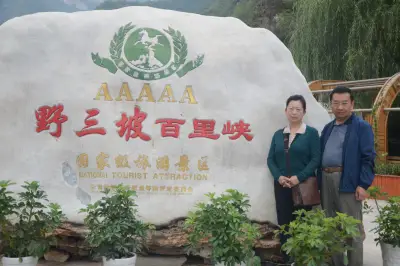
Yesanpo Baili Gorge (National AAAAA Tourist Area)
Located in Laishui County, Baoding, Hebei, it’s an excellent spot near Beijing for enjoying natural scenery and escaping the summer heat.
Yesanpo is the collective name for a scenic area cluster, featuring canyon cliffs, alpine meadows, karst caves, and riverscapes, each with its own charm. This time I visited Baili Gorge.
Baili Gorge is hailed as the “Number One Gorge Under Heaven” and is one of Yesanpo’s most distinctive attractions. Its unique erosional rift valley landform keeps temperatures warm in winter and cool in summer, with summer highs rarely exceeding 22°C, making it an ideal summer retreat.
My suggestion: enter via Shixuan Gorge, take the cable car to the mountaintop to watch the high-wire performance across the valley, then descend via Haitang Gorge—this route tends to have fewer visitors.
Western Qing Tombs (one of the first batch of National Key Cultural Relic Protection Units, listed as a World Cultural Heritage Site by the World Heritage Committee, and a National 5A Tourist Attraction).
Since Baili Gorge is deep and so pleasant, it was nearly 4 p.m. by the time I finished exploring. There was no time for the planned visit to the Western Qing Tombs. To get a glimpse, I drove through the mountain roads of Yesanpo for almost two hours to reach the tombs, passed through the scenic area, and made a brief stop at Yongfu Temple.
The hotel breakfast was really good.
I had originally planned to visit Xiong’an Impression in the Xiong'an New Area, but it was closed on Monday, so I changed plans to Xiong'an Country Park, then drove through the city centre to get a feel of it.
Baiyangdian (National 5A Tourist Attraction)
The largest freshwater lake in northern China. You can take a boat to reach various scenic spots, but simply visiting the Lotus Grand View Garden and the Culture Garden is enough for sightseeing. The Culture Garden houses Kangxi’s Temporary Palace, the Yanlingdui Memorial Hall, and more.
On the return journey, I passed through Dingzhou.
I took the chance to tour the ancient city of Dingzhou and had dinner there.
Renowned for its long history and brilliant culture, Dingzhou Examination Hall (a National Key Cultural Relic Protection Unit) is the only relatively well-preserved imperial examination venue for selecting scholars and tribute students in northern China.
Zhengding
A national historical and cultural city with a history of over 1,600 years, Zhengding boasts an exceptionally rich cultural heritage and numerous temples and cultural sites. It was once known as one of the “Three Famous Towns of the North” alongside Baoding and Beijing. Today, it has 9 national protected relics, 6 provincial protected relics, and over 10 county-level protected relics. Driving in the city is fairly easy, with free parking at every scenic spot.
Rongguo Mansion (National AAAA Tourist Attraction)
The main attractions of Rongguo Mansion include the Rongguo Mansion area, Ningrong Street, and the Cao Xueqin Memorial Hall. It was designed and built based on the descriptions in the classic Chinese novel Dream of the Red Chamber.
Zhao Yun Temple (National AA Tourist Attraction)
The main structures include the temple gate, Siyi Hall, Wuhu (Five Tigers) Hall, Junchen Hall, and Shunping Marquis Hall, preserving and enriching the temple’s historical appearance. It provides a place for both Chinese and international visitors, as well as Zhao Yun's overseas descendants, to pay homage and enjoy sightseeing.
Longxing Temple (National AAAA Tourist Attraction, among the first batch of National Key Cultural Relic Protection Units)
One of the earliest, largest, and most well-preserved Buddhist temples in China, and one of the country's top ten famous temples. First built in the Sui Dynasty as “Longzang Temple,” it was renamed Longxing Temple in the Tang Dynasty. By the Song Dynasty, it had become a grandiose architectural complex. After multiple renovations through the Qing Kangxi period, it developed into a tripartite layout with east, central, and west routes, reaching its peak of perfection.
The temple contains six items among the nation’s best: the Song Dynasty Mani Hall, praised by architectural expert Liang Sicheng as a unique surviving example of ancient world architecture; the Reclining Guanyin, hailed by Lu Xun as the “Oriental Goddess of Beauty”; the largest early revolving sutra bookcase in China; the Longzang Temple Stele, regarded as the finest Sui stele; the tallest ancient bronze-cast Buddha in China; and the most exquisite ancient bronze-cast Vairocana Buddha.
Additionally, on the northeast side of the temple lies Longteng Garden, a Ming-Qing style garden integrating historical relics display, tourism, and leisure.
Tianning Temple Lingxiao Pagoda (a National Key Cultural Relic Protection Unit)
Tianning Temple was built during the Da Zhong Xiang Fu era of the Northern Song Dynasty (1008–1016) and originally named “Cheng Tian Temple.” During the Zheng He era (1111–1118), it became known as Tianning Temple.
In the early Republican era, the temple suffered repeated calamities; its halls were destroyed one after another, leaving only Lingxiao Pagoda.
Lingxiao Pagoda gets its name from its towering height. Because much of its body is made of wood, it is commonly called the Wooden Pagoda.
Kaiyuan Temple Bell Tower and Xumi Pagoda (National Key Cultural Relic Protection Units)
First built in the 2nd year of Xinghe of the Eastern Wei Dynasty (540) and renamed Jiehui Temple in the 10th year of Kaihuang of the Sui Dynasty (591).
By imperial decree in the 26th year of Kaiyuan of the Tang Dynasty (738), it was renamed Kaiyuan Temple. By the late Qing, due to neglect, the temple fell into ruin, and only the bell tower and Xumi Pagoda remained.
Linji Temple Chengling Pagoda (National Key Cultural Relic Protection Unit)
Linji Temple is an ancient monastery first built in the 2nd year of Xinghe of the Eastern Wei Dynasty (540). Chengling Pagoda features delicate design, attractive shape, ornate carvings, and varied structure, making it a masterpiece among multi-eaved pagodas.
Guanghui Temple Huata (Multi-treasure Pagoda) (National Key Cultural Relic Protection Unit)
Also known as the Multi-treasure Pagoda. Guanghui Temple was first built during the Zhenyuan period of the Tang Dynasty (785–804), but the pagoda itself was built later, during the Jin Dynasty. It is the most uniquely shaped and lavishly decorated brick pagoda in China. The Huata consists of a main pagoda with four attached small pagoda pavilions at the corners of the ground floor, all constructed of brick. The small pagodas surround the main one, creating a staggered, harmonious composition that is exquisitely ornate and strikingly elegant.
Zhengding Ancient City Wall (Hebei Provincial Key Cultural Relic Protection Unit)
First built during the Eastern Jin Dynasty, it has a history of over 1,600 years. After enduring wars and the passage of time, only a small section of Zhengding's city wall remains, making it one of the few surviving Ming Dynasty city walls in China.
There are many watchtowers and archery towers atop the wall, offering spectacular panoramic views of the entire ancient city!
Bailin Chan Temple (National Key Cultural Relic Protection Unit)
First built during the Jian'an period of the Eastern Han Dynasty (196–220), it was anciently called “Guanyin Cloister,” became “Yong’an Cloister” in the Southern Song, “Bailin Chan Cloister” in the Jin Dynasty, and since the Yuan Dynasty it has been known as Bailin Chan Temple. The current temple buildings (except the Bailin Temple Pagoda) were successively built from 1992 onward. Covering over 90 mu, it is an important ancestral court in the history of Chinese Chan Buddhism.
Zhaozhou Bridge (National Key Cultural Relic Protection Unit)
Spanning the Xiao River in Zhao County, it was built during the Sui Dynasty between 595 and 605 AD, designed by the craftsman Li Chun. With a history of over 1,400 years, it is the second-oldest existing well-preserved single-arch open-spandrel stone arch bridge in the world today.
Baoduzhai (National AAAA Tourist Area)
Not a village, but the name of a famous mountain.
It is a scenic area combining both natural and cultural landscapes. Located 17 kilometres west of Shijiazhuang city, the mountain stands majestically, accessible only by narrow winding paths on the north and south slopes. Reaching the summit opens up a wide vista where you’ll find the largest mountaintop archway in China—Nantianmen (South Heavenly Gate), the country’s first underground mountaintop hall of 500 stone Arhats, a Han Xin Shrine decorated with China’s largest gold-painted murals, and sections of the Great Wall and fortress walls.
You can ascend via the newly opened “Xiyuan–Lianhua Mountain–Baoduzhai” passenger cableway, which stretches over 1,800 metres and reaches a maximum height of 271 metres, becoming a sight in itself.
With half a day left before leaving Shijiazhuang, I returned to the Hebei Museum to visit the remaining exhibitions: “Warring States Glory: Ancient Zhongshan Kingdom,” “Quyang Stone Carvings and Northern Dynasties Murals,” “Famous Kilns and Porcelain,” and the “Joyous Hebei” Intangible Cultural Heritage Exhibition Hall, among others.
In a short week, I travelled a thousand miles and gained abundant experiences. Already I’m looking forward to the next Hebei trip—Zhangjiakou, Chengde, and beyond.
I returned to my warm home aboard a 300 km/h Fuxing bullet train.
On this journey, after arriving by train, I rented a car and enjoyed complete freedom—a delightful and memorable trip.