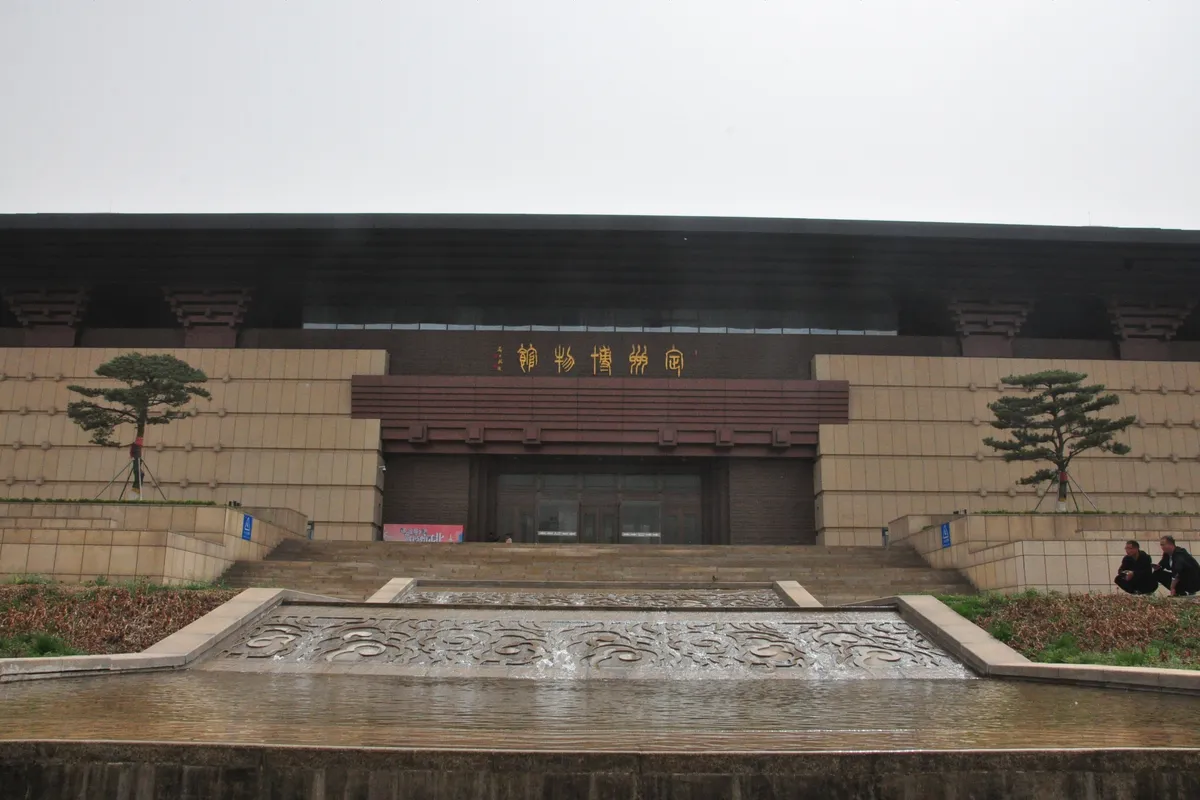
Hebei Travelogue: Dingzhou Museum
At 1:10 pm on April 14, 2023, we took bus No. 1 from the train station and got off at Wenbo Garden, which is the site of the ancient city of Dingzhou. Dingzhou wasn't originally in our plans—it was simply a necessary stop on the way to Beiyue Temple. But since we were passing through, we thought we might as well explore a little, and that's when we learned that Dingzhou is an ancient city. We decided to see what it had to offer. In the end, the biggest surprise was the Dingzhou Museum.
The ancient city of Dingzhou is about 50 km southwest of Baoding, Hebei Province. Its history runs deep, and its culture is rich. From the Shang and Zhou dynasties onward, it was an important political, economic, military, and cultural center in the north. The area is home to many historical sites: the Dingzhou Examination Hall, the Dingzhou Confucian Temple, the Kaiyuan Temple Pagoda, and more. The Examination Hall was first built in the third year of Qianlong in the Qing Dynasty and rebuilt in the thirteenth year of Daoguang. Up until the fall of the Qing, it was where local scholars and students from Dingzhou and surrounding areas took exams to become Xiucai or Gongsheng. The Confucian Temple sits in the central part of Dingzhou; it was first built in the second year of Dazhong in the Tang Dynasty and is dedicated to Confucius. It is the best-preserved ancient Confucian temple complex in Hebei Province and a key provincial cultural relic site. The temple covers 15,685 square meters, its halls are grand, and the courtyard, with its evergreen cypresses, has an ancient and serene charm. The famous 'Dongpo Twin Locust Trees' can be found here. Kaiyuan Temple Pagoda is an octagonal tower over 83 meters tall; it narrows as it rises, and each storey is slightly shorter. Inside, there are Song Dynasty murals and abundant carvings—a sight not to be missed.
After getting off the bus, we first looked for a place to eat. Lunch over, around 1:30, we headed to the Dingzhou Museum. I never expected that the museum would be so worth seeing. We ended up spending a full two and a half hours there, and I have to say, it easily rivals many provincial-level museums. Not only are the exhibits extensive, but many are truly exquisite treasures.
On August 28, 2018, the new building of Dingzhou Museum opened to the public. It covers about 36,700 square meters, with a total floor area of 25,600 square meters. The new building is very impressive, even magnificent, and serves as a landmark in the restoration and renovation project of Dingzhou's ancient city. Its design, inspired by Han Dynasty architecture, features bracket sets (dougong), a high platform, and a pitched roof—clean and straightforward. Tall spaces and transparent sightlines bring a modern architectural feel, dignified and grand.
By January 2021, the museum housed over 50,000 artifacts, including 107 first-grade cultural relics, 214 second-grade, and 644 third-grade. There are also 28,000 volumes of ancient books and local chronicles, and 30,000 woodblocks of the 'Jifu Series'. The collection focuses primarily on objects from the Han and Song dynasties. The most eye-catching pieces are three national treasures, two of which are on the list of 195 cultural relics prohibited from being exhibited abroad. A county-level museum with such holdings is truly remarkable.
Dingzhou Museum is a national second-tier museum. It currently features six themed exhibitions:
First, 'Palaces of the Han Dynasty' – this gallery displays a large number of exquisite artifacts unearthed from the tombs of Han Dynasty Zhongshan kings, reflecting the politics, economy, and social life of that era. Two national treasures are here: a large Eastern Han celadon jade disc with dragon and ring carving, and an Eastern Han openwork jade screen depicting immortal tales. The jade screen with immortal tales is on the list of 195 cultural relics prohibited from being exhibited abroad.
Second, 'Buddhas of the Northern Dynasties' – this exhibition shows 99 Buddhist statues from the Northern Wei, Eastern Wei, and Northern Qi periods. During the Northern Dynasties, Dingzhou was the center of Buddhist statue-making in northern China, developing the distinctive Dingzhou-type white-marble sculptures.
Third, 'White Ware of the World' – the Ding kiln was one of the five great kilns of the Northern Song Dynasty, and Ding porcelain is praised as 'white as jade, thin as paper, resonant as a chime.' The exhibition traces the kiln’s history in four sections—Origins, Development, Peak, and Legacy—showcasing its evolution and exquisite craftsmanship. This gallery holds another national treasure: a Northern Song Ding kiln white-glazed carved dragon-head ewer, also on the prohibited exhibition list.
Fourth, 'Millennia Beyond the Mundane' – here you see precious artifacts unearthed from two pagoda foundation crypts: Jingzhi Temple and Jingzhong Temple, both from the Northern Song. On display are relics containers, Buddhist statues, incense burners, ritual instruments, offerings, as well as reconstructed scenes of the crypts and facsimiles of murals. The two crypts were discovered and excavated in 1969, yielding over 800 invaluable items, including gold and silver wares, stone objects, porcelain, wood carvings, jewelry, ironware, and textiles from the Jingzhi Temple crypt—along with more than 2,700 bronze coins from the Warring States to the Northern Song, and 115 pieces of Ding porcelain. The Jingzhong Temple crypt produced 106 artifacts, mainly silver pagodas, silver coffins, silver bottles, stone caskets, stone coffins, glass bottles, and 55 early Northern Song Ding wares. In the exhibition, you can see a seven-layered coffin set containing a Buddha’s relic, Song Dynasty murals depicting the Buddha’s nirvana, and a dazzling array of altar offerings. There are also life-size reconstructions of the Jingzhong Temple pagoda foundation and the relic gold pagoda, as well as incomparable gilded bronze heavenly kings and painted wood guardian figures.
Fifth, 'Starry Sky of the Homeland' – Dingzhou has a long history and has produced many notable figures. This exhibition introduces famous personalities from various periods and fields.
Sixth, 'Gleaming Gold and Jade' – the name comes from Cao Zhi’s 'Ode to the Goddess of the Luo River': 'Wearing ornaments of gold and jade, adorned with bright pearls to make the body shine.' The display showcases 203 sets of gold, silver, and jade jewelry from the Liao Dynasty to the Ming and Qing dynasties—exquisitely crafted, highly skilled, and brilliantly beautiful, their radiance spanning centuries. This is the best museum I’ve ever seen in a county-level city. It far surpasses our Shangqiu Museum, whether in the quality of the exhibits or the style and standard of the curation.
At 4:00 pm, we finished our museum visit and, stepping outside, saw the nearby Kaiyuan Temple Pagoda. Unfortunately, the scenic area was closed, so we could only take a photo from outside.
Crossing the road, there were three sights to the north. We went first to the former Dingzhou Prefectural Government Office, which is free to enter. It consists entirely of newly built imitation ancient architecture, all shut up, the courtyard deserted—a rather unsuccessful attraction.
Next, we planned to visit the Examination Hall, but it was a bit far and we had to catch an evening train, so we decided to skip it. By chance, we ended up at the entrance of the Confucian Temple, but a staff member told us it was already closed. We could only wander along the old street for a while. Then we took bus No. 1 back to our hotel, picked up our luggage, and went to the train station to board the 6:15 pm K600 train to Baoding. We arrived at 7:10 pm, checked into Home Inn, a standard twin room for 108 yuan.