Wild Great Wall at the Foot of Baishi Mountain (Mongolia-Hebei-Liaoning, Part 13, 202309)
The day before yesterday, when nearing Baishi Mountain, I saw a watchtower by the road. I knew this was the Baishi Mountain Great Wall.
This morning, while leaving Baishi Mountain for Laiyuan, I checked how far the wall was on my map—just two or three kilometers. I asked the bus driver to stop at the Great Wall so I could hop off and take a look, planning to catch the next bus.
The driver drove right past the watchtower, finally stopping a good kilometer or two further on, and told me this was the place.
After getting off, I looked around. A few farmhouses stood by the road, but there was no sign. On the ridge ahead, I could faintly make out a stone-built Great Wall snaking along it.
Ah, the driver had taken me for a wild-wall scrambler.
Oh well, since I was here, I might as well go and see.
I left my luggage with a farming family and, following their directions, set off with my trekking pole.
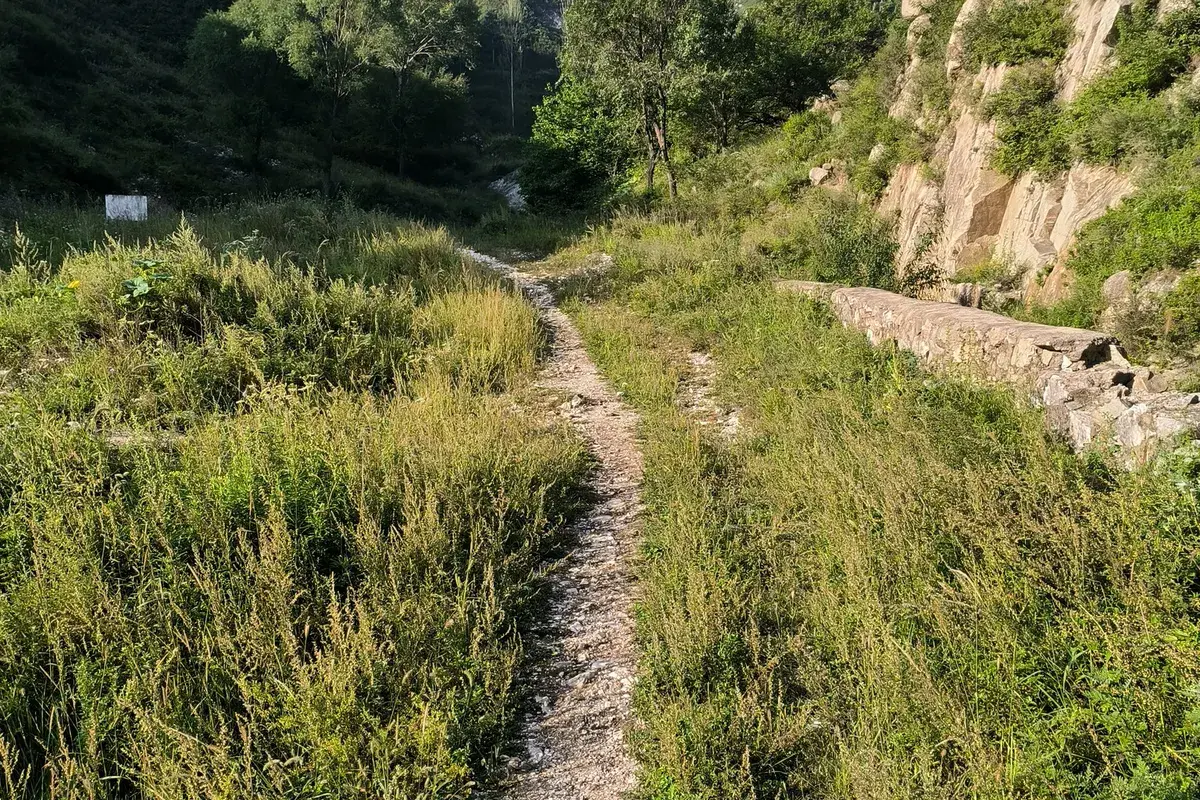
There was no proper path. First, I walked along the gully bottom until the shallow water threatened to soak my feet, then headed up the slope.
The slope had a few scattered crops but was mostly wild grass.
Soon there were white pebbles, then thick wild grass. I could only follow faint footprints through the grass and thorny bushes.
My trouser legs were soaked with dew, and the way forward grew ever more impassable, yet the Great Wall still stood far off on the high ridge.
They say you're not a hero until you reach the Great Wall, but faced with this wild section, I could only sigh in resignation—halfway along, I admitted defeat.
For safety's sake, I retreated!
Stumbling and slipping, careful yet clumsy, I finally made my way down from the slope.
Back at the farmhouse, a girl said that not long ago a young man had broken his leg out there.
Knowing when to turn back—that's wisdom on my part!
The Baishi Mountain Great Wall visitor area lies on the northwestern foot of Baishi Mountain. It's a Ming Dynasty section that has survived relatively intact, never restored in modern times, showing the wall's original appearance. The Ming Great Wall within Laiyuan is an inner Great Wall, serving as an inner defense line for Beijing and the Hebei plain.
The inner Great Wall starts in Huairou in the east, passes through Badaling southwest to Laiyuan, then extends into Shanxi Province. The Baishi Mountain Great Wall is a stretch of this Ming inner wall. To its west lies Chajianling Pass and to its east Baishikou Pass, both important fortress towns. About eight kilometers of wall between the two passes remain two-thirds basically intact, with battlements even well-preserved in some spots. Of over 40 watchtowers, more than 30 are basically intact, and many now serve as shelters for shepherds.
This Ming wall was built between 1573 and 1576. On a stone in the western section is carved "Workers from Hua County, Daming Prefecture"—meaning it was built by laborers from Hua County in Daming Prefecture (present-day Hua County, Henan Province). The eastern mountain section has a double layer of wall, still locally called "Quyang City" because it was built by laborers from Quyang County, Hebei Province.
Typically, watchtowers stand astride the wall, but here two watchtowers are set over 30 meters away from the wall itself. These are sentry towers, perfectly illustrating the design principle of "adapting to local conditions" at work in building the Great Wall.