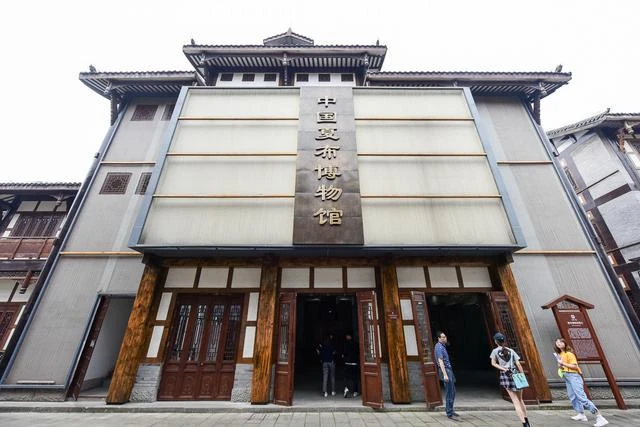
China's Only Xiabu Museum: The Most Comprehensive Collection of Xiabu Materials and Artifacts
In the eyes of many, Chongqing was once an industrial city and is now a cyber city. In fact, this is a misunderstanding of Chongqing. Chongqing is first and foremost a famous cultural city with a history of more than 3,000 years. Industry is just one aspect of it, and being a trending online city is only one of its labels. Chongqing is ancient and vast, and no one dares to claim they know it well, because very few people have truly traveled all over Chongqing, including the locals themselves.
Chongqing is not just its main urban area; it is a collective term for 38 districts and counties, each with its own unique characteristics and culture, each boasting its own signature scenic spots. You may have heard of the Three Natural Bridges in Wulong, the Dazu Rock Carvings, the Ghost City in Fengdu, and the White Emperor City in Fengjie. You may also have heard of the Peach Blossom Spring in Youyang, the Jinfo Mountain in Nanchuan, the Fishing City in Hechuan, and the Goddess Peak in Wushan. But how many have heard of what Qijiang has? What Xiushan has? What Rongchang has? Or what Liangping has? What Shizhu has? What Tongnan has? ...
Some friends might say: Qijiang has Gujian Mountain, Xiushan has Hong'an Border Town, Liangping has Shuanggui Temple, Shizhu has Huangshui, Tongnan has Shuangjiang Old Town... Of course, every district and county in Chongqing has its remarkable side, and which one isn't famous? Shuanggui Temple is the ancestral temple of Southern Buddhism, and Shuangjiang Old Town is one of China's first ten famous historical and cultural towns. Aren't they all national-level, national treasure-level existences? So, Chongqing is definitely worth visiting again and again, never getting tired of it. It is not only China's hottest trending city but also China's most charming tourist city and the city with the most AAAAA-level scenic spots.
Today I want to introduce a remote district under Chongqing—Rongchang. It is a small city in western Chongqing not known for tourism, but it also has astonishingly profound culture. In ancient times, it was called Changzhou, also known as the Land of Begonia Fragrance. In the seventh year of Hongwu in the Ming Dynasty, it was renamed Rongchang by taking the first characters of Rongzhou and Changzhou, meaning 'prosperity and flourishing.' It was an important settlement area for the 'Huguang Fills Sichuan' migration and is known as a living fossil of Hakka culture. Moreover, it possesses three national intangible cultural heritages: Rongchang pottery (one of China's four famous types of pottery), folding fans, and Xiabu (ramie cloth). It is also the origin of the world-class fine pig breed 'Rongchang Pig.'
These rich cultural heritages may not have as much influence as the neighboring Dazu Rock Carvings, Hechuan Fishing City, or Tongliang Dragon, but which one is not an outstanding achievement? Take Xiabu, which this article introduces: the only national-level Xiabu Museum in the country is located in Rongchang. This museum offers a comprehensive introduction to Xiabu.
The Xiabu Museum is situated on Xiabu Town in Rongchang, Chongqing, and is a core attraction and important component of Xiabu Town. The entire museum takes the national intangible cultural heritage—Xiabu weaving skills—as its main theme. While focusing on the protection, exhibition, and popularization of traditional cultural heritage, it is also dedicated to introducing the history and culture of Rongchang Xiabu.
Rongchang Xiabu has an extremely long history, and its name has changed several times. In the Han Dynasty, it was called 'Shu cloth'; in the Tang Dynasty, 'Ban cloth'; in the Song Dynasty, 'Tong cloth'; and today, it is called 'Rongchang Xiabu.' In 2008, it was included in the second batch of the National Intangible Cultural Heritage List.
Looking back at its history, records of Xiabu (Shu cloth) date back to the Han Dynasty. The 'Yuanhe County Annals' of the Tang Dynasty records: 'Changzhou pays tribute of Tong cloth and Ban cloth.' The so-called 'Tong cloth' is a medium-fine type of Xiabu, often rolled into a tube shape and packed into bamboo tubes for easy transport, hence the name 'Tong cloth.' Based on its shape and color, it is also called 'Ban cloth.' The 'Taiping Huanyu Ji' also records: 'Changzhou produces Ban cloth and Tong cloth.' Being both a specialty and a tribute cloth indicates that ramie weaving techniques in Changzhou were relatively developed since the Tang and Song dynasties, and the cloth was even presented as tribute to the imperial court.
In simple terms, Rongchang Xiabu is a type of ramie woven fabric, specifically divided into three categories: fine cloth, coarse cloth, and ribbed cloth. The fabric has fine and even textures, a clean and lustrous color, and is tough and durable. Moreover, due to its light and thin ramie nature, it is easy to wash and dry after wearing, and it holds crisp creases after ironing, giving it an antique elegance and beautiful appearance. Therefore, it has been deeply loved by people throughout the ages.
According to the staff, before the Qing Dynasty, Rongchang Xiabu was a rare commodity mainly used as tribute to the imperial court. It was not until the late Kangxi period that it became a commodity for production and was exported both domestically and internationally, especially to Korea, Japan, and Southeast Asia, becoming a famous specialty of China.
However, as a purely handmade product, Rongchang Xiabu later faced severe competition from imported cotton yarn and artificial silk, gradually losing market space. Its international sales also encountered great resistance. Faced with machine-spun cotton yarn with much higher production efficiency, handmade Rongchang Xiabu lost market competitiveness and gradually faded from people's sight.
Later, after the reform and opening up, some high-end foreign brands discovered that handmade Xiabu had many advantages that machine-made gauze could not replace, leading to a surge in demand. This reawakened the dormant looms, and many old Xiabu weavers in Rongchang began teaching their skills again, reviving the almost-lost traditional craft like a withered tree springing back to life.
Around 1995, the inheritors of Rongchang Xiabu, combined with modern technology, made some innovations to the original craft, achieving major breakthroughs in ramie bio-degumming and plant dyeing. This increased the production efficiency of Rongchang Xiabu by 1.6 times compared to before the founding of New China, ushering in a heyday in which the whole Rongchang district (then a county) produced 700,000 bolts of Xiabu annually.
Later, Rongchang Xiabu's influence in China grew. In 1998, the Ministry of Agriculture successively awarded Rongchang the honorary titles of 'Hometown of Chinese Xiabu' and 'Xiabu Processing Base.' In 2008, Rongchang Xiabu was recognized as a 'National Intangible Cultural Heritage' by the Ministry of Culture. In 2009, Yan Kunji, then 80 years old of Rongchang, was confirmed by the Ministry of Culture as the 'Representative Inheritor of the National Intangible Cultural Heritage Project – Xiabu Weaving Skills.'
To showcase, publicize, and promote Rongchang Xiabu, Rongchang specially built an AAA-level 'Intangible Cultural Heritage Tourism Scenic Spot' named Xiabu Town, which integrates Xiabu exhibition, research and development, information release, display and sales, and experiential tourism. The town covers an area of over 100 mu (about 16.5 acres), with a total building area of 53,000 square meters. The main buildings consist of 24 courtyard complexes imitating Ming and Qing Dynasty styles, featuring green tiles and ancient courtyards, covered bridges and artistic dreams, horizontal and vertical walkways, each step exquisitely lifelike. The Xiabu Museum is one of them.
The museum systematically introduces the history, culture, and production techniques of Rongchang Xiabu, as well as many ancient weaving machines and textile articles. This is an old shuttle, related to the saying 'time flies like a shuttle.' Its surface is very smooth; when thread is passed through it, a gentle throw takes the thread to the other side, and the cycle repeats.
This is an ancient loom, said to be over 200 years old, but still usable for weaving Xiabu.
Xiabu has a wide range of uses, including clothing, bedding, and daily necessities. This is another national intangible cultural heritage of Rongchang: folding fans made of Xiabu.
This is a scarf made of Xiabu.
Besides illustrated introductions, tools, and physical displays, the museum also has many sculptures depicting scenes of Xiabu production in the past.
This is a miniature landscape of the former Rongchang Xiabu workshop, as vivid as the 'Along the River During the Qingming Festival.'
A corner of the miniature landscape: shops, bridges, workers, boats, etc., are clearly visible.
Mosquito nets and bed curtains made of Xiabu in the past.
A reconstructed scene of selling ramie yarn in the past.
A display of Xiabu production scenes from the past; this should be the scene of drying ramie yarn and Xiabu.
Workers transport the finished ramie yarn by boat for sale.
Now, with Rongchang Xiabu being declared a national intangible cultural heritage, its production has become more standardized, scaled, and internationalized. Local artisans try to use it as a raw material for bags, furniture decorations, round fans, and other items. Even on some international high-end brand garments and at international fashion shows, Rongchang Xiabu can often be seen. Orders from all over the world are pouring into Rongchang like snowflakes, making this national business card even more brilliant.


