Five-Day Four-Night Cruise on the Yangtze River Three Gorges (Yichang – Chongqing): Maiden Voyage of M/V Victoria Katarina
During the National Day holiday, the key to avoiding traffic jams and crowds is not to go out on the 1st, 2nd, or 3rd, but to wait until the 4th. Since 2020 had an eight-day holiday, leaving on the 4th was not too late, and it avoided the peak travel period. After some thought, I consider myself lazy, so I decided to experience the scenery of the Yangtze River Three Gorges on a river cruise, enjoying a laid-back "Ge You-style recline" all the way to Chongqing. That was my idea, and that's exactly what I did.
Since I took the route from Yichang to Chongqing, I started at the Yichang Three Gorges Tourist Center, took the cruise line's transfer bus, and arrived at Zigui Port (also called Maoping Dock). During the National Day holiday, taking the transfer bus was reliable; buses departed continuously from 18:00 onwards.
The passenger cable car at Zigui Port moved slowly in the night, very much like a scene from Hong Kong or some other place. If a TVB drama scene or a Chow Yun-fat movie clip came on at this moment, it would really feel that way.
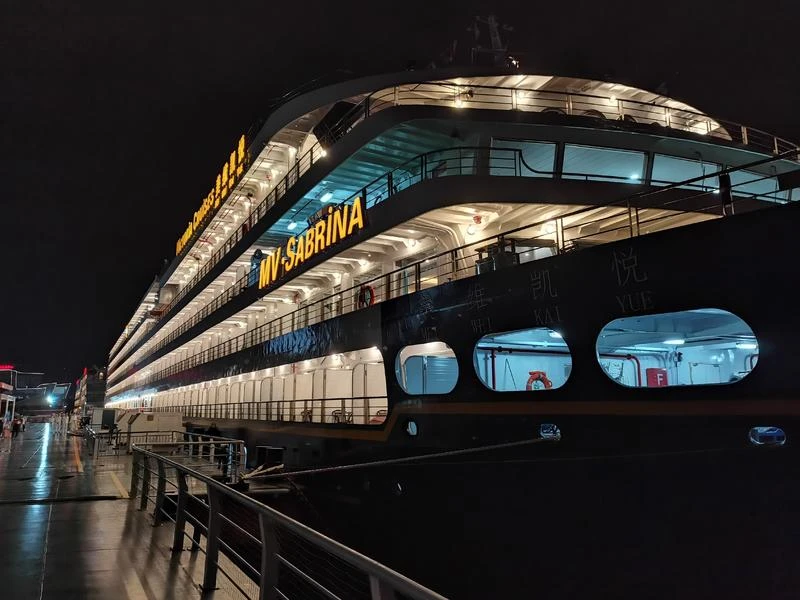
This time we sailed on the M/V Victoria Katarina, a newly launched super-five-star river cruise, a large ship with a gross tonnage of 17,000 tons.
After passing through the port security, four neatly uniformed young men had been waiting at the boarding area for some time, and many young ladies were waiting to take photos there.
The check-in process was quite fast. Although there were many people, the front desk ladies were very skilled, making check-in relatively quick. There were also many guests waiting to upgrade cabins and raise their floor level, because the higher the floor, the better the view. We stayed on the fifth floor.
We stayed in a standard room with a balcony. In addition to two single beds, there was a three-seat sofa, plus two chairs on the balcony, enough to accommodate five people chatting in the room. If you come with a large group, you'll surely have a good chance for a long talk.
Central air conditioning, a safe, and a bathroom with separate wet and dry areas – the same configuration as a star-rated hotel, equally comfortable. But don't worry about air quality because of the central AC; they use a photohydroionization air purification device that generates nanoscale photohydro ions to freshen the air, quickly and efficiently kill various bacteria in the air, and oxidize and decompose chemical toxic and harmful gases. Moreover, disinfectant is available at boarding and in public areas on the ship, so you can clean your hands at any time.
Also, because the balcony leaves a tiny gap, a constant flow of river breeze renews the indoor air – pure natural air. This is definitely worth having.
You can put important items, including documents, in the safe, which operates like a hotel safe and is safe and reliable.
The balcony may not look big (due to the angle), but two people can sit here leisurely to chat and drink tea. There is a water purifier at the stern, and you can also buy bottled water on the ship. Anyway, making tea every day is a must, because tea is perfect for relaxation and good for health. (Two bottles of water are provided daily.)
Note: Dinner is not provided on the first night of boarding. You can have dinner before boarding, or order food at the paid restaurant on the ship.
Attraction: Three Gorges Folk Village (5A Scenic Area)
Early the next morning, the tour guide for the Three Gorges Folk Village came to pick us up. The young Tujia girl carried a small bamboo basket on her back, simple and sweet.
The area shoulders two dams and links two streams. The beautiful Three Gorges Folk Village is located on the bank of the Xiling Gorge, one of the Three Gorges, nestled by mountains and rivers, with picturesque scenery. At the intersection of Longjin Stream and the Yangtze River, several ancient sailboats stand against the wind. The clear green water of the stream, the lush green trees, the mottled Longxi Bridge spanning over it, and a few small fishing boats quietly moored under the bridge. On one side is the clear stream, on the other the muddy river water; in one dimension, yet seemingly in two different worlds.
The high-pitched folk songs echoed throughout the valley. Two elderly folk artists began to sing when tourists passed by. Although most tourists couldn't understand the lyrics, it didn't hinder their appreciation. The joys and sorrows, production and life scenes, and male-female emotions of the Tujia people are the main themes of their songs.
This is the water village. Unlike the water towns in Jiangnan, the people living on the water here are Tujia people who have migrated through the ages. They are not the gentle southern women but spirited girls with a touch of playfulness. The young Tujia girl holding an umbrella occasionally interacts with tourists on the shore, either replying with a word or a folk song.
Usually, the girls washing clothes by the stream are not there because of the rain; only the washed-and-hung homespun sheets can be seen. Singing while washing clothes is a unique pleasure.
Since it was the National Day holiday, there were many tourists. The courtyard in front of the stilted building was full of people waiting for the upcoming wedding performance. According to Tujia customs, the ceremony includes crying at the wedding, getting into the sedan chair, lifting the sedan, bowing, and entering the bridal chamber. The guide jokingly called this place a "special zone" where all men could catch the bridal bouquet during the performance. But generally, men who came with wives (or girlfriends) remained "indifferent", and it was us singles who scrambled for it.
Did you notice that the matchmaker in the performance was actually a man in drag? He is known as the "First Matchmaker of the Gorge River."
Of course, the dried fish and pan-fried potatoes sold in small shops along the road at Three Gorges Folk Village are beyond words – they look and smell delicious. After a tour, snacking on them is a great way to fill your stomach. And now local oranges are in season, so buy some to taste – they are authentic flavors.
Three Gorges Dam (5A Scenic Area)
This is a scenic area that all tourists will be impressed by and yearn for. It is not only a national megaproject, but many older people first learned about the construction of the Three Gorges Dam through the overwhelming CCTV news coverage more than twenty years ago. Coming here today is a kind of pilgrimage and a wish fulfillment, to express the excitement in their hearts. In one's life, one must visit the Three Gorges Dam at least once to have no regrets.
To reach the Three Gorges Dam tourist area, you need to transfer to the scenic area's shuttle bus at the transfer center, and then take the most impressive three-level escalator (no argument – it has a steep slope and runs even in rain). The first stop is Tanziling, named because Tanziling Park looks like a pickle jar.
Climbing high and looking far, you can overlook the entire dam area. The majestic figure of the dam cutting off the river is awe-inspiring. Although there was a little rain, there were some clouds and mist, which gradually dissipated, greatly improving visibility.
Walking in the Three Gorges Dam tourist area in the rain is actually quite pleasant. If it were a scorching sun, many scenes wouldn't be clearly visible.
The five-step ship lock allows you to enjoy the fun of watching boats rise with the water. Children shout loudly when they see ships passing, trying to interact with people on board. The permanent ship lock has 24 miter gates. Two-thirds of the miter gates are 36.75 meters high, 20.2 meters wide, 3 meters thick, and weigh 850 tons, covering an area close to two basketball courts. Their size and weight are both world records, known as the "Number One Gate under Heaven."
At the 185 platform, you can clearly see Ziguixian New County – the first county upstream of the dam – including the Quyuan Hometown Scenic Area, which has obvious mountain-style architecture.
Shennong Stream (5A Scenic Area)
Badong Shennong Stream is known as China's "Volga River." The mysterious hanging coffins in the crevices of the cliffs, the vivid trunk-like Elephant Trunk Hill, the unfathomably deep Yanziqian Cave...
Badong is the place where Huang Xiaoming's "old waist" was strained in 《Chinese Restaurant》Season 4. The banks are densely packed with buildings. There is a folk saying: "Zigui is a line, Badong is a large stretch." And the mysterious Shennong Stream is right in Badong. This time we transferred from the cruise ship to the scenic area's transport boat to cruise Shennong Stream, continuing our journey against the wind and waves.
You can't hear the heroic feeling of "the torrent plunging three thousand feet" from a waterfall; what you hear is the quiet flow of the stream like a gentle lady. Although it is only a tributary, it doesn't lose to the grandeur of the great rivers.
The peaks are tight, the cliffs steep, and the hanging coffins in the gorge are truly amazing. Thousands of years ago, how were these coffins hung on cliffs hundreds of meters high? Even today, it would be a considerable project. According to the guide, the higher the hanging coffin, the more filial the descendants, and it also symbolizes promotion and wealth.
The guide not only explained in detail but also sang several authentic folk songs. She also introduced local delicacies and invited everyone to taste selenium-rich wild tea, a tea made from large tree leaves. It can be drunk when cooled, or chilled in summer. It has a sweet aftertaste and is said to have the effect of reducing internal heat.
It's a pity we didn't have the chance to ride the "wandojiao" (pea-shaped) small boat, which would have allowed us to go deeper into Shennong Stream and experience more comprehensive and richer scenery and culture.
A stream of clear water stirs Kuimen; the calm lake quietly shows its beauty. The western starting point of the Yangtze River Three Gorges – Baidicheng in Fengjie, Chongqing. A large number of timeless poems have made Fengjie the only "City of Chinese Poetry" in the country. Baidicheng is also an important historical witness to Liu Bei's entrustment of his son during the Three Kingdoms period, and has been a strategic military site throughout history. The Kuimen pattern on the 10-yuan RMB note also comes from here. There are many photogenic spots waiting for you to explore and discover.
Sitting on the M/V Victoria Katarina, when I saw the words "Baidicheng · Qutang Gorge," I knew Baidicheng was really close.
"East side sunrise, west side rain; it seems sunny yet not sunny." This couplet was written by Tang Dynasty poet Liu Yuxi when he was an official here, and it's also the best explanation of the weather at Baidicheng. When we disembarked, there was still some light rain, but it had completely stopped when we arrived, as if welcoming us.
The elderly on the same boat were all absorbed in viewing the historical sites, but the young people were not idle either. The red walls of Baidicheng became a great place for young people to take photos.
For those who love ancient architecture, it goes without saying that they will carefully examine and study it, after all, it is a relic with a thousand years of history.
At the end of the Xinmang period and the beginning of the Eastern Han Dynasty, Gongsun Shu occupied this area. A white dragon emerged from a well, and Gongsun Shu considered it an auspicious sign, so he set up a separate regime in Yizhou and renamed Yufu to Baidicheng. This is the origin of the name Baidicheng. Initially, the Baidi Temple was indeed dedicated to Gongsun Shu, and it continued for an unknown number of years. But in the seventh year of Zhengde of the Ming Dynasty, it was changed to worship Han general Ma Yuan, along with the earth god and river god, and the temple was renamed "Sangong Shrine." In the twelfth year of Jiajing of the Ming Dynasty, it was changed to worship Liu Bei and Zhuge Liang. In the thirtieth year of Jiajing, statues of Guan Yu and Zhang Fei were added, embodying the meaning of "wise ruler and virtuous ministers," thus forming the current enshrinement arrangement in Baidi Temple.
Baidicheng has never been just a memorial hall for Liu Bei. For thousands of years, it has been a military stronghold. Since the Han Dynasty, city walls have been continuously built for military defense. Therefore, the walls are exceptionally abundant, with walls from different dynasties overlapping to form very sturdy fortifications. It was a strategic military site until before the Qing Dynasty.
A Western-style building in Baidi Temple looks a bit out of place. This is the "White House," built by a warlord during the Republic of China period. Building a small Western-style house in this beautiful scenic spot, although somewhat jarring, still leaves us a place to visit today.
But the sealed history can no longer be recorded, and the smoke of historical warfare gradually dissipates. What remains for visitors today are the poetry and romance, the loyalty and righteousness, and the cultural atmosphere of this place.
If you have a 10-yuan note in hand, take it out boldly and compare it with this scene. Isn't this scenic spot engraved on RMB worth a commemorative photo? The pose here is: wave your hands and fling the 10-yuan note.
This is actually a very ethereal place. As we all know, Fengdu is a magical place where the three realms of "humans, ghosts, and immortals" coexist. And the Jade Emperor Holy Land is a large-scale blessing and dream-fulfilling destination that integrates the strengths of Buddhism, Confucianism, and Taoism, a place that people yearn for.
Come with sincerity, come with integrity, to pray for blessings for your family, to bless your friends, and to dream a beautiful future for yourself.
Walking ninety-nine steps to the mountain gate, prayers and blessings are always there. Not greedy, not lustful, tranquil and infinite; not angry, not irritable, long-lived world. Although we seek blessings, a good life still depends on our own efforts.
Performance by ship's staff; Handsome driving in the captain's cabin; Enjoying the view on the 5th floor deck (the view on the 6th floor is even better!)
This trip on the M/V Victoria Katarina was very relaxing overall. No need to change hotels every day, no need to plan the itinerary. Every day a local guide picked us up for shore excursions, and there was a cruise guide explaining the scenery along the Yangtze Three Gorges. Meals varied daily with balanced nutrition. Suitable for family trips with elderly and children. If you want to do nothing, you can hang out at the bar every evening, enjoy afternoon tea with friends, practice tai chi in the morning, or watch a movie in the ship's cinema. For mahjong enthusiasts, there is a well-lit, well-ventilated card room. Of course, there is also a gym for those who want to exercise. When taking a Yangtze River cruise, take the most luxurious one.


