Chongqing, Can You Swap the Nickname 'Magic City' with Shanghai?
When talking about Chongqing, the first keywords that come to mind are magical, 8D, hot pot, and getting lost.
Indeed, this unique city is like a pot of yuanyang (dual-flavor) hot pot, with its bloodline naturally flowing with mix-and-match and unruliness.
The confluence of two rivers is like the two broths; the distinct main urban areas and unique attractions are like the signature ingredients.
Each ingredient has its own special flavor, such as the light rail, the Yangtze River Cableway, Ciqikou Ancient Town, Hongya Cave, and so on.
We had longed to visit Chongqing but never made it. This time, an opportunity suddenly arose, sponsored by the big boss SAIC Maxus, who provided a car, money, and even an itinerary to treat us to a trip to Chongqing. Of course, we packed our bags without hesitation! We must solemnly thank our big boss! And we must also say that the G50 sponsored by Maxus this time was really great to use. It is definitely an excellent choice for commuting, travel, and families with two children!
We'll talk about our experience with the G50 later; let's first talk about this city.
Chongqing, abbreviated as "Yu," also known as "Mountain City" and "Fog City," is one of China's four municipalities. As early as 2 million years ago in the Paleolithic Age, the earliest humans in China, the "Wushan Man," lived here. During the Xia and Shang dynasties, it was called Baipu Land, and it was rich in rock salt. Since salt was an important hard currency in ancient times, it began to develop rapidly, forming the Ba civilization. Thereafter, for thousands of years, Chongqing was one of the most important cities in the southwestern region.
Until the full outbreak of the War of Resistance Against Japan in 1937, the Republic of China government moved its capital to Chongqing, making it the wartime capital. Subsequently, a large number of industrial enterprises moved in, turning Chongqing into a heavy industrial city focused on military industry. During the war, as the rear area, it assumed the role of military, economic, and cultural center, becoming the Far East command center of the World Anti-Fascist War. Countless moving and heroic stories of the war emerged. Of course, during the Chinese Civil War, it also became a main site where the Military Statistics Bureau persecuted our party's martyrs, but that's a later story.
Since the founding of New China, Chongqing has developed rapidly, going through three establishments and removals until it finally became one of the four municipalities as it is today.
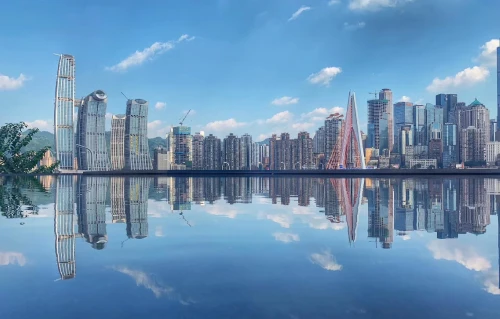
This magical city has a strong sense of the world of jianghu (the underworld). It has the down-to-earth human烟火 and modern skyscrapers. It changes rapidly and develops quickly. After arriving, we drove to the downtown area. The first time we drove through the streets, it felt like the futuristic three-dimensional city scenes in some sci-fi movies. The closer to the ground, the older it gets. The old houses bear mottled traces of time, covered by dense ivy. On the undulating roads, old-fashioned red three-wheeled motorbikes run parallel to motor vehicles. By the roadside, you can often see "bangbang" (porters) pushing carts or carrying shoulder poles, walking with difficulty, giving you a feeling of traveling back decades. But if you look up, above this mundane world, countless high-rise buildings stand. They have various shapes, full of imagination. Look up again, and a low-flying plane passes over your sight, like a vehicle in a future world shuttling through the air roads.
The main reason for this urban layout and landscape is that Chongqing is a mountain city. The whole city is built along the two rivers and among the mountains. Over time, with population growth, buildings gradually spread from the foot to the top of the mountains. Since it's not easy to clear a flat space among the mountains, whenever there is a piece of flat land, Chongqing people will perform a magic trick and build the buildings as high as possible, the higher the better, to increase utilization and reach for the sky. Over time, today's 8D pattern was formed. Often you enter an elevator from the 1st floor, press the button for the 10th or 20th floor, and when the door opens, you find yourself still on the ground. It makes you constantly doubt your sense of space. So, when taking an elevator in Chongqing, pay attention to one detail. Many elevator floor signs have a "street level floor" mark. This means that if you exit from this floor, you can reach the ground. But many times, there will be two or even three street level floors, no wonder you get dizzy.
On the first day we arrived, we drove around the city for a long time. Although the two of us with four ears listened to the navigation of the "Zebra System" and didn't get lost, it was still quite thrilling. Often the voice navigation couldn't keep up with the changes at intersections. Occasionally, all lanes would be left-turn or right-turn. The navigation told us to turn left, but we were actually just following the road. We went around and around and gradually got used to it. So we first went to see the world-famous "light rail through building" at Liziba Light Rail Station.
Rail transit plays an extremely important role in Chongqing's public transportation system. It started as early as 1946. Now the entire light rail network in Chongqing extends in all directions, even appearing unexpectedly. Suddenly a light rail train whizzes overhead when driving. Moreover, Chongqing's light rail uses monorail form, with wheels close to the track horizontally. So, looking up from below, the underside of the train looks like a cute big caterpillar. Big caterpillars shuttle through the city, full of cuteness.
After watching the light rail through building at Liziba Station, it was already past 18:00. Following our understanding of evening in East China, we hurried to Hongya Cave, worried that if we arrived too late and it got dark, we wouldn't capture the lighting process. However, we were wrong. It gets dark relatively late in Chongqing; around 19:45, it finally felt like dusk and sunset.
Hongya Cave was originally called Hongya Gate, one of Chongqing's ancient city gates. The ancient city gate has been damaged and disappeared. Later generations built this unique landscape project along the mountain slope here. The design concept is derived from the traditional Bayu stilted buildings, overlapping and interlacing. This forms an aerial three-dimensional pedestrian street, connecting Jiefangbei to the riverside. It looks especially like the scene from Hayao Miyazaki's animation "Spirited Away." Standing by the river, you have a dizzy feeling of not distinguishing between illusion and reality. There are many food and snack shops inside Hongya Cave, divided into food streets, exotic style streets, Bayu style streets, and dynamic bar streets. There's also the natural scenic area like Hongya Drip. It really feels like making do with limited space, containing a universe. Both the 1st floor and the 11th floor open to streets, fully showcasing the characteristics of the mountain city to tourists.
We walked inside for a long time; there were still quite a few tourists. But adhering to the diet creed of "can't eat much at night, losing weight is a lifelong career," we looked at the dazzling array of snacks but dared not taste them one by one (actually, wasn't it just fear of spiciness? If they were all not spicy, we would have gone to each shop long ago). We had some ice jelly, and it even had a spicy taste! That's so Chongqing! By the way, we must recommend the 'Conquering Dragon Claws' (Xianglong Zhaozhua). Their chicken feet and duck tongues are really delicious! There should be many chain stores in Chengdu and Chongqing. You must try them.
After visiting Hongya Cave, we went to the 11th floor, or rather the 1st floor. Anyway, it's the ground above, not the ground below! To take the Yangtze River Cableway. The Yangtze River Cableway used to be mainly for practical use. In the past, there were few cross-river bridges, and the cableway was one of the main means of transportation for residents commuting across the river. Now with very convenient bridge traffic, the Yangtze River Cableway has become a scenic spot for tourists to enjoy the river view and gradually exited the actual transportation system.
Many movies related to Chongqing start with the Yangtze River Cableway (or Jialing River Cableway, but the Jialing River Cableway is currently out of service for reconstruction). I was finally able to ride it this time, feeling quite excited. Since we arrived late, there were not many tourists left, so we boarded the cabin without queuing. At the moment the cableway started, I felt a bit nervous, but then I was shocked by the beautiful scenery of the two banks and the river surface, throwing that trace of fear behind. The total length of the cableway is 1.2 kilometers, and a one-way trip takes only about 4 minutes. Before we had enough, we had already reached the opposite bank. Feeling unsatisfied, I silently pulled out my phone and wrote in my notepad: "If you come to Chongqing, you must take the Yangtze River Cableway no matter what."
Getting off the cableway on the south bank, we could go nearby to the "Nanshan One Tree" scenic area. The name "Nanshan One Tree" sounded funny to us, reminding me of "The Vigilante of One Tree Plum Blossom." We were still laughing about this pun when we arrived. It wasn't until we climbed the steps and reached the formal viewing platform, looking far across the river, that we were conquered by the incredibly stunning night view and no longer dared to mock this somewhat cute name. We immersed ourselves in this night scene.
From the viewing platform at Nanshan One Tree, you can overlook the night view of the bustling area of Yuzhong District. Looking from afar, the staggered distribution of high and low buildings becomes more obvious. Scenes from sci-fi movies uncontrollably flashed in my mind again. Chongqing is so magical; change an angle and you're shocked by it, change another angle and you're shocked again. We were shocked and conquered all day. After gazing for a long time, I couldn't help but exclaim: The night view here is really much better than that of Victoria Harbour. Don't go to Hong Kong to see the night view anymore. Come to Chongqing; the 8D night view will satisfy you.
The first day's itinerary ended when the lights at the One Tree scenic area turned off. On the way back to the hotel, I kept thinking about one question. Why is Chongqing so magical but not called the Magic City? Why is Shanghai, so flat and well-behaved, called the Magic City? Please swap your nicknames; Chongqing is really more suitable for this title. The word "magical" is undoubtedly yours.
On the second day, we got up early and gave up the complimentary breakfast at the hotel. Thinking that since we came to Chongqing, we must have an authentic Chongqing breakfast. Full of ambition, we set off in our G50 to find a local breakfast shop in the alleys run by locals. We found an unnamed street with snack shops along the roadside, and the diners looked like locals. We happily parked the car to look, but then found a problem. All the little noodles and red oil wontons, etc., were so spicy we dared not eat them. In the end, we had to choose a bowl of chicken soup wontons, admitting defeat! But these chicken soup wontons were also very delicious.
After breakfast, we went to the first stop of the day, Ciqikou Ancient Town, to experience the most authentic Chongqing customs in this thousand-year-old town. Ciqikou is about 15 kilometers from the city center, and most of the route is along the riverbank. The roads were mostly without traffic jams, but parking became a problem after arriving because I really couldn't understand the road signs to the scenic area parking lot. I circled twice according to the signs but still couldn't find the entrance to the parking lot. It said turn left, but there was only a straight road! So hard!
Here's a tip: For self-driving tourists, you don't have to follow the scenic area parking guidance signs. Across from the main entrance archway of Ciqikou, about 80 meters to the right, there is a parking lot entrance between two buildings that is open to visitors. The parking fee is only 8 yuan, and it takes about five or six minutes to walk to the scenic area entrance, very convenient.
[Parking location image]
Ciqikou Ancient Town, originally named Longyin Town. It was built in the Song Dynasty and has a unique landform of "one river, two streams, three mountains, four streets." It forms a natural good port and was an important water and land dock along the Jialing River. The ancient town contains rich Bayu culture, religious culture, Shaci culture, Hongyan culture, and folk culture, each with its own characteristics. A stone road, a thousand-year-old Ciqikou, is the epitome and symbol of the ancient city of Chongqing, praised as "Little Chongqing."
Ciqikou Ancient Town has developed traditional performances such as oil pressing, silk reeling, sugar making, dough figurine making, Sichuan opera, as well as various traditional snacks and tea houses. The most characteristic traditional activity is the Ciqikou Temple Fair held every Spring Festival, attracting tens of thousands of citizens to participate.
Walking on the bluestone road of the ancient town, it felt like stepping through thousands of years of time, entering that old era. Dense shops lined up one after another, dazzling arrays of food making people's eyes blur. The hot pot base being fried in hot oil drilled straight into the nose. The air was filled with a thick hot pot scent, smelling so delicious! The young man selling hot and sour noodles was demonstrating the production process while inviting people to taste at the shop. The master making glutinous rice cakes called me to experience it. Oh my, the wooden pestle for pounding the rice cake was so heavy! After two or three strikes, I couldn't lift it anymore. I really admire them for using it easily and making delicious rice cakes. Is it the chili that gives them strength?
There are so many delicious foods on the ancient streets of the old town. As we walked, we were constantly tempted by the aromas. We ordered a portion of anything not spicy to try. Although, indeed, non-spicy items were rare.
We walked, ate, and it seemed Ciqikou wasn't big, but it still took about 3 hours to finish. By the way, there's a theater called the Fortune-Turning Building in the ancient town. Many people who are tired of walking stop here for a cup of tea, rest their feet, and watch an opera. You can plan that too, after all, it's really rare to see traditional opera performances nowadays.
Overall, Ciqikou Ancient Town is not much different from most ancient town scenic areas in China. Similarly, shops along the street solicit customers, play deafening music, and enthusiastically offer free samples, to the point of embarrassement. The product repetition rate is also relatively high. However, for some reason, I felt that these business practices, which would be annoying in a Jiangnan ancient town, had more of a jianghu atmosphere in this mountain city, and even felt fitting, as if everything happening in this passionate mountain city was not so incongruous.
After visiting Ciqikou, we had a simple meal at a certain brand fast-food restaurant (dared not eat anything spicy) and then headed to Zhazidong.
Zhazidong is located at the foot of Geleshan in Chongqing, 2.5 kilometers from Baigongguan. It is only about 3 kilometers away from Ciqikou Ancient Town. We suggest arranging visits like us, in the morning and afternoon of the same day. Zhazidong was originally a small coal kiln on the outskirts of Chongqing, named for more slag and less coal. Zhazidong is surrounded by mountains on three sides and a ditch on one side, making its location relatively hidden. In 1939, Kuomintang Military Statistics Bureau agents forced the mine owner to death, seized the coal kiln, and set up a prison here. It is divided into inner and outer courtyards; the outer courtyard contains secret service offices, interrogation rooms, etc., and the inner courtyard has 16 rooms on one floor and one basement for male prisoners, and two bungalows for female prisoners.
Imprisoned here were revolutionaries arrested after the "June 1" mass arrest case, the "Little Democratic Party" case, the "Forward March" case, and three failed armed uprisings in upper and lower East Sichuan, such as Jiang Zhuyun (Sister Jiang), Xu Jianye, He Xuesong, etc. At its peak, there were over 300 people. The "Little Turnip" and his family also lived here. On November 27, 1949, Kuomintang agents, on the eve of their rout, planned a shocking massacre that stunned China and the world, with only 15 people escaping.
On the way to Zhazidong, our mood gradually became heavy and solemn. We two chatted, lamenting the sacrifices of the martyrs who exchanged their lives for our beautiful life today, for the great rejuvenation of the Chinese nation. We were filled with emotion.
Zhazidong is free to visit, but you need to make a reservation on the official website one day in advance. After arrival, enter with the reservation QR code or ID card. During the COVID-19 prevention period, you also need to apply for a Yu-Kang code and show a green code before entering.
Having grown up listening to stories from "Red Crag," entering Zhazidong and seeing the familiar names at the cell doors had a strong impact on us. Originally, the texts and stories seemed so far away from us. Now, seeing these scenes right before our eyes made us feel even more deeply how difficult it was for the martyrs imprisoned here to survive. Looking at the interrogation room filled with unimaginable torture instruments, I felt like crying. It was so shocking, so inhumane. The martyrs were so great.
Zhazidong is not large; it's just a three-courtyard compound. We finished the visit quickly, but until we sat back in the car, neither of us spoke; we were psychologically deeply shaken. Again, we thanked the martyrs for their sacrifice that brought us this beautiful life.
For self-driving tourists going to Zhazidong, after arriving at the entrance according to navigation, there is a parking lot exit on the right, actually used for both entry and exit. Park close to the exit, and a staff member will come to ask if you have made a reservation. Show them the reservation QR code, and they will lift the barrier to let you into the parking lot. If you haven't reserved, you can't park there.
After finishing the day's tour, tired and deeply shocked, we returned to the hotel to rest for a while. Actually, the driver only rested when we got to the hotel; the passenger, relying on the G50's comfortable spaciousness, had already slept comfortably in the car on the way back.
Actually, we originally planned to visit Chaotianmen Docks after Zhazidong, but when we arrived, we found that Chaotianmen Docks are currently suspended. So we had to go down to the riverbank, take some video footage, and then left, somewhat regretful.
After resting, we gathered our courage and dared to eat a Chongqing hot pot. Since we came to Chongqing, it would be inexcusable not to have hot pot. We found a local hot pot restaurant called "Sister Pei." Anyway, it's said that no matter where you eat hot pot in Chongqing, you won't be disappointed.
This hot pot meal really got our blood pumping, mainly because of the spiciness. But we must say it was really delicious. Especially the duck blood. Fresh duck blood was put in, and when taken out, it was still smooth and tender, refreshing and savory. It's hard to find such delicious duck blood in hot pot restaurants inland.
We also have to mention the crispy pork. Crispy on the outside, tender on the inside, with mixed flavors of pepper and burnt aroma. Eating it directly or dipping it in the hot pot both taste great.
Sitting and watching the beef tallow melt, wafting layers of chili aroma, a bubbling red-hot pot. We picked up a piece and counted seconds up and down seven or eight times, dipped it in a sauce of sesame oil, minced garlic, oyster sauce, chopped green onions, and coriander. At the moment of biting into the crispy duck intestines and tripe, we couldn't resist. Next, ingredients competed to enter the pot one after another: tripe, duck intestines, kidney slices, brain flowers, duck gizzard, and the special "8-second potato slice." They completely conquered our taste buds, and naturally, completely conquered us with spiciness. But it was worth the spiciness; not eating such delicious food would be a wasted trip to Chongqing.
In the blink of an eye, it was the last day of this trip. Originally, we planned to go to Wulong Scenic Area today. But considering the distance, round trip takes 5-6 hours, and we had to return our Big White, oh, the G50, that afternoon. Alas, after a few days we had already given it a nickname and deeply loved it. So we gave up the idea of going to Wulong, but since it was rare to be in Chongqing, we couldn't just rest at the hotel. So we decided to go to the Huangjueping campus of Sichuan Fine Arts Institute to see the graffiti buildings, and then go to Jinyun Mountain, which is closer to the city, to enjoy natural scenery.
Sichuan Fine Arts Institute has two campuses: Huangjueping and Huxi. The famous Graffiti Street is located at the Huangjueping campus. The buildings on both sides of the street are covered with paintings, very distinctive, and it is also a check-in spot for many literary youths. The campus also houses the Chongqing Contemporary Art Museum, whose art exhibitions are said to be quite interesting. However, due to the pandemic, the campus is not open to visitors.
We parked the G50 at the parking lot at the school gate and walked to visit the nearby Graffiti Art Street. Graffiti Art Street starts from Huangjueping Railway Hospital and ends at 501 Art Base, with a total length of 1.25 kilometers and a total area of about 50,000 square meters. It is currently the largest graffiti art group in China and even the world. The entire graffiti project involved over 800 workers, students, and artists, using 12,500 kilograms of various paints and nearly 30,000 various brushes and paint rollers. After 150 days of meticulous production, a total of 37 buildings were graffitied. It completely changed the previously shabby urban appearance of the area and created a good environment for the development of cultural and creative industries centered around Sichuan Fine Arts Institute.
The journey to Jinyun Mountain is about 45 kilometers, including urban roads, highways, and mountain winding roads. This gave us a chance to conduct a full road test of the G50. Since we're at it, let's talk about the overall impression of this G50 1.5T automatic version over the past few days.
First, the appearance. It is said that the average age of the G50 design team is only 30 years old. So the overall exterior design is youthful and energetic, unlike the old-fashioned and steady look of some traditional MPVs. The G50 adopts a more lively large grille design. From a distance, it looks like it's smiling at you. Looking at it improves your mood. In this world that values appearance, cars are no exception.
The interior is also designed in a car-like style. The center console design is similar to the D90, highlighting family genes. But it looks brighter and simpler. The entire dashboard has an enveloping feel, appearing more high-tech and cutting-edge, while also having a more homey MPV atmosphere. In addition, it has colorful ambient lighting that can be set on the large screen. The instrument panel also has two display styles to switch: a sports style with red light and a comfort style with blue light. Very youthful.
Also, the finishing touch is the Zebra System. As a user of another brand's Zebra system, I want to give a shout-out to Zebra! Voice control is really convenient! Once you get used to it, it frees your right hand and frees up your scarce attention while driving.
As for space, one word: "unimaginably large." It's incredibly accommodating. We had a 28-inch suitcase, a 22-inch suitcase, two backpacks, and a long tripod bag. The car swallowed them effortlessly.
Regarding driving feel and power, to be honest, my expectations were not high at the beginning. But once I got the car on the road, my doubts quickly dissipated. Except for a slight hesitation at startup, acceleration performance during normal driving was quite good. The torque seemed to be on call. The 7-speed dual-clutch transmission didn't just focus on upshifting; RPM was kept reasonable, so even without deliberately pressing the accelerator deeply, the acceleration feedback was decent. However, when encountering uphill mountain roads, the transmission hesitated a bit too much on downshifts, reducing confidence on mountain roads. The suspension overall is tuned on the soft side, combined with the large body and height, making the car feel slightly floaty at 120 km/h, especially during lane changes. It improved significantly when slowing down to around 100 km/h. But being a comfort-oriented MPV, the soft tuning brings a very pleasant ride comfort, making long-distance driving and riding very good.
We arrived at Chongqing Jinyun Mountain, known for its beauty of "Jinyun Clouds and Rosy Clouds," located on the bank of the WenTang Gorge of the Jialing River in Beibei District. It is a great place to watch the sunrise, view the sea of clouds, escape the summer heat, admire winter fog, and enjoy the natural scenery of evergreen broad-leaved forests. The ancient name of Jinyun Mountain was "Ba Mountain," recorded as early as in the "Yellow Emperor's Inner Cannon." Jinyun Mountain is named because the mountains are shrouded in clouds and mists all year round, rosy as sunset glow, like fog but not smoke, vast and thick, and because the ancients said "more red and less white is called Jin," hence the name Jinyun Mountain. Later, Li Shangyin wrote: "You ask me when I'll return, but I can't say; The mountain night rain fills the autumn pool today. When can we sit together by the west window, and talk of mountain night rain while it's still away?" This made "Ba Mountain Night Rain" famous nationwide, and the Ba Mountain in the poem refers to Jinyun Mountain in Beibei.
Jinyun Mountain is a Buddhist holy site with a history of over 1,500 years, together with Sichuan's Qingcheng Mountain and Emei Mountain, known as the "three major religious mountains in Shu." From north to south, there are nine peaks: Zhaori Peak, Xianglu Peak, Lion Peak, Juyun Peak, Yuanxiao Peak, Lianhua Peak, Baota Peak, Yujian Peak, and Xizhao Peak, among which Yujian Peak is the highest at 1050 meters. The scenic area has many beautiful natural landscapes such as Foguang Rock, Xiangsi Rock, Sheshen Cliff, Dai Lake, and Baiyun Bamboo Sea. The human resources of Jinyun Mountain are very rich, with eight major ancient temples such as Jinyun Temple, Wenquan Temple, Baiyun Temple, Shaolong Temple, Fuxing Temple, and Shihua Temple, and historical sites such as the late Tang Dynasty stone screen wall, Ming Dynasty stone archway, and Song Dynasty stone carvings. There are relics of the World Buddhist Institute of Chinese-Tibetan Teaching Theory (1932) and ancient fort sites such as Lion Peak Fort and Qinglong Fort. It is also a Buddhist resort with a history of over 1,500 years, and the summer office site of the Southwest Bureau leadership of the Communist Party in the 1950s (He Long's courtyard and Deng Xiaoping's former residence), as well as newly built Taoist cultural park and attractions such as Baiyun Temple and Shaolong Temple. The scenic area hosts the Jinyun Mountaineering Festival and the "Jinyun Swordsmanship" martial arts tournament annually.
For self-driving tours to Jinyun Mountain, you can park at the entrance and buy tickets for only 12 yuan per person. Private cars can drive up to several parking lots on the mountainside, saving a lot of walking distance. Of course, you have to hike on foot to officially start the visit. There should have been a cable car before, but we saw it abandoned when we went. Actually, from the parking area to Lion Peak is not very far. It's about 1.3 kilometers along the stone steps. But because it's uphill all the way and the path is quite steep, walking is still quite strenuous. However, when you reach the Lion Peak viewing platform and overlook the cityscape in the distance, with the sea of clouds beneath your feet and the pagoda of Baota Peak standing beside you, all this effort is well worth it.
After saying goodbye to Jinyun Mountain, we drove to the 4S store to return the car. The journey was uneventful, but when we actually handed over the keys, we felt a bit reluctant. Big White accompanied us diligently over these days and performed excellently, allowing us to visit this mountain city comfortably and enjoyably. We are so grateful to it. Of course, we must again thank the big boss SAIC Maxus for giving us this opportunity.
Goodbye, Big White. Goodbye, G50. On this trip, we fell in love with a city and fell in love with a car. It was worth it.


