In Search of Shangri-La—Autumn 2019, Self-driving through Gannan, Western Sichuan, and Northwestern Yunnan (10) Wujiang Gallery, Gongtan Ancient Town.
In 1933, James Hilton's novel "Lost Horizon" depicted an earthly paradise like a utopia called "Shangri-La". To find this "ideal home" in people's hearts, countless explorers, scholars, and even photographers and travelers have traversed Gan, Qing, Chuan, Dian, and Zang, yet still cannot determine where exactly the "utopia" in the novel lies. More than 80 years have passed, and people are still searching, still asking: where is this "last earthly paradise"? Does it really exist?
I think that Shangri-La really exists somewhere and was not solely the author's imagination. However, the scenes in the novel are not exactly the same as reality; there must be some artistic embellishment. If one strictly follows the descriptions in the novel, one will never find a Shangri-La identical to the novel. Now, most people generally believe that Shangri-La refers to the border area of Sichuan, Tibet, and Yunnan, namely the area around Daocheng Yading in Sichuan and Diqing Shangri-La in Yunnan. In fact, where exactly Shangri-La is no longer matters much. Shangri-La has become more of a symbol, expressing people's longing for an "ideal world", thus deeply imprinted in people's hearts. Everyone has their own Shangri-La. Seeking Shangri-La is seeking the "utopia" in each person's heart, seeking the "earthly paradise" in each person's spirit.
The route from Gannan, Western Sichuan to Northwestern Yunnan features towering plateaus, majestic snow mountains; vast grasslands, magnificent forests; lakes like emeralds, rivers like silver ribbons; mysterious and solemn temples, and kind and honest folk customs. All of this fits perfectly with the descriptions of Shangri-La in the novel. Taking this route is the best choice for finding Shangri-La.
Due to its location on a high plateau influenced by crustal movements and plate collisions, many fault zones have formed along this route, leading to frequent geological disasters such as earthquakes, landslides, and mudslides. Especially in the rainy season, washed-out roads, landslides, and falling rocks are common. September and October are after the rainy season, when the risk of geological disasters is relatively low, making it the safest time to visit. At the same time, the autumn sky is clear and cloudless, and the weather is fine, making it the most beautiful season in this area.
On September 24, 2019, my wife and I set off from Beijing to begin our self-driving trip through Gannan, Western Sichuan, and Northwestern Yunnan.
About Altitude Sickness:
This route has an average altitude of about 3,500 meters. Preventing and coping with altitude sickness is the most critical factor in completing the entire journey.
Altitude sickness is essentially hypoxia. Because the air is thin on the plateau, everyone will experience some degree of altitude sickness upon first arrival. However, some people have mild symptoms, while others have strong symptoms. Generally, after half a day to a day, most people will adapt. A few individuals with severe reactions may not be able to adapt, and in serious cases, they must seek medical attention or immediately descend to lower altitudes.
I had previous experiences with altitude sickness. The first time was in 2015 at Xinduqiao. The reaction was not strong. I felt better after sleeping one night and had no further issues. The second time was in 2016 at Hongyuan. Although the altitude was not high, only about 3,500 meters, the reaction was very strong. I had a splitting headache that made it impossible to lie down, let alone sleep. Oxygen and medication were completely ineffective. Finally, I couldn't bear it anymore. I checked out in the middle of the night and drove back to Chengdu.
With these past lessons, I was actually afraid of high altitudes. Although I had long yearned for this route, my fear of altitude sickness delayed my trip. This time, summoning the courage was a challenge. Despite thorough preparations beforehand, I was not sure I could make it through. I was prepared to turn back at any time. In fact, throughout this entire trip, we basically did not experience strong altitude sickness symptoms, which was directly related to our sufficient preparations.
Our preparations included: starting to drink Rhodiola rosea two weeks before departure, while strengthening physical fitness training and avoiding colds. We also prepared emergency drugs such as Gaoyuan'an (a Tibetan altitude sickness remedy), glucose liquid, and Compound Danshen Dripping Pills. In addition, we purchased 30 portable oxygen cans of 1000 ml each.
On this trip, we did not experience strong altitude sickness symptoms and completed the entire journey smoothly. Here are some tips for dealing with altitude sickness to share with you: (1) Drinking Rhodiola in advance is effective; it's best to start two weeks before departure. (2) Glucose liquid has a significant effect on acute symptoms of altitude sickness. (3) When feeling uncomfortable or experiencing symptoms of hypoxia such as chest tightness, breathlessness, or difficulty breathing, inhale oxygen at any time; it helps greatly in alleviating altitude sickness symptoms. (4) Keep warm; wear as many clothes as possible, avoid catching a cold, and especially avoid bathing. It is best if the accommodation has heating, and even better if oxygen is available. (5) Avoid strenuous exercise; maintain a calm mind; talk less, drink plenty of water, and do not eat too much. (6) Have a strong mentality; altitude sickness is a normal physical response. As long as you are well prepared and respond appropriately, there is no need to fear. Of course, if the reaction is strong and cannot be relieved, do not tough it out; you must seek medical attention promptly.
About Road Conditions and Safe Driving:
The road conditions on this route are excellent, much better than a few years ago. Small cars can handle them without any problem. However, there are two sections that require caution: one is the S313 section from Langmusi to Diebu County, which is in poor condition due to road construction; the other is the section from Shangri-La Town to Benzilan Town, where falling rocks from the mountains need attention.
Refueling along the way is no problem. It is recommended to choose regular gas stations in county towns or larger towns, and ensure that the fuel level never falls below one-third of the tank. Note that in many Tibetan areas, you need to show your ID and vehicle registration when refueling, and register the vehicle information.
Cars also react to high altitudes. The most direct manifestation is reduced power. If the load is heavy, the symptoms are more obvious. You must be fully aware of this while driving.
I have mentioned the topic of safe driving many times in previous travel notes. Apart from doing pre-trip inspections and maintenance, and preparing reflective warning signs, fire extinguishers, flashlights, spare keys, and simple tools, the most essential point is to strictly obey traffic regulations, which is the guarantee of safe driving. There are several special reminders for driving in high-altitude mountainous areas: First, absolutely no overtaking on curves. Second, do not follow too closely, and do not let the vehicle behind follow you too closely, especially on uphill and downhill sections. Either overtake immediately or pull over to let the vehicle behind pass; otherwise, slow down or speed up to create distance. Third, be sure to control speed and yield to livestock. If you hit a Tibetan herder's cow or sheep, even if your vehicle is fine, compensation will be troublesome.
Day 1 (September 24, 2019): 7:26 AM, set off from Yidu, Fangshan District, Beijing (odometer reset). 10:58 AM, arrived at Hanging Temple in Hunyuan County, Shanxi Province (odometer: 241 km). 12:45 PM, heading to Yingxian Wooden Pagoda, had lunch on the way. 2:00 PM, arrived at Yingxian Wooden Pagoda (298 km). 3:24 PM, heading to Datong city. 4:33 PM, arrived in Datong, checked into Yungang Jianguo Hotel (372 km). 6:30 PM, dinner at Beiwei Family Feast.
Day 2 (September 25, 2019): 10:10 AM – 1:15 PM, Datong Park, Yungang Grottoes. 1:30 PM, lunch at Fenglingge. 2:50 PM – 4:00 PM, Huayan Temple, Nine-Dragon Wall.
Day 3 (September 26, 2019): 7:18 AM, set off for Hukou Waterfall on the Yellow River in Shaanxi Province (odometer: 414 km). 3:07 PM, arrived at Shaanxi Hukou Waterfall Scenic Area, checked into Yunshang Guanpofang Hotel (1067 km). 6:20 PM, dinner at hotel.
Day 4 (September 27, 2019): 6:50 AM – 8:30 AM, Hukou Waterfall. 9:20 AM, set off for Liupan Mountain Red Army Long March Scenic Area in Guyuan, Ningxia. 3:16 PM, arrived at Liupan Mountain Red Army Long March Scenic Area (1620 km). 5:20 PM, arrived in Longde County, Ningxia, checked into Longcheng Hotel (1630 km). 6:10 PM, dinner at Old City Hotpot.
Day 5 (September 28, 2019): 7:58 AM, set off for Labrang Monastery in Xiahe County, Gansu. 1:40 PM, arrived at Xiahe Jinlun Hotel (2104 km). 3:15 PM – 6:20 PM, Labrang Monastery. 6:40 PM, dinner at Nobel Saio Restaurant on hotel ground floor.
Day 6 (September 29, 2019): 8:50 AM – 10:10 AM, Buddha Viewing Platform, Great Stupa. 10:25 AM – 11:27 AM, Sangke Wetland, Sangke Grassland (2114 km). 11:32 AM, heading towards Hezuo, Luqu County, Dai’erzong Bridge, Watershed Viewpoint, Gahai Lake, Caibaoshan Viewpoint. 2:46 PM, entered Sichuan Province. 2:58 PM, arrived at Langmusi Town, checked into Luqu Mijing Langmu Inn (2301 km).
Day 7 (September 30, 2019): 8:28 AM – 10:30 AM, Gerdi Temple, Namo Gorge. 10:45 AM, heading to Diebu County. 12:55 PM, arrived at Zhagana Scenic Area. 1:49 PM, checked into Zhagana Yuanshengtai Hotel (2397 km). 2:50 PM – 6:45 PM, Zhagana Scenic Area, Yeri Village, Dari Village, Daiba Village (2408 km).
Day 8 (October 1, 2019): 8:20 AM, heading to Ruoergai Flower Lake Scenic Area. 11:36 AM – 2:40 PM, Flower Lake Scenic Area (2526 km). 2:48 PM, heading towards Tangke Town. 4:20 PM, arrived at Tangke Town, checked into Tangke Wangfu Hotel (2631 km).
Day 9 (October 2, 2019): 5:30 AM – 8:40 AM, First Bend of the Yellow River. 9:30 AM – 4:20 PM, rest at hotel. 5:00 PM – 7:20 PM, First Bend of the Yellow River. 8:00 PM, dinner at hotel.
Day 10 (October 3, 2019): 9:13 AM – 12:18 PM, Tangke Town (2688 km), Jiuhong Grassland Scenic Road, Waqie Pagoda Forest, Moon Bay, Hongyuan County Jiayuan Hotel (2775 km). 4:20 PM – 7:45 PM, Hongyuan County town, dinner at Xiaojun Gan.
Day 11 (October 4, 2019): 9:25 AM – 3:50 PM, Jiuhong Grassland Scenic Road, Chazhenliangzi Watershed between Yangtze and Yellow Rivers, Eyaotang Flower Sea, Shuajingsi Town, Zhuokeji Tusi Official Village, Barkam Jiarong Hotel (2961 km).
Day 12 (October 5, 2019): 9:13 AM – 2:17 PM, Songgang Watchtower Group, Dajinchuan River, Alike Grassland, Changdu Temple, Dadu River, Jinchuan county town, Jiaju Tibetan Village parking lot (3142 km). 2:25 PM – 4:00 PM, Jiaju Tibetan Village. 4:56 PM, checked into Danba County Zangxiangge Hotel (3164 km).
Day 13 (October 6, 2019): 8:45 AM – 1:05 PM, China Panda Avenue, Yala Snow Mountain, Kangba's Eye Viewpoint, Shanka Temple, Bamei Town (3251 km). 1:35 PM – 3:20 PM, Mo Shi Park, Tagong Grassland, Muya Golden Stupa, Tagong Grassland Mandela Hotel (3278 km). 6:10 PM, dinner at hotel.
Day 14 (October 7, 2019): 9:38 AM – 2:25 PM, Tagong Temple, Xinduqiao Photography Corridor, Xinduqiao Town, Xinduqiao Zangdi Xiangxue Hotel (3333 km). 5:18 PM – 7:20 PM, Gongga Snow Mountain Viewpoint. 7:50 PM, dinner at hotel.
Day 15 (October 8, 2019): 6:40 AM – 8:00 AM, Xinduqiao Town. 9:50 AM – 7:20 PM, Gaoersi Pass, Karenbu Village, Yajiang County town, Hekou Town, Xianggezong Viewpoint, Jianziwan Mountain Tunnel, Xiongzongka Viewpoint, Nimagong Shenshan Viewpoint, Kazila Mountain, Kela Township, Litang County town (lunch), Zhaga Snow Mountain, Wuliang River Viewpoint, Tu'er Mountain, Haizi Mountain, Shihe Park, Gachong Shenshan, Bangpu Temple, Sangdui Town, Red Grassland, Daocheng White Pagoda, Jinzhu Town (Daocheng county town), Daocheng Sunshine Hot Spring Hotel (3712 km). 8:20 PM, dinner at hotel.
Day 16 (October 9, 2019): 8:00 AM – 10:00 AM, Daocheng county town. 10:00 AM – 1:00 PM, Bang River, Xiongdeng Temple. 1:30 PM – 4:40 PM, Duogelangzhu, Zunsheng Stupa Forest, Eluo Village, Rewu Temple, Bogong Mountain, Chitu River Valley, Gongga Langji Ha Temple, Zhongdui Village, Shangri-La Town, Gongjinlianri Hotel (3826 km). 6:20 PM – 8:30 PM, Shangri-La Town, dinner.
Day 17 (October 10, 2019): 7:30 AM – 6:45 PM, Yading Scenic Area. 6:55 PM – 8:00 PM, Shangri-La Town, dinner at Laozhuang Junwang Tangguo.
Day 18 (October 11, 2019): 9:06 AM – 4:13 PM, Mula Township, Tibetan Township Autumn Colors (Bandao Village), Hegu Ranch Viewpoint, Rizhao Shenshan Viewpoint, Dalanggugu Viewpoint, Qicailin Viewpoint, Dongwang River, Secong Village, Secong Bridge, Maowu Tunnel, Dingqu River, Derong Dawang Hotel (4070 km). 5:40 PM – 7:10 PM, Derong county town, dinner.
Day 19 (October 12, 2019): 8:50 AM – 12:20 PM, Dingqu River, Jinsha River, Benzilan Town, First Bend of the Jinsha River Scenic Area (4175 km). 12:27 PM – 3:46 PM, Dongzhulin Temple, Wunongding Viewpoint, Feila Temple Viewpoint, Meili Past Inn (4270 km).
Day 20 (October 13, 2019): 6:30 AM – 8:20 AM, Feila Temple Viewpoint, Snow Mountain Golden Light. 10:20 AM – 6:50 PM, Baima Snow Mountain Tunnel No. 1, Balagezong Scenic Area (Shangri-La Grand Canyon) (4400 km). 7:00 PM – 8:30 PM, Dukezong Ancient Town Manxin Boutique Inn (4481 km). 9:00 PM – 10:30 PM, Dukezong Ancient Town, Qingmu Kitchen, dinner.
Day 21 (October 14, 2019): 8:11 AM – 9:50 AM, Baiji Temple. 10:00 AM – 10:50 AM, Dukezong Ancient Town. 12:15 PM – 4:40 PM, Haba Snow Mountain Viewpoint, Tiger Leaping Gorge Scenic Area (4598 km). 4:45 PM – 7:00 PM, arrived at Shuanglang, checked into Ideal Life Inn (4768 km). 7:26 PM – 9:06 PM, Shuanglang, Southern Villa, dinner.
Day 22 (October 15, 2019): 7:20 AM – 12:00 PM, Shuanglang. 12:05 PM, set off for Qujing. 5:16 PM, arrived in Qujing, checked into Qujing Guanfang Hotel (5260 km). 5:45 PM, dinner at Yunnan Renjia.
Day 23 (October 16, 2019): 8:45 AM – 10:00 AM, Shengjing Pass, World's Ancient Ginkgo Hometown (Panzhou). 10:00 AM – 3:30 PM, Huangguoshu Tunnel, Guiyang West, Guizhou Tianyi Haosheng Hotel (5642 km). 6:00 PM – 7:30 PM, Qianling Park. 8:00 PM, dinner at Guai Lufan.
Day 24 (October 17, 2019): 6:30 AM – 12:48 PM, Nanmudu Wujiang Bridge, Zunyi County, Meitan County, Wulong County, Pengshui County, Wujiang Gallery Scenic Area (6157 km). 1:00 PM – 3:00 PM, Wujiang Gallery. 3:08 PM – 4:18 PM, arrived at Gongtan Ancient Town, checked into Qianshan Inn (6201 km). 5:00 PM – 8:00 PM, Gongtan Ancient Town.
Day 25 (October 18, 2019): 6:50 AM – 8:20 AM, Gongtan Ancient Town. 8:50 AM – 11:00 AM, confluence of Wujiang and Apeng Rivers, millennium-old golden nanmu forest (6224 km). 11:20 AM – 7:30 PM, Bao-Mao Expressway, Hu-Yu Expressway, Fuchang Yangtze River Highway Bridge, Jingzhou Yun Hotel (6810 km).
Day 26 (October 19, 2019): 8:48 AM – 2:40 PM, Er-Guang Expressway, Han River, Liujiang Yellow River Bridge, Xinxiang Lotus Moonlight Hotel (7406 km). 6:40 PM, dinner at Shuwei Yuqu Geshi Hongmen Yangrou.
Day 27 (October 20, 2019): 8:55 AM – 2:39 PM, Xinxiang, Yu-Jie boundary, Zhanghe River Bridge, Ji-Jie boundary, Zhangfang, Yidu, Fangshan, Beijing (7986 km).
[Route summary:] Beijing Fangshan Yidu – Shanxi Hunyuan Hanging Temple – Yingxian Shijia Pagoda – Datong – Yungang Grottoes – Shaanxi Ji County Hukou Waterfall – Ningxia Guyuan Liupan Mountain Red Army Long March Scenic Area – Longde County – Gansu Xiahe Labrang Monastery – Sangke Grassland – Gahai Lake – Sichuan Langmusi Town – Gannan Diebu Zhagana – Sichuan Ruoergai Flower Lake – Tangke Town – First Bend of the Yellow River – Hongyuan County – Barkam City – Jinchuan County – Jiaju Tibetan Village – Danba County – China Panda Avenue – Bamei Town – Tagong Grassland – Xinduqiao – Yajiang County – Litang County – Daocheng County – Shangri-La Town (Yading) – Derong County – Yunnan Deqin Benzilan Town – First Bend of the Jinsha River Scenic Area – Wunongding – Feila Temple (Meili Snow Mountain) – Balagezong (Shangri-La Grand Canyon) – Dukezong Ancient Town (Shangri-La City) – Tiger Leaping Gorge – Dali Shuanglang Town – Qujing – Guizhou Huangguoshu – Guiyang – Chongqing Pengshui County – Wujiang Gallery – Youyang Gongtan Ancient Town – Jingzhou – Xinxiang – Beijing Fangshan Yidu.
Pengshui Wujiang Gallery
Wujiang River, ancient name Yanjiang or Qianjiang, is the largest tributary on the south bank of the upper reaches of the Yangtze River. It originates from the Wumeng Mountains in Weining County, western Guizhou, runs through central and northeastern Guizhou, and joins the Yangtze River at Fuling, Chongqing, with a total length of 1,037 kilometers. The section of Wujiang that flows through Yanhe County (Tongren City), Wanmu Township of Youyang County, Gongtan Ancient Town, and Pengshui County, about 100 kilometers, is known as the "Thousand-li Wujiang, Hundred-li Gallery," collectively called Wujiang Hundred-li Gallery. Pengshui Wujiang Gallery refers to the river section from Wanzu Pier to Gongtan Ancient Town, which is the essence of the Wujiang Hundred-li Gallery.
The way to experience Wujiang Gallery is by sightseeing boat. Take a boat from the Wujiang Gallery Visitor Center (Wanzu Pier) along the Wujiang River all the way to Gongtan Ancient Town, and you can also visit Gongtan Ancient Town. There is also a half-way return option. Since we needed to drive to Gongtan, we bought a half-way return ticket, priced at 120 yuan. To be honest, it’s a bit expensive.
The Wanzu Pier area is at the confluence of the Wujiang and Ayi Rivers, with a wide river surface. Boarding the boat, the river breeze blows gently, the lake shimmers, green mountains and clear waters rush toward your face, immediately making you feel like you're in a painting.
Wujiang Gallery is a section of the Wujiang River, actually also a reservoir. Due to the construction of the Pengshui Hydropower Station, the water level has risen, making the station also serve navigation, flood control, water storage, and power generation. It has now become a scenic spot of the Wujiang Gallery.
Villages along the river, nestled against mountains, seem like fairy dwellings.
Spray splashes at the stern; the power station and villages gradually fade away as the boat enters the gorge area.
The mountain shapes on both sides change constantly; sometimes they look like mythical beasts, sometimes towering cliffs—varied and wonderful, each step brings a different view.
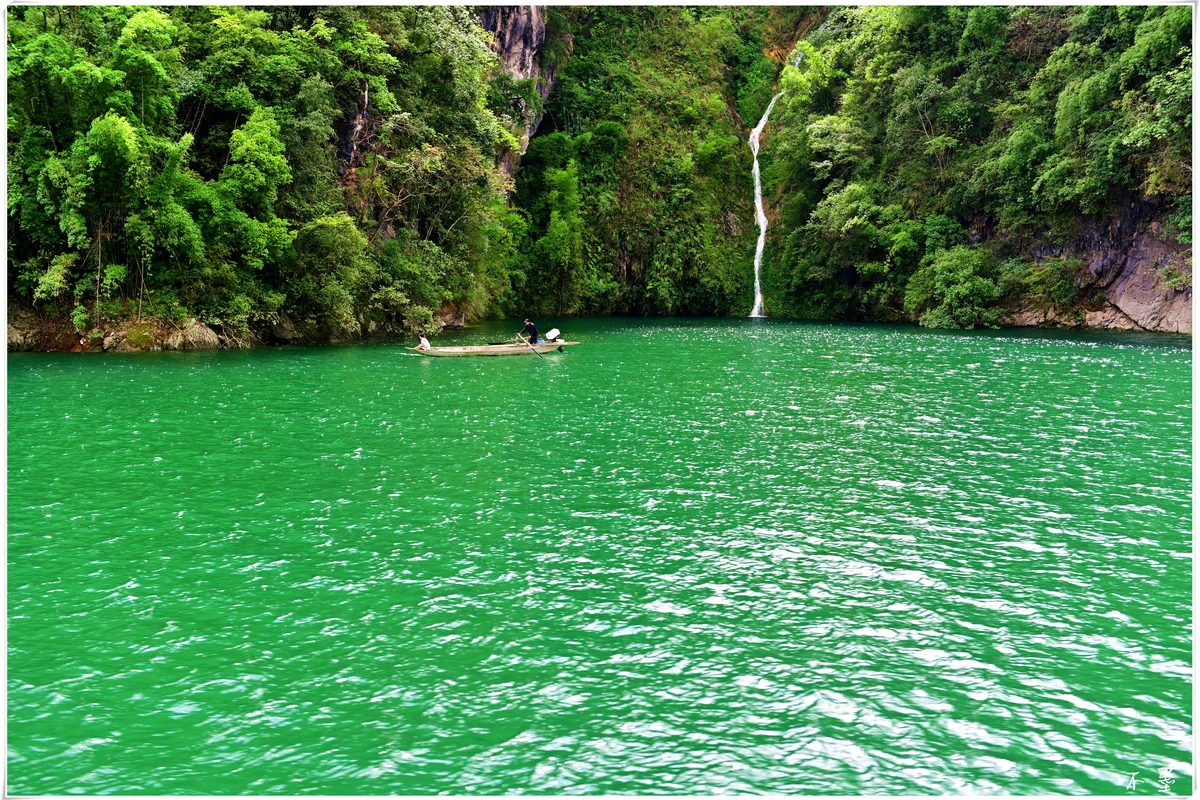
The water of Wujiang Gallery is the most delightful and refreshing. Pure and clear, its color alone is intoxicating: at first dark green, then turning emerald green at the mountain bend. A silver ribbon hangs on the mountainside; a small boat sways on a jade pool. Wujiang Gallery unfolds like a series of ink wash paintings.
About an hour and a half later, the boat turns back and returns to Wanzu Pier.
It's about an hour’s drive from Wujiang Gallery Visitor Center to Gongtan Ancient Town. At 4:00 PM, we arrived at Qianshan Inn in Gongtan Ancient Town. The inn is at the entrance of the ancient town. Seeing it was still early, we dropped our luggage and entered the ancient town. Maybe because it’s off-season, or perhaps the peak tourist hours had passed, there were few visitors and no one was collecting tickets.
Gongtan Ancient Town is located in Youyang County, Chongqing, at the confluence of the Wujiang and Apeng Rivers, bordering Pengshui County, Chongqing, and Yanhe County, Guizhou. Since ancient times, it has been a transit and distribution center for goods in the Wujiang River basin. Now it is the core scenic spot of Wujiang Gallery. Due to the construction of the Wujiang hydropower station, the real ancient town no longer exists. The Gongtan Ancient Town before us is a replica built to resemble the original. Although a copy, it is convincing enough, and it’s quite pleasant to stroll around.
There are two paths into the ancient town: the riverside promenade along the river and the flagstone-paved road within the town. From a high viewing platform outside the town, you can see stilted buildings clinging to the riverbank and scattered on the hillside.
Entering the ancient town feels like reminiscing.
The green flagstone paths, blooming bougainvillea, undulating streets—every corner exudes tranquility and comfort.
Street-side shops, quiet courtyards, and Chairman Mao quotations faded on wooden planks leave traces of time.
Shadowy mountains, gentle river ripples, scattered houses—choose a tavern and sit by the railing. Even without drinking, you are already intoxicated.
As dusk falls, lights twinkle. The ancient town under the night is even more dreamy and enchanting.
In the early morning, the ancient town is shrouded in a light mist, like a girl in a veil—misty, bashful, pure.
Gongtan Ancient Town is about 3 kilometers south along Route 211. A clear stream flows from east to west into the Wujiang River—this is the Apeng River.
The Apeng River is quieter and slimmer than the Wujiang, with purer water. As a small boat glides by, ripples spread. Watching the boat disappear into the distance, we lingered unwilling to leave.
China Golden Nanmu Garden
The China Golden Nanmu Garden was not in our planned itinerary. Only because we saw a sign at the Apeng River Bridge indicating "China Golden Nanmu Garden" did we decide to check it out. The China Golden Nanmu Garden is located in Neikou Village, Liangzeng Township, Youyang County. From the Apeng River Bridge, take Route 211 to Houjiawan, turn left, and you'll soon arrive. The road is easy to follow.
The China Golden Nanmu Garden seems to be an unfinished scenic area, perhaps abandoned mid-construction. The parking lot is large, and there are some small buildings reminiscent of a resort, but no staff and almost no visitors. Naturally, no tickets needed. It is said that the village has hundreds of golden nanmu trees hundreds of years old, eight of which are most representative. The two largest are over 600 years old.
These eight trees are distributed on a slope at the village entrance, named respectively: Gate Gods Tree, Couple Tree, Number One Scholar Tree, Lucky Tree, Peace Tree, Child-giving Tree, Protector Tree, and Longevity Tree.
First time seeing pomelos growing on trees.
The Gate Gods Tree stands on two sides.
Longevity Tree, known as the King of Chinese Golden Nanmu, has a trunk that takes six people to encircle, with thick roots. Over 600 years old, it still flourishes with dense foliage, blocking out the sun. When elderly people in the village celebrate birthdays, they come to worship this tree, praying for longevity.


