Guizhou, Sichuan, Chongqing—Let's Go!
I've visited Guizhou, Sichuan, and Chongqing countless times. This time, to fill in the gaps, I specially designed an itinerary, called three friends, and spent 18 days: renting a car twice, taking high-speed trains four times, and joining a tour group once. All modes of transport—land, sea, and air—were covered. Now, in text and images, I share this with my readers.
Zunyi Xinzhou Airport
DIY6/18: Arrived at Zunyi Xinzhou Airport near midnight. Stayed at the airport business hotel. The next morning, the car rental company delivered the car to us as promised. Our first target was Hailongtun, located southwest of Zunyi, the only World Cultural Heritage site in Guizhou Province. Its story dates back 600 years. At that time, the Yang family had ruled the Bozhou region for centuries, establishing a semi-independent Tusi system. During the Wanli reign of the Ming Dynasty, the ruler Yang Yinglong's conflict with the imperial court intensified, leading to a massive war. This military fortress, carefully built by generations in the deep mountains, eventually turned to dust. Today, we visited the ruins of Hailongtun, once known as the impregnable fortress. It had multiple defensive lines, several passes and gates, as well as palaces and buildings. Due to the difficult terrain and lack of development, I only climbed Tongzhu Pass, Tiezhu Pass, and Feihu Pass, not reaching the summit—a small regret.
A few kilometers away, the gate tower
Bozhou Tusi City is a newly built project. To reach Hailongtun, you must pass through here. It has a visitor center, restaurants, entertainment venues, as well as farm stays and various types of guesthouses.
Bozhou Tusi City 1
Bozhou Tusi City 2
Bozhou Tusi City 3
Entrance (need to take a sightseeing bus to enter Hailongtun)
The winding mountain road
The climb up the pass is nearly vertical, very difficult—called the "Heavenly Ladder."
Second, after leaving Hailongtun, we headed to Loushanguan, passing through the city center. The Zunyi Conference Site is Zunyi's number one attraction; no matter how tight the schedule, we had to visit.
The site is in the city center, with narrow roads and heavy traffic.
During the epidemic, many indoor venues were closed, including the exhibition hall.
Took a photo for remembrance!
Third, we arrived at Loushanguan around 3:30 PM. By then, the sky had cleared, the best time of day. The scenic area is about 50 kilometers northeast of Zunyi. In 1935, the Red Army won its first victory of the Long March here, leading Chairman Mao to write the famous poem "Dream of a Maid of Honor·Loushanguan." From the visitor center, we took a shuttle bus straight up to Xifengtai, over 1200 meters high, then walked to the glass walkway, returned to Yanming Pagoda and Changkong Bridge, then to the Poetry Stele and the Pass Tower, and back to the visitor center. The entire route was smooth and orderly.
Below is the Sichuan-Guizhou Highway, truly "one man can hold the pass against ten thousand."
Changkong Bridge below Yanming Pagoda
DIY6/20: That night we stayed in Zunyi. Early the next morning, we drove north. The famous Moutai distillery is located in Renhuai Town, between Zunyi and Chishui. We couldn't pass up the chance to visit.
Gate of the packaging plant
We arrived in Bing'an Town a little after 1 PM. After lunch, we went to the Grand Waterfall. The entire Chishui Danxia scenic area is vast. Our tickets were free (during the epidemic, all tickets in Guizhou were free), but the sightseeing bus round trip cost 20 yuan, and the elevator single trip was an additional 20 yuan. Although this waterfall is not as famous as Huangguoshu, the experience is just as good, and the drop is even greater.
Long-distance view—majestic
Close-up—thunderous roar
Mid-range—like a thousand troops
Tourists under the waterfall
Buddha's Light Rock is far from the Grand Waterfall. Visiting both scenic spots in one day is almost impossible, so we chose to stay in Bing'an Town. In the early morning and evening, we visited the ancient town of Bing'an. Historically, Bing'an was also a distribution center for Sichuan salt, but it is also famous on the Long March. Lin Biao's First Army Corps was stationed here, and nearby is the site of the Four Crossings of the Chishui River, so the red atmosphere is strong.
Bing'an Town in the early morning
Stilted houses? Not exactly!
This is also the hometown of Geng Biao.
DIY6/21: Buddha's Light Rock is also about 25 kilometers from Bing'an, one to the east, the other to the west. After driving to the scenic area, we took a shuttle bus and then hiked along the path. Buddha's Light Rock has an arc length of 1117 meters and a drop of 385 meters, known as the "Crown of World Danxia." Uniquely, a waterfall falls gracefully from the center.
After visiting Buddha's Light Rock, our itinerary in Guizhou ended. We drove to nearby Yaoba Ancient Town, which belongs to Hejiang, Luzhou, Sichuan. Yaoba is one of the top ten ancient towns in China. It is located at the junction of Guizhou, Sichuan, and Chongqing, with thriving commerce and many well-preserved historical relics. There is the Zhou Mansion of a military martial arts graduate, the former residence of the famous second-generation director Ling Zifeng, and the exhibition hall of the renowned critic Wang Chaowen. The ancient town differs from Jiangnan water towns; it has simple folk customs and unique architecture, an excellent place to experience Western Sichuan folk culture.
Imitation ancient gate tower (with introduction to Hejiang inside)
Ancient tree in front of Guanyin Temple
Baba tea, longmenzhen (chatting)
Former jinshi (imperial scholar) mansion, later Tianhong Rice Shop, now activity center.
Teahouse, activity room
Stage in an ancient temple
Still from director Ling Zifeng's film "Kuang"
Wang Chaowen Exhibition Hall
Luzhou is only about 27 kilometers from Yaoba. There are attractions like Fangshan and Luzhou Laojiao ruins in the city. Due to time constraints, we chose the Bell and Drum Tower in the city center. Spent the night in Luzhou.
On the left is the Bell and Drum Tower
Stayed at Four Seasons Lanting Hotel
Ate at Xiangli Xiangqin (Local Fellow Villagers)
DIY6/22: Drove 80 kilometers directly to the national scenic area "Southern Sichuan Bamboo Sea." Unfortunately, the weather didn't cooperate; it drizzled in the scenic area, with mist and fog, poor visibility. Moreover, the entry rules had changed: private cars were no longer allowed in, replaced by a shuttle bus stop system. Our plan to stay inside was disrupted. Following recommendations, we visited Xianyu Cave, Tianbao Village, Jadeite Corridor, and Colorful Waterfall. We wanted to take a panoramic photo from the Sea-Viewing Tower, but it was under renovation. To see the panorama, Xiao Chen and I each spent 70 yuan on a round-trip cable car.
Xianyu Cave (below is a huge canyon)
Tianbao Village (with the Thirty-Six Stratagems stone carvings)
Jadeite Corridor, a comfortable place.
Riding the sightseeing cable car to see the vast bamboo sea.
Mo Xi (Ink Stream) at the foot of the mountain
After visiting the Bamboo Sea, we drove directly to Xingwen County, 70 kilometers took nearly 2 hours. The next morning, we went to the "Xingwen Stone Sea and Cave Scenic Area." It is located in southeastern Sichuan. Although a national scenic area, it is little known. But everyone who has visited praises it highly. Here you can see strange peaks and rocks, cave wonders, and southwestern minority customs. There is much to see, rich in content.
Looks like volcanic lava
Tiankeng (sinkhole), big funnel, photo with the beautiful guide
Called "China's largest tour cave by area"
From here, take another shuttle bus back to the visitor center. Round trip cost 50 yuan.
After touring the stone sea and cave, we had lunch and drove more than 130 kilometers to Yibin, the hometown of Wuliangye. We returned the car as agreed. At this point, the first leg of our trip ended. Next, we would rely on public transport for the second leg.
DIY6/24: Took high-speed train G2232 to Chengdu East. We stayed near the station at 7 Days Inn. Xiao Chen and I went to Jinsha Site Park and Kuanzhai Alley, while Xiao Yang and Old Hu went to Wuhou Temple. On the 25th, we joined the "Heishui Two-Day One-Night Tour."
1. Jinsha Site Museum
The site was discovered in 2001, yielding the Sun Bird gold foil, now a World Heritage emblem, and a gold mask similar to Sanxingdui.
Shape of the Sun Bird gold foil
Ancient people's reverence beyond imagination
Kuanzhai Alley is a favorite of young women
Kuanzhai, I've finally arrived
DIY6/25: We joined the "Heishui Two-Day One-Night Tour." Heishui is a county in Ngawa Tibetan and Qiang Autonomous Prefecture. From Chengdu it takes about 5 hours. Due to road repairs from Mao County to Heishui, we didn't arrive until 3 PM. Heishui county seat is Mao'ergai of the Red Army period. Dagu Glacier is the last snowy mountain crossed by the Red Army, "Dagu Snow Mountain."
The weather was excellent, with blue sky and white clouds. Because the scenic area requires reservations, we first visited the area outside called "Naizigou," known for its colorful forests, then visited the Tibetan villages of Jiazu, Luocuo, and Yangrong.
That night we stayed in Heishui. Early the next morning, when I opened the window, it was raining. Helplessly, we just went with the flow. From the scenic area to the cable car station took another 50 minutes by shuttle. The cable car took us to the 4800-meter summit. Because of bad weather, we could only see the shy face of the snowy mountain that would normally be set against blue sky and white clouds.
Self-driving tourists
2. Dagu Glacier
Vegetation in rain and mist
Trendy coffee house
Challenge myself: The oxygen canister provided by the travel agency, I didn't use it.
Glacier faintly visible
"Tears Lake" formed by Glacier 1 and 2
Shouting for the magnificent landscape
Glacier 3 cascading down
Zhongdapu along the return journey
Wartime yellow flowers especially fragrant
On the return from Heishui to Chengdu, it rained and winded, plus road construction caused traffic jams. We didn't arrive at Chengdu West until 10:30 PM. Fortunately, we caught the last subway back to our hotel at Chengdu East.
DIY6/27: Early, we took the 8:27 bullet train to Jianmen Pass. After getting off, we left our luggage at a storage point and hired a car for 40 yuan directly to the Jianmen Pass visitor center. Our route at Jianmen Pass: North Gate → Cable Car 1 → Fairy Corridor → Bird Path → Glass Walkway → Liangshan Pavilion → Shisun Peak → Xianyun Inn → Leiming Bridge → Pass Tower → South Gate. It took over 4 hours, the most tiring day of the trip.
North Gate visitor center
On the cliff, the upper path is the Bird Path, the lower one is the Ape Path (requires safety rope, 60 yuan per person).
For climbing the Bird Path, gloves are important.
Shu Road's natural fortress—Jianmen Pass
After coming down from Jianmen Pass, we missed a train, so the four of us directly hired a car to Guangyuan and checked into Dissen Hotel.
DIY6/28: Hired a car to Mingyue Gorge and Thousand Buddha Cliff. Guangyuan has five must-see places: Jianmen Pass, Zhaohua Ancient City, Mingyue Gorge, Thousand Buddha Cliff, and Huangze Temple. Due to time, we skipped Zhaohua Ancient City because tomorrow we would go to the better "Langzhong Ancient City."
Mingyue Gorge is in Chaotian District, about a dozen kilometers away. It has two entrances; one was closed due to the epidemic. Six roads have appeared here over time: the Jialing River waterway in the middle, the Qin-era plank road and former National Highway 108 and Jinniu Road on the left, and the Baoji-Chengdu Railway and the trackers' path on the right.
The Thousand Buddha Cliff beside the Jialing River was first built in the Northern Wei Dynasty, flourished in the Tang Dynasty, with over 950 niches of statues. After a thousand years, it remains basically intact, listed as a first batch national key cultural relic protection unit.
Huangze Temple is a living temple for Empress Wu Zetian, containing her golden statue, very precious.
Six roads ancient and modern in one gorge
Above is the old national highway, below is the plank road.
Vast project, arduous and painstaking; the Shu Road thus opened here!
Baoji-Chengdu Railway, freight trains occasionally flash by.
Jialing River outside Thousand Buddha Cliff
Truly an ancient temple
Niches densely covering the cliff face
Climbing allows appreciation of each cave
Northern Wei style, Yungang style, Su X niche (Tang).
Dayun Ancient Cave (Tang)
DIY6/29: Early, took train K544 from Guangyuan to Langzhong. At the exit, we stored our luggage for 20 yuan, then hired a car for 20 yuan to Aoshan Shengyao Scenic Area. After visiting, we walked down to Nanjin Ancient Town, crossed the town to the ferry dock, took a ferry across to the opposite side to Langzhong Ancient City. Climbed Huaguang Tower, then hired a car to the white pagoda across the Jialing River (80 yuan) to take a panorama of Langzhong (return directly to Zhang Fei Temple on West Street). After visiting Zhang Fei Temple, we walked east along the street, passing Zhongtian Tower to the Sichuan West Office, the Examination Hall, and the Confucian Temple. In one day we visited all attractions in Langzhong City. At 18:30, took train C5846 to Chongqing North and checked into Yishi Hotel.
1. Aoshan Shengyao Scenic Area
Aoshan Shengying is a Taoist cultural tourism area.
Worships Kuixing Emperor and Lord Guan; during the college entrance exam period, a flood of students.
Now newly built five wealth-attracting generals, Zhao Gongming.
Climb Kuixing Tower
2. Nanjin Ancient Street
Nanjin Pass: During the Three Kingdoms, Zhang Fei and Ma Chao fought here for over a hundred rounds, leaving a thousand-year story.
Free entry to the ancient street
Graffiti is very creative
Strong commercial atmosphere
Ferry crossing east here (5 yuan per person)
3. Langzhong Ancient City
First tower of the ancient city—Huaguang Tower
Climbing the tower gives a view of the entire city.
Old houses moved through window lattices
At the white pagoda, you can photograph the whole city below (featured on CCTV)
Mountains on four sides, water on three sides—the best feng shui city in China.
Zhang Fei Temple has a history of over 1700 years
Fierce general and good official, body and head separated
Zhongtian Tower in the center of the city
Strong flavor of late Qing and early Republic.
Historically, Langzhong served as the capital of Sichuan for over twenty years.
Sichuan people establish themselves through education, left for reference.
High-end guesthouse
DIY6/30: Arrived in Chongqing, the second leg ended. We weighed pros and cons and decided to rent a car again. After picking up the car, we drove over 170 kilometers to Wulong. The weather forecast said cloudy, but on the highway we noticed something was wrong. The radio broadcast a yellow rainstorm warning. Around 9 AM, a torrential rain arrived as predicted. Rain poured down, and we could hardly see outside the windows. Fortunately, the highway wound along the mountaintops, and we didn't encounter landslides or mudslides.
At Fairy Mountain Town, it was all white fog first. At the visitor center, we were told that the Three Natural Bridges Scenic Area was temporarily closed due to flooding. So we checked into a hotel first. Around 2 PM, we decided to go to Fairy Mountain Scenic Area to have a look. Surprisingly, the top was different; the clouds and fog were dissipating. Fairy Mountain is a key national-level resort area for tourism, leisure, and camping, with forests, grasslands, and jungles, known as the "Switzerland of the East." Entering the scenic area didn't require getting out of the car; we just scanned a QR code.
Planned area 70.6 square kilometers, built area 15 square kilometers, very large.
The fog lifted, revealing lush green.
At 3:30 PM, the Three Natural Bridges reopened. We entered as the last batch of visitors that day. The Three Natural Bridges are a World Natural Heritage site, a national 5A scenic area, and a national geological park. We took a shuttle bus in, then an elevator down to the valley floor, and visited Tianlong Bridge, Qinglong Bridge, and Heilong Bridge in sequence. One and a half hours was just right.
2. Three Natural Bridges
Elevator straight down to the valley floor
Tianlong Bridge—steep cliffs
DIY7/1: From Wulong, we went directly to Hechuan, mainly two attractions: Laitan Ancient Town and Fishing City. Laitan is also one of the top ten ancient towns in China, starting from the Song Dynasty. The existing city wall was built during the Xianfeng reign of the Qing Dynasty. It has cliffs on three sides and a river on one, so it's more appropriate to call it Laitan Ancient Stockade. The Erfo Temple (Second Buddha Temple) inside is famous far and wide.
Hechuan's Fishing City is even more impressive. During the Southern Song Dynasty, the Mongol Khan Möngke led an army to conquer the Song. When they advanced here, they encountered fierce resistance from the Hechuan army and civilians. Relying on the special terrain of Fishing City, they held out for a full 36 years. Möngke fell beneath the city wall, nearly changing world history.
1. Laitan Ancient Town:
12.5-meter-tall golden Buddha statue
2. Fishing City:
Visitor center sign
Fortress built on sheer cliffs
Confluence of three rivers—the throat of Chongqing (Qujiang, Fujiang, Jialing River)
Commanding height, easy to defend, hard to attack.
Many inscriptions praising
Thousand Buddha Cliff. Sleeping Buddha
DIY7/2: Early departure from Hechuan, conveniently visited Wenfeng Ancient Street, then went to Dazu to visit the famous Dazu Rock Carvings. Since the expressway wasn't open yet, it took a full 2 hours to drive. The Dazu Rock Carvings are widely distributed, mainly concentrated in Baoding Mountain and Beishan, starting from the early Tang Dynasty and flourishing in the Song Dynasty. They represent the highest level of world cave art from the 9th to the 13th century, inscribed on the World Heritage List in 1999.
1. Baoding Mountain Caves:
Dazu Rock Carvings Museum
Three Saints of Huayan (Southern Song)
Illustration of the Great Expedient Buddha's Sutra of Filial Piety (Southern Song)
Illustration of Shakyamuni's Nirvana (Southern Song)
Millennium-old temple—Shengshou Temple
Footprint pavilion in front of the temple (Dazu)
2. Beishan Caves:
Protected corridor built
Internal structure of the corridor
Vaisravana Deva niche (Tang, Jingfu first year)
Shakyamuni preaching niche (Tang, Jingfu first year to Qianning second year)
Water-Moon Guanyin cave (Southern Song, Shaoxing)
Mahamayuri cave (Northern Song, Jingkang first year)
DIY7/3: Today is the last day in Chongqing. Considering the complexity of Chongqing traffic, we returned the car early to experience the subway and light rail. Our plan: Morning visit Ciqikou Ancient Town, Zhazidong, Baigongguan, Liziba. Noon back to hotel for rest. 4 PM depart to Yangtze River Cableway, Jiefangbei, Hongya Cave, and Qiansimen Bridge for night views.
1. Ciqikou Ancient Town
2. Zhazidong, Baigongguan
Baigongguan is farther from Zhazidong.
Baigongguan was originally Xiangshan Villa
3. Liziba
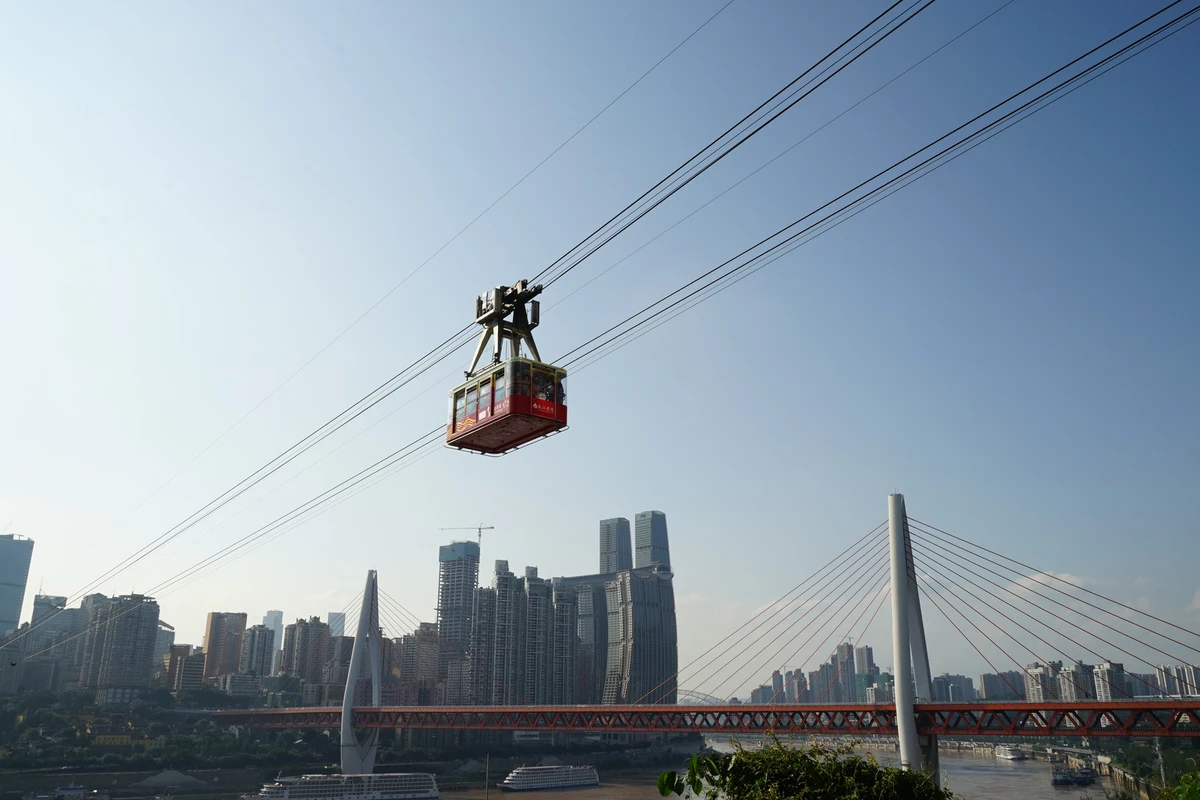
4. Yangtze River Cableway
Cable car station is also a scenic spot
Scenery on both sides of the Yangtze River
Skyscrapers vying for height
Chongqing's central point
6. Hongya Cave
7. Qiansimen Bridge
DIY7/4: Free time in the morning. At 14:32, took train Z258 and arrived at Shanghai South Station at 9:05 the next day. The 18-day Guizhou-Sichuan-Chongqing trip concluded successfully. Everything went as planned.


