A 2-Day, 1-Night Self-Drive Trip to Rongchang, Chongqing’s Western Gateway
Rongchang is a small frontier town in Chongqing. As the westernmost city in the municipality, it sits right next to places like Longchang and Luxian in Sichuan province. This was my first time here, and I had the chance to deeply experience the town’s history, culture, and local specialties. Chongqing's western gateway turned out to be so vibrant. Now, let me take you on my two-day Rongchang journey.
Day 1: Chongqing – Rongchang Antao Town Visitor Center – Rongchang Pottery Museum – Yayu Ceramic Art Studio – Taobao Ancient Street – Xiabu Town – Wanling Ancient Town
Day 2: Wanling Ancient Town – Gufo Mountain – Qingjiang Old Street – Hezhong Island – Cunzao Farm
Rongchang Antao Town Visitor Center
Located in Anfu Subdistrict, Rongchang. The history of Anfu dates back over 300 years to the Kangxi period of the Qing dynasty, but the story of Rongchang pottery reaches even further back to the Han dynasty. Even then, this was a nationally renowned ceramics production base, and it is here that one of China’s four famous pottery styles, Rongchang pottery, originated.
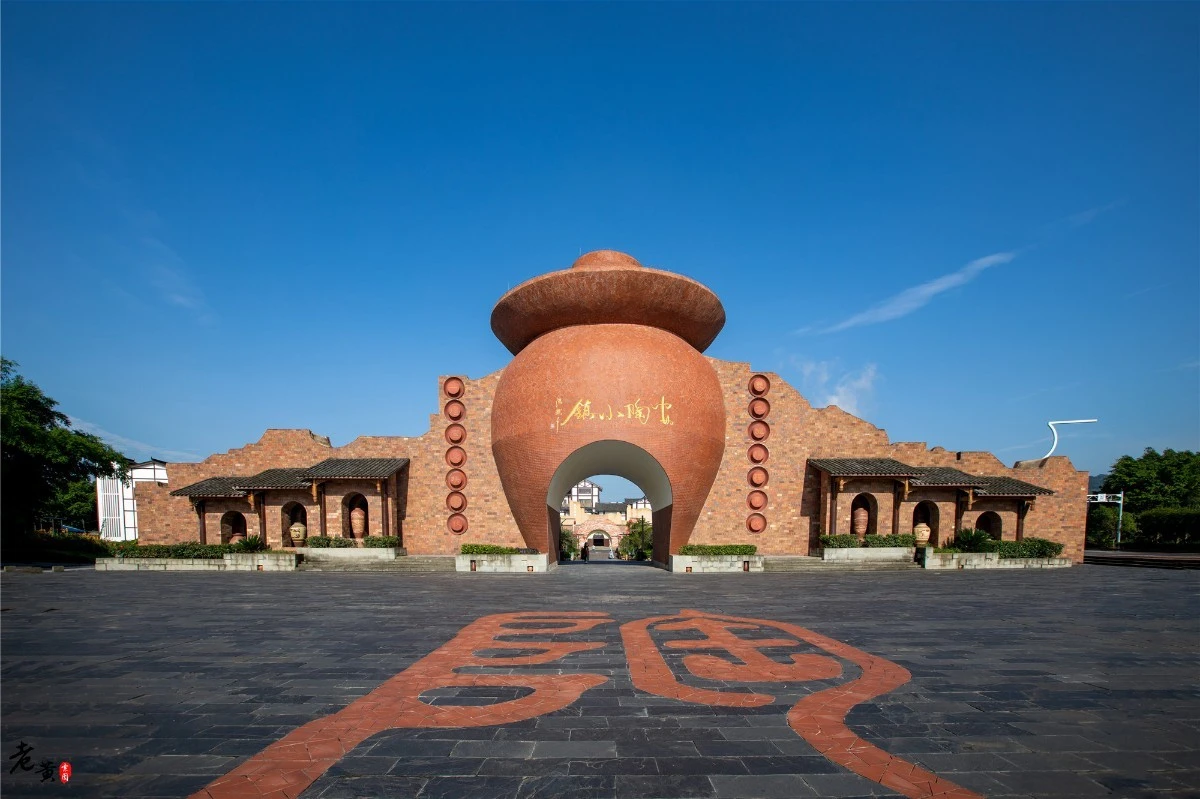
Our first stop was on this fabled land. Rongchang pottery, one of the area's four signature cultural treasures known worldwide, had already made its mark in ceramic circles long ago. As the gateway to Antao Town, the visitor center itself leaves a deep impression with its design. The entrance is shaped like a giant pickling jar—the kind you’d find in every local household—playful and brimming with character, yet delightfully familiar. Some may mock its rustic, old-fashioned look, but they fail to grasp that striking a chord is what truly matters. The image of a pickling jar holds deep significance for people from Sichuan and Chongqing. So, for Rongchang, which is now promoting all-for-one tourism, this logo-like structure in Antao Town is fast becoming the district's most distinctive tourist icon, ready to be shared with the whole country and even the world.
In front of the entrance stands the Chinese character for “pottery” written in small seal script, its strokes flowing with an antique elegance that pairs perfectly with the ancient charm of ceramics. From above, the grandeur is even more striking.
The main visitor center building itself is shaped like a ceramic teapot, with its lid lifted to form the main entrance—fully expressing the essence of Rongchang pottery. The two most familiar images in Rongchang pottery, the pickling jar and the tea set, give visitors an immediate taste of its widespread appeal. But if you think Rongchang pottery is cheap, something anyone can afford, you’d be very wrong. Most Rongchang pieces are far from inexpensive. Why are they so valuable? Let’s move on to the next two stops to find out.
Rongchang Pottery Museum
This museum showcases the history of Rongchang pottery in one place, illustrating its evolution from past to present and its growth into a major craft. Rongchang pottery is praised as “thin as paper, red as dates, bright as a mirror, and resonant as a chime,” and holds a high reputation in Chinese ceramic circles.
As a representative of western-style pottery, Rongchang ware combines the clean lines and understated elegance of northern ceramics with the bold forms and rich colors of central Chinese pottery. It's no exaggeration to say that Rongchang pottery synthesizes the strengths of many traditions. It is widely used in decorations for Buddhist temples—roof tiles, wall ornaments, carved dragons and phoenixes on ridgepoles, sculpted flowers on walls, and more are among its shining features.
Rongchang pottery falls mainly into two categories: “coarse pottery” and “fine pottery.” As the terms suggest, the difference lies in the level of craftsmanship. Coarse pottery was mostly for ordinary people and is what the public encounters most often—jars, vats, urns, basins, bowls, and so on, all typical of Rongchang’s coarse ware. Flowerpots, in particular, reveal its rugged beauty. Fine pottery, on the other hand, is used for vases, teapots, desk accessories, and other more upscale items. These lend themselves better to exquisite craftsmanship. That’s why Rongchang tea sets, for instance, tend to be pricey, often beyond the reach of average buyers.
Talking only about history can be dry, and just looking at finished pieces can feel flat. So, let’s step into a real pottery workshop and see the dedication of today’s artisans.
Yayu Ceramic Art Studio
This studio is located right across from the main entrance of the Rongchang Pottery Museum. It is run by Ms. Liang, whose father, Mr. Liang Xiancai, is a nationally recognized inheritor of intangible cultural heritage. Here you’ll not only find exquisite ceramic works but also witness the entire process of pottery-making by craftspeople in action, and feel their artisan spirit.
Inside the studio, the team works in a clear division of labor, each focused on their own step—throwing, trimming, carving, and so on. To me, the throwing wheel is the most mesmerizing part. A lump of clay, in the hands of these workers and spinning with the motor, transforms into a piece with real form. It’s truly mesmerizing. The process looks simple, almost effortless—just apply the right pressure as the wheel turns. But in reality, it’s far from easy. It’s not just about technique; experience is key. Manipulating the clay with such ease only comes with time.
The main reason Rongchang pottery commands a high price is its entirely handmade nature. In our tech-driven age, pure handcraftsmanship is all the more precious. Machines churn out batches, but each handmade piece is one of a kind. No two are exactly alike, so their value is significant.
Taobao Ancient Street
This street lies within a kilometer of the Antao Town visitor center. Taobao Ancient Street is a restored architectural complex, built to give visitors a sense of the grand prosperity of the old five-li-long street in Anfu and its bustling glory. The buildings largely follow the style of the late Ming and Qing dynasties' brick-and-wood structures, along with the early Republican-era timber architecture characteristic of eastern Sichuan.
The half-kilometer-long street is lined with Ming-Qing-style buildings. Walking here feels like stepping back in time to the old Anfu. Every now and then, you hear trickling water and see it flowing from ceramic jars. The street expresses Rongchang’s character perfectly. First, pottery: many street fixtures are shaped like ceramic crafts. Second, xiabu (handwoven ramie cloth): quite a few shops sell xiabu, so visitors can experience three of Rongchang’s four treasures at once—pottery, xiabu, and folding fans. It’s a trip well worth making.
Xiabu Town
When Rongchang's treasures come up, xiabu is never left out. The area has been titled “Home of Xiabu” and a “Xiabu Processing Base” by the state, so this handwoven ramie fabric is an indispensable part of Rongchang’s identity. Xiabu Town integrates xiabu exhibitions, research and development, information sharing, display and sales, and experiential tourism into one destination. Let’s step inside.
Xiabu is handmade ramie cloth with a long history in China. Without going too far back, even our grandparents' generation would be familiar with it. Though hand-weaving ramie is no longer mainstream, that doesn’t mean xiabu has disappeared. On the contrary, with advances in textile technology, xiabu has gradually expanded beyond its original use in clothing into other fields, making it more widely known.
Despite its long history and fame, xiabu remains something of a rarity. The price of xiabu products makes it clear they are expensive, often beyond the reach of average consumers. Here, I can’t help but share a little anecdote. I had only a superficial understanding of xiabu—its fabric, texture, and hand feel didn’t strike me as particularly valuable. When someone held up a xiabu folding fan and asked me to guess the price, I offhandedly said, “A hundred yuan.” Of course, I was way off. A seemingly ordinary fan was priced at over 1,000 yuan. That really made me reassess xiabu’s worth.
The high value of xiabu comes mainly from its complex production process and entirely handcrafted nature. Today, natural ramie is scarce, and people are increasingly drawn to eco-friendly, natural greens. Add to that its pure handwork and its status as a national-level cultural heritage product—all these factors make xiabu as ethereal as “otherworldly.” But no matter what, its cultural standing and value are undeniable.
Wanling Ancient Town
Wanling Ancient Town is one of Chongqing’s well-known historic towns. Since the Southern Song dynasty, it thrived due to waterway transport and its production of honey, a royal tribute. The old wharf served as a distribution center for goods, with government funds, grain, and weaponry all passing through, which brought unprecedented prosperity to Wanling (formerly known as Lukong Town).
As time passed, that bustle has faded, but in a way, today’s Wanling has gained the quiet elegance and slow pace an ancient town should have. Strolling along the riverbank, crossing stone bridges, and occasionally spotting aunties with bamboo baskets on their backs—that’s the only kind of “hustle and bustle” you’ll find here now.
When morning sunlight spills onto the town, the flagstone paths take on a soft red glow. The street market begins to stir. But more than buying and selling, the tea houses are where locals gather to relax and play cards. The town is small, with few permanent residents, so everyone basically knows each other, making it easy to find leisure companions. By just past 9 a.m., the tea houses are already full. Tea, chats, card games—that’s the rhythm of life in this ancient town.
The old wharf of Wanling (Lukong Town) is now abandoned, but the river never stops flowing. It carries away the years, leaving behind memories and deep emotions.
Gufo Mountain
Gufo Mountain lies in Qingsheng Town, Rongchang, and is a relatively new scenic area. Rongchang is developing the Gufo Mountain eco-leisure tourism zone largely because of its geographical advantages. The mountain has rich vegetation and isn’t far from the city center, making it a favorite spot for locals to cool off, relax, and hike on weekends.
On Gufo Mountain, there’s a Baifo Garden (Hundred-Buddha Garden), an important part of the scenic area. Here, 99 different versions of the Chinese character “佛” (Buddha) are carved on various stones, each in a distinct calligraphic style, each with its own charm. But it’s called Hundred-Buddha Garden while only having 99 characters. What’s the mystery? I asked a staff member and got the answer: the final Buddha is kept in one’s heart. Visitors don’t usually dwell on such details, and many may not even notice there are only 99. Yet wherever Buddha is, there must be a pure land—perhaps somewhere on earth, perhaps in the heart. That’s the Buddhist wisdom each person can contemplate.
Gufo Mountain not only offers such spiritual spots but also has light-hearted attractions. For example, the currently popular glass bridge, glass slide, and glass water chute. These three activities let visitors not only commune with nature in the scenic area but also enjoy the fun of interactive games.
Spend a weekend hiking Gufo Mountain, leave the city behind, and let your body and mind unwind.
Qingjiang Town
This is a small town under Rongchang’s jurisdiction, with a specialty in sightseeing agriculture. It is dedicated to creating loquat and longan picking demonstration gardens and strengthening the cultivation and management of these fruits. On top of existing planting areas, they are expanding longan cultivation around Hezhong Island to build a thousand-mu longan base. There are also several model farm projects in Qingjiang Town that combine agriculture with guesthouses, giving visitors an authentic taste of pastoral life.
Our first stop in Qingjiang was the old street. The street is divided into an upper and a lower section; we only walked the lower part. Qingjiang’s location borders Luxian County in Sichuan, and the dividing line is the Laixi River—half the water belongs to Qingjiang Town, Rongchang, and the other half to Luxian, Sichuan. Standing on the bridge, you can have one foot in Sichuan and the other in Chongqing. Due to flooding this year, the bridge seems very low. On the bridge, you can clearly tell where the boundary lies: look at the railings. The Chongqing side is painted and looks neat, while the Sichuan side has been neglected for years, its railings rusty and peeling. A new bridge is reportedly to be built nearby soon; the piers are already in place. So this small, history-laden bridge will soon fade from the stage, becoming a memory of an era.
After the old street, we headed to the second stop in Qingjiang Town: Hezhong Island. True to its name, the island is surrounded by water—the only standalone island on the river. It's fairly large, with a loop road of about 3.5 kilometers. The road conditions are good, and I noticed that cars on the island travel in one direction only, with clear arrows painted. Such details show that Hezhong Island’s development is quite mature. Driving around, we found the environment lovely. Visitors can fish here, and in harvest season they can pick fruit. Notably, there are many orchards on the island, like loquat and longan orchards. I heard that during the harvest, they hold a longan picking festival; the island’s longan resources are indeed abundant. Beyond that, Hezhong Island is designed for relaxation and health—there are cycling trails, so weekend travelers can unwind, enjoy leisure time, stay fit, and immerse themselves in the pastoral setting.
While Hezhong Island already gave us a taste of Qingjiang Town’s pastoral charm, it wasn’t the ultimate expression. Finally, we visited the third stop: Cunzao Farm. This is where the town’s pastoral vision meets guesthouse culture most thoroughly. Cunzao Shared Farm combines seven bases into one “internet + sharing” experience: eco-agricultural product sharing, ornamental rice science education, eco-fishery research and training, specialty eco fruit viewing, 5G smart agriculture demonstration, and leisure tourism experiences. From above, the farm is laid out like a swimming goldfish. Several flower baskets nearby are also shaped like fish, adding a playful touch. “Abundance year after year” is a traditional blessing, reflecting the hope for a good life.
Wherever you go, how can you pass up the local food? Rongchang is famous nationwide for its pig farming, and the Rongchang pig is one of the area’s most famous icons. So while tasting Rongchang’s cuisine, don’t miss the local pork. Classic home-style dishes like twice-cooked pork and red-braised pork, made with local pork as the main ingredient, taste distinctive. The meat is tender, and the flavor of grain-fed pigs is incomparable to those raised on feed. The first must-try food in Rongchang is its pork.
The second is braised goose. From the moment I stepped off the train at Rongchang's main urban area, I spotted dozens of shops selling braised goose along the way, which shows its high status in Rongchang cuisine. The goose itself is tender and fully infused with flavor. You can eat it on its own and still savor the rich spiced broth. But that’s not the whole essence. As locals will tell you, the goose itself isn’t the most stunning part—the soul of the dish is the dipping sauce on the side. When you dip the goose into the chili oil and seasonings, that’s when it truly comes alive, an exquisite combination that will leave you craving more and raving about it.
Other dishes I won’t list one by one. As long as you remember these two highlights, you’ll have tasted the heart of Rongchang’s food scene. Of course, if you visit a farm, trying the farmhouse cuisine is also a great choice!
And so, my 2-day, 1-night trip to Rongchang came to an end. Two days was too rushed, just a fleeting glimpse of this small western gateway city of Chongqing. I hope to have another chance to dive deeper into Rongchang, to unearth even more fascinating culture and stories.


