Where to Go on the Weekend? Follow Uncle’s Footsteps and Explore Rongchang
Antao Ancient Town – Xiabu Ancient Town – Wanling Ancient Town – Gufo Mountain – Qingjiang Ancient Street – Hezhong Island – Cunjiao Farm
A two-day weekend trip around Chongqing
Day 1: Chongqing city – Gufo Mountain – Qingjiang Ancient Street – Hezhong Island – Cunjiao Farm
Accommodation: Farm stay at Cunjiao Farm.
Departing from Chongqing, the first stop I’ll head straight to Gufo Mountain. The drive from Chongqing to Gufo Mountain takes about 2.5 hours.
Gufo Mountain stands majestic and precipitous, with layered rugged cliffs and beautiful scenery. It holds spots like the Gufo Temple, Xianren Cave, Xiongshi Rock, Changliang Cave, and at its foot, villages such as Yinshang Ancient Village. It’s a great destination for rock climbing, pilgrimages, and adventure. Each year in mid to late April, when the tung trees are in bloom, Gufo Mountain is at its most picturesque—a time so stunning you’ll be amazed, charmed, intoxicated, and reluctant to leave.
Gufo Mountain is an eco-leisure tourism area that Rongchang is developing as a key rural leisure destination. In recent years, the Gufo Mountain scenic area has firmly grasped the opportunity of being an ‘ecological conservation and leisure zone,’ focusing on eco-leisure, and systematically building a multi-functional ecotourism area that blends rural recreation, leisure, cultural experience, and health & retirement services. With the three goals of becoming a ‘outdoor fitness paradise, farming culture base, and health & retirement haven,’ it has vigorously improved infrastructure, scenic spots, and supporting facilities.
In the Gufo Mountain scenic area, my favorite is the Bai Fo Garden (Hundred Buddhas Garden). The garden features 99 carved ‘佛’ (Buddha) characters, each in a different calligraphic style by various masters. Strolling through Bai Fo Garden is like visiting a calligraphy exhibition, where visitors can admire works by Wang Xizhi, Huaisu, Su Shi, Huang Tingjian, Tang Yin, Mao Zedong, and others. Each ‘佛’ character not only varies in age and script but also carries different meanings. Some depict a boy worshipping Guanyin, others a figure clutching the Buddha’s foot in desperation; the characters are so vivid that they seem composed of two human figures, symbolizing piety and teaching people to be earnest and responsible.
Gufo Mountain Glass Suspension Bridge
Rongchang’s first glass suspension bridge is located in the Gufo Mountain scenic area in Qingsheng, Rongchang. The bridge is 81 meters long and 2.4 meters wide. Standing on the transparent glass feels like you’re suspended in midair. As you reach the middle, the bridge sways left and right, thrilling and exciting, while the stunning scenery all around is fully visible through the glass surface.
Gufo Mountain Glass Slide & Glass Water Drift
The dry slide is 200 meters long, and the drifting slide is 1,200 meters long, made of tempered glass. During the drift, visitors glide through forests and over streams, drifting around bends while enjoying a full sensory experience with visual, auditory, and tactile delights. ‘The drifting slide is open year-round because it has been professionally improved; the water and boat are naturally separated, so you won’t get wet and don’t need a change of clothes.’ Here you can feel ‘speed and passion.’
Currently, the Gufo Mountain scenic area has developed a series of wellness and leisure activities integrating hiking, fitness, fruit picking, and tea tasting. The economic fruit forests at the mountain base and the green tea gardens above are picturesque; the Bai Fo Garden, Sansheng Cave, and Arhat Hall blend naturally into the landscape. Stroll or cycle along the colorful lakeside path for recreation; climb high for distant views to cleanse your lungs and soothe your mind; pick seasonal fruits like cherries, loquats, plums, and pears; savor farmhouse cuisine such as cured pork, Hunshui rice cakes, and tea-leaf tofu pudding. Plus the exhilarating glass suspension bridge, all guarantee a relaxed yet fun outing.
After visiting Gufo Mountain, we drive to Qingjiang Ancient Street.
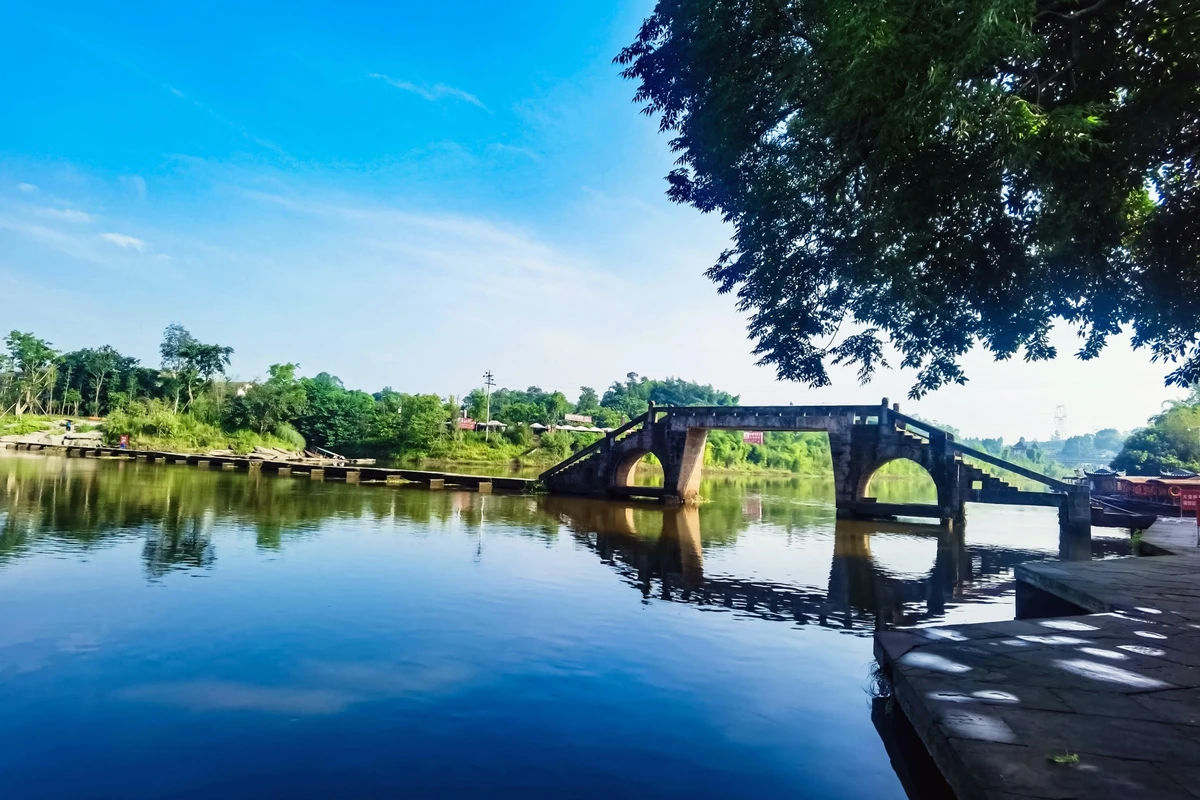
A river, the Qingjiang. Along its bank lies a century-old street, ‘Qingjiang Ancient Street,’ a town with hundreds of years of history, adjacent to Lu County in Sichuan. The two sides are separated by the river, with the boundary running along the middle of the water. You can see the demarcation from the bridge piers below. The riverside scenery is lovely, the air cool. In summer, sitting under the shade of trees by the river, fanning yourself with a palm leaf fan, is a good way to escape the heat.
Qingjiang Town has a unique location on the southwestern edge of Rongchang District, at the boundary between Chongqing and Sichuan Province, bordering Lu County of Luzhou. The town center sits right on the provincial border, so ‘crossing provinces’ in Qingjiang is a matter of a moment.
The ancient street and its folksy residents present a scene of bustling prosperity. The town’s douchi fish (fish with fermented black beans) is quite famous; you must try it when visiting.
Hezhong Island eco-tourism sightseeing area is surrounded by water on all sides—the Laixi River, 100 meters wide, 5.5 kilometers long, with an average depth of 7 meters, encircles the island, creating a unique natural island landscape. The island is planted with large numbers of economic fruit trees, offering spring-like weather year-round, aged trees with dense shade, and fragrances of flowers and fruits in every season. There are century-old longan trees and yellow horn trees. At Fenshuiya, a rocky spring cascades down; along the banks, dense bamboo groves stretch for miles; occasionally rare water birds frolic. Inside the island, at Fenshuiya, the current is swift; the Huilong Cave is deep and serene; Huilong Temple retains its ancient charm. The island’s undulating small hills are scattered in an orderly fashion, with well-integrated mountains, water, roads, and woods, creating a natural and unique landscape famed as ‘Little Taiwan’ for its wonderful sights and legendary tales.
The island abounds with fruits and vegetables. Picking fruits and vegetables as you roam is a delight. In May, among the dense leaves of loquat trees, clusters of round, plump loquats glow golden and translucent under the sunlight, radiating warmth.
In September, the longans on the island are basically ripe. The island boasts 13 ancient longan trees over a century old, standing over 15 meters tall with trunk diameters of 40–60 cm. Their fruit is thick-fleshed, small-seeded, and honey-sweet. Harvest time is the liveliest season on Hezhong Island. Will you bring your children and family to share in this joy of harvest?
Here, picking, accommodation, and farm stays come together. On weekends, bring your kids to catch fish, shrimps, and pick vegetables in the fields; do your own cooking and make delicious meals—it’s endless fun.
Qingjiang Town focuses on rural tourism. Its natural resources are very rich, with the Laixi River adding boundless vitality and imbuing the town with a special aura.
Friendly reminder: farm stay rooms here are very limited, so if you plan to stay overnight, contact the accommodation in advance.
Day 2: Antao Ancient Town – Xiabu Ancient Town – Wanling Ancient Town – return to Chongqing city
After a hearty breakfast at Cunjiao Farm stay, we drive to Antao Ancient Town.
Antao Ancient Town is laid out according to the ‘ancient streets and water lanes’ concept. Besides the 400-meter-long Taobao Ancient Street, there will be a 1.1 km long, tens-of-meters wide Tashui River, cleverly using channels and ditches to divide the water lanes into separate yards, creating the effect of ‘water embracing the ancient town, pottery fragrance lingering.’ The pickle jar is the most representative household pottery of Rongchang and has enjoyed a centuries-long reputation. Rongchang’s pickle jars have a very plump shape, fine texture, and excellent permeability. Vegetables pickled in them won’t bloom or develop off-flavors—they are very tasty. As a result, they are widely popular; in Yunnan, Guizhou, and Sichuan, almost every household has several pickling jars. In the 1950s and 60s, at the first national pottery competition, a Rongchang potter’s hand-thrown pickle jar won the gold prize, further cementing its fame nationwide and making it a signature product of Rongchang pottery.
After about an hour’s drive from Cunjiao Farm, we arrive at the Antao Ancient Town visitor center. Park the car and stroll through Antao Ancient Town, learning about the history and craftsmanship of Rongchang pottery. Rongchang pottery dates back to the Song Dynasty. It is ‘red as dates, bright as mirrors, thin as paper, and resonant as chimes.’ ‘Red as dates’ refers to the red luster after glazing and firing, like warm jade. ‘Thin as paper’ refers to the potter’s nimble hands pulling clay into wafer-thin bodies. ‘Bright as mirrors’ means the glaze is smooth and translucent enough to reflect a shadow. ‘Resonant as chimes’ means tapping the pottery produces a musical sound like a chime. This is Rongchang pottery’s unique charm.
Meticulous craftsmanship earned Rongchang pottery the fame of being red as dates, bright as mirrors, thin as paper, and resonant as chimes. The faithfully passed-down techniques have spread Rongchang pottery across the land and to over thirty countries and regions worldwide.
Taobao Ancient Street in Antao Ancient Town is also called ‘Xiazhazimen’ by locals. ‘Smoke links a hundred kilns, Ya Mountain fosters a line of pottery jars; fame fills five continents, thousands of merchant ships swim the sea of pottery.’ From this couplet we can see that the ancient pottery capital not only has the scenic Ya Mountain but also boasts Rongchang pottery, a treasure of the Chinese people. The city walls on both sides of the gate mimic the Ya Mountain range behind, which is the source of raw material for Rongchang pottery. The spot where you stand is the Tashui Bridge, and the bridge surface is paved with pottery bricks fired from Rongchang’s red clay.
Originating in the Han Dynasty, with excellent texture and passed down for a hundred generations. ‘Light as cicada wings, thin as xuan paper, flat as a mirror of water, fine as silk gauze.’ Made into garments, it is comfortable, soft, breathable, and dries quickly. In the Tang Dynasty, top-grade Rongchang ramie cloth was presented as tribute to the palace, adorning beauties of the harem and decorating the emperor’s dragon bed. Today, Rongchang ramie cloth, along with that from Hunan and Jiangxi, forms one of China’s three main ramie cloth production bases. Rongchang ramie cloth is not only excellent for clothing but also merges with painting and calligraphy art, and is exported far to Europe, America, South Asia, Japan, and Korea. A poem praises: ‘Under Guanyin Bridge spring waters glisten green, bleaching ramie cloth, its fame spread across continents.’
In the Ramie Cloth Museum, the historical development, production process, and today’s various products of ramie cloth are displayed. Ramie cloth production involves several steps: beating the hemp, winding hemp clusters, winding hemp threads, warping, reeding, starching, weaving, bleaching, shaping, and dyeing.
Beating hemp: Local hemp is harvested three times a year—spring, summer, and autumn. Beating includes five steps: cutting, stripping, washing, smoking, and scraping.
Bleaching: Main methods include clear water bleaching, sunlight bleaching, dew bleaching, limewater bleaching, and charcoal smoking. After bleaching, the ramie is graded by quality and length into standard, top, second, third grades, white cord, sun-dried green, etc., and bundled.
Thread drawing involves four steps: tearing into strips, rolling into strands, twisting into yarn, and winding. The naturally bleached ramie is torn into strips, rolled into strands, placed in a clear water basin, then combed by fingers into fine ramie threads, and finally wound into balls.
Rongchang ramie cloth is fine, even, lustrous, smooth, tough, and durable. Because of its coolness in summer and warmth in winter, ventilation, and breathability, it is absorbent, crisp, and cool. It comes in many varieties by color: natural, bleached, dyed, and printed. Coarse cloth can be used for sacks, linings, mosquito nets; medium and fine cloth for clothing, or embroidered and cross-stitched into tablecloths, chair cushions, handkerchiefs, window screens, and other decorative crafts. The refined, bleached fine cloth is snow-white, delicate, and soft, praised as ‘ramie silk’ or ‘pearl rib,’ and is famously described as ‘light as cicada wings, thin as xuan paper, flat as a water mirror, fine as silk gauze’—a top-grade product among ramie cloths.
With its ‘ink-and-wash charm, misty-rain ancient town,’ Wanling Ancient Town blends deep historical culture. The town, the stockade, the ancient bridge, and the lively river combine into a living ink-wash scroll. Today, let me lead you into this flowing timeline to experience the town’s unique rhythm and richness.
The town has a strong flavor. As a 4A scenic spot and a town with profound historical and cultural heritage and dynamic waterside scenery, Wanling enjoys the reputation of ‘settlers’ water town.’ As early as the Southern Song Dynasty, the Laixi River in Wanling was the main transportation route from ancient Dazu to Rongchang, and from Rongchang to Luzhou in Sichuan. With water transport and the production of palace tributes like folding fans, ramie cloth, Rongchang pottery, and Rongchang pigs, all boats passing the Laixi River had to anchor here to navigate the shoals, making Wanling a famous wharf and goods distribution center, where merchants from north and south gathered, forming the town’s earliest appearance.
Wanling’s ‘Darong Fort’ is one of the few well-preserved ‘Han stockades’ in southwestern China, inhabited by Ming and Qing dynasty immigrants. Legend has it that this area was originally inhabited by the Pu, Yong, and later the Ba people. After prolonged wars during the Eastern Jin period, the population of Bashu plummeted. During the Xiankang years, the Liao people from the southern Sichuan area took the opportunity to move out of the mountains, gradually entering Ba Commandery, and the valleys of today’s Rongchang region had scattered Liao inhabitants. In the Northern Zhou period, Liao people settled around present-day Liangping and Hebao, leaving behind traces of their dwellings and burials, locally known as ‘Manzi Caves.’ Wanling Town lies between Sichuan and Chongqing, thriving on water trade and commerce. To protect business from war, a fortified ancient town was built against the mountain. The town is embraced by green hills, built along the terrain with stepped platforms and stilted buildings, presenting a layered and overlapping architectural scene.
Wanling is a famous historical and cultural town in China. This vibrant land has nurtured outstanding people; the industrious and wise town folk have created a unique culture. Fourteen intangible cultural heritages, including Chansi Boxing, Wanling Entertainment, New Year Pig Slaughter, and Dragon Boat Racing, have been passed down to this day. Historical figures such as Ming Dynasty Minister of Justice Yu Maojian, revolutionary pioneer Zhao Zongkai, anti-Japanese hero Liu Naifu, and ‘Father of Chinese Petroleum’ Zhao Zongxun are celebrated through the ages. The traditional family precepts represented by ‘the Incorruptible Official Under Heaven’ Yu Maojian have been promoted nationwide by the Central Commission for Discipline Inspection, becoming the storyline for the CCTV documentary ‘Remember Nostalgia—Wanling Town: Clean and Upright.’
Suggested Wanling Ancient Town tour route: Starting from Taiping Gate, via Zhao’s Ancestral Hall – Yanyu Alley – Riyue Gate – along the river area – Shuinian Alley – Eighteen Steps – round stone brick pillars – Shizi Gate – Huguang Guild Hall – Qinfang Pavilion – Erya Academy – Hengsheng Gate.
Recommended Rongchang foods: Rongchang braised white goose, Pugai noodles (spreading noodles), douchi fish.
I’m Mohai from Chongqing, a self-media person who started with photography. Having studied photography for ten years, I’ve earned the title of travel photographer. I mainly engage in experience-based promotion of travel, hotels, cuisine, and photography. I cooperate with many websites and TV stations, and jointly run activities with tourism bureaus and companies across multiple provinces and cities. I’ve traveled to every province and city in China, wandering through every scenic spot and hotel.


