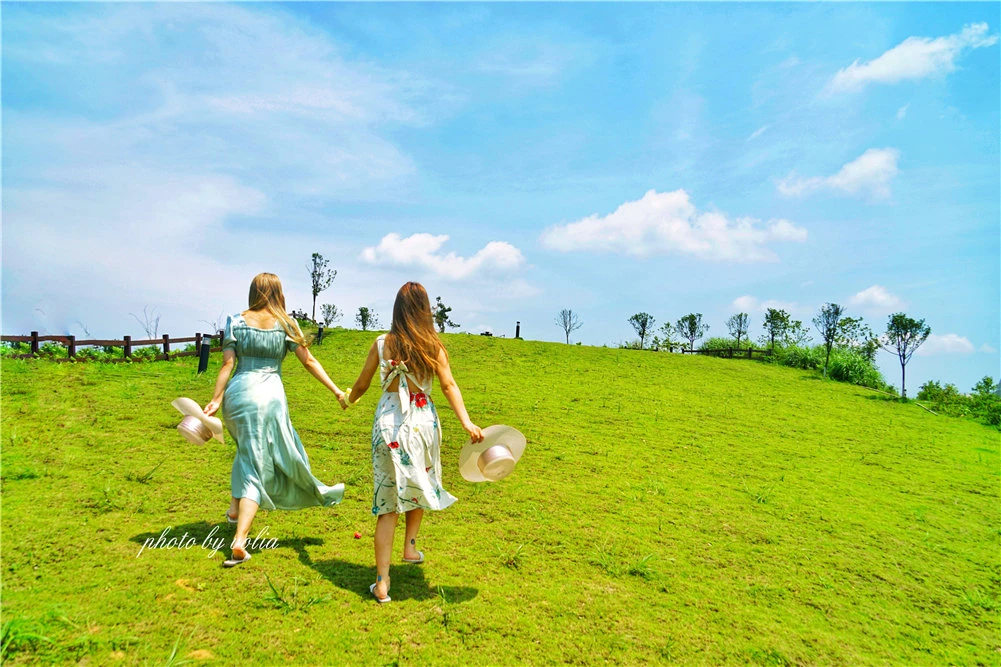
Roam the Sea of Flowers and Fairy Valley, Climb the Ancient Sword Famous Mountain, Stay at the Starry Camp, and Savor Local Delicacies—Chongqing Qijiang Is a Great Fun Place
It's graduation trip season again~!
Have you already made plans to travel with your friends?
This summer vacation, let's go to Qijiang~!
Qijiang is just an hour's drive from downtown Chongqing. With majestic green mountains and clear blue waters, blooming flowers and orchards full of fruit, it has a romantic starry sky camp and the ancient Sword Mountain. It is home to the Qijiang farmers' woodcut prints, hailed by the international art world as 'Oriental Picasso' primitive art, and the Qijiang Museum, the only one in China featuring the Liao culture. Roam the Sea of Flowers and Fairy Valley, climb the Ancient Sword Famous Mountain, stay at the Starry Camp, and savor local delicacies—Chongqing Qijiang is a great fun place~!
On Provincial Road 283 to Hengshan Huaxian Valley, you have to pass the famous 'Nine Turns.' I heard that Andy Lau once filmed 'Lost and Love' here. From a bird's-eye view, it's quite impressive. As we drive along the winding mountain road, we are about to encounter a beautiful floral event on Hengshan.
Hengshan Huaxian Valley is located in Hengshan Town, Qijiang District, known as the 'natural oxygen bar' and 'air-conditioned town.' It is the core area of the Hengshan municipal-level tourist resort, themed as a 'little beautiful life paradise' and centered on the core value of 'creating simple happiness.'
Hidden among the mountains, Huaxian Valley feels like a paradise. At an altitude of 1,000 meters, with an average annual temperature of 25°C, the lake ripples, the fragrance of flowers assails the senses, and it's a delight to the eyes.
European-style large swings, pink decorations, a crystal church, and numerous internet-famous photo frames are scattered throughout the sea of flowers, making every spot a great place for taking pictures.
Huaxian Valley covers six themed functional areas, five major internet-famous flower landscapes, over ten online-famous photo spots, and more than 20 interactive experience projects such as the romantic flower sea and the cute pet paradise. It is a composite leisure vacation destination integrating sightseeing, outings, family experiences, leisure holidays, and study tours.
The beautiful and romantic verbena, the blooming sunflowers, are perfect for portrait photography. With literary signs, a rainbow avenue, a small train, and a helicopter... Whether it's a family trip or a gathering with friends, you can find your own wonderful time here.
Strolling through the 800-mu romantic flower sea, feeling the 'natural oxygen bar' gifted by nature in the depths of floral fragrance, shuttling among the internet-famous photo spots on the lawn and flower paths, getting up close with crops in the fields—if lovers walk embracing, it's even more romantic.
Or you can sit quietly by the lake, watching the ripples and the shadows of clouds passing by...
——Hengshan Huaxian Valley is definitely a great place for tourism, family outings, and leisure vacations!
Chongqing has many mountains, and Qijiang boasts three famous ones: Gujian Mountain, Laoying Mountain, and Shihao Mountain, with Gujian Mountain being the most famous. Located in the north of Qijiang, Gujian Mountain is majestic and steep, with winding paths, no less spectacular than Fanjing Mountain in Guizhou.
Gujian Mountain is formed by the winding Dalou Mountain in Guizhou, about ten kilometers from downtown Qijiang. With a year-round average temperature of only 18.5°C, it is very cool in summer.
This is my first time climbing Qijiang's Gujian Mountain. Because its shape resembles a rooster, locals call it 'Rooster Mountain.' It is one of the famous 'Twelve Scenes of Bayu' in eastern Sichuan. In fact, Gujian Mountain has many scenic spots, over 40 large and small. This time we only visited the most essential part—the Rooster's Beak of Rooster Mountain.
Now it's very easy to reach the highest peak of Gujian Mountain. The scenic area has a shuttle bus at 'Guanzizai' that takes you to the square at the top in just a few minutes.
Jingyin Temple is not large in area, but its incense is particularly strong. Because there are too many pilgrims, the temple has been expanded, with the new part at the foot of the mountain to分流 pilgrims and make it easier for them to offer incense and worship.
It is said that during the Ming Dynasty, when repairing the temple, people unearthed an ancient sword from the ground, which is the origin of the name Gujian Mountain (Ancient Sword Mountain). Over a thousand years, through many dynasties, the temple has been built and destroyed several times; only a few ancient buildings remain at the top of Jingyin Temple.
As early as the Yongzheng period, Gujian Mountain had become a famous Buddhist mountain revered by monks and laypeople. Especially Jingyin Temple at the top attracts a steady stream of pilgrims. Standing on the 'Rooster's Beak,' you can see lush green mountains all around, feeling refreshed and invigorated!
Gujian Mountain also has a romantic place—the Gujian Mountain Tent Campground.
The Gujian Mountain National Standard Demonstration Tent Campground is a typical mountain-type campsite, covering an area of 180 mu, with complete supporting facilities.
The campsite has one RV courtyard, five unique tents, 22 fixed tent sites, 50 free tent sites, 15 small log cabins, three starry sky rooms, nine constellation bubble houses, as well as a visitor reception center with bathrooms, a children's play area, and a barbecue area.
The campsite is well-equipped and offers comfortable accommodation. Whether it's an RV, a log cabin, or a starry sky tent, it will take you into a fairy tale, allowing you and your family to enjoy the slow life of Qijiang.
I especially like the starry sky tents here; they are beautiful and romantic, with good privacy, allowing you to enjoy a secluded spot among the mountains.
Watch the clouds roll and unfold, gaze at the brilliant stars, listen to the gentle breeze, and smell the birds and flowers. Life is short; I only wish for the fragrance of flowers and the safety of time...
Wang Liang was a famous general in the early days of the Chinese Workers' and Peasants' Red Army and served as the commander of the Fourth Red Army. Originally named Wang Hua Gai, styled Fu Liang, and named Xing Chun, he was born on August 5, 1905, in Yongcheng Town, Qijiang District. He knew three foreign languages and enlisted at the age of 21. He studied at the Whampoa Military Academy. He died before fulfilling his ambitions, but his life was brilliant and his military achievements were outstanding.
Wang Liang's former residence is located in Sanhuai Ba, Zhonghua Village, Yongcheng Town, Qijiang District. Built in 1805, the residence is a courtyard-style layout, covering about 1,200 square meters, with one floor and one attic, facing east with its back to Fengguan Mountain and facing Laoying Mountain. It is a typical Sichuan-style column-and-tie building.
The exhibition at Wang Liang's former residence is divided into three parts. The first is the restoration display of the main building, which was the living area for Wang Liang's family. The second is the right wing, which serves as an exhibition room for Wang Liang's deeds, briefly displaying his life. The third is the left wing, which is the Red Qijiang exhibition room, displaying major Party history events and important figures in Qijiang.
Wang Liang's former residence introduces the brilliant life of this young general through detailed pictures, texts, and artifacts.
Near Wang Liang's former residence, there is a 'Yongcheng Wind and Percussion Exhibition Hall.'
Bayu wind and percussion music originated from warfare, initially used to intimidate enemies into surrendering with dance and music. Later, it evolved into drums, flutes, and loud suonas that could resound through the mountains and valleys.
Yongcheng wind and percussion is a folk instrumental genre from Yongcheng Town, Qijiang District, with a history of over 300 years.
In 2008, Yongcheng wind and percussion was successfully declared a national intangible cultural heritage. Have you ever seen a suona that is 4 meters long and 1.8 meters in diameter? And it's made of bamboo! Today in Qijiang, I've really broadened my horizons!
Yongcheng wind and percussion is a folk music genre from the mountainous rural areas of Chongqing, introduced from Bayu over 300 years ago. The skilled performers are mostly local bamboo weavers, carpenters, and painters. In their spare time, they make their own suonas and gongs and drums, expressing their feelings through music.
Now, Yongcheng wind and percussion has been passed down; there are weekly classes in Qijiang, and almost all students have mastered this skill.
Speaking of Qijiang, it has been a strategic military transportation hub in southern Sichuan. Since ancient times, there has been a saying: 'If there is no trouble in the world, it's fine; if there is trouble, Guizhou and Sichuan will change; when they change, Qijiang will be the first to see conflict.' Qijiang was the only place in Chongqing where the Central Red Army passed during the Long March, providing important guarantee and support for the great turning point of the Central Red Army. It was an important node for the three main Red Army forces in Chongqing. Many moving stories have been left behind, and the red gene has permeated the bloodline of Qijiang city.
The Central Red Army's Long March to Qijiang lasted only a little over seven days, like a transit move, but it had very important strategic significance. By reaching Qijiang, the Red Army created a military posture threatening Chongqing directly, successfully containing the pressure from the Kuomintang army on the Central Red Army, and protecting the smooth convening of the Zunyi Conference. At the same time, it ensured the completion of the Central Military Commission's strategic plan to cross the Chishui River northward, creating valuable opportunities for the Four Crossings of the Chishui River. Today, we remember the martyrs and retrace the Red Army's path!
The Red Army Bridge, originally named Lianghekou Bridge, is located at the junction of Xiangshu, Gaoshan, and Zaoni villages in Shihao Town. Built in the 12th year of the Tongzhi reign of the Qing Dynasty, the bridge is 10 meters high, 3 meters wide, with a span of 19 meters. It crosses the two villages of Xiangshu and Gaoshan, with stone stairs at both ends connecting to the bridge deck. It is a stone and wood structure with a gabled green tile roof and column-and-tie framework, preserving the original architectural style.
Not far from the Red Army Bridge, there is also a Red Army Cave. To commemorate the fallen Red Army soldiers, local people renamed 'Yougangzui Cave' to 'Red Army Cave.'
From 1964 to 1983, the people of Qijiang successively built Red Army martyr tombs near Baiguo Village and Shihao Market, gradually moving the remains of five Red Army martyrs together. In 1991, it was renovated and expanded, becoming the current Shihao Red Army Martyr Tomb.
The entire martyr tomb consists of seven parts: the Long March poem stele, the martyr cemetery, the martyr statue, the martyr memorial tower, the inscription stele forest, the exhibition room, and the Red Army propaganda slogan stele forest. Remembering the predecessors who fought for our country, we recall the glorious years!
The Qijiang Museum is the only museum in China featuring Liao culture. With a building area of 3,677 square meters, it has five exhibition halls and is the best place to learn about Qijiang's history.
The Qijiang Museum evolved from the Qijiang Stone Carving Art Museum, which was relocated from Sanjiao Town's Shimensi Temple in 1997. It was expanded in 2008 to form a comprehensive museum.
Qijiang has many mountains, and within its territory flows the Qijiang River, originally called Bo Creek, Yelang Creek, or Nanjiang. Its source comes from the highest peak, Laoying Rock, of Shihao Mountain in southern Qijiang. The Qijiang River runs through Qijiang from north to south. This area was once a favorite habitat for dinosaurs; archaeologists have discovered multiple dinosaur footprints and fossils in Qijiang, which are now preserved in the Qijiang Museum.
In Qijiang, there is the ancient town of Dongxi with a thousand-year history. People discovered a Southern Song Dynasty Nanping Liao stele, now collected in the Qijiang Museum as its treasure.
In 2015, more than 30 senior Thai historians came to Qijiang and identified the oldest Thai script on the Nanping Liao stele, thus determining that the ancestors of the Thai people might have lived in Qijiang.
The above picture shows a treasure collected by the Qijiang Museum—a crinoid fossil, an echinoderm that first appeared in the Early Cambrian, living in the sea.
Friends who like visiting museums must not miss it when in Qijiang; admission is free.
PS: Qijiang Museum opening hours: Monday to Saturday 9:00-17:00; just present your ID card for registration.
In Qijiang, there is an art form with a strong Qijiang imprint, which has earned Qijiang the title 'Hometown of Chinese Folk Culture.' It has also become a business card for the Chongqing municipal government in foreign exchanges. This is Qijiang farmers' woodcut prints, hailed by the international art world as 'Oriental Picasso' primitive art. Qijiang has also been granted honors such as 'Hometown of Farmers' Woodcut Prints,' 'Hometown of Modern Chinese Folk Painting,' etc.
Qijiang farmers' woodcut prints originated in the Ming and Qing dynasties and rose in the 1980s, said to integrate ancient folk crafts such as stone carving, wood carving, clay sculpture, paper cutting, cross-stitch embroidery, and batik. To understand Qijiang farmers' woodcut prints, it's best to visit the Qijiang Farmers' Woodcut Print Institute.
Located on the north side of Jiulong Square, Wenlong Street, Qijiang District, Chongqing, the Qijiang Farmers' Woodcut Print Institute houses thousands of prints, including many award-winning works. The prints are characterized by bright colors, bold and exaggerated shapes, mostly created by folk artists, reflecting the local people's beautiful aspirations for their lives.
It is said that each time a print is made from a wooden board, it won't be exactly the same; woodcut prints have special textures that other creation methods cannot achieve. The creation time varies depending on the size and complexity of the work. It is common for a print to take two months to complete.
The original creators of the prints were farmers, and their themes were mostly drawn from life, hence the 'farmers' added to the name. However, now anyone who likes woodcut prints can create them; it is no longer limited to farmers.
What sustains the endless creativity of the artists is their extreme love for woodcut prints. Perhaps this is one of the reasons Qijiang farmers' woodcut prints are famous worldwide.
Immersing oneself in nature can cultivate the mind, and appreciating culture can nourish the spirit. Qijiang farmers' woodcut prints are such an existence. If you want to get a closer understanding of Qijiang farmers' woodcut prints, you might as well come to the Qijiang Farmers' Woodcut Print Institute.
When in Qijiang, you must try Qijiang Beidu fish.
Qijiang Beidu fish became famous in the 1980s and is renowned at home and abroad. It originated from the Beidu ferry in Qijiang. The method involves scaling and gutting live fish, cooking them in an earthen stove, adding fresh fish, and then sprinkling a large amount of chili, Sichuan pepper, garlic, and some special seasonings, finally drizzling with a secret boiling oil. The resulting Beidu fish is fresh, fragrant, numbing, spicy, tender, and satisfying, making it a famous 'jianghu' dish.
Now, classic methods of 'one fish, four eats' have been developed: spicy fish, tomato fish, pickled cabbage fish, and fish head soup with wontons, making it a famous Chinese dish.
Anwen Town in Qijiang District, Chongqing, is located in a mountainous area, very suitable for goat farming. During the long process of raising and eating goats, the people of Anwen have developed a unique cooking technique for mutton, making Anwen mutton famous far and wide, a local delicacy in the Qijiang area. Currently, the cooking technique for Anwen whole lamb soup has been successfully declared an intangible cultural heritage.
First, you should have a bowl of the rich white broth, then savor the fragrant and soft mutton dipped in sauce—every bite is satisfying! You can also cook various vegetables in the soup. If you still have room, try some mutton dumplings and mutton rice noodles—delicious!
Anwen mutton specially offers a variety of dishes: clear soup, red soup, braised mutton pieces, fresh mutton, special steamed dishes, special grilled lamb chops, braised lamb chops, special grilled mutton slices, special lamb trotters, grilled lamb liver, nutritious two-treasure health soup, etc.—all favorites among diners.
In just three short days, I only visited some spots in Qijiang; there are many more places worth seeing.
Goodbye~! I look forward to coming to Qijiang again~!


