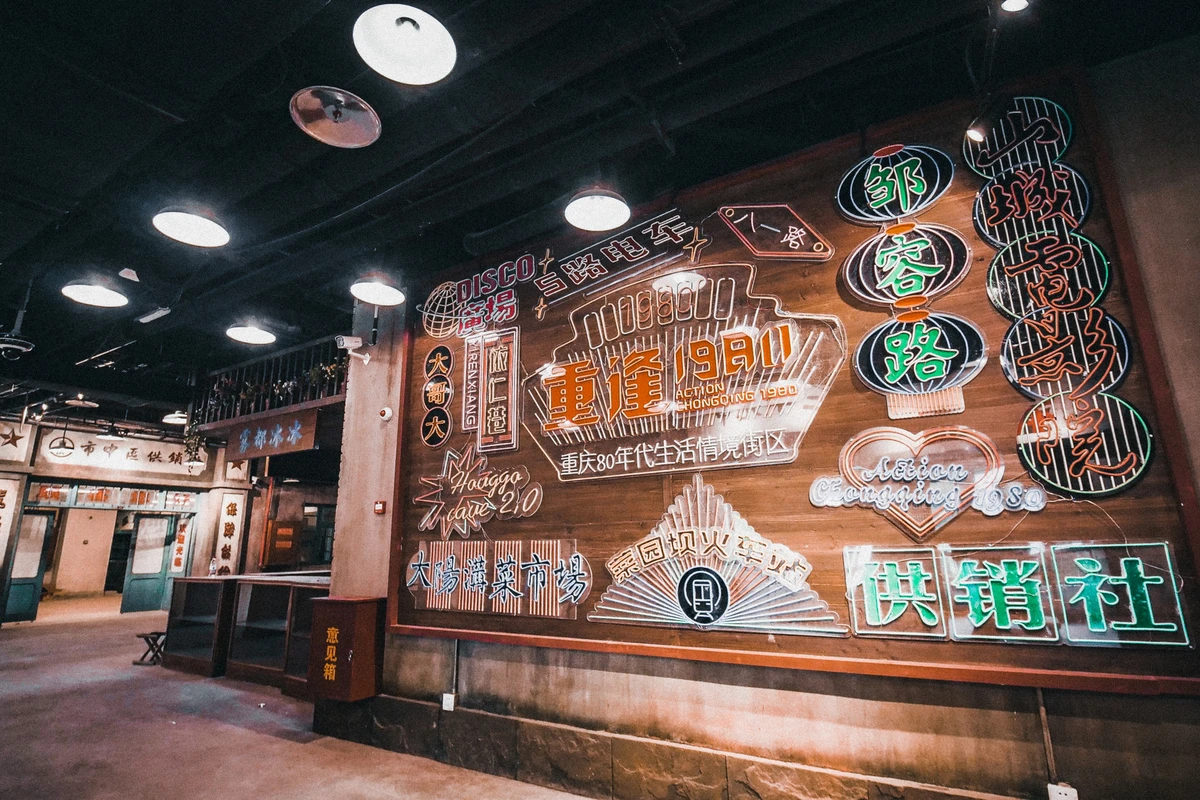
Encountering a Different Chongqing | A Century-Spanning "Time Travel" at Hongya Cave's Reunion 1980
Whenever Chongqing is mentioned, Hongya Cave, built along the mountain and integrating the city's dock culture into the Bayu stilted building art, has undoubtedly become the mountain city's unique city card. Its night view—warm lights scattered among the stilted buildings on the cliff, merging with the Jialing River and Qiansimen Bridge, contrasting sharply with the skyscrapers across the river in Jiangbeizui—has been dubbed by netizens as the "Spirited Away" dreamland, attracting thousands of tourists from China and around the world. But does Hongya Cave only have its night view? Or rather, is the night view all it has to offer?
When we step into the Reunion 1980 district on the fifth floor of Hongya Cave, I believe everyone will find the answer is a resounding no.
Many netizens may have no memory of Chongqing in the 1980s, or may never have experienced it. But back then, as the economic center of western China, Chongqing showcased its unique charm and strength through places like the tram on Linjiang Road, the bustling department stores, Caiyuanba Railway Station, and Chaotianmen Dock. Though time has passed and many of those scenes have faded from the stage of history, surprisingly, the Reunion 1980 district at Hongya Cave perfectly recreates the modern elements and retro scenes of that era. When you walk through the entrance, you'll surely find this a rare "time travel".
The theme "Old City, Stories · Chongqing, Reunion" runs through the entire district. From the giant replica camera at the entrance to every classic spot inside, visitors can immerse themselves in the vibrant, everyday atmosphere of Chongqing in the 1980s while strolling, exploring, eating, drinking, and having fun.
The entire district consists of an inner city and an outer city. Key photo spots in the outer city include: the era-specific apartment buildings in Bayilu Tongzilou, the No. 5 tram on Mianhua Street, the Sanba Store (the predecessor of Chongqing Department Store, a must-photo spot) on Datong Street, the People's Park roller skating rink, the small shop in Dayanggou Market, and the Bayu tea and cigarette stalls on Taipingmen River Street. Here, you can walk through the Tongzilou amidst vendor shouts and stroll along Taipingmen River Street. Or you can sit quietly and enjoy a cup of Bayu tea, savoring the leisurely moments of old Chongqing while recalling the unique life atmosphere of the 1980s and 1990s.
Additionally, the city also features a supply and marketing cooperative selling Chongqing specialties, the People's Bank, and the People's Post Office...
About the inner city (another key point): it includes era scenes like Chongqing Caiyuanba Railway Station, Zourong Road, and the city center square. Among them, there are many great photo spots that are well worth the ticket price!
For example, the oldest Caiyuanba Railway Station in Chongqing carries the memories of many locals and has witnessed the city's vigorous development. So standing at the station entrance and taking a photo with it gives the picture an old Chongqing flavor. To commemorate the national revolutionary hero, Zourong Road was named after the Liberation Monument. It features a specially set up old city photo studio, a very trendy place in that era. You can pretend to be a photographer inside and experience the work atmosphere of that time. The city center square's Global Breakdance Exchange Center Disco Plaza and the Laughing Mirror Toilet are both incredibly cool. Dance a tune under the laser lights, and the photos will come out naturally. Also, there is the Shan City Widescreen Cinema, which is Chongqing's first and only officially authorized Teresa Teng holographic cinema. As an MR interactive music show "Searching for Teresa Teng", it combines cutting-edge holographic technology, virtual avatars, visual effects, and other tech elements. Audiences can watch Teresa Teng "personally" sing classic songs in naked-eye 3D without wearing any equipment. Her every smile and frown seems to pull everyone back to a live concert by Teresa Teng 30 years ago, creating an immersive viewing experience and a refreshing cultural experience.
How to Play (High Energy Throughout, Recommend to Save)
Since there are many photo-worthy spots, each with its own style, I've categorized them into three styles: Retro, Japanese-style, and Everyday street-life for your reference.
- Retro Mountain City Style:
Datong Street is located in Yuzhong District, Chongqing, connecting the upper half and lower half of the city, leading directly to Chaotianmen Dock. According to legend, its name comes from the Qing Dynasty, when coppersmiths from Chongqing would gather here with their casting tools, and the sound of hammering copper could be heard day and night—hence the name Datong Street (Copper Hammering Street). Moreover, because the furnace fires in the coppersmith shops never went out and provided exceptional warmth, it also became a temporary shelter for many homeless people. During the War of Resistance against Japan, Datong Street and its surrounding areas housed the Bank of Communications Chongqing Branch, Chuankang Bank Headquarters, Meifeng Bank Headquarters, Bank of China Headquarters, Juxingcheng Bank Headquarters, Chuanyan Bank, Hecheng Bank, etc. Thus, Datong Street was also known as "China's Wall Street during the War of Resistance."
After understanding the historical background, looking at this replicated spot in the Reunion 1980 district gives a deeper appreciation of why it was so prosperous and why the authorities named it "Neon Green and Red." In this scene, numerous commercial signboards from Chongqing's past are hung, complete with old-school lighting, such as the roller skating rink, the Immortal Teahouse, and the previously mentioned Sanba Store. At first glance, it seems a bit messy, but if you stop and observe carefully, you can find a unique order and rules belonging to old mountain city. Another strong reason to recommend this photo spot is that its bustling scene closely resembles Temple Street in Kowloon, Hong Kong—a classic filming location for Hong Kong TV dramas. So photos taken here can also be called the "Pretending to Be in Hong Kong" series.
The eye-catching barber pole sign and iconic rotating cylinder lamp hang on the wall, accompanied by vintage curling tools and photos. Sit down on the chair, and with a snap, you get a blockbuster shot straight out of a Wong Kar-wai film.
With economic and living conditions improving, modern urban life makes us willing to settle in towering skyscrapers, and the Tongzilou (tube-shaped apartments) of our childhood have long been abandoned. But a few decades ago, Tongzilou were enviable, comfortable homes. Tongzilou, once called Khrushchev buildings, were a symbol of a well-off family in the 1980s and 1990s—bright, airy, with good lighting, and the corridors and railings could be expanded as private space. Another feature was that life was intertwined with neighbors; trustworthy neighbors looked after and helped each other, which alleviated many of life's difficulties.
The Reunion 1980 district at Hongya Cave perfectly recreates the Tongzilou scene: messy little posters plastered in the corridors, red printed accommodation characters, black-and-white posters of Marilyn Monroe, Soviet-style residential buildings unique to the last century, all bathed in warm lighting. When you walk through this entrance and see light filtering through the cracks in the walls, illuminating the posters, it's easy for the older generation to recall their youth and for the younger generation to feel the atmosphere of that era. The historically evocative benches also allow everyone to sit casually on the stairs and take retro-style photos.
【Reunion is Fate】
Next to the Disco Plaza, there is a singing stage that closely resembles Broadway. The first thing that came to my mind when I saw it was the classic scene from "Romantic Storm" where Lu Yiping first sings on the stage in Great Shanghai. I suggest that when you come to this photo spot, wear a small Republican-era cheongsam, sing a song in front of the microphone, and the photo will be like a debut. :)
【Themed Signboards】
Using classic typography and neon colors to make signboards of featured spots, no need to say more, straight to the point, must-photo.
- Fresh Japanese Style
【No. 5 Tram】
Turn back time to 1983 in Chongqing, when there were five trolleybus routes: No. 1, No. 2, No. 3, No. 4, and No. 5, carrying the memories of many.
The Reunion 1980 district recreates the No. 5 tram. The lighting at this photo spot is excellent, making photos taken both inside and outside the tram feel like scenes from a Japanese school movie. I once asked someone born and raised in Chongqing in the 1980s, and she said she indeed took the tram to and from school every day. When she heard about this scene, she was very surprised and wanted to bring her daughter to check it out, sit inside, and let her feel what it was like back then.
I suggest wearing a JK uniform or a Japanese-style floral dress to take photos—it adds a special flair.
【People's Post and Telecommunications Office】
In that era, making long-distance calls, sending remittances, and shipping parcels all had to be done at the post office, which served as the hub for people's communication with the outside world. Also, sending clothes, specialties, or parcels to friends and relatives in other places, or picking up remittances and parcel notices, all went through the post office. You can see the important role of the post office.
Within the Reunion 1980 district, the People's Post and Telecommunications Office is right next to the tram. Due to its decoration style and lighting, it retains the distinctive Chinese decorations of the last century but also has a touch of Japanese clarity. And because green is very flattering to skin tones, it's great for photos.
Moreover, every post office has a mailbox at the entrance. With a meter-high mailbox paired with the vertical sign on the left, add a bit of grain filter, and combined with the tram photos, it naturally becomes a set of retro photos titled "Pretending to Be in Japan."
- Everyday Street-life Style
This photo spot is a bit easy to overlook because the entrance is narrow, but once you discover it, it's truly breathtaking! It's a 100% reproduction of residential buildings from the last century: old benches, colorful window grilles from childhood in red, yellow, and green, slightly faded couplets dusted with age, old egg baskets, cured meat and underwear hanging from the rooftop, cups (Zhong Zhong; standard Chongqing dialect for cup) casually placed on the table... In short, just sit on a bench and strike a casual pose, and you'll get the most authentic street-life photos.
【Supply and Marketing Cooperative】
During the planned economy era, the supply and marketing cooperative handled all buying and selling for Chinese farmers, serving as an irreplaceable distribution channel in rural China. Farmers used food coupons, cloth coupons, cigarette coupons, liquor coupons, etc., to "buy with coupons" at the cooperative. At that time, these coupons were as good as real money, and people commonly referred to going to the store as "going to the supply and marketing cooperative." However, by 1993, the national rationing of grain was abolished, food coupons were discontinued, and the supply and marketing cooperative gradually faded from people's sight.
To allow everyone to concretely recall this period, the supply and marketing cooperative has been brought into the district. It's very easy to find—if you come in from the giant camera door, it's on the right. You can take a photo with it at the entrance, reuniting with the memories of the last century.
【The Wall of "XXX Was Here"】
This might be the only scenic wall in the country where you can freely leave your name or scribble. The words left by visitors make this wall a unique photo background. Feel free to write your own name or the name of your favorite idol and take a photo!
【Youth Phone Wall】
Next to the "Was Here" wall, there is a wall full of old-style telephones. Pick up a phone, call your former self or your family from the last century, and capture that moment. Tip: The lighting makes you look very fair.
【Seeing in All Directions】
This is a very distinctive pillar covered with old TVs and radios. You can even see the old patterns and characteristic screen glitches that only appeared when watching TV as a child. Since it's a childhood memory for most young people and deeply rooted in the minds of the older generation, taking a photo with this wall gives off a classic retro, everyday vibe.
【Disco Plaza】
Full name: Global Breakdance Exchange Center Disco Plaza. Just by the name, you know it's very modern. With special projection lights and a retro TV wall, it's really fun to play around. Bring your friends and dance disco or wave your hands here! And there's a motorcycle in the corner—sit on it, strike a cool pose, and you'll look like a cool guy!
In the 1980s and 1990s, arcade games swept through towns across China. Middle and high school students would always spend their hard-saved pocket money on arcade games after class. Even after their money ran out, they couldn't bear to leave and would hang around to watch others play.
Here, the scenic area has brought in three or four real arcade machines, free for everyone to play! You can't miss these eye-catching arcade machines near the Disco Plaza, with loads of games. Come and relive classic games like King of Fighters, Naruto, Streets of Rage, etc. Tip: Very popular, so get in line early!
A short walk from Datong Street leads you to the Yule Circle shop. The yellow door is easy to recognize, the interior decoration is very distinctive, and the owner is very enthusiastic. The walls feature classic cartoon characters from blue and yellow tones: Black Cat Sheriff, Haier Brothers, Calabash Brothers... Instantly bringing back childhood memories.
There are three main games. The first is ring toss—I'm sure you're familiar with it, but it's rare to find a dedicated place for this now. Come and experience it (whisper: if you ring the second-to-last row of bottles, you can enter a draw; prizes include iPhone 11, Huawei, etc.). It just opened, and the promotional price is 10 yuan for 25 rings—great value! There's also beanbag throwing and shooting, both classic amusement park games from childhood—a nostalgia series.
Opening Hours: Monday to Sunday: 11:00 - 23:00
- Reunion 1980: 1980s Life Scenario District - 29 yuan/ticket
- Searching for Teresa Teng: Holographic MR Interactive Music Show - 29 yuan/ticket
- Combo Ticket (includes Reunion 1980 + Searching for Teresa Teng) - 39 yuan/ticket
Transportation:
- Hongya Cave Station: Buses 151, 181, 262, 466, 0491 (night) can reach.
- Xiaoshizi Station: Buses 111, 114, 135, 401, 866 can reach.
- Take Light Rail Line 2 to Linjiangmen Station, then walk northeast for about 500 meters.
- Take Metro Line 1 to Xiaoshizi Station, then walk about 500 meters.
- Take Metro Line 6 to Dajuyuan Station, then walk across Qiansimen Bridge.
- From Jiefangbei: about 11 minutes.
- From Raffles City: about 16 minutes.
Travel Notes Contents:
1. Preface
2. Reunion 1980 | Chongqing 1980s Life Scenario District
3. Reunion 1980 District | Photo Spots
4. Reunion 1980 District | Interactive
5. Opening Hours
6. Tickets
7. Transportation Routes
Travel Information: Hotel Index, Guide Index, Airfare Index, Website Navigation, Travel Index, Cruise Index, Corporate Travel Index, Cooperation, Distribution Alliance, Friendship Links, Corporate Gift Card Purchase, Insurance Agency, Agency Cooperation, Hotel Franchising, Destination and Scenic Area Cooperation, More Cooperations
About Ctrip: About Ctrip, Ctrip Highlights, Contact Us, Careers, User Agreement, Privacy Policy, Business License, Security Center, Ctrip Content Center, Intellectual Property, Trip.com Group Algorithm Announcement


