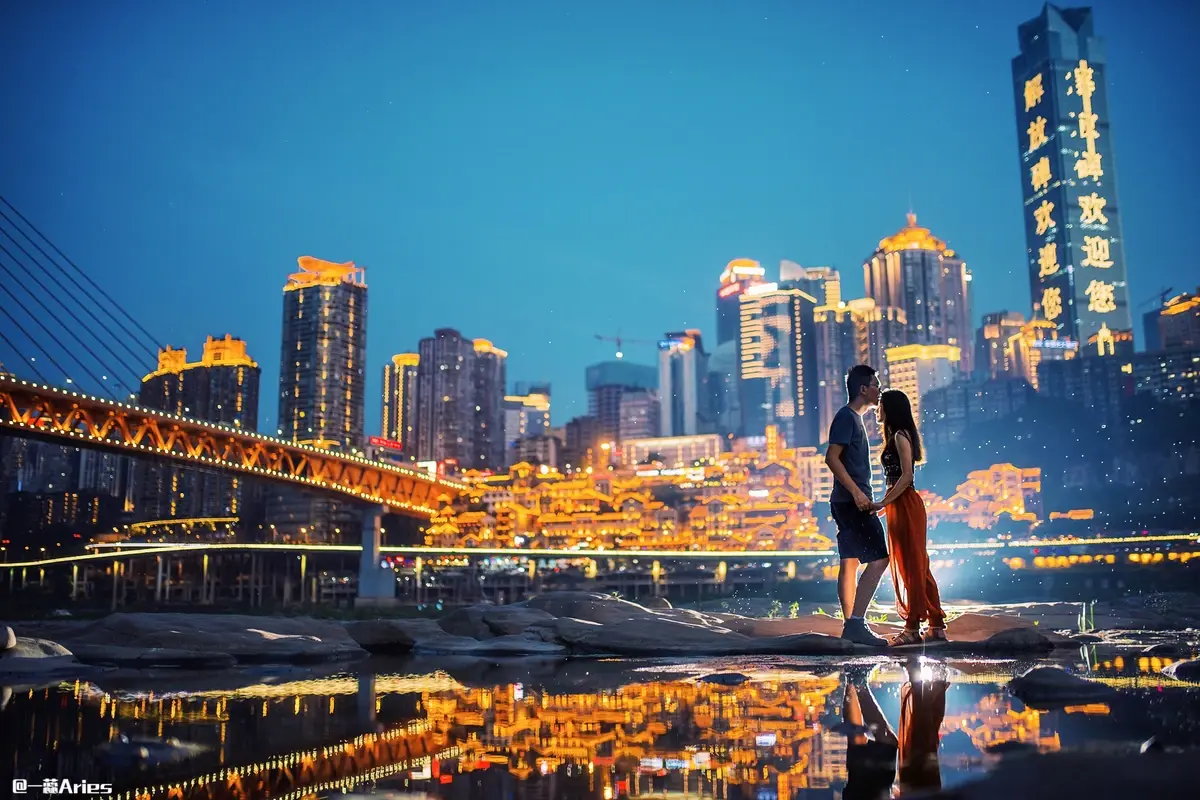
Chongqing Film Pilgrimage: Following the Lens of the Divine Eagle Travelers to Explore Chongqing's Most Popular Filming Locations 1:1!
(An amazing video – sneak peek first!)
How long has it been since you last sat in a movie theater and watched a good film?
Today, let’s take the time of one movie, follow the lens of the Divine Eagle Travelers, and drive into the cinematic labyrinth of Chongqing for a wonderful adventure!
Chongqing is the 2019 film Better Days: the sunlit corner of Kuixing Tower, the dappled shade of the Railway Middle School’s green path, and the banyan trees rooted in Zhongshan 4th Road.
When you cross the dark alleyway of Haitangxi and speed along the neon-lit Nanbin Road,
“This is the paradise we once had, the youth we cannot escape.”
Chongqing is also the 2016 film I Belonged to You: the CITY RADIO on the rooftop of Eling Factory 2, the bustling night of Jiefangbei, and the heart-wrenching run along the riverside road.
“If it’s just passing by, then I’ll wait for you at the end.”
Chongqing is also the 2006 film Crazy Stone: the dizzying Rongqiao Overpass and Zuoying Sky Bridge, the hanging cable cars carrying passengers’ joys and sorrows, and the ancient temples hidden in the bustling city, filled with people’s beautiful hopes.
“A single stone stirs a thousand waves – Chongqing has its wild side too!”
Chongqing is also the 2016 film The Final Master: the “boiling mortal烟火” in the air-raid shelters, and the panting up and down of Baixiang Ju.
When we stand at the Chongqing Grand Theatre and see the stunning sunset over the mother city,
“At this moment, you are the hero in my heart!”
Today, there are not many domestic cities that can be instantly recognized and have their own unique aura. Chongqing, a city deep inland where mountains and rivers coexist, has a unique terrain that gives its buildings a surreal feel, its public transport a punk core, and its streets and alleys a lively, local vibe. These are all memorable labels and undoubtedly great material for directors to draw inspiration.
Every film release gives us a new understanding of Chongqing.
Chongqing is not only a darling in directors’ hearts and the light of freedom in film, but also a magic city that gets everyone’s blood pumping.
As a half-Chongqing native, every “Chongqing film” has made me teary-eyed – not just moved by the plot, but also by the psychedelic atmosphere that hits you in the face; isn’t this the city I love most in my heart?
Of China’s 9.6 million square kilometers, why Chongqing specifically?
Welcome to China’s best film labyrinth – watch the Divine Eagle Travelers in Chongqing recreate four classic film sets 1:1, and take a grand pilgrimage through the Chongqing film world!
Original work, thanks for watching, hope you like it! All rights reserved. Please contact the author for reprints.
The film Better Days released last year pushed Chongqing onto a pedestal. Two isolated islands in the city, facing the coldness of the adult world, choose to protect each other.
The handsome four-character brother Yi Yangqianxi and the lovely Zhou Dongyu perfectly portrayed the youth of teenagers.
“You go ahead, I’ll be right behind you!” was the most tear-jerking moment of 2019.
We also thank the crew for digging up a bunch of great filming locations: Haitangxi, Kuixing Tower, Crown Grand Escalator, Railway Middle School, Zhongshan 4th Road, etc. In the film, the mountain city has a special character, with colors more vivid and intense than many other cities.
“You, the youth; me, the middle-aged.” Let’s walk the youthful path together!
【Address】: Haitangxi Main Street, Nanan District, Chongqing.
“Time will take everything away, but it cannot wash away people’s memories.”
After watching the film, everyone should have a deep impression of Chen Nian’s tube-shaped building.
The octagonal courtyard-style building, old stairs, gloomy tones – like a deep well sealing time.
In the evening, passing the golden Sheraton Twin Towers, an inconspicuous street corner, climbing the steps up, the walls yellowed and peeling from time, dusty awnings, moss-covered stone walls. At the end of the dark corridor, a beam of sky light spills down from the cliff – isn’t this where Zhou Dongyu took the poster photo?
Turning into the dark stairs deep inside the tube building, the stuffy weather, high humidity at the bottom, mosquitoes swarming – after taking two photos, we fled in panic.
Suddenly I remembered that line: “Even if we live in a gutter, we must remember to look up at the stars.”
Although the environment is harsh, you have to admit it’s incredibly cinematic. Setting up our two small lights instantly recreated the movie scene.
The platform connecting the buildings offers a great view at night; from the end of the corridor, you can see the entire night view of Yuzhong District.
Today, Chongqing still retains many such tube-shaped buildings, a stark contrast to the modern, clean, and bright elevator apartments. These hidden corners are called “kaka guoguo” in Chongqing dialect.
Every day, opening the door faces crowded hallways and neighbors you see all the time. Although conditions are poor, the residents take care of it – planting greenery, hanging handwritten couplets. An elderly woman saw us taking photos and cheerfully reminded us to be careful and to take our trash when we leave.
The layered staircases preserved on one side of the tube building are also impressive, showing many features of the mountain city.
The director of Better Days, Derek Tsang, once said: “Chongqing’s overpasses, tall buildings, and alleys are like a maze. Putting characters here gives a sense of being unable to escape, which helps the film convey the inescapable melancholic mood of adolescence.”
Today, amid rapid modernization, old buildings hidden among towering skyscrapers continue the old times of the mountain city with their unique charm and grounded living atmosphere. We don’t know the future fate of these tube buildings and staircases, but at least in the movies they are faithfully recorded.
1. Please be quiet and slow when visiting, take care of the environment, and do not disturb residents.
2. Be sure to stay safe while filming; do not take dangerous actions.
Address: No. 17, Datang Plaza, Linjiangmen, Yuzhong District.
“In Chongqing, you can never find the horizon!” Chongqing’s buildings are built along the hills. Taking the elevator from the first floor up a dozen floors, you step out and still see the first floor; going in and out is a magical experience, and it’s the essence of the mountain city.
The Kuixing Tower Sky Bridge caught me off guard. From the upper half of the city (commonly known as the “square on the 27th floor”), looking at Kuixing Tower, the bridge connecting the 22nd floor of Gaosheng Building seems ordinary.
But stepping onto it is a whole different world – 65.8 meters above ground, a sudden “abyss.” As you walk, the bridge shakes slightly; if you’re timid, don’t look down – your legs will go weak!
In the 40°C summer, eating ice cream on the bridge, your mouth can’t keep up with the melting speed.
Below the bridge, a long line of people are taking photos at the corner where Yi Yangqianxi’s younger brother walked in the poster. We scouted ahead and timed it right; when the sunlight passed through the gap between two buildings, Xiaoqiang walked up the slope recreating the path Xiaobei took.
Better early than late; if you want the same shot, time it right!
Summer sunny days, July, August, September around 4 PM – lighting matches the poster.
Address: 1st Floor, Crown Building, No. 107, Zhongshan 3rd Road, Lianglukou, Yuzhong District.
The Crown Grand Escalator officially began operation in 1996. That Spring Festival, my parents and I first took it from Caiyuanba Railway Station to Lianglukou and then to Jiefangbei.
Back then, this “second longest in Asia” escalator was just a means of transport connecting the upper and lower parts of the city, saving Chongqing people a lot of climbing trouble.
Last year, Yi Yangqianxi silently escorted Zhou Dongyu to school on this escalator, and Huang Bo filmed Extreme Challenge here – after more than 20 years of operation, the Crown Grand Escalator became popular again!
Revisiting old haunts, familiar yet strange! The 30-degree tilt is still visually thrilling; the staff are still “fierce”; the shaking rhythm is still clear. The only difference is that tourists outnumber regular passengers.
To prevent overheating in summer, only two of the three tracks run alternately (one up, one down). To get the same profile shot as Yi Yangqianxi, Xiaoqiang went all out, holding a 16-jin stabilizer and camera, acting as director, videographer, and actor all in one. Haha, the real Atom Boy!
Before filming the escalator, we found a parking lot next to it that opened a few years later. The entrance was surreal – yes, in choosy Chongqing, even cars use elevators to go down to the garage. Carefully squeezing the car into the elevator, afraid of scratches.
Luckily, the radar was super helpful; we parked heart-poundingly and breathed a long sigh of relief. No wonder it’s a magic city – people and cars don’t take the usual path!
1. The escalator is 112 meters long, with a vertical rise of 52.7 meters, taking just 2 minutes 20 seconds. One-way fare is 2 yuan, pay with cash (2 yuan) or bus card (1.8 yuan).
2. If you need to take photos while riding, be especially careful and hold the handrail firmly.
Address: Caiyuanba, Yuzhong District, Chongqing.
Exiting the Crown Grand Escalator brings you to Caiyuanba, the location of Chongqing’s oldest railway station. It appears many times in the movie as empty shots.
Looking at the three-dimensional, rhythmic urban symphony in front of me, over the years I’ve witnessed the birth of this magic city – from riding green trains to driving myself, from the first light rail line to the overpasses that even navigation systems can’t figure out.
Every year I return, I get more lost, “ha cuo cuo” (stupidly) losing myself in this 8D city, unable to extricate myself.
Address: Zhongshan 4th Road, Shangqingsi, Yuzhong District, Chongqing.
Zhongshan 4th Road, evergreen like spring, was once named Chongqing’s “Most Beautiful Street.”
This Anti-Japanese War culture street has relics like Gui Yuan, Zhou Gong Guan, Dai Gong Guan, and the former site of the National Government’s Presidential Palace, witnessing Chongqing’s past and present.
On a summer afternoon, driving slowly down this street under the shade; sunlight filtering through the leaves casts beautiful patches. In the movie, Xiaobei and Chen Nian walk one after another, everything quiet and beautiful.
The banyan tree, also called huangge tree, is beloved by Chongqing people – you can see it in place names like “Huangjueping, Huangjueya, Huangjuewan…” Perhaps because in the furnace of Chongqing, having one banyan tree means having a patch of deep shade.
The banyan tree’s crown is lush, and its roots are spectacular. In the mountain city with more stones than soil, it doesn’t hinder its growth; as long as there’s a crack, you can see thick roots on hard stone walls.
The banyan tree’s character is like the straightforward Chongqing people – fiery temper, never dragging things out.
Climbing slopes, crossing rivers, Chongqing people once measured this barren mountain city on foot; now they use light rail through buildings, bridges across rivers, tunnels through the city.
This optimistic and tenacious spirit – isn’t it just like the banyan tree? Growing vigorously and passionately!
Address: No. 100, Dianli Wucun, Huangjueping, Jiulongpo District.
Old streets are the soul of a city, witnessing history and giving birth to indelible memories.
Near the Sichuan Fine Arts Institute, a straight path is shaded by lush trees. Driving by, the scenery outside is like a silent movie.
On both sides of the road, you can almost see groups of students in uniforms, their youthful faces beaming with smiles.
Every day, going to and from school, Xiaobei silently watches over Chen Nian.
“You go ahead, I’ll be right behind you.” His eyes hide youthful emotions.
This iconic tree-lined road in the movie is at the gate of Chongqing Railway Middle School, Dianli Wucun, Huangjueping, Jiulongpo District. The school was founded in 1956.
The sense of history easily creates the atmosphere needed for the film. The whole Huangjueping area has this quality – besides the famous Sichuan Fine Arts Institute, it’s also an important rail, port, and cargo distribution center.
Address: Sanjiao Dao, Railway Sizhu, Longyin Road.
? Green trains, swaying. From 1952 to 2019, the distance on the Chengdu-Chongqing Railway shortened from 505 km to 308 km, train speeds increased from 60 km/h to nearly 300 km/h, and travel time from Chengdu to Chongqing dropped from 13 hours to 1.5 hours.
Home and family, poetry and distant places are no longer far away. People living in Railway Village gradually faded from the era after witnessing and participating in China’s rapid railway development.
In 1950, the Chengdu-Chongqing Railway began grandly, and Huangjueping Railway Village became the backyard for Chongqing’s railway system families. Following the path, at the end of the old neighborhood marked with demolition signs, we finally found the worn tracks.
Beyond the tracks and trains in the movie are the young people’s distant aspirations.
A bright red rescue train sits at the end of rusted tracks, surrounded by dilapidated buildings covered in thick oil and dust.
Besides young people taking pictures, occasionally elderly folks walking dogs or buying groceries pass by.
In an unremarkable corner near the railway triangle track, laughter echoed. A big brother in a gray hat and black-rimmed glasses, fanning himself with a palm-leaf fan, greeted the young people passing by.
It turned out he was the owner of “Jun Ge Bookstore.” This legendary figure is extraordinary – he once took his daughter cycling from Lhasa to Kathmandu.
In this cluttered but organized yard, he has collected thousands of books about Chongqing culture, six thousand maps, and a whole wall of old house number plates!
My sharp eyes spotted the Shibati where Mao Shiba lived in I Belonged to You and the “unmanned” Diancun in Crazy Stone.
After a sip of iced Tianfu Cola, the heat dissipated. Brother Jun played chess while enthusiastically chatting with us; the long, quiet tracks finally came alive.
Sitting in this yard is perfect for “wasting” time, experiencing “the simple joy of human life.”
As we left, seeing our cameras, Brother Jun suddenly looked up and said, “Take lots of photos! This place is going to disappear!”
People with feelings always sympathize. Goodbye, Railway Village.
Address: Next to Metropolitan Garden, Mianhua Street, Yuzhong District, Chongqing.
This spot is quite hidden. When I found it, I suddenly understood – maybe only in Chongqing could Wei Lai roll down such a long staircase!
This super-long staircase is hidden between residential buildings, built along the mountain, connecting the road on one end and the Jialing River on the other; tall buildings, steps, Qiansimen, Jialing River, Chongqing Grand Theatre – all the most Chongqing features converge here.
Now that Shibati is demolished and Xiahao is gone, Mianhua Street represents the mountain city’s staircase life.
Looking at the steep slope and maddening steps, I suddenly remembered an elderly Chongqing man I met on the way. He said casually, “Go down the steps ahead, turn at the end, and you’ll reach Hongyadong. Simply ‘turn at the end’ in Chongqing dialect, and in fifteen minutes you’re there.”
Strongly recommend going from above (Mianhua Street) down (Hongyadong) for an easier version. Along the way, you can still find the long-gone cable cars.
Address: Near Tongyuanju Light Rail Station, South Bridgehead, Caiyuanba Yangtze River Bridge, Nanan District.
On 72-meter-high piers is China’s highest ramp bridge – Sujiaba Overpass.
The huge spiral curves are like a roller coaster at an amusement park. The first time I drove through, looking at the scenery below the bridge, I was really scared.
In the movie, Xiaobei’s home is built under these giant piers. The director probably wanted to show the small and helpless loneliness of the young man in the city.
The huge contrast is exactly what the film needed. Director, you really know how to pick places!
Address: Under the south bridgehead of the E’gongyan Rail-only Bridge.
Speeding on Nanbin Road, Xiaobei carries Chen Nian through their youth; the wind from the Yangtze River blows away all the young man’s troubles.
This section of Nanbin Road outside Qianfo Temple offers the best city views. The sunset and night scene complement each other. We raced along Nanbin Road at full throttle.
When the film was shot, Raffles City was still under construction; now this red building has become a new landmark in Chongqing, riding the waves of Yuzhong.
After nightfall, go down to the riverbank outside Binjiang Road, watch the thick Yangtze River, the majestic bridge, and the most beautiful sunset on the city skyline.
Loving a city isn’t because it’s beautiful, but because of genuine affection. Starting from the confluence of the two rivers, we have become one with it.
If Better Days is Chongqing’s adolescence, then I Belonged to You is Chongqing’s prime, outlining a literary, love-filled mountain city.
Even though I visit Chongqing every year to see relatives, I am still amazed by the fleeting scenery outside the car window.
Behind the myriad lights, individuals are small in the city. The city amplifies every character’s emotions and gives each story rich flavors.
Roll up the window, connect Bluetooth, play a song from I Belonged to You, and have a sound baptism. Stay passionate and join us for the next mountain and sea.
Address: 8th Floor, Building H, Testbed 2 Cultural and Creative Park, No. 1 Eling Main Street, Yuzhong District, Chongqing.
“I hope to meet someone like you, like the cool breeze in the mountains, like the warm light of an ancient city – as long as it’s you in the end. Pass through your world, I am Chen Mo.”
The CITY RADIO atop the city is an iconic scene from I Belonged to You. Driven by our love for the movie, we drove to Eling Factory 2.
Time polishes the past. From a mint to a color printing center, Eling Factory 2 was once a thriving big factory in the hearts of old Chongqing people. By 2017, the forgotten factory was reborn with a cultural and creative shell, getting a stylish English name – TESTBED2.
By chance, director Zhang Yibai encountered Eling Factory 2 and placed the radio building from I Belonged to You here, making Factory 2 wildly popular.
In 2019, Director Zhang returned to open a studio, recreating the late-night radio that comforted countless wanderers in the movie (the original shooting site was demolished). Visitors can become broadcasters and convey their feelings.
The two of us sat there and got a news broadcast vibe, haha.
Climbing the 27 white steps, we felt like we had entered the movie. The CITY RADIO sign shone on the Jialing River’s city skyline; the city’s brilliant landscape lay at our feet – an unbeatable view!
Key scenes of the love triangle among Chen Mo, Xiaorong, and Yaoji all happened here.
While recreating those movie scenes, it felt like stepping into the characters’ hearts – all their sadness and joy were restored.
When the sun sets and the sky turns blue, under the yellow lights, the rooftop takes on a hazy, ambiguous charm.
We were deeply infatuated with this beauty, just like the words on the ticket: “Everything is like a movie, even better than a movie!”
I like Zhang Yibai’s choice of location and his perspective. Perhaps because he grew up in Chongqing, he has a strong Chongqing complex. In his lens, Chongqing has a unique romantic atmosphere.
Eling Factory 2 was reborn in the sparks created by these excellent artists, returning to young people’s sight in its best form.
1. Love Rooftop ticket: 19 yuan/person, valid all day; enjoy daytime views during the day and night views of the two rivers at night.
Address: No. 100, Zourong Road, Yuzhong District, Chongqing.
800-year-old Chongqing Prefecture, 100-year-old Jiefangbei. This monument that wakes the mountain city with its bells every day is one of Chongqing’s cultural symbols – Jiefangbei.
In my childhood memory, Jiefangbei was tall; as I grew up, the buildings in Yuzhong got taller. The “shrunken” Jiefangbei still holds the historical and cultural C-position; it remains the soul of Yuzhong in my heart and one of Chongqing’s icons.
In the movie, Yaoji walks with an umbrella in the rain, Chen Mo and Yaoji ride by, Chen Mo runs by holding a sign saying “I am an idiot” – many scenes happen here.
My favorite is the night scene: in the pouring rain, Yaoji holds an umbrella, walking toward Jiefangbei, set against the dreamy, sparkling neon lights. The lonely, sad mood makes the whole city feel sorrowful.
The deserted Jiefangbei in the movie only appears when the city is asleep. Without the crowds, Jiefangbei at night has a unique ethereal beauty!
Around midnight, you can capture Jiefangbei’s deserted night view.
Address: Near No. 108, Binjiang Road, Jialing River.
“Where there is a river, there is a bank; where there is a bank, there is a road.”
Below Hongyadong in Yuzhong District is the Binjiang Road of the Jialing River. The scene where Zhu Tou chases Swallow’s taxi was filmed here.
When I was young, my grandmother’s house was at Cangbai Street above Hongyadong. The year Hongyadong was built, I ate sour and spicy noodles in this “three-dimensional skywalk.” Years later, Hongyadong became a huge hit. This stilt-style building is extremely popular, glowing brilliantly.
Although many Chongqing people say Hongyadong isn’t that great, when outsiders praise it, they still feel a sense of pride!
Perhaps because too many people take photos on Binjiang Road below Hongyadong, Swallow took a taxi to the airport and had to go a kilometer further along the river.
The part where Zhu Tou chases the car happens to offer a perfect view of the Jiangbei CBD, but he only had eyes for Swallow and didn’t see the unbeatable night view.
Xiaoqiang insisted on filming this scene; he said Xiaoyueyue is the essence of the whole film. For safety, we waited until midnight when Hongyadong’s lights went out before starting.
But there were still tourists everywhere who couldn’t get taxis, and an elderly man walking along Binjiang Road without sleeping – they added live commentary, making me break into laughter repeatedly.
Can you imagine? “Ha cuo cuo” Xiaoqiang ran while shouting, “Yirui, how can I live without you!”
Various subtitles around: “Not invested enough.” “Run faster!” “Wait and see!”
This scene must have been NG’ed about a hundred times! To be honest, Chongqing people have plenty of entertainment spirit – after all, over a hundred movies’ crews come to film here each year, so they’re probably used to it.
Address: Liziba Light Rail Station, Yuzhong District, Chongqing.
The most popular transport in Chongqing is definitely the light rail. Big directors use a lot of light rail elements in their films – almost every movie includes some.
From I Belonged to You: Tongyuanju Station for Zhu Tou and Swallow, Huanghuayuan Station for Chen Mo and Yaoji, and Grand Theatre Station where Xiaorong gets out of a taxi. From Crazy Stone: Huang Bo’s iconic head-shaking while opening a cola. Better Days and The Final Master have various empty shots.
The light rail flies up to the sky and dives into the ground, like a roller coaster, like a snake, weaving through every corner of the city. Chongqing’s magical realism reaches its peak on the light rail!
The popularity of Liziba Station on Line 2 is incomprehensible to many Chongqing people – to them, it’s nothing special, after all, Route 2 buses can stop on the 8th floor, so what’s the big deal?
Moreover, compared to the light rail passing through the building, the tourists at Liziba who “eat the light rail” with their antics are the real magic!
“Boss, two portions of Liziba light rail through the building, extra spicy! To go!”
Thus, Chongqing people watching have a new show: Liziba Bizarre Behavior Awards.
Personally, I prefer the more remote stations in Jiangbei District, like Tangjiayuanzi Station in The Final Master – a quiet platform with pleasant greenery. Riding the light rail there is a true pleasure!
Every station has its scenery; just one light rail ride can give you a day trip of Chongqing!
Address: Tongyuanju Metro Station, Rail Transit Line 3.
Tongyuanju Metro Station might be the most favored location by film directors – three movies, I Belonged to You, Better Days, and The Final Master, all filmed here.
The intricate stairs, with their unique structure and rare perspective, have become a darling of cinema.
Zhu Tou and Swallow, two people from completely different worlds, stand there. The huge reflective glass wall outside the metro station maps a real yet illusory world, implying everything.
As time jumps, when the roar of the Changjiang Electric Factory sounded, parents in work uniforms headed to the factory, children with backpacks ran to the school.
In old Chongqing’s youthful memories, Tongyuanju is where Chongqing’s industry took root – the first electric light lit here, the first machinery factory established here. The Chongqing Tongyuanju created countless “firsts” in Chongqing and was never absent at any key point in the era’s progress.
Address: Haitangxi Pier, Nanbin Road Scenic Area.
The extremely hot weather finally mellowed in the rippling river breeze of the Jialing River. The cargo ships docked under Qiansimen lit up, complementing the glowing blue sky and yellowish river.
The confluence of the two rivers gives Chongqing rich dock culture.
With the development of road transport, water transport’s status gradually declined. With Raffles City like a dragon head, Chaotianmen Dock lost its former glory and now exists more for sightseeing.
By chance, we found a great spot by the river – drove the car into Haitangxi Pier on Nanbin Road. Children playing in the Yangtze River water laughed joyfully.
Under the night sky, the city lights are like stars reflected on the water, making you feel immersed in a galaxy of stars.
The whole city was dazzling, lights ablaze. A day in Chongqing ended in this romantic fireworks.
“Pass through your world, I’ll wait for you in Chongqing!”
In 2006, the black comedy Crazy Stone burst onto the scene, becoming the biggest dark horse among low-budget films that year.
It was a milestone for genius director Ning Hao. Thanks to Liu Dehua’s 3 million yuan investment from “Asia New Star Director,” small cost, big return – box office soared, kicking off the domestic black comedy movie trend.
A large amount of Chongqing dialect and classic gags made the film not only authentic but also highly entertaining. The main cast – Guo Tao, Huang Bo, Wang Xun, Liu Hua, Xu Zheng, etc. – all later had stellar careers.
Compared with the previous two romance films, in my mind Crazy Stone is the most Chongqing-gened film. The “crazy effect” continues to work in the magic mountain city.
Proving the saying: “Always imitated, never surpassed!”
Address: South Station of the Yangtze River Cableway, Xinhua Shang Street.
“Every time I look at this city from this angle, I strongly feel that the city is the mother, and we live in her womb…”
At the beginning of the movie, Xie Xiaomeng hits on a girl on the Yangtze River Cableway, then gets stomped by a high heel, dropping his cola, which hits Bao Kezhang’s van, causing a chain crash.
Classic! I still remember this opening after 14 years!
The film was a huge hit, and the Yangtze River Cableway became famous too. Flying over the vast river, experiencing the air bus of the mountain city – this most Chongqing label was magnified.
Today, only one cableway remains, almost always full. To catch a less crowded trip, we got up early to be the first.
The Yangtze River Cableway is the first large-scale cross-river passenger cableway on the Yangtze River, designed and built by China. It’s 1,166 meters long, connecting Chang’an Temple on Xinhua Road in Yuzhong District and Longmenhao on Shangxin Street in Nanan District.
A basket, two ropes, at 6 meters per second, sliding from a hundred-meter-high building to the river center, then slowly climbing back up. In a one-way 4-minute ride, you can overlook Chongqing’s mountains, rivers, and cityscape.
How popular is the Yangtze River Cableway? It’s almost a must-have spot for domestic film and TV productions shooting in Chongqing – even empty shots often include a short segment.
1. The first trip at 7:30 AM has the fewest people; get up early if you want an empty shot.
2. One-way ticket 20 yuan, round trip 30 yuan, valid for the day. Recommend planning your itinerary before buying.
Address: No. 7, Luohan Temple Street, Yuzhong District.
The main storyline of Crazy Stone starts at Luohan Temple: Xie Xiaomeng asking his old man for money, the first theft chase for the jade, and international thief Michael scoping the place – almost all the main plot was filmed here.
Also, Hei Pi crawls into a sewer, and the car wheel covers the manhole cover in front of Luohan Temple.
Under that crushed cover was Huang Bo himself, haha!
Many classic quotes were born here.
For example: “Bones are fine, but the tendons are broken!”
“Nike… they also make cameras!”
The movie turned this Buddhist realm in a concrete forest into a household attraction.
Exquisite stone carvings, finely carved windows, and intricately decorated buildings – although the ancient Luohan Temple has been fully renovated, the interior is still worth seeing.
The biggest feeling while touring the temple is the high density of mountain city buildings. Perhaps because it’s in the prime business district of Yuzhong, you see skyscrapers in the background from any angle.
This combination of modern and traditional, noise and tranquility, perfectly illustrates “finding peace in the midst of noise,” bringing a great impact visually and mentally.
Luohan Temple is currently under renovation and expansion. In the backyard’s Guanyin Pavilion, we found the “theater” where the gem was displayed.
The caretaker aunt was surprised when we said we were looking for the filming location of Crazy Stone: “You young people also know this movie?”
The aunt said almost every old Chongqing person has seen Crazy Stone. Yes, in my heart it’s the most authentic Chongqing film, and nothing has surpassed it yet. Thank Ning Hao for the resonance.
Address: Rongqiao Road, Nanan District, Chongqing.
What is your first impression of Huang Bo?
In my memory, Huang Bo is Hei Pi on the overpass – dark and scrappy, mouth full of bread, running wildly.
As the camera turns, Xiaoqiang’s tribute to his idol was heartfelt – “ban ming” (desperate) running, actually reaching 60 km/h.
When the city’s aura perfectly combines with the film, even chasing a thief can be shot for ten minutes.
This “life-taking” roundabout is the famous Rongqiao Overpass in Chongqing – a 720-degree spiral, two-way four lanes, one end on Rongqiao Road, the other on Shuangfengshan Road, with a huge height difference, looking like a three-layer roundabout from afar.
This “devil track” has mixed reviews. Some find the spiral dizzying (“rounds the head”), while others like me find it quite pleasant.
Especially when I overtake taxis at over 60 km/h – so stable!
If Huang Bo had known how to drive back then, he wouldn’t have run so miserably, haha!
Address: Downhill slope of Guanyinyan, Yuzhong District, bottom side connecting Chunyang Cave top side to Kangjian Hall and Diancun Village.
Why are Chongqing people so good at driving? Well, each place nurtures its own experienced drivers! The overpasses that crash navigation systems are nothing – at worst, a day trip around Chongqing. The steep slopes of the mountain city are the real nightmare for beginners, especially manual transmission cars. If you’re not skilled, you can’t even get home.
My relatives live in Jingang Pagoda, Diancun Village, Guanyinyan. There’s a terrifying steep slope near the community entrance. On a rainy day, driving a manual car, I slipped more than ten times and couldn’t get started.
Later I saw a news report – it’s one of Chongqing’s top five “deadly” steep slopes: narrow road with illegal parking, a sharp right turn at the top, large height difference, tires prone to slipping.
This memory of “dark, hard head” reminds me of the scene in Crazy Stone where a van rolls back and hits a BMW at Diancun village: “Yeah, high tech, unmanned driving!” Only on Chongqing’s roads could such a classic scene be filmed!
Luckily, the car was reliable – strong grip on the polished steep slope, stepping on the gas, revving to 4,000 rpm, fierce power surging forward without slipping. The frustration of that year vanished.
Address: Xinlong Building Sky Bridge, Zuoying Street, Yuzhong District.
“Standing on the bridge looking at the scenery, you become someone else’s scenery.”
If Chongqing’s bridges make you dizzy, then Chongqing’s roads waste your legs. But the straightforward Chongqing people used the simplest and roughest method to solve the problem of climbing slopes. So, between buildings, between buildings and mountains, many adrenaline-inducing sky bridges appeared.
Zuoying Street Sky Bridge is longer than Kuixing Tower’s. One end connects to the road, the other to the 13th floor of a residential building, 40 meters above ground. I don’t understand why Xie Xiaomeng always chooses such dangerous places to pick up girls – totally unreliable!
Stepping onto the sky bridge, you walk and suddenly hang in midair. If they turned it into a glass walkway, it would be mind-blowing!
I often feel that Chongqing is a city that doesn’t get visually tiring. With rivers as ponds, perched on cliffs, from modern skyscrapers to smoky old streets and alleys, everything is intricately connected – truly a “Chongqing Forest”!
Address: No. 4, Huangjueping Street, Jiulongpo District, Chongqing – App. 5.
Although the Traffic Teahouse has few shots in the movie, its aura and sense of history make it worth a visit.
In 1987, Professor Chen Anjian of Sichuan Fine Arts Academy quietly paid ten years of rent to save the teahouse from closing down to become an internet café. He only asked: “If the teahouse is damaged, repair it, but don’t change its original appearance.” The teahouse thus became his place for painting.
Once, the customers were dock’s paoge (gangsters), bangbang (porters), Huangjueping residents, and idle street kids – endless gossip, gang logic, occasional fights to vent excess energy. Now on weekends, it’s almost all out-of-town tourists, hard to find a seat.
Through the inconspicuous entrance, the walls blackened by years of oil smoke, battered square tables, unpredictable flickering white light tubes, bubbling long-spout kettles on gas stoves, and traditional blue-and-white cover tea bowls – a sense of vicissitude rushes at you.
Even with many tourists, there are still regulars, creating their own world.
Old men speak authentic Chongqing dialect, fiddling with long cards that young people don’t understand. In swirling smoke, they casually lean on tables and chairs, chatting about anything from trivialities to painting aircraft carriers – spinning tall tales.
This is the attitude of old Chongqing. Compared to fashion and novelty, I prefer this unadorned look – these are the most authentic Chongqing people!
Of course, we might not understand the youngsters with pants dragging on the ground, wearing sunglasses in the dark, hair spiking to the ceiling, mumbling something incomprehensible.
What is cinematic? Isn’t this the best cinematic feel? No wonder Ning Hao wrote the classic gags like “plainclothes civilized law enforcement” while drinking tea here.
To some extent, the more grassroots, the more life; the more conflict, the more eye-catching.
Peek into the old Chongqing life at the Traffic Teahouse – anyone with a bit of sentiment should not miss it!
“In the mountain city, there is hotpot; in hotpot, there is a world!”
If Crazy Stone made countless audiences remember Chongqing’s underworld aura,
then “The Final Master,” with scenes like gang fights in front of hotpot shops and murders at alley corners, turned Chongqing, with its inherent complex and psychedelic character, into “China’s Gotham.”
“Eat rattan vegetables and you’ll be handsome!” The lead actor Chen Kun is a Chongqing native – honestly, the film isn’t as good as him.
You know, Chongqing not only produces stunning beauties but also plenty of handsome men. Your current idols – Wang Junkai, Wang Yuan, Chen Kun, Li Yundi, Xiao Zhan – all come from Chongqing! Awesome, right?
How did Chongqing, the “Hengdian of crime films,” successfully rise?
Address: Intersection of South District Park Road and Pipashan Main Street, Yuzhong District, Chongqing.
The opening of The Final Master shows Chen Kun and his three buddies opening a “Laotongxue” hotpot restaurant in an air-raid shelter. First-timers are amazed – can you really have hotpot in a bomb shelter? So crazy!
Air-raid shelters have always been special in Chongqing people’s hearts. When I was little, my grandmother told me that during the Anti-Japanese War, when the Japanese bombed Chongqing, the people survived by relying on the city’s 1.1 million square meters of underground city – the largest urban air defense project in history.
So Chongqing’s depth is not just ten-story buildings but also over 1,600 caves horizontally into the mountains.
In peacetime, air-raid shelters no longer serve a single purpose – they integrate into daily life.
Not every city can have hotpot in a bomb shelter – only Chongqing has aboveground and underground flames.
Besides hotpot restaurants, air-raid shelters are used for cooling off, playing mahjong; some have become traffic tunnels, some wine cellars, and even gas stations.
Behind Liziba Light Rail, there’s a bomb shelter gas station built in 1982: Guihua Garden Gas Station – to refuel, enter the cave first!
In summer, Chongqing people’s lives depend on air conditioning, and it’s humid all year round – even at 40°C, humidity is high.
People instinctively crave spicy hotpot to dispel the dampness accumulated inside.
Chongqing’s hotpot is unique – stirring and unforgettable. The base must be beef tallow, mixed with chilies and boiled, deeply flavorful.
“Yu Xiaohui, I like you!” The hostage scene is too good.
Those guys with bare torsos in the misty cave, blanching tripe – their sweaty skin has a translucent look as if absorbing the essence of heaven and earth. Only when you’re floating in the heat does the dampness dissipate.
After eating and drinking, waking up the next day, you’ll be amazed to find every pore in your body exuding Chongqing’s strong smoky atmosphere – and it’s beef tallow flavored!
【Tips】
1. Since the filming location “Laotongxue” of The Final Master has a bad reputation, we chose a better-looking one – “Dongdong Li Chi Huoguo” (Eat Hotpot in a Cave). Average taste but few people, good for photos.
2. What Chongqing people call “mild spicy” is actually “spicy to the sky” for outsiders. If you don’t eat spicy, order very mild or a yuanyang (half-and-half) pot.
Address: No. 1-6, Baixiang Street, Yuzhong District.
In the movie, Liu Bo (played by Chen Kun) is cornered in the corridor outside his door, forced to repay debts – the fight nearly goes downstairs. From the blurry thick iron chains and orange bridge cables in the poster, you can tell it’s near the riverside road cableway.
Checking the place – oh my, isn’t this the famous Baixiang Ju, the “24-story building with no elevator” in Yuzhong District?
As someone who has been there, rubbing my sore calves, I responsibly tell everyone: navigation doesn’t work here. Without preparation, you might end up climbing stairs to heartache.
Baixiang Ju has multiple entrances:
1F entrance on Changjiang Binjiang Road,
10F entrance on Baixiang Street,
14F entrance on Jiefang East Road.
Passing through the public corridor connecting Buildings 3 and 4, past a group of residents playing cards and chess, you reach the movie’s same corridor and Liu Bo’s home.
This seemingly ordinary corridor is perfect for photos. Your lens can capture many Chongqing elements: cableway, bridge, light rail, Huguang Guild Hall, and Raffles City – all part of the “mother city” culture.
Besides this corridor, wandering around the building brings surprises – the stair turns offer great views.
The stairs inside the building are like scissors – X-shaped. “Brain flooded” climbed up 24 floors, limbs weak, watching the Yangtze River cableway pass before my eyes, three questions left: “Who am I? Where did I come from? Where am I going?”
This 24-story walk-up cleverly avoids the embarrassment of climbing through corridor designs, winning first prize in Chongqing’s Excellent Architecture Design in 1994.
I have to say, Chongqing people’s wisdom is honed from climbing slopes. As if Zhang Dongsheng (from The Bad Kids) might appear and smile, asking if I want to climb stairs together? The still from The Bad Kids was taken on this staircase!
During filming, an accident happened: Xiaoqiang set up the tripod, and we ran to the opposite staircase to take photos, asking a younger sister to press the record button. After filming, we agreed to meet on the 14th-floor platform. Downstairs, we didn’t see her for a long time – something was wrong. Sure enough, looking through the railing down the mountain, Paopao had gone down 14 floors in one breath. We heard her desperate voice: “Oh no!”
Online, they say no one doesn’t get lost in Chongqing. We experienced it firsthand – truly, this is Chongqing!
Address: East Wenhua Street, Jiangbeicheng, Chongqing.
When I was little, my sister took me to the confluence of the two rivers in Jiangbeizui to see the panorama of Yuzhong. Back then, Chongqing was stilt houses, docks, bangbang, and countless staircases.
In 2009, during college, I returned to Chongqing for Spring Festival and found a striking new building in this very spot.
The irregular geometric shape, huge glass walls – this angular building is the second-largest national theater in China – the Chongqing Grand Theatre.
It looks like a giant rock or a sailboat on the river. Day or night, from any angle, it’s highly recognizable.
In The Final Master, the scene where Chen Kun and Bai Baihe sit on a bench talking was filmed here.
As the sun sets, standing on the theater’s plaza, looking at the Yuzhong mother city, the uneven, patchwork skyscrapers sprouting like bamboo shoots after rain – a real-life Monument Valley.
The sunset’s afterglow casts a golden light over the whole city. Qiansimen Bridge spans the Jialing River like a red dragon.
It’s a road-rail dual-use bridge – cars on top, light rail below. The single-tower, single-plane cable-stayed design, like a shuttle, drop-shaped, smooth lines.
The neatly arranged cables are like strings; the flowing traffic is the notes dancing on them, orange and gray, extremely modern.
Open roads when meeting mountains, build bridges when meeting rivers – Chongqing has utilized space to the fullest, earning the title “City of Bridges.”
These “backbones of the city” achieve connectivity and also shape the city into a giant playground – naturally, they are favored cinematic elements by directors.
Night falls again – this time, it’s time to say goodbye to Chongqing.
I love Chongqing deeply and return every year not only because the blood of Chongqing flows in my veins, but because in China’s homogeneous urbanization process, Chongqing is a unique template that cannot be formatted.
Stories keep happening here – it’s hardcore, absurd, punk, psychedelic…!
What is Chongqing?
It’s the youth in Better Days,
It’s the love in I Belonged to You,
It’s the underworld in Crazy Stone,
It’s the spice in The Final Master.
With a thousand faces, Chongqing seems hard to define with one word.
When the lights on the big screen go out, the stories of Chongqing, and our own stories, ferment in the darkness.
At that moment, you’ll fall in love with her too!
This film comes from “half-Chongqing sister” – Yirui, “comedian delayed by photography” – Xiaoqiang, and our lovely Sichuan girl – Paopao.
Thank you for watching. We hope you enjoy this “Chongqing Big Movie” filmed in 40°C heat, where even raw eggs can half-cook, just for you!
1. Chongqing is a mountain city with narrow roads, also one of the top five most congested cities in China. Strongly recommend for self-driving friends: steady driving skills, travel off-peak.
2. Parking spaces in downtown Chongqing are tight. Find a parking lot near attractions in advance – large shopping malls are usually convenient.
3. Currently, Chongqing has no restriction policy for local or out-of-town vehicles, only for high-emission vehicles in the main urban area. So renting or driving your own car – no worries about restrictions.
Travelogue Directory
1. Preface
2. Tour of Better Days Filming Locations
3. Haitangxi Tube Building
4. Kuixing Tower
5. Crown Grand Escalator
6. Caiyuanba Overpass
7. Zhongshan 4th Road
8. Chongqing Railway Middle School
9. Huangjueping Railway Village
10. Mianhua Street
11. Sujiaba Overpass
12. Nanbin West Road
13. Tour of I Belonged to You Filming Locations
14. Eling Factory 2
15. Jiefangbei
16. Yuzhong District Binjiang Road
17. Chongqing Light Rail
18. Tongyuanju Metro Station
19. Chongqing Docks
20. Tour of Crazy Stone Filming Locations
21. Yangtze River Cableway
22. Luohan Temple
23. Rongqiao Overpass
24. Guanyinyan Jingang Pagoda
25. Zuoying Sky Bridge
26. Traffic Teahouse
27. Tour of The Final Master Filming Locations
28. Eating Hotpot in a Bomb Shelter
29. Baixiang Ju
30. Grand Theatre
31. The End
32. Chongqing Self-Drive Travel Tips
Travel Information
Hotel Index
Strategy Index
Flight Index
Website Navigation
Travel Index
Cruise Index
Corporate Travel Index
Franchise Cooperation
Distribution Alliance
Friendship Links
Corporate Gift Card Procurement
Insurance Agent
Agent Cooperation
Hotel Franchise
Destination and Attraction Cooperation
More Cooperation
About Ctrip
About Ctrip
Ctrip Hotspots
Contact Us
Careers
User Agreement
Privacy Policy
Business License
Security Center
Ctrip Content Center
Intellectual Property
Trip.com Group Algorithm Disclosure


