A Year-Round Date with Pink: A 3-Day, 2-Night Self-Drive Worry-Free Journey Through Time in Youyang
In summer and autumn, there's a romantic date here with pink cloud grass...
In winter and spring, the flowing water and peach blossoms here make people intoxicated...
And the Wujiang River is as green as jade...
Youyang, a place to escape the city and forget troubles. 3 days and 2 nights, suitable for self-driving. Experience the earthly paradise described by Tao Yuanming, immerse yourself in the romance of pink "grass", stroll along the bluestone paths of Gongtan Ancient Town, breathe in the misty air of the Wujiang River, and then return to the city full of energy.
Old Bei is about to take you on a worry-free journey.
About the Itinerary and Transportation
Departure: Yuzhong District, Chongqing — Youyang County
Mode: Self-driving
One-way distance: 380 km (about 5 hours)
Toll: 195 yuan
Tickets:
Youyang Taohuayuan: 100 yuan/person (75 yuan/person online)
Dieshi Huagu: 99 yuan/person (90 yuan/person online)
Gongtan Ancient Town: 15 yuan/person
Wujiang River boat tour: 158 yuan/person
Accommodation: Qing'ai Wensu
Day 1: Chongqing - Youyang
Night tour of Youzhou Ancient City
Eat authentic Yangyu Rice
Stay at Qing'ai Wensu
Day 2: Morning: Mung bean noodles
Youyang Taohuayuan
Dieshi Huagu
Eat Dingguan Rice
Day 3: Gongtan Ancient Town
Wujiang River boat tour
Return trip
No backtracking on the entire journey!
Because it's far, it's even more necessary to include all the essential scenic spots in one trip. I'm someone who has been to Youyang at least 10+ times, so here I've sorted out this most reliable travelogue for you, starting a worry-free journey in Youyang.
Accommodation: Sleeping in the best guesthouse in Youzhou Ancient City
Actually, as soon as you get off the highway in Youyang, you directly enter the entrance of Youyang Taohuayuan scenic area, next to which is the golden Youzhou Ancient City. I think Youzhou Ancient City is quite beautiful, especially at night. The mountain road terrain is terraced, with layers and layers, and the buildings have a rich three-dimensional feel when lit up.
On both sides of the road in Youzhou Ancient City, there is a dazzling array of restaurants and inns. This uphill road is 1.3 kilometers long, mainly based on Tujia and Miao culture, integrating Tujia and Miao architecture and folk customs. It is a "museum" showcasing Tujia architecture, history, customs, and culture.
The buildings on both sides are antique. The first floor is restaurants, and above the second floor are mostly inns.
On one side of Youzhou Ancient City are inns, and on the other is a sloped pavilion-style corridor. The night lights paired with ancient fans are truly beautiful:
I've stayed in many guesthouses in Youzhou Ancient City. The best is the Qing'ai Wensu, newly opened in 2019, and I always stay here every time I come. It can be said to be the best guesthouse in Youzhou Ancient City.
There are currently five phases of "Qing'ai Wensu". Yard No. 1 is the closest. Further up are yards 2, 3, 4, and 5.
It's clean and tidy, with a fresh and elegant green and white decor. I've stayed in all of them from Phase 1 to Phase 4.
The rooms vary in size to meet the needs of different family members.
The most basic standard room has a sofa, and some rooms have a dedicated "living room area".
The bathroom lights automatically turn on when you walk in, no need to "press". Disposable slippers and plastic slippers for bathing are provided. Toiletries are complete. Bathrobes are also provided.
Xiaodu smart home system allows you to control lights and curtains through voice commands. Curtains, lighting, and TV are all automatic.
Per person cost: About 238 yuan/night for a standard room. A deposit of 300 yuan is required when checking in, which can be paid via mobile payment. The deposit is refunded immediately upon checkout. Invoices (regular invoices) are available, and a dedicated envelope for the invoice is provided—very professional.
The room door also has a combination lock. After checking in, you provide your phone number and receive a text message with the lock code. It's very advanced, safe, and reassuring.
The small fridge has two free bottles of water, and charging cables are provided. Free Wi-Fi is available.
The lobby of each phase is slightly different. The Japanese-style "dry landscape garden" on the first floor of Phase 1 is quite beautiful.
The lobby also has tea sets and a lounge area, giving a traditional Chinese cultural feel.
Sleeping well is the key to having fun!
Activities: Youyang Taohuayuan
On the second day, start with a bowl of mung bean noodles in the morning to begin your first day of travel. When you come to Youyang, you must try their special mung bean noodles. Almost every small noodle shop makes them. The texture is relatively "rough" and thick, allowing your lips and tongue to feel the surface granules and unevenness of each strand of mung bean noodle. I quite like this rustic flavor. I love all kinds of noodle dishes.
Youyang Taohuayuan is right next to Youzhou Ancient City, and a morning is enough to visit.
There are two entrances. You must be clear about whether you want a half tour or a full tour.
Special note: Below Youzhou Ancient City, there is a transfer point for shuttle buses between the two visitor centers of Taohuayuan Scenic Area, called the Stadium Station. There is a visitor center and scenic entrance here. Visitors can enter the Taohuayuan Scenic Area from here, but they can only tour within the "Shangri-La" village, and then exit the scenic area from this same entrance. This is called a half tour. The visitor center outside the city, closer to the highway exit, is called Taigu Cave. That is the entrance for the full tour. The tour route somewhat resembles the walking route described by Tao Yuanming: enter through Taigu Cave, pass through a long karst cave, enter the "Shangri-La" village, and exit the scenic area at the Exhibition and Sales Center (i.e., Stadium Station).
Therefore, for self-driving visitors taking the full tour, first park your car at Taigu Cave, walk all the way forward without backtracking, exit the scenic area at the Exhibition and Sales Center (Stadium Station), and then take the shuttle bus back to Taigu Cave to retrieve your car. However, if you did not enter through Taigu Cave, your ticket allows a second entry within 2 days to make up for the area you missed.
Note: During the 2020 National Day holiday, Taigu Cave was temporarily closed. But I can still introduce the specifics of Taigu Cave here:
Taigu Cave, simply put, is a karst cave, known as the "Secret Path to the Peach Blossom Spring." Inside the cave are various stalactites of different shapes. It is about 3 kilometers long, has a history of over 300 million years, and is still growing and developing. Taigu Cave is said to be the last hiding place for Confucian scholars from Xianyang in ancient times to avoid government capture (originally named Fuxi Cave). It is a typical karst cave in southern China. The cave is huge and majestic, with winding corridors, steep canyons, and beautiful scenery. Inside, stalactites stand upright, stalagmites cluster, stalactite curtains hang high, and stalactite pillars are towering. Decorated with carefully placed lights, the cave is colorful and dreamlike, earning it the name "Underground Peach Blossom Spring." It takes about an hour to walk through Taigu Cave. At the exit of Taigu Cave, there is an inscription by Zhu Xuwen, the "Father of Tiankeng Science," reading "World Wonder, Underground Stone Forest."
"There are two Peach Blossom Springs in the world: one in your heart, and one in Youyang, Chongqing."
I think this phrase is beautifully written. Seeing the misty scenery at the scenic spot makes it truly worthwhile.
"After walking dozens of steps, the view suddenly opened up. The land was flat and open, with houses neatly arranged. There were fertile fields, beautiful ponds, mulberry trees, and bamboo groves. Paths crisscrossed the fields, and the sounds of roosters and dogs could be heard from one household to another. People were busy farming, and men and women were dressed like outsiders. The elderly and children alike were content and happy." Youyang Taohuayuan recreates the lifestyle described in the poem.
Domestic and international experts, after research, believe that the Youyang Taohuayuan Scenic Area closely matches the Shangri-La described in Tao Yuanming's "The Peach Blossom Spring." In the ancient city, there are various unique thatched cottages to experience one by one: the Qin Music House with ancient music performances, the Return to Farmstead for sipping peach juice and dew, the Xi Stream Pavilion for slowly tasting Ye Qu Qing Ai, and the Qin Fun Garden for experiencing bamboo weaving.
The scenic area showcases the "Qin people, Qin style, Qin appearance, and Qin fun" from 2,000 years ago, embodying the concept of "men farm and women weave, harmony between heaven and man," as if dreaming back to the Qin Dynasty.
Every snapshot captures misty clouds, making it very ethereal.
The Peach Blossom Winery, smelling of cooking smoke, is abundant with grains. You can also see scenes of mulberry planting and silkworm raising, linen weaving, grinding and ox plowing, as well as various peach blossom snacks to satisfy my Chongqing stomach.
You can experience making glutinous rice cakes, weaving linen, drawing silk, and tasting crispy treats in three flavors: glutinous rice, mung bean, and black sesame.
You can change costumes in the scenic area to become a real Qin Dynasty person. Wear "Qin costumes," take photos in the Peach Blossom Village, and return the clothes when leaving the scenic area. Each set costs 20 yuan per person.
Free-range mountain chickens live happily and freely in the scenic area.
The most beautiful season is spring when peach blossoms are in full bloom, filling the garden with pink colors that cannot be hidden.
Activities: Dieshi Huagu
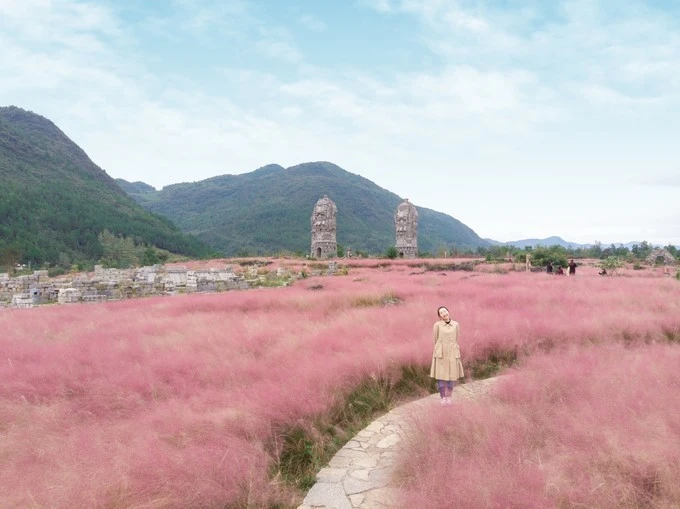
If you want to see pink in autumn, Youyang can also offer you a field of pink cloud grass, right at Dieshi Huagu. Every autumn, it's the most beautiful season for Dieshi Huagu in Youyang. From September to November each year is the best time to view pink cloud grass. Pink clouds drift over the green grass, dreamlike and fantastic.
Youyang Dieshi Huagu is the world's only scenic area combining a stacked stone art theme park with a Nuo culture exhibition park.
"Nuo" (傩) is composed of the character for "person" (亻) and "difficulty" (难), meaning: when people encounter "difficulties," they hope for relief and the blessing of spirits. Thus, our ancestors created imaginary deities and endowed them with supernatural powers to pray for disaster relief. Later, Emperor Li Shimin of the Tang Dynasty, after a "dream visit to the underworld," brought back the lively scene of singing in the Moon Palace to reality, creating the masked "Yang opera," which has been passed down to this day. "Masks" naturally became the link between humans and gods.
With the development of human civilization, this precious "Nuo culture" has been preserved, and it can be seen right here at Dieshi Huagu in Youyang, Chongqing.
The Dieshi Huagu area not only features the Twenty-Four Opera Gods sculptures but also the December God Pillar Stone Array, Stacked Stone Magic Pit, Canyon Zipline, Sanhuang Terrace, and Nuo Altar Ruins, among other stacked stone-themed landscapes.
Near the mysterious 30° north latitude, there are many particularly mysterious and interesting natural phenomena. The Youyang Dieshi Huagu Scenic Area happens to be located in this zone, with nearly 2 square kilometers of "flowers in stone." These stone flowers are fossils of seaweed from billions of years ago in the ocean, forming various flower patterns.
Blooming flowers on stone. They look like porcelain paintings on blue and white porcelain bowls, with flowers as lifelike as if carved by hand, astonishing viewers. To this day, they are still breathing, and the ubiquitous stone flowers are incredibly beautiful.
The stone flowers are hidden among the ubiquitous pink cloud grass. Pay attention to the scenery at your feet.
So beautiful, I love pink cloud grass so much, no matter how many photos I take, it's never enough.
In the scenic area, there is a giant stacked stone magic pit, which looks like a large pot from afar. Above the magic pit are four statues, like gods protecting this land, also representing "favorable weather." Legend has it that if you stand at the center of the magic pit and turn clockwise three times, the magic pit will take away all your worries and bad luck. In the pink cloud grass area, there is a huge natural canyon perfectly connected by a zipline bridge and two landscape suspension bridges. One of the landscape bridges features a naked-eye 3D effect, which is fun for photos.
Both sides of the bridge are full of stacked stones shaped like mushrooms. The suspension bridge is very stable to walk on, suitable for both the elderly and children.
The General Suspension Bridge is more challenging, for those with courage. I am one of those brave people.
Next to the zipline is a giant stone pillar made of stacked stones. It is majestic, imposing, and extraordinary. This is the fertility worship totem pillar of the Dieshi Huagu Ecological Park. In ancient times, clans and tribes needed to increase their population for production and warfare, reflecting the individual's subordination to social interests.
Don't think that the tour ends after seeing the pink cloud grass in the northern area. The Dieshi Huagu Scenic Area is actually composed of the Dieshi Huagu area and the Chinese Rural Art Park. After visiting the stacked stone and Nuo culture area in the north, you can take a scenic shuttle for a few minutes, or walk for about ten minutes, to the southern part to enjoy an artistic feast.
A string of phone numbers made from stacked firewood is the first interesting artwork that catches your eye: Who would have thought that a phone number could become art? The material chosen is "firewood," an essential heating material in rural areas. Splitting wood is a necessary rural labor. Nature and labor, light and warmth, create a real and simple rural scene. Mobile phones and communication break down the urban-rural barrier in information exchange.
A group of trees wearing bamboo hats: A bamboo hat is originally a rural tool for sun and rain protection. Each tree wears a bamboo hat belonging to it. Wearing a bamboo hat means carrying home. Trees are rooted in the homeland, and because of this bamboo hat, the hometown remains eternal in the artist's heart.
Stacked Stone Theater: Combining the relationships among mountains, water, scenery, and people, it forms a theater with local characteristics. This theater is not for watching performances, but here you can see the countryside and nature. The center of the theater is made of trampoline material, making it a favorite spot for children during family outings.
A train made of thousands of brooms...
Each piece combines the skills of local artisans with rural characteristics.
A "breathing" tree:
Every piece of art is also a photo spot.
This semi-enclosed circular structure uses local soil from Youyang as the wall material. Entering from outside and stepping on the cobblestones of "Flowing Time," the ground around you will shake, and from two speakers on the building, you can hear the sounds of nature from the "outside world."
The Dieshi Huagu Art Park features a total of 17 works of art, each worth savoring and appreciating slowly.
Address: 12 km south of Youyang County, Chongqing City
Transportation: You can first take a train from Chongqing main city to Youyang, then take a bus to the scenic area.
Self-driving route: Chongqing main city - Shiyu Expressway - Yinbai Expressway - Baomao Expressway
Activities: Gongtan Ancient Town
Gongtan Ancient Town is about a 2-hour drive from Youyang County, a town with a history of over 1,800 years. Therefore, it has become one of the must-visit spots on the return trip from Youyang.
The entire ancient town has a long history, with traces of time everywhere. It has no sense of modern commercialization and remains the same thousand-year-old ancient town it once was.
The bluestone-paved streets connecting the entire town are as smooth and dark as jade. Along the streets are antique wooden stilted buildings that overlook the cliffs. Beautifully legendary buildings like Jin Lou, Zhi Nu Lou, and Yuan Yang Lou stand in quiet harmony. The deep bluestone streets, paired with wooden stilted houses built along the river, are praised as "notes on the cliff."
The thin mist over the Wujiang River has just dissipated, and a small boat gently ripples on the green river... Gongtan Ancient Town is inseparable from the green of the Wujiang River.
As an important transit point for Sichuan salt in ancient times, every household in the ancient town still retains the tradition of hanging "salt lamps."
Coming here, you can truly feel the simplicity and hard work of this ancient and rustic little village.
There are also many inns in Gongtan Ancient Town, with prices around 200 yuan, relatively cheap but also simple and rustic.
Almost every inn, when you open a window or step onto the balcony, offers a view of the green Wujiang River and the lush green mountains—so beautiful...
In Gongtan, Ran is a major surname. The Ran Family Courtyard has a history of 300 years.
It is said that there are more than 150 fireproof walls, over 200 quadrangle courtyards, and more than 50 stilted buildings of various shapes. This is a well-preserved and fairly large-scale Ming and Qing dynasty architectural complex.
The Xiqin Guild Hall in the ancient town features evening performances of folk customs and traditions by local residents. Folk wind and percussion instruments and folk songs and dances derived from the labor of the Tujia people all convey the locals' praise for labor and pursuit of a better life.
If you choose to stay in Gongtan Ancient Town, it can also be a good way to relax and enjoy some peace. You can watch performances in the evening.
What I like most are the gaps between the stilted buildings in Gongtan Ancient Town—the green of the Wujiang River and the antiquity of the ancient town create a contrasting color palette.
In Gongtan, you can also taste Tujia cuisine, such as Tan fermented tofu, Gongtan mung bean noodles, Gongtan braised pork, buckwheat cakes, sip Yiju tea, and drink bitter buckwheat wine.
Or, in a small but beautiful café called "Sweet Zhi Zhi," you can have a cup of coffee and a bowl of sweet sago dew, enjoying the serenity and far-reaching tranquility.
The Wujiang River's mountains are handsome and majestic, its waters gentle and beautiful. The combination of movement and stillness is the essence of the Wujiang River Gallery.
Gongtan Ancient Town is located at the confluence of the Wujiang and Apeng Rivers, facing Yanhe County in Guizhou across the river. It is the starting point of Youyang's "Thousand-Mile Wujiang, Hundred-Mile Gallery." Since ancient times, it has been a transit point for goods along the Wujiang River basin and even the Yangtze River basin. It is currently the only well-preserved thousand-year-old ancient town in the world along a major river.
It is known as the "Core Scenic Area of the Wujiang Gallery and a Bright Pearl." From Gongtan Ancient Town, heading upstream along the Wujiang River, passing through Tuotuozi Gorge, Baiji Gorge, to Lizhi Gorge, it is the essence of the Wujiang Hundred-Mile Gallery, famous for its "strange mountains, unusual rocks, clear waters, dangerous shoals, covered bridges, towpaths, and hanging burials."
Pack a copy of "Zha Haijiao" (a Chongqing dialect term for a pickled pepper product) to take away, letting the spiciness of this ancient town spread in all directions.
Coming to Gongtan Ancient Town, you don't need to deliberately look for attractions. Just slowly enjoy the solitude that every corner offers you...
Gongtan Ancient Town has long been known as "Rich Gongtan." This is the "Old Street" depicted in the paintings of the famous traditional Chinese painter Wu Guanzhong. The culture of trackers, docks, salt merchants, and religion bears witness to Gongtan's 1,800-year history. The folk customs of the Tujia and Miao peoples, as well as their folk operas, songs, dances, and handicrafts, have been preserved. Wu Guanzhong praised Gongtan Ancient Town: "It is a Tang street, a Song city, and the home of grandparents."
The Qing dynasty poet Mei Ruoweng praised Gongtan Ancient Town and the Wujiang River Gallery in a poem: "The wonders of the landscape in Sichuan should rank this as number one."
The performance "Dreamlike Peach Blossom Spring," officially opened in Youyang on March 27, 2019, can only be seen at 8 PM on Fridays and Saturdays. It was temporarily closed during the 2020 National Day holiday but will continue to be performed in the future, so it's a reference for those reading travel notes later.
It is located in Youyang County, next to Youzhou Ancient City and Youyang Taohuayuan, very convenient.
It can accommodate 2,000 people per show.
The stage itself took three years to build. The stage area features fan-shaped water screens, fire-breathing special effects, and 360-degree wire rigging.
The show lasts over 70 minutes: segments like "Encountering the Peach Blossom Spring," "Pastoral Percussion," "Many Beauties in the Peach Blossom Spring," and "Love in the Peach Blossom Spring" focus on folk customs and songs and dances, showcasing the rich Tujia and Miao ethnic customs.
Using holographic projection and 3D projection effects, it transports the audience back to the earthly paradise.
"Dreamlike Peach Blossom Spring" is divided into nine acts: Escape and Discovery of the Peach Blossom Spring, Pastoral Percussion; Many Beauties in the Peach Blossom Spring, Mysterious Tima Song; Carnival Maogusi, Love in the Peach Blossom Spring, Crying Wedding Songs of the Peach Blossom Spring; Interactive Game "Wrapping Headscarves," and Dreamlike Peach Blossom Spring.
The performers wear authentic Tujia costumes, singing and dancing.
The leisurely and carefree life of the Peach Blossom Spring recreates the pure spiritual world that people seek. The water features and stilted buildings are all real, costing hundreds of millions, creating a very immersive scene.
Food: Authentic Yangyu Rice and Dingguan Rice
Since I've been to Youyang many times, I recommend two restaurants that locals love to eat at. [Authentic Yangyu Rice] Authentic Yangyu Rice has two branches in the county, very close to each other. I've eaten at both, and both are delicious.
It's a Tujia dish that locals in Youyang really enjoy. The most distinctive thing is not the dishes, but the rice — Authentic Yangyu Rice.
The pan-fried potato rice is so fragrant, and the complimentary small bowl of pickled cucumber is also a specialty. Each table gets one free serving, and you have to pay for extra.
Every dish goes well with rice. There's a wild vegetable called "duck foot" that is super tasty. I ate it for the first time. I also fell deeply in love with the chicken giblets and mung bean noodles, sour and spicy.
Every dish is so delicious!
Address 1: Room 1-22, 1st Floor, Building 3, Youzhou Tiancheng
Address 2: No. 25, Zhonglingshan Avenue West Road (opposite the Liskal Hotel, by the river, Youzhou Tiancheng riverbank)
[Dingguan Rice] In Youyang, I learned that there is a type of rice called Dingguan Rice. The brand we chose is Minglan. Locals love to eat here.
The charm of Dingguan Rice lies in its ability to retain flavor. And the restaurant's dining style is quite unique, like a northern kang but without taking off shoes.
Since Youyang is at the junction of Sichuan, Wuhan, and Hunan, its flavors merge the characteristics of all three regions. In winter, families gather in the kitchen around a fire pit with firewood or tree stumps for warmth, placing a tripod over it to cook Dingguan Rice. Some also hang the Dingguan pot above the stove's flame, close to the fire, to cook rice. Rice, corn, or sweet potatoes and potatoes mixed together and cooked are especially fragrant. The water for cooking Dingguan Rice is added all at once, and the rice is stirred in after the water boils, usually without draining the broth. When the broth is almost gone, the lid is put on, and it is simmered over low heat.
According to locals, the Dingguan Rice brand we chose is the most authentic one in Youyang at present, often packed, and sometimes you need to book in advance. This Dingguan Rice restaurant has no main hall; all rooms are fire-kang style private rooms. The rooms have straw stools and low tables. Then you order dishes and rice. The dishes are Tujia specialties, and the rice is firewood-cooked Dingguan Rice.
The deliciousness of Dingguan Rice is incomparable to modern pressure cooker or electric rice cooker rice. This is mainly because the Dingguan pot retains flavor exceptionally well. The pot is made from cast iron molds. A new pot becomes usable after being fired. Over time, the inner wall becomes clean and smooth from friction with food and the iron ladle. The stewed rice does not lose its flavor, and cooked rice left in the pot for days does not spoil even in hot summer days. The taste also comes from the different cooking method: slow firewood roasting ensures even heating. Combined with freshly harvested rice from the fields, everything is original and natural; it's hard not to produce delicious food.
Oil-residue vegetable tofu, sour steamed pork, coriander minced beef, and stuffed peppers are typical Tujia dishes. I think the vegetable tofu is great with chili sauce. Maybe some people don't like it, but I find it has no strange taste or sourness; the red chili sauce is very fragrant.
The waitstaff frequently comes around with the Dingguan pot asking if you want more rice, very enthusiastic.
There is also a special stir-fried pumpkin. For the first time, I ate pumpkin sliced so thinly that I didn't even realize it was pumpkin—so crispy. There are also pickled vegetables under the crispy rice crust. The stir-fried potato slices are so delicious that I think I finished that whole plate myself.
Address: Near Longwan International, Taohuayuan Avenue North Road, Taohuayuan Town.


