Exploring the Nine Scenes of Jiulong, Encountering the Exclusive Memories of Jiulongpo
Yearning for the freedom of poetry and distant lands, yet overlooking the warmth of one's homeland.
What is it like to travel around the heart of the city you live in?
This time I went to the 'Nine Scenes of Jiulong' in Jiulongpo District,
to experience Chongqing's regional scenery from different perspectives.
Chongqing is a city of mountains and rivers, rich in tourism resources and profound in culture. Jiulongpo District, located in the southwestern part of Chongqing, is an important part of the Yuzhong Peninsula embraced by the Yangtze and Jialing Rivers.
This year, Jiulongpo selected nine most representative natural, urban, and cultural landscape landmarks, collectively known as the 'Nine Scenes of Jiulong'. This time I will visit each of the Nine Scenes to experience the exclusive memories of Jiulongpo.
Tips: This itinerary takes a total of 3 days. Since some places are far from the city center, it is recommended to drive starting from the second day.
Specific itinerary:
Morning: Jiulongpo - Animal Paradise
Afternoon: Jiulongpo - Museum Cave World - Wanxiang Commercial Hub
Morning: Jiulongpo - Great City Zhongliang - Huayan Zen Forest
Afternoon: Jiulongpo - Art Peninsula
Morning: Jiulongpo - Hero's Former Residence - Xipeng Aluminum Capital
Afternoon: Jiulongpo - Zouma Ancient Town
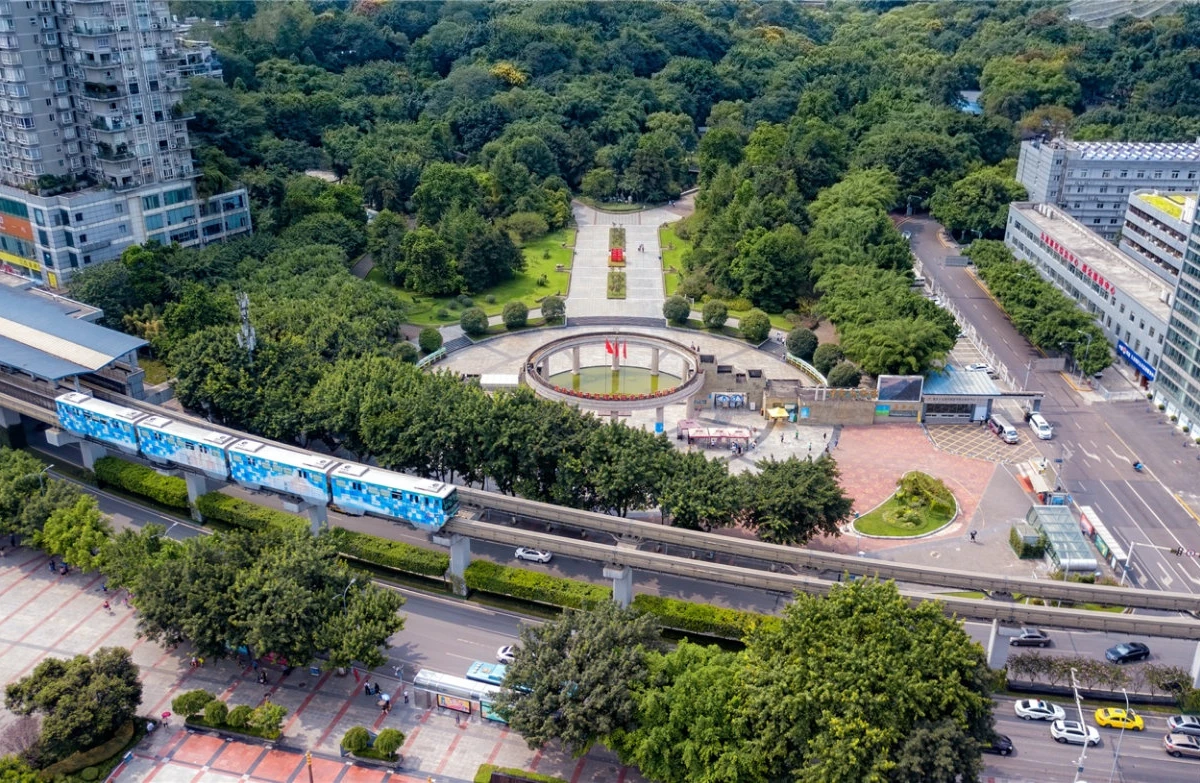
Animal Paradise · Exploring the 'Urban Oasis' in the City Center
Ticket: 25 yuan
Opening hours: 7:00–18:00
Transportation:
For children, the zoo might be the first gateway to understanding the world.
It allows children eager to learn about the world to fall in love with animals while also fostering their awareness of protecting and studying animals.
Chongqing locals have a special affection for this zoo. Why?
Because this zoo has accompanied citizens for a full 65 years, preserving the childhood memories of generations of Chongqing people. It stands quietly in the city center, with memories filling the mountain city.
In fact, over a lifetime, the things we remember and the words we want to say gradually become blurred with time. But the wild running and frolicking of childhood, a sort of 'naive bravery', the warm hands we held, the boldness and joy of first discovering the world—these are traces we never want to erase.
For us as children, the zoo was exactly such an existence.
I arrived at Chongqing Zoo early in the morning. Although the gate faces the street, it was unexpectedly quiet. It is truly rare to carve out such a pure land from the bustling city for animals to inhabit.
As soon as I entered the park, I could feel the lush vegetation.
Chongqing Zoo was formerly known as 'West District Park', so it's no surprise that there are many plants and towering ancient trees. There is also a more endearing name for it—'Xixi Park', reportedly due to the Chongqing accent. Calling it Xixi Park is more natural than Xiqu Park, so people tacitly and quietly changed its name.
Chongqing Zoo is an 'urban oasis' in the city center. For animals to thrive in such a comfortable environment is indeed a rare paradise!
We visited at the end of summer, and we could still hear some cicadas chirping as we walked through.
The zoo is well-organized, with more than 20 animal houses, housing over 260 species and more than 4,000 animals. Here you can see rare species such as giant pandas, red pandas, takins, and argali. The various exhibition halls are not far apart but do not disturb each other, maintaining a peaceful atmosphere. Each animal enjoys its own territory. Pandas leisurely eat bamboo, roll on the grass, or rub against tree trunks to relieve itching, amusing themselves.
The 'Double Happiness' twin giant panda pairs, along with Xinxing, the world's oldest captive-bred giant panda who is now 38 years old, are the big stars of the zoo. Many tourists come specifically to see them playing.
To provide a better living environment for giant pandas, the entire panda house was built along the mountain terrain, restoring the wild environment as much as possible. At the same time, artificial streams, rocky caves, and other scenes were created. During the day, pandas can play freely outdoors, and at night, they return to artificial caves to rest.
According to staff, in April and May each year, some 'uninvited new residents'—egrets—are attracted to the zoo, allowing visitors to enjoy the unique harmonious scene of people and egrets.
I could see some citizens walking, practicing tai chi, and exercising here, treating this place as a health retreat.
The entire zoo is spacious and quiet, suitable for occasional outings to relax. In January 2009, the National Tourism Administration approved Chongqing Zoo as a national 4A-level tourist attraction.
Ticket: 50 yuan
Opening hours: 9:00–17:30
1. Rail transit: Take Rail Transit Line 2, get off at Xiejiawan (Exit B).
2. Bus: Routes 471, 207, 362, 148, 419.
Chongqing is a mountain city, and during the War of Resistance against Japan, many air-raid shelters were built here. Jiulongpo District utilized these shelters to establish the Jianchuan Museum. But in the past, I only heard the elderly talk about it and never visited. So this time I planned to go to Chongqing Jianchuan Museum to experience Chongqing's distinctive anti-war culture.
Climbing a long flight of steps, you can see the theme sculpture of Chongqing Jianchuan Museum—'Braving the Enemy's Gunfire'. It depicts a soldier standing tall, holding a machine gun, with a firm and open gaze. This sculpture, located next to the Egongyan Yangtze River Bridge, is the most iconic building, symbolizing the revolutionary predecessors' heroic spirit of resistance and their determination that the revolution would ultimately win.
Entering through the gate, I found a hidden world. This museum is built from 32 air-raid shelters, divided into 9 themed halls and 1 temporary exhibition hall. They are: the Weapon Development History Museum, the First Arsenal of the Ordnance Department (Hanyang Arsenal) Site Museum, the Anti-Japanese War Cultural Relics Museum, the Chongqing Story Museum, the Folk Prayer Culture Museum, the Chinese Double Happiness Culture Museum, the Ticket Life Museum, the Traditional Chinese Medicine Culture Museum, the Chongqing Civil Air Defense History Exhibition Hall, and the New China Seventy Years of Folk Memory Museum. Inside, weapons and artillery vehicles from the Anti-Japanese War era are scattered, along with daily necessities from the 1950s and 1960s, combining Chongqing's distinctive anti-war culture with a touch of everyday life.
There are well-preserved cave rock walls. Walking in the caves, I touched the uneven rock walls and felt a slight coolness from my fingertips. It is hard to imagine how much life these caves bore in the turbulent years of history.
According to staff, the museum exhibits over 40,000 cultural relics, including 116 national first-class relics. The relics mainly include modern historical materials and items from the Anti-Japanese War, military industry, folk customs, and the Red Era, covering a century of Chinese history from the Xinhai Revolution to the Reform and Opening-up.
Among them, what caught my eye most was this flag with the character 'Death'.
This flag was given by Wang Zhicheng of An County, Sichuan, to his son when he volunteered to fight the enemy, to encourage him to defend the country. 'I do not want you to fulfill filial piety by my side, only hope you will be loyal to the nation.' This simple sentence expresses the patriotic heart of an ordinary citizen in national crisis. In fact, it is not just one person's wish and will, but also represents the fearless spirit of many soldiers during the Anti-Japanese War who put the fate of the country first.
The Chongqing Jianchuan Museum embodies the museum's founding purpose: 'Collect war for peace; collect lessons for the future; collect disasters for tranquility; collect folk customs for inheritance.'
Coming to Chongqing Jianchuan Museum feels like a time travel through the air-raid shelters. The entrance and exit of the shelters seem to represent two eras—one of hardship and suffering during the Anti-Japanese War, and the other of peace and freedom created by our predecessors. The meaning of the museum is to educate people to reflect on past hardships and cherish the present.
Wanxiang Commercial Hub · Searching for the 'Jiulong Seal' Amidst Bright Lights
After visiting Jianchuan Museum, I felt as if I had undergone a baptism of war. To change my mood, I decided to stroll around Wanxiang Commercial Hub. Wanxiang Commercial Hub is a commercial complex integrating Chongqing's Yangjiaping Business Circle and The Mixc, a new internet-famous check-in spot in Chongqing.
In the Yangjiaping Business Circle, there is an iconic building—'Jiulong Gate'.
According to the 'San Qin Ji', 'Dragon Gate Mountain is on the east bank of the River... Every late spring, yellow carps swim upstream, and those that succeed transform into dragons.' The dragon gate embodies people's wish for rapid advancement and a change of fortune.
The four pillars of Jiulong Gate, rising straight from the ground, are all shaped like the character '门' (gate). Chief designer Zhang Yeqing endowed it with deeper connotations—Jiulongpo District opens its innovation gate, opening gate, hope gate, and future gate to guests from all directions.
Rail Transit Line 2 passes through 'Jiulong Gate', carrying the good wishes of Jiulongpo's prosperous development, making it Chongqing's unique 'Jiulong Seal'.
The Mixc gathers international first-line luxury brands like HERMES, GUCCI, PRADA, DIOR, and fast-moving consumer goods brands, encompassing everything and satisfying the shopping needs of people of all ages.
For foodies, visiting The Mixc is a good choice. There are local dishes representing Chongqing's 'spicy' characteristics, such as Shouqi Beef, Changgaokuan Old Hotpot, Xu Dingsheng Home-style Cuisine, as well as fashionable international cuisines like Western food, Japanese cuisine, and Korean BBQ. If you're lucky, you might catch a night market, enjoy a band performance, and pick up some interesting trinkets to take home.
Wanxiang Commercial Hub is not only full of fashion but also has its unique inclusiveness and open-mindedness. All your passions and persistence can shine in this area.
Great City Zhongliang · Encountering Cloud Ridge Scenery, Feeling the Pulse of Mountains and Rivers
In early autumn, it's perfect for ascending heights to look far into the distance. I had long heard about the layered peaks and fresh air of the Zhongliang Mountain Range, so I invited a friend to go hiking.
We set out early, leaving at 7:30 a.m., and it took about an hour by car from the main city.
After leaving the main urban area, the scenery gradually opened up. The distant mountains were hazy, shrouded in a light veil, flickering in the misty clouds, sometimes near, sometimes far, elusive.
Away from the towering buildings and heavy traffic, I could finally embrace nature—it had been a long time.
Although autumn had arrived, the mountain forest was still lush and green. Autumn in the south always comes later than in the north.
The Zhongliang Mountain Range is located in the western part of Chongqing's main city, belonging to the remnants of the Huaying Mountains. It spans a wide area, crossing six districts: Yubei, Beibei, Shapingba, Jiulongpo, Dadukou, and Jiangjin, stretching about 100 kilometers north-south, with an altitude of 400–1,000 meters.
As Chongqing's 'green lung', it has over 90% forest coverage, gathering 10 unique natural and cultural resources such as strange peaks, caves, springs, temples, and legends. Among the 'Nine Scenes of Jiulong', it is the only natural scenery landmark. We visited one section—the Zhongliang Yunling Forest Park.
Zhongliang Yunling Forest Park was formerly known as Jiandaoshan Forest Park. Climbing along the hiking trail, you can see scenic green peaks like Yunfeng Mountain, Chaqi Mountain, and Shamao Mountain.
The hiking trail has over 1,000 steps, taking about half an hour to reach the top. The mountain is covered with dense, lush forests, and occasionally you can hear the melodious and ethereal chirping of birds.
It is learned that the Jiulongpo District government plans to use existing resources such as Zhongliang Yunfeng, mine caves, hot springs, and mineral springs to build nine sub-projects, including Zhongliang Mountain Earth Center Jiulong, Mining Time City, Zhongliang Mountain Flower Expo Park, and Zhongliang Mountain International Health City (International Artists' Village), to create a national 5A scenic area called 'Great City Zhongliang · Famous Mountain Under Heaven', making it a Jiulongpo business card for 'City of Mountains and Rivers, Land of Beauty'.
Standing on the mountaintop, you can take in the panoramic view of Jiulongpo District, with the Jialing River winding like a ribbon, and the city appearing particularly small in the embrace of the mountains.
The Zhongliang Mountain Range is majestic and towering, standing between heaven and earth, inspiring all things.
Hiking and looking far here is an excellent choice. 'Long trapped in a cage, I return to nature.'
Huayan Zen Forest · Returning to a Peaceful Mind
Opening hours: 8:00–17:00
Vegetarian restaurant hours:
Monday to Friday: 9:00–20:30; Saturday to Sunday: 8:30–19:30
Average consumption: 67 yuan/person
'In early morning I enter the ancient temple, the first sun shines on the high forest. A bamboo path leads to a secluded place, the meditation room is deep amid flowers. Mountain light delights the birds, the pool's shadow clears the mind. All sounds are silent here, only the bell and chime remain.'
After descending the mountain, I felt refreshed and decided to visit Huayan Zen Forest. It is said there is a vegetarian restaurant in the temple, perfect for lunch. It only takes about 15 minutes by car from here.
Arriving at Huayan Tourist Area, I stepped into a Buddhist sanctuary. My mind became much calmer, as if the temple gate separated the world's greed, anger, ignorance, and suffering. It was drizzling that day. The temple had carved beams and painted rafters, lotus leaves in the pond, and the rain silently moistened everything, with only the long sound of bells.
Huayan Tourist Area, located in Jiulongpo District, Chongqing, has convenient transportation and a long history. It is known as 'Bashan Spiritual Land' and is a municipal-level cultural relic protection unit and Chongqing's lotus production and exhibition base. The entire tourist area is led by three major architectural complexes: the Mahavira Hall, the Reception Hall, and Huayan Cave, integrating temple, lake, garden, forest, mountain, and cave. The scenic area not only has ancient temples, pagodas, stone carvings, sculptures, and ancient bridges, but also cultural landscapes like 'Heavenly Pool Night Moon', 'Ten Thousand Pines Whispering', and 'Distant Temple Bell'. The whole area is lush with pines and bamboos, very serene. Throughout history, many literati have come here, either for antiquing or to visit monks and discuss Zen, leaving behind hundreds of poems, couplets, and inscriptions.
The outdoor giant golden Buddha—a gold statue of Shakyamuni Buddha—stands peacefully in the center of the square, with a total height of 20.8 meters. He compassionately watches over all beings. A moment on the mountain, a hundred years in the human world. This is a holy place for prayer and blessings, with flourishing incense and many believers. Every New Year's Day, male and female devotees come in an endless stream.
After paying homage to the Buddha, we came to the Seven-Step Lotus Pond. Here are planted rare varieties such as Space Lotus No. 36 and Meitai Guanyin. August is said to be the best season for lotus viewing. You can see lotus flowers nestled quietly against round green lotus leaves, standing gracefully, unstained by dust. Many tourists and photography enthusiasts stop here to enjoy the lingering fragrance in the air. Cultivating lotuses in a Buddhist sanctuary seems to guide people to understand a peaceful mind.
At noon, we dined at the temple's vegetarian restaurant, tasting dishes like crispy rice, red bean soup, and 'Spring River Warmth' (a vegetarian dish). They were refreshing, light, sweet, and delicious.
The entire temple environment is spacious and serene, allowing visitors to slow down fully and experience the tranquility of returning.
Hearing the name 'Art Peninsula', you can probably feel that this place has a strong artistic atmosphere.
Painting freely on a 1.25-kilometer-long building complex, splashing creativity—is it only artists who dare to be so 'willful'?
Chongqing Art Park is part of the Yangtze River Cultural and Art Bay Area. It has the world's largest graffiti street, is the birthplace of Sichuan Fine Arts Institute, and is China's contemporary art holy land and original base. Now, with the Sichuan Fine Arts Institute Huangjueping campus as the core, the power plant industrial culture area as the chain, and the Jiulong Riverside ecological area as the pole, they are creating a borderless Chongqing Art Park for public participation.
The Huangjueping Graffiti Art Street starts from the Huangjueping Railway Hospital and ends at the 501 Art Warehouse, with a total length of 1.25 kilometers and a total area of about 50,000 square meters. It is the world's largest group of graffiti artworks, becoming another business card and new landmark of Chongqing as a fashion capital.
When we arrived, we saw many young people checking in and taking photos here. Every painting on the wall expresses the painters' sincerity and love for this city.
It is said that this graffiti art street project was the idea of Luo Zhongli, president of Sichuan Fine Arts Institute, and was jointly created by the Jiulongpo District Government and President Luo. The entire graffiti project involved over 800 workers, students, and artists, using 12,500 kilograms of various paints and nearly 30,000 brushes and rollers. After 150 days of meticulous work, a total of 37 buildings were graffiti-painted, creating a unique artistic atmosphere belonging to Huangjueping.
After the completion of Huangjueping Graffiti Art Street, the entire block's appearance changed significantly, also creating a good environment for the development of cultural and creative industries centered on Sichuan Fine Arts Institute. Art festivals are often held here, making it lively.
After spending some time at Huangjueping Graffiti Art Street, we also visited the nearby Sichuan Fine Arts Institute and the Traffic Teahouse. The vibrant and lively graffiti street stood in stark contrast to the quiet and peaceful teahouse, and the combination of dynamic and static better reflects the multifaceted nature of the city.
Your connection with this city is not just a one-sided encounter.
Hero's Former Residence · A Red Journey to Rediscover the Original Aspiration
Opening hours: 9:00–17:30
Note: Closed on Mondays.
Chongqing is a heroic city, a place of origin for red culture. Behind this mountain city lies an admirable red revolutionary history, and it also nurtured generations of revolutionary forebears and great figures of the era.
Today, we visited the hometown of the revolutionary predecessor Zhou Gongzhi.
Zhou Gongzhi was a pioneer of the Chinese communist movement. He was arrested for participating in the revolution. Despite the enemy's use of both soft and hard tactics, threats and bribes, he firmly guarded the Party's secrets and preferred death to surrender. In 1928, Zhou Gongzhi, together with Fu Lie, Cheng Minghai, Huang Zhongyuan, and nine other communists, was heroically executed at the Shazui execution ground by the Chaotianmen dock on the riverside in Chongqing. Zhou Gongzhi was 29 years old that year.
His former residence is located in Zhoujia Dawan, Doushita Village, Tongguanyi Town, Jiulongpo District. It is a quadrangle courtyard facing south, covering an area of over 1,100 square meters, consisting of three courtyards: central, eastern, and western, named Chuxin Hall (Initial Aspiration Hall), Zhongxin Hall (Loyalty Hall), and Chixin Hall (Red Heart Hall), with green tiles and white walls, dignified and grand. Surrounding the courtyard are orange groves and lotus ponds, with the entire courtyard nestled among green hills, secluded and peaceful.
The former residence displays Zhou Gongzhi's glorious deeds throughout his life. Through an in-depth analysis of history, it reminds people not to forget the hardships of founding the nation and to always remember their mission.
A short two-hour visit cannot fully recount the lives of the forebears.
All the freedom and security that this era bestows upon us come from others carrying the burden for us. This red journey gave us a deeper understanding of staying true to our mission and not forgetting our original aspiration.
Xipeng Aluminum Capital · One Aluminum Drives a City
Xipeng Aluminum Capital may be unfamiliar to tourists, but it holds a very important position in the economic strategic deployment of Jiulongpo and even the entire Chongqing.
Xipeng Aluminum Capital is a provincial-level economic and technological development zone approved by the National Development and Reform Commission. It is among the top ten industrial parks and ten best characteristic industrial parks in Chongqing. The park is adjacent to the golden waterway of the Yangtze River, located at the junction of the Belt and Road Initiative and the Yangtze River Economic Belt, and is an important fulcrum of the Chengdu-Chongqing city cluster. It is jointly built by the Chongqing Municipal Government and Chinalco as the 'Capital of China's Aluminum Processing'.
The total planned area of the park is 65 square kilometers. Relying on good transportation advantages and industrial city foundation, the park vigorously promotes the development of non-ferrous metal processing, new materials, intelligent and high-end equipment, trade and logistics industries. It has initially built multiple 'parks within parks' industrial clusters such as the smelting and casting industrial park, transportation aluminum industrial park, and electronic industrial park.
Among them, the representative enterprise of Xipeng Aluminum Capital—Chinalco High-end Manufacturing Co., Ltd.—is the largest and most complete aluminum processing cluster in the industrial chain, which can be called Chongqing's industrial business card. Its subsidiary, Southwest Aluminum Group, provides high-end aluminum materials for aerospace series such as 'Long March', 'Tiangong', 'Shenzhou', 'Chang'e', and national heavy equipment like the Tianyan telescope and the domestic large aircraft. By 2025, it aims to achieve the 'double thousand billion' target in output value and market value.
When we arrived, we could only see the strict exterior of the park, with neatly lined trees on both sides and wide unobstructed roads. Since it is an industrial park, it was inconvenient to visit inside the companies, so we let you feel the grandeur of the industrial park through a few aerial shots.
Whenever I arrive at an ancient town, I feel a sense of nostalgia.
Maybe it's because of the deep influence of 'Rainy Alley'—whenever I come to an ancient town, I always think of the long, quiet blue-stone paths and the girl holding an oil-paper umbrella.
When we arrived at Zouma Ancient Town, it was exactly noon. After dining at a local restaurant, we also visited a small teahouse. Occasionally, pedestrians passed by, but everything was quiet. A few doors and windows of the stilted buildings were open, and I could vaguely see figures moving inside. Unlike the big city, the pace of the ancient town is very slow, perfect for zoning out and relaxing.
According to the shop owner, Zouma Ancient Town was very prosperous in ancient times. It was once a must-pass place on the route from Chongqing to Chengdu, with a constant stream of merchants and travelers, making it very lively. These passersby brought all kinds of news to Zouma Ancient Town, leading to the creation of countless folk songs, stories, and unofficial historical anecdotes, passed down through generations, forming a unique national intangible cultural heritage—Zouma Stories. This gave rise to the folk saying, 'Whether you know the ropes or not, it's hard to cross Zouma Ridge.'
Zouma Ancient Town has a long history. Tracing its origins, it dates back to the Han Dynasty and began to flourish in the mid-Ming Dynasty. It belongs to Ba County in the north, borders Bishan in the west, and connects to Jiangjin in the south, earning the title 'One Foot in Three Counties'. The ancient town retains relics such as ancient post road sites, old streets, a blacksmith's shop, old teahouses, and an ancient opera stage from the Ming and Qing dynasties. In 2008, Zouma Ancient Town was designated as the fourth batch of 'Historical and Cultural Famous Towns' by the State Council.
There are two opera stages in the town, one in front of Guanwu Temple and the other inside Yuwang Temple. During festivals and temple fairs, opera troupes perform. Famous Sichuan opera artists like Wu Xiaolei and Chen Shufang have performed here, attracting villagers from all around, with long and short operas in full swing. This earned Zouma Ancient Town the title of 'Hometown of Chinese Quyi'.
Nowadays, although the ancient town has shed its worldly glamour, it retains the most pristine tranquility. Drinking tea, watching opera, and listening to stories in the ancient town has a unique elegance.
Chongqing is a 'magical city', with beautiful landscapes and charming scenery. Its unique mountain city culture is fascinating.
As Chongqing's 'mountain city industry pulse', Jiulongpo not only has the title of 'River City Art Island' but also forges the humanistic spirit of 'Nine Hearts United as One, Dragons Roaming the World'. It is a thriving base for Chongqing's cultural and creative industries.
The 'Nine Scenes of Jiulong' possess the unique charm of the mountain city and are the most distinctive culture of Jiulongpo.
Welcome to visit the 'Nine Scenes of Jiulong' to experience a different Jiulongpo and gain a brand-new cultural tourism experience.


