Exploring the 'Nine Scenes of Jiulong' - A Comprehensive Journey into Jiulongpo's Unique Imprints
Exploring the 'Nine Scenes of Jiulong' - A Comprehensive Journey into Jiulongpo's Unique Imprints
Every city is like a thick encyclopedia, encompassing everything, with its own stories slowly settling over time, whether ancient or vibrant.
Jiulongpo District is one of the core urban districts of Chongqing, located in the southwestern part of the city. It is an important part of the Yuzhong Peninsula, embraced by the Yangtze and Jialing Rivers. The district boasts rich tourism resources, a long-standing historical and cultural heritage, and a fertile artistic soil.
Every city has its own unique imprints, past or present, and Jiulongpo is no exception. Recently, Jiulongpo District selected nine of its most representative landscapes and landmarks, covering both natural and human-made attractions, forming a tourism boutique that represents the characteristics of Jiulongpo – the 'Nine Scenes of Jiulong.' These precious imprints encapsulate the development trajectory of Jiulongpo's history and human ecology, and have become the district's external business card and symbolic image.
In early autumn, the Zhongliang Mountains are lush and green, serving as a natural barrier for Chongqing's main urban area. They stretch approximately 100 kilometers from north to south and are about 2-7 kilometers wide.
As the 'green lungs' of Chongqing, the Zhongliang Mountains span across six districts: Yubei, Beibei, Shapingba, Jiulongpo, Dadukou, and Jiangjin. The mountain range is undulating and majestic, resembling a 'green spine' running through Jiulongpo from north to south, supporting the ecological axis of Chongqing's main urban area. With over 90% forest coverage, it gathers ten unique natural and cultural resources, including strange peaks, caves, springs, temples, and legends. The landscape of mountains, water, forests, fields, lakes, grasses, and springs composes a green symphony. Strolling through it, one feels relaxed and immersed.
The Zhongliang Mountains have an altitude of about 400-1000 meters, not too high, making them an ideal place for citizens to relax, entertain, and nurture health. Due to their vast area, there are many scenic spots to visit from different angles. One great place for hiking and outings is the Zhongliang Yunling Forest Park.
Originally named Jiandao Mountain Forest Park, the Zhongliang Yunling Forest Park is a continuous and undulating area perfect for climbing high and looking far, hiking, and outings. Along the hiking trails, you can gradually enjoy the unfolding beautiful scenery, which is refreshing and exhilarating.
On the Zhongliang Mountains, you can overlook Jiulongpo in the distance. Climbing high and looking far always excites. The rivers and mountains are picturesque, making it impossible not to love them!
It is worth mentioning that in the future, the Zhongliang Mountains will launch a journey through the earth's core. With the goal of becoming the 'Great City Zhongliang, World-Famous Mountain' and the global largest urban 'twin' mine cave as the core attraction, the abandoned Zhongliang coal mine tunnels, which total 67 kilometers in length, have 9 levels, and reach 20 meters below sea level underground, will be developed into a model of urban ecological civilization and a well-known domestic tourist destination, making it a 'Land of Beautiful Rivers and Mountains' in Jiulongpo.
'Chongqing Art Park' is a place full of artistic atmosphere. As part of the Yangtze River Art and Culture Bay Area, it boasts the world's largest graffiti street and is the birthplace of Sichuan Fine Arts Institute, a contemporary art sanctuary and original base in China. In addition, there are popular spots like the Transportation Teahouse, Jungo Bookstore, and Himalaya Bookstore.
From the moment you step into the campus of Sichuan Fine Arts Institute, it feels as if the interesting sculptures and graffiti, every corner of the wall, every stretch of road, and even every fallen leaf shine with their unique artistic charm. Any view you capture is a masterpiece of composition.
Huangjueping is located by the Yangtze River, amidst the old neighborhoods shaded by ficus virens. The rows of seemingly ordinary residential buildings, after years of artistic influence, collide the simple architecture with bold artistic elements, exuding a unique literary and artistic temperament.
Long ago, students from Sichuan Fine Arts Institute added unique outer layers to the streets and buildings, giving birth to Graffiti Street. It breaks the rules of space, blending art into an open living space, making it easy to 'fall into' a unique artistic atmosphere. The old street radiates unprecedented youth and vitality through art and creativity.
The graffiti in Huangjueping is a pure artistic product, already becoming a hot spot for tourists from all over the country to check in.
Chongqing Art Park embodies the residents' pursuit of art and understanding of life. Here, one can encounter artists with a turn and have a new artistic experience with a single stop.
Now, with the Huangjueping campus of Sichuan Fine Arts Institute as the core, the power plant industrial cultural area as the chain, and the Jiulong Riverside ecological area as the pole, a borderless Chongqing Art Park is being created for extensive public participation.
A 'city' changes a city. The MixC Chongqing, integrated with the Yangjiaping commercial area, is the largest MixC in western China and one of only three national five-star shopping centers in Chongqing, propelling the city's commercial civilization forward by leaps and bounds.
At MixC, you can experience a one-stop service of eating, drinking, and entertainment. It includes international flagship stores, retail boutiques, high-end supermarkets, various specialty cuisines, the colorful MixC ice rink, and a top-tier cinema, among many other entertainment and leisure facilities.
In short, MixC can meet all your needs. If you are a shopaholic and love gourmet meals, MixC is definitely your top choice.
Besides local cuisines, MixC is also a place for luxury shopping. Many high-end brands have settled in MixC, some of which have entered Chongqing for the first time.
You can enjoy authentic Sichuan dishes or snacks, or choose high-end Western food, Japanese cuisine, etc. One must-mention is the world-class internet-famous coffee shop that only sells 'coffee' – %Arabica Coffee, which is also the first %Arabica in Chongqing.
Located at the top of the staircase between the sunken squares on the first floor of MixC, the coffee shop cleverly connects the broken stairs, blending with the outdoor environment to become a coffee space resembling one on a hillside, attracting many visitors to take photos.
Apart from MixC, the Yangjiaping commercial area is one of Chongqing's five major commercial circles, located in the core area of Yangjiaping in Jiulongpo. It is also a high-quality choice for eating, drinking, and entertainment. After renovation and upgrades, landmarks like the Nine Dragons Gate and the Nine Dragons Seal have become new check-in spots and iconic buildings of the Yangjiaping commercial area.
As soon as the 'Nine Dragons Gate' was unveiled, it became a new landmark for netizens to check in. The four pillars of the Nine Dragons Gate are fiery red, and the treasure basin inside features dragons and phoenixes auspiciously. Viewed from the sky, the pattern of the Nine Dragons Gate is formed by two dragons interacting, with a strong Chinese style. The overall design is grand, and the pattern is auspicious, making it another urban logo for Jiulongpo. Chongqing Metro Line 2 passes through the 'Nine Dragons Gate,' creating a unique scene in Chongqing.
**Animal Paradise: Chongqing Zoo - Reliving Happy Childhood Memories at the Animal Paradise** (Ticket price: 25 yuan)
As one of the new Twelve Scenes of Chongqing, Chongqing Zoo, formerly known as 'West District Park,' is the joy of generations of Chongqing people and is filled with memories.
With a history of 65 years, the zoo carries the childhood memories of several generations. Almost every Chongqing resident has a photo taken with the zoo. Today, it remains the most beloved zoo in Chongqing's main urban area.
Chongqing Zoo is the only zoo in the country that simultaneously exhibits both the golden cat and the clouded leopard. Besides, we can see popular animals like pandas, hippos, rhinoceroses, and giraffes. Giant pandas have always been the crowd favorites. In memory, the giant panda is the treasure of the zoo. Many parents bring their children here to see the national treasure panda up close. The zoo houses two pairs of twin pandas born on the same day – 'Double Happiness'; the world's longest-living artificially bred giant panda, 'Xinxing,' just celebrated its 38th birthday (equivalent to over 110 human years) this June.
At Chongqing Zoo, you can not only see various animals but also awaken some beautiful childhood memories. The place where the Tibetan brown bears live has never changed; the thick moss on the walls witnesses the passage of time.
Children who once said they wanted to go to 'West District Park' when young are now bringing their own children to play, their little hands still clutching the classic zoo three-piece: ice cream, popcorn, and sausages.
**Museum Cave: Chongqing Jianchuan Museum Cluster - Returning to Fiery Times at Jianchuan Museum** (Ticket price: 50 yuan, 44 yuan if bought online!)
Chongqing is a mountain city, also a city full of air-raid shelters. The elderly often recall that 'Chongqing's air-raid shelters made great contributions to the War of Resistance Against Japan.' Chongqing's air-raid shelters are a unique product of history. Today, the unique 'air-raid shelter culture' has become a unique landscape in Chongqing.
Speaking of air-raid shelters, we must mention the Chongqing Jianchuan Museum. Jianchuan museums are found in many places across China, but only the Chongqing Jianchuan Museum is built inside an air-raid shelter. This earned it the reputation as the country's first cave museum about the War of Resistance.
The Chongqing Jianchuan Museum is located in a system of ditches and tunnels. There are 32 air-raid shelters left over from the war. After the war, this was once the location of the Chongqing Construction Factory. These shelters were used as workshops. After the factory moved, these shelters lay idle until Fan Jianchuan transformed them into the unique Chongqing Jianchuan Museum.
Visiting the Jianchuan Museum first makes you feel like traveling back in time. It showcases the development history of China's industry, the history of the War of Resistance, and each step of development after the founding of New China in a well-organized manner.
Even if you can't find a sense of familiarity from distant eras, you are sure to find warm memories from some exhibition hall or artifact in the museum.
Half a life in military service, half a life for the country—layers of bright red handprints overlap. The veterans of the War of Resistance are old, but it was their hands that wielded big knives and spears, withstanding the fierce Japanese invaders and lifting the future of the entire Chinese nation.
**Hero's Former Residence: Zhou Gongzhi's Former Residence - Visiting the Hero's Former Residence to Find the Impressions of the Times**
Compared to the heaviness of Zhazidong and Baigongguan, I prefer the tranquility of Zhou Gongzhi's former residence. It was where Zhou Gongzhi lived before his death and also the site where the Sichuan Provincial Committee of the Communist Party of China held an enlarged meeting and was established.
Zhou Gongzhi's former residence is located in the Zhou Family Courtyard, Doushita Village, Tongguanyi Town, Jiulongpo District, Chongqing, about 50 kilometers from the main city. The surrounding environment is beautiful, with abundant greenery and a lotus pond, creating a paradise-like scene.
Zhou Gongzhi was a pioneer of the Chinese communist movement. In 1928, he was arrested for participating in the 'Founding Conference of the Ba County Party Committee of the CPC.' Under the enemy's temptation and coercion, he remained unyielding and died a heroic death at the age of 29.
Walking on the bluestone path, the stones make a distinctive echo, firm and powerful. Although time has passed on these stones for over a hundred years, the sound they make is like the owner of the house, leaving a brilliant mark in the long river of time with a 'forceful' life.
Arriving at the Original Heart Hall, the first thing you see is the bright red party flag and the words 'Original Heart, Mission, Struggle' standing at the main entrance. Inside the former residence, Zhou Gongzhi's glorious life story is displayed, promoting patriotism. In the middle room on the east side, there is a wooden lecture desk and benches that Zhou Gongzhi used to teach local children, as well as a stone statue of him. Also on display are the documents from the first congress of the Sichuan Provincial Committee of the CPC and Zhou Gongzhi's life story.
From the perspective of patriotic education, the atmosphere here is rich in educational significance. Through understanding history and interpreting events, we then remember the martyrs, keep the mission in mind, and never forget the original intention. This is the core value of red tourism today. Although we may be far from the smoke of war, remembering the bitterness and appreciating the sweetness, and continuing the prosperity of the country cannot stop for a moment.
Note: It is closed on Mondays, so visitors should be careful not to go on that day.
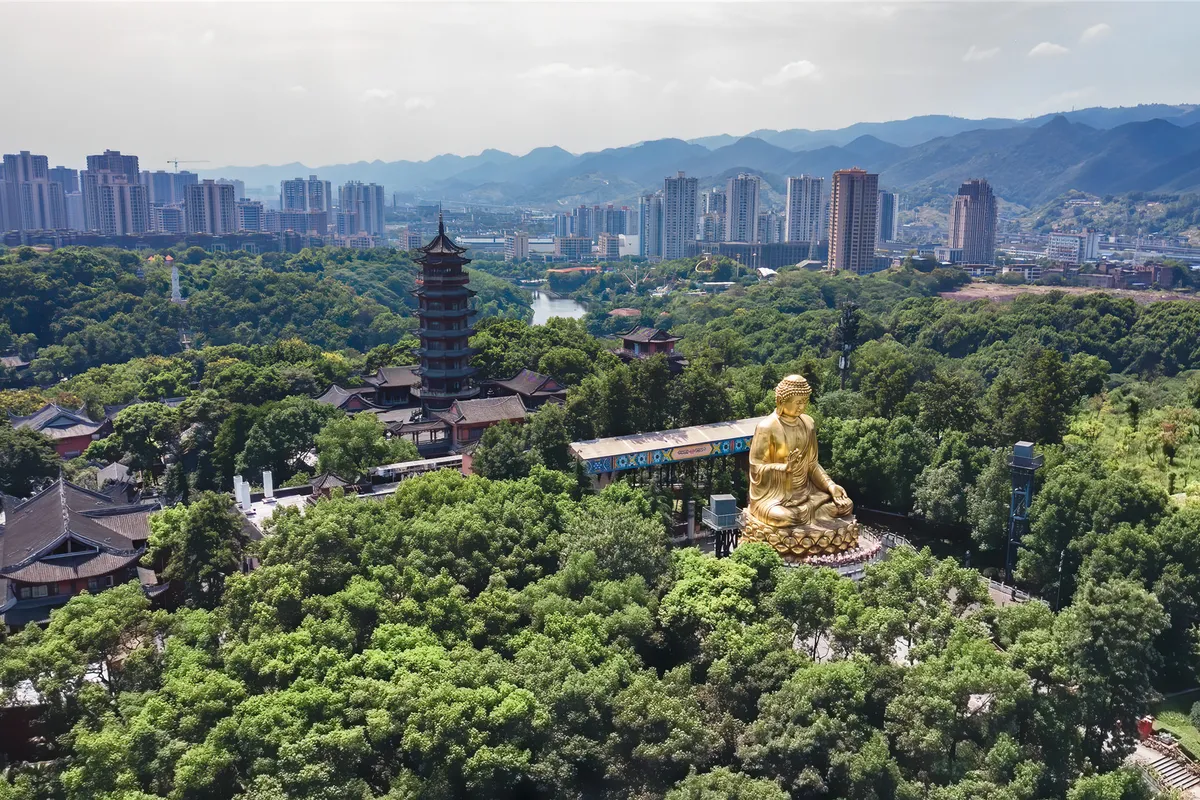
Huayan Tourist Area covers an area of over 1,600 acres, integrating mountains, water, forests, caves, and temples. It is one of the top ten jungles in Southwest China, known as 'Bashan Sacred Land' and is a national AAAA-level scenic spot. The famous Sichuan eastern temple—Huayan Temple—is one of the new Twelve Scenes of Chongqing.
The most famous attraction in Huayan Tourist Area is this large outdoor golden Buddha statue. Its expression is gentle, with the left hand open resting on the knee and the right hand raised with the palm outward, a classic Buddhist pose. Inside the golden Buddha, there are Buddhist instruments, sutras, calligraphy, paintings, and treasures. Standing under the golden Buddha, it feels as if the soul is elevated.
There are also regular Buddhist lectures in the Huayan Tourist Area, making it a place for studying Buddhist principles. That day, I was fortunate to encounter a lecture. Although I couldn't clearly hear what the master said from a distance, seeing the students listening intently, I could still feel the charm of Buddhism.
After paying homage, I slowly walked by the Seven-Step Lotus Pond. There is also the large Huayan Lake to circle, and then admire the egrets flying leisurely. At this moment, I truly felt that there is nothing else in life. In Huayan Tourist Area, calm your mind. Even if you don't understand Buddhist rituals, try to be a person with affinity. Plant good seeds in your heart to benefit future generations.
Another famous feature of Huayan Tourist Area is its vegetarian culture. Inside the scenic area, there is a vegetarian restaurant that uses only vegetarian ingredients, without any meat. It emphasizes tradition while also focusing on creative innovation and nutritional balance, allowing you to eat deliciously and healthily!
Now, the Huayan Temple vegetarian restaurant has brought back the century-old 'spicy crispy rice' and 'sesame oil vegetarian noodles,' which have been widely praised by customers.
In Huayan Tourist Area, you can worship, enjoy the scenery, and eat delicious food. Here, away from the hustle and bustle of the city, you can experience deep tranquility.
**Xipeng Aluminum Capital** - Not exactly a scenic spot, but the 'Nine Scenes of Jiulong' cannot exclude it. It represents the most important industrial sector of Jiulongpo and is its pillar. It is the most large-scale aluminum processing cluster with the most complete industrial chain, a business card of Chongqing's industry. It presents an 'alternative' scenic impression. Looking down at the entire factory area from above, the buildings are well-arranged and large-scale, giving a more intuitive sense of the changes brought by Chongqing's current economic boom.
On August 29, 2019, the Chongqing municipal government and CHINALCO signed a cooperation agreement to jointly establish China Aluminum Group High-end Manufacturing Co., Ltd. (abbreviated as 'CHINALCO High-end Manufacturing') by Chongqing Aluminum Industry Development and Investment Group Co., Ltd. and CHINALCO. This collaboration between the central and local governments aims to create a high-end aluminum materials aircraft carrier. The CHINALCO High-end Manufacturing project leverages CHINALCO's position as the world's largest nonferrous metals enterprise and a leader in China's nonferrous metals industry, with its advantages in management, talent, capital, and technology. It also leverages Chongqing's strategic position as an important pivot for Western Development and a key junction of the 'Belt and Road' and the Yangtze River Economic Belt, as well as its solid industrial base as a national important modern manufacturing base. Together, they promote the transformation of military cutting-edge technology into high-end civilian products and extend the aluminum industry chain to the high end, leading the transformation and upgrading of high-end materials research and manufacturing in China to world-class levels.
Its subsidiary, Southwest Aluminum Group, after more than 50 years of development, is one of the strongest comprehensive strength ultra-large aluminum processing enterprises in China. It is a core base for the research, development, and supply of aerospace and national defense military materials, as well as for the production and export of high-precision aluminum materials.
**Zouma Ancient Town** - As its name suggests, it is inextricably linked to horses. Legend has it that Zouma Ancient Town was built on a rock shaped like a galloping horse, with a very steep terrain that is difficult to climb, giving rise to the folk saying, 'Whether you know it or not, you can't pass Zouma Hill.' Since ancient times, it has been called 'Zouma Hill' by locals, and later named Zouma Town.
There is another explanation: because Zouma Ancient Town is located in a position that is part of Ba County to the north, Bishan to the west, and Jiangjin to the south, it is said to 'step on three counties.' It was a necessary passage from Chongqing to Chengdu and an important post station on the Chengdu-Chongqing road. Because it was a key thoroughfare, trade here has been frequent since ancient times, and it was once a place of economic activity with many wealthy people.
Whether for business or for personal affairs, people traveling between Chengdu and Chongqing had to pass through here. This resulted in a scene of people coming and going, and horses bustling about. The word 'Zouma' (walking horse) vividly depicts the prosperous scene at that time.
Today, Zouma Ancient Town is more peaceful and tranquil. Few pedestrians are seen on the streets, and the town maintains a good primitive ecology. Strolling along the streets, you can see neighbors playing cards in teahouses and townsfolk chatting over tea to pass the time.
In short, the purest impression you have of an ancient town is the real situation in Zouma Ancient Town now.
But if you think the town is backward and lifeless, you are greatly mistaken! It is said that there are markets every Tuesday and Friday. That is the most lively time in the town, when all kinds of vendors gather, and the small town comes alive, showing a lively and dynamic side different from usual. There are also storytelling venues and opera houses, allowing these disappearing urban pleasures to be revitalized.
Zouma Ancient Town is worth walking slowly and savoring carefully, letting the rustic atmosphere soothe the restless soul of visitors, bringing back the unique peace and beauty of the past.
Our hometown is so charming that we need to experience it with our hearts. If you have the opportunity, visit these 'Nine Scenes of Jiulong' and re-understand Jiulongpo from different perspectives—nature, city, and human culture—and I believe you will have many different feelings!


