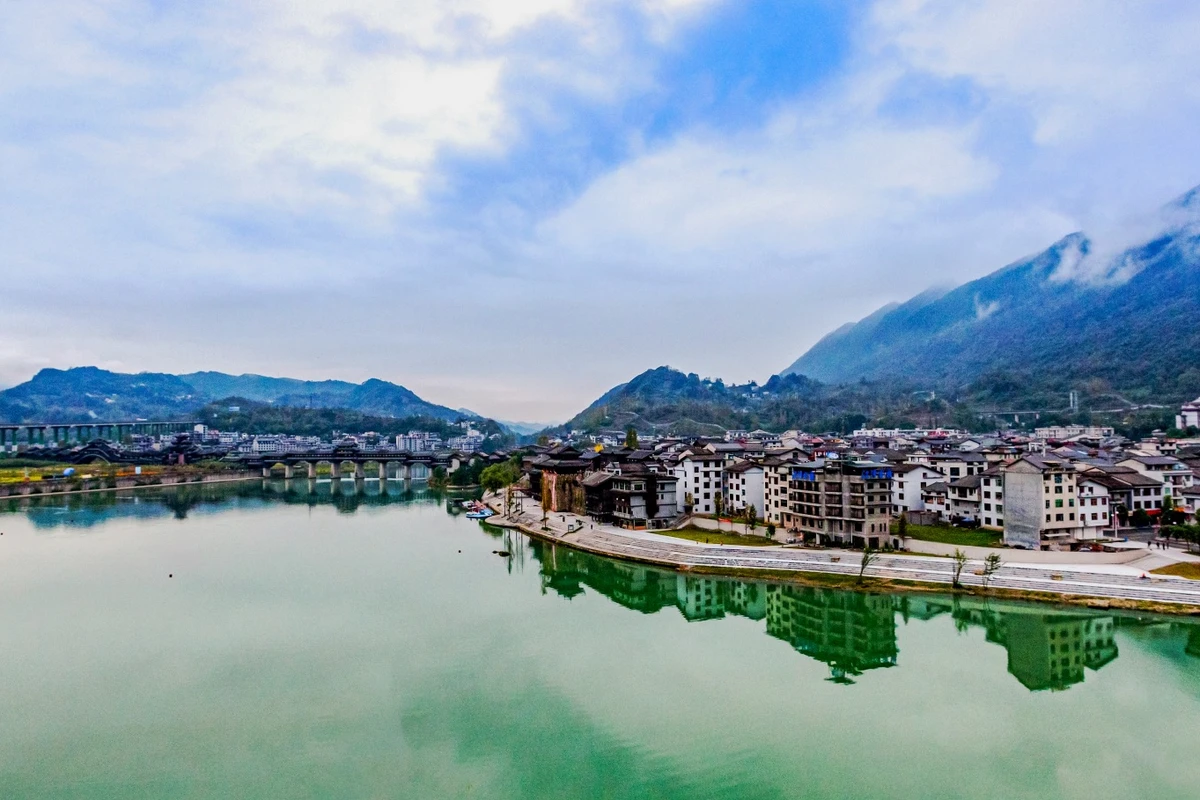
Autumn Escape to Southeast Chongqing: Gorgeous Gorges and Autumn Splendor
Chongqing is a tourism powerhouse, brimming with sights. This journey took me through the representative landscapes of southeast Chongqing’s Wulong, Pengshui, Qianjiang, Youyang, Xiushan, and Shizhu. I explored the Zhuoshui Scenic Area in Qianjiang, Baima Mountain in Wulong, the Ayi River in Pengshui, the Die Shi Hua Gu (Stacked Stone Flower Valley) in Youyang, and the Chuanhegai Scenic Area in Xiushan, immersing myself in the lush mountains, rivers, and local culture of the Wuling Mountain region.
**Qianjiang Grand Canyon: Living Room of Wuling**
“China’s Canyon City, Wuling’s Drawing Room” – this tagline instantly captures Qianjiang’s character. The first phrase highlights the natural wonders, unique resources, and brand identity; the Qianjiang gorge stands out among China’s canyon destinations as peerless and globally rare. The second phrase speaks to its human side – ethnic flavor and geographic position.
The Zhuoshui Scenic Area, on its way to becoming a national 5A attraction, features the world’s longest covered bridge and the Qianjiang City Grand Canyon. The canyon’s cliffs rise over 1,100 meters, carved through karst landscapes stretching across seven geological eras, spanning 10 kilometers and covering 723 hectares. On average 200 meters deep, the chasm plunges to 500 meters at its lowest. Here, a colossal 123-meter-high cliffside Guanyin bas-relief and a transparent glass walkway cling to the rock. Mountains, water, gorges, karst caves, pavilions, temples, and the Guanyin statue merge into what many call “the most spiritually charged place in China.” It is the country’s only urban grand canyon, its rare conglomerate cave systems forming a cityscape where “the city rests above the gorge, and the gorge cradles the city.” Within Balahu Park, a mural of Guanyin – the pure-bottle Guanyin, one of the bodhisattva’s thirty-three manifestations – is carved into the cliff. It’s the world’s largest Guanyin statue, framed by Lotus Square, Echo Terrace, and a life-release pond.
**Puhua Dark River Scenic Area**
Nestled in Zhuoshui Ancient Town in Qianjiang, the Puhua Dark River is a key link in the Apeng River tourism chain. About 20 kilometers from Qianjiang town and two kilometers from Zhuoshui Ancient Town, it brings together an underground river, three natural bridges, and sinkholes (tiankeng) in irresistible splendor. The subterranean stretch runs roughly two kilometers, with depths exceeding 20 meters. It comprises the dark river itself, clusters of natural bridges, giant funnel formations, cliffside boardwalks, and the Puhua River Canyon. High above, three bridges soar at over 150 meters in a stunning spectacle, while the mysterious “Black Dragon Pond” sinkhole keeps its secrets. Along the dark river’s banks, stalactites and stalagmites sculpt surreal scenes. Emerging from the river into the gorge, you’re greeted by murmuring streams, boulder-strewn shallows, vines, and wildflowers – a place of pure delight. The sheer cliffs and caverns beckon visitors to sightsee, explore, and seek a dose of wild adventure. Gliding by boat through the caves, the jagged stone towers of the Three Natural Bridges form a heavenly spectacle, adding an extra layer of magic. The scenery all around is breathtaking, the air impossibly fresh. Whether deep inside the karst caves or on the cliffboard walkways, every turn reveals a different view and deeper insight into the region’s culture.
**Zhuoshui Ancient Town**
The old town is a mosaic of historic buildings: the Baxian Hall, the Gong family’s elevated mansion, the former residence of Wang Benshan, the Wang family workshop, Guangshunhao, the Yanfang money house, and the Zhuoheba Lecture Hall. Each site carries its own history and time-worn charm. As a prime example of Chongqing’s old city lanes, Zhuoshui retains a remarkably intact street network, rich with the distinctive flavor of southeast Chongqing’s ancient towns. It embodies the fusion, heritage, and reinvention of Ba culture, Tujia traditions, and Han culture, while its wharf culture, merchant spirit, and market-town life intertwine.
Spanning the Apeng River here is a covered bridge, hailed as the finest in Asia (the Number One Wind-and-Rain Covered Bridge). Stretching 303 meters long and five meters wide, it is said to be Asia’s longest covered bridge, divided into three sections: the bridge proper, pagodas, and pavilions. The Zhuoshui covered bridge is built entirely of wood, joined by mortise and tenon, straight and diagonal pieces fitting tightly into a strong, precise structure. Three-tiered pagoda pavilions rise along its length, with about a hundred carved wooden windows that can open freely, and red-lacquered benches lining the interior. At nightfall, the bridge reveals its mystical allure, glowing like a soaring dragon – a truly magnificent sight.
The covered bridge is closely woven into the ancient town, arching like a beautiful rainbow over the Apeng River. Inside, it is roughly 50 meters wide and eight meters high. Along the middle of the side railings, thick wooden planks 40 centimeters wide serve as continuous seating. The broad roof provides shelter from wind and rain, shade in summer, and warmth in winter, offering a safe haven for traders and villagers when the weather turns harsh. At the midpoint, there was once a two-story wooden lookout tower. In early summer, abundant light streams in; in the mornings and afternoons, sunlight even reaches directly inside. With its herringbone roof of grey tiles and wooden beams, the bridge is open on all sides yet stays dry, as rain never penetrates. During market days when crowds swell, the trough-like structure helps channel the flow of people, preventing the chaos of a packed street. Different spaces within the bridge serve different purposes, subtly dividing the interior into intimate, flowing tiers. The long, wide bridge allows a smooth, unhurried movement of people.
**Die Shi Hua Gu (Stacked Stone Flower Valley) in Youyang**
There are two Peach Blossom Paradises in the world: one lives in your heart, the other in Youyang, Chongqing. Stepping into Die Shi Hua Gu, artistic structures punctuate the landscape, accented by the ethereal pink haze of muhly grass, lending the whole valley a dreamy, romantic air. Visitors pose everywhere, striking all kinds of poses before cameras, while red silk scarves flutter in the breeze. Graceful young women celebrate their beauty, weaving warmth and elegance into a living picture. “A vast field of pink – it’s so healing! Standing in it for a photo makes my girly heart burst!” it attracts flocks of young women and photography studios. High-end brands like Aishang Xinpai, Aishang Milan, and Jinfuren wedding photography, along with indie studios like You Ge Zhaoxiangguan, Maizi Yinghua, and Migong ancient-style photography, as well as the Youyang Photographers Association, all descend here. Countless stunning images emerge, making Die Shi Hua Gu an autumn must-post on social media.
The pink muhly grass (Muhlenbergia capillaris) is a warm-season perennial growing 30–90 centimeters tall and spreading 60–90 centimeters wide. Its arched stems bear fine green leaves and cloud-like pink plumes from September to November. When planted en masse, it creates a spectacular pink ocean, remaining beautiful from September into mid-November. Perfect for large-scale planting, it also works in solitary settings, pots, or as a backdrop and border. The stacked-stone flower valley is a perfect marriage of layered stone formations, stone art, and ancient Nuo culture. The stromatolites date back to the Cambrian period some 500 million years ago, while Nuo culture emerged in humanity’s early religious stirrings, about 10,000 years ago. The stacked-stone area blends viewing with interaction, featuring the Twelve Moon God Pillars Stone Array, Stone Magic Pit, zip-line gorge overlooks, the Three Emperors Platform, Nuo ritual altar ruins, and the Twenty-Four Opera Gods Bonfire Terrace. It’s a clever fusion of primitive Chinese culture and romantic expression, a portal from modern life into the mysterious 30th parallel north.
**Chuanhegai Scenic Area in Xiushan**
Xiushan, “the border town,” is a feast for the eyes. The area is famous for its table mountain – named for its flat, table-top shape. Chuanhegai is rich in natural gifts: “In spring, see the red azaleas blaze; in summer, find cool retreat; in autumn, gaze upon silver-tipped grasses; in winter, drink in northern scenery.” Its high-mountain grassland and flower seas are unique in southeast Chongqing – the only large-scale alpine ecological landscape that combines grassland and floral splendor. The mountain panoramas are striking: Comb Ridge, Lu Ban’s Saw, the Golden Toad Seeking the Phoenix, Icefall in the Divine Cave, the Lovers’ Sacrifice, and Immortals Playing Chess – all vivid and awe-inspiring. Water features like Naxi Stream, Baishui Stream, and Pearl Spring Waterfall captivate visitors and make them linger. With its ever-changing four-season plant cover, distinctive stone-and-thatch architecture, and open hilltop plateaus, Chuanhegai is ideal for varied nature-friendly activities, centered on eco-sightseeing and returning to nature.
Chuanhegai lies 15 kilometers northeast of Xiushan County, covering 28 square kilometers. It holds vast high-mountain pastureland spanning tens of thousands of mu, at an average elevation of 1,230 meters and an annual mean temperature of 12.1°C. The seasonal landscapes are unmistakable: spring’s fiery azaleas, summer’s blooming lotuses, autumn’s frothy white plumes, and winter’s northern-style frost. Beyond the endless grasslands, natural landmarks abound: the Golden Toad Seeking the Phoenix, General Rock, Comb Ridge, Granny Zhu Rock, Lu Ban’s Saw, Lotus Blessing Village, the Sleeping Buddha of Chuanhe, Icefall in the Divine Cave, the Ten-Thousand-Year Divine Turtle, Three Apes Gathering, Dragon Cave Terraced Fields, and the Four-Door Cave. The area also witnessed Red Army battles; a monument here records that red history. Since 2016, Chuanhegai has been developed to national 4A standards, with new roads, a cable car, visitor center, walking trails, a ring road, Starry Sky Hotel, camping base, and a rainbow slide. It now welcomes 1.3 million visitors yearly. When snow falls, Chuanhegai transforms into an otherworldly vision of beauty. Perched at 1,200 meters, this table mountain wears snowflakes like a dream, dressing its distinctive peak in ethereal white.
**Wanshou Mountain in Shizhu**
Tujia flavors and wellness in Shizhu: Wanshou Mountain Scenic Area is a mountain destination combining sightseeing, cultural innovation, rural experience, heritage conservation, health retreats, and forest sports. Rated national 4A, it sits at the magical 30th parallel north, along the golden tourism corridor of eastern Chongqing, conveniently just 10 kilometers from Shizhu County. The area covers 308 hectares at an elevation of 1,250–1,500 meters, with dense vegetation, a pleasant climate, and temperatures lingering between 15 and 25°C year-round.
At its heart lies the Qin Liangyu Military Fortress Heritage Park, rich in ecological and cultural sights. The iconic “Male and Female Stone Pillars” of Shizhu stand here: the Male Pillar rises about 100 meters behind the rear fort gate, resembling a heroic man with a pronounced nose and deep-set eyes, incredibly lifelike. The Female Pillar, 70 meters tall, poses gracefully just outside the front fort gate, like a serene maiden sitting against the mountain, dignified and enchanting. The park also preserves the ancient battlefield where Qin Liangyu – the only female general officially recorded in Chinese history – commanded Tujia white-rod soldiers to defend their fortress. Wandering among the old gate, walls, Xuanwei Mansion, beacon towers, and the Rhino Gazing at the Moon, you feel General Qin’s loyal, patriotic love for her nation. A cliffside boardwalk snakes over 1,000 meters; the Shouxian Buddhist Path combines danger, wonder, and grandeur, featuring the southwest’s largest statue of the God of Longevity surrounded by Buddhist rock carvings and mysterious natural caves...
“She mastered the Eight-Formation battle array; in her embroidered sleeve, she held the commander’s tally. Why must a general be a man, when a woman willingly embraces the role?” Lines praising Qin Liangyu abound, reflecting her extraordinary achievements.
**Ayi River in Pengshui**
Pengshui, the Miao heartland – a Miao and Tujia area blending mountains, waters, forests, springs, and gorges into a landscape of grandeur, peril, wonder, elegance, and seclusion. The Miao people call a kind, beautiful, clever woman “Jiao Ayi,” and so the river got its name. The Ayi River is a pristine, original ecosystem: on the mountain, you admire natural scenery; down by the river, you soak in folk customs. The Yantouba Visitor Center is built in the rustic elegance of southeast Chongqing’s traditional architecture, harmonizing perfectly with the landscape and ethnic charm.
The scenic area is divided into three sightseeing zones (gorge viewing, walking tours, bamboo rafting), two leisure resorts (the reception center folk-culture resort and Niujiaozhai folk-culture resort), two experience zones (whitewater rafting and outdoor adventure), one thrilling rafting section, and one specialty market. Eight major activities await: gorge echo listening, bamboo raft songs, splashing in the emerald pools, riding the rapids, betrothal at the Miao village, the Qinglong Sky Ladder, Qinglong Cave, and Qinglong Valley. Hiking reveals rare flowers, ancient vines, and venerable trees; boating offers the rush of rapids and roaring waves; spending a night in a mountain village means savoring Miao cuisine and immersing in local life. Ayi River is a top choice for relaxation, folk experiences, rock climbing, and water sports. Before entering the main scenic area, you’re treated to the uplifting gorge views of the mysterious Muzixi Grand Canyon – a classic river gorge landscape, primeval and breathtaking. The water runs clear and deep in parts, shallow in others; fish dart about, rivaling the crystal lakes of Jiuzhaigou. This is a future highlight: gorge exploration.
**Baima Mountain in Wulong**
Natural heritage, global Wulong: The scenic area takes the love story of the White Dragon Horse and the Blue-Robed Fairy as its thread, woven with traditional Chinese culture, aiming to become a nationally acclaimed 5A destination – the “Baima Mountain under Heaven” – and a world-renowned site that drives Wulong’s all-for-one tourism. Standing on the cliff edge at the mountain’s high point, you gaze down at the Wujiang River’s blue torrents surging for miles, with fishermen plying its waters; in the distance, the ethereal peaks of Fairy Mountain paint a scene of magical grace.
When Baima Mountain comes up, many people mention the “Sky Kiss.” Shaped as a pair of lovers – “Baima” and “Fairy” – the ride rotates and rises. As the structures ascend, Baima and Fairy lift to 54 meters above the ground, meeting in the air for the world’s highest, most affectionate, most romantic kiss – a beautiful symbol. Aboard the Sky Kiss, the two flying islands slowly spin and climb to a thousand meters, treating you to a panoramic view of Baima Mountain’s stunning landscape and a vertiginous visual thrill. This dual interactive flying island ride, unique in the world, perches on a cliff more than 1,300 meters high. Each cabin holds 60 passengers, and the two islands move together, one rotating 307.5° anticlockwise, then returning clockwise. As someone afraid of heights, I mustered the courage to try it this time. Suspended high above, 360-degree views of breathtaking scenery unfurled below – an unforgettable experience.
Thanks for reading.
I’m Mohai from Chongqing, a self-media creator who began with photography over a decade ago and earned the title of travel photographer. Now I focus on experiencing and promoting travel, hotels, cuisine, and photography. I collaborate with numerous websites and TV stations, and partner with tourism bureaus and travel companies across many provinces. I’ve journeyed through every province and city in China, moving between scenic spots and hotels.


