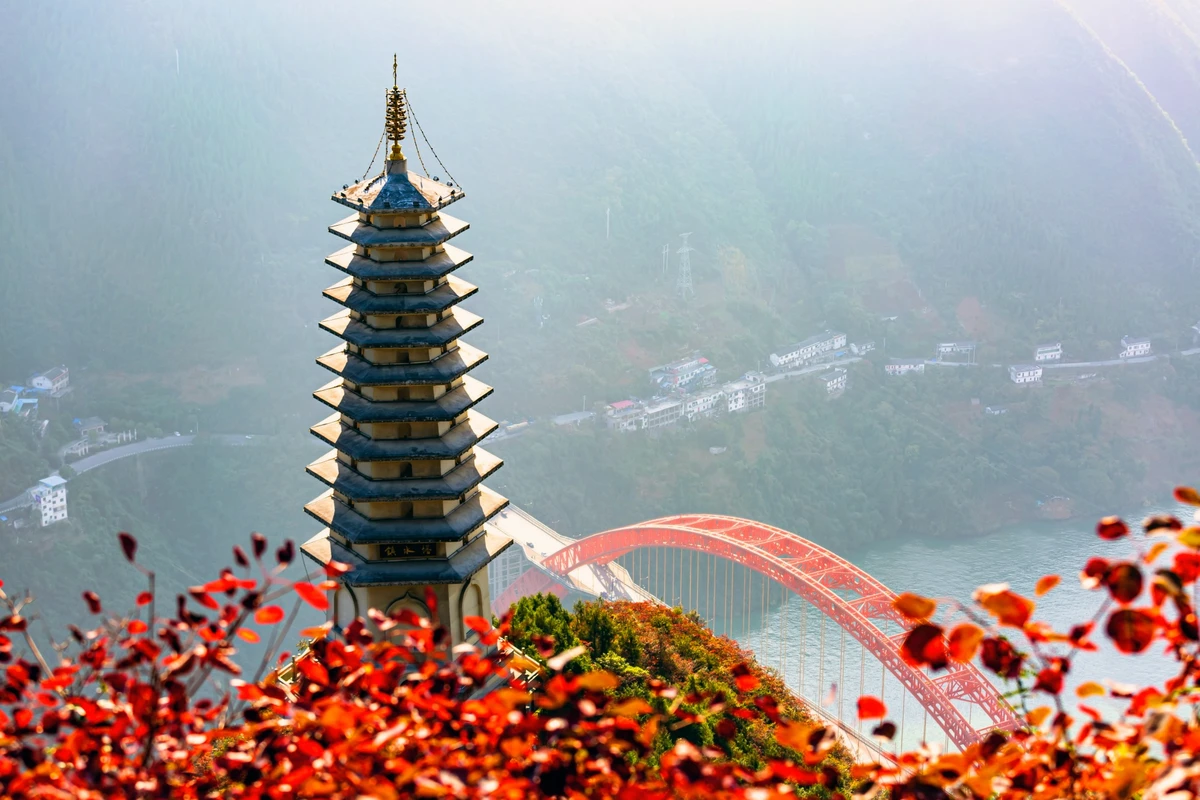
The red leaves of Wushan are red again; I won't wait until next year.
Autumn in Chongqing is infinitely charming. The clouds and rain of Wushan, along with its unique red leaves, have revealed their brilliant colors. Many poets and scholars have spoken highly of Wushan and created numerous works about it.
In the evening, red leaves rustle under the breeze, / A ladle of wine at the long pavilion. / Remnant clouds return to Mount Taihua, / Sparse rain passes over Zhongtiao Ridge. / The colors of trees follow the distant mountains, / The sound of rivers flows into the distant sea. / Tomorrow we arrive at the imperial capital, / Yet still I dream of fishing and woodcutting.
These poems fully illustrate the beauty of autumn and the allure of red leaves. They have also attracted countless photographers, who carry long lenses and tripods to capture these beautiful moments.
Wushan, with its unique geographical conditions, has red leaves that are oval in shape. Only here can the leaves turn red. It is said that professionals tried to transplant Wushan red leaves elsewhere but failed—the transplanted trees grew well, but their leaves never turned red, puzzling many experts.
The red leaves of Wushan have brought unique beauty to this city, spreading the story of the Goddess far and wide. The Twelve Peaks of Wushan are nature's greatest gift to Wushan tourism, but how many people know them?
The Twelve Peaks of Wushan are not only graceful and varied in shape, but the ever-changing, elusive clouds and rain of Wushan also add to their mystery. The high mountains and deep valleys in the gorge area, with lingering moisture, rise slowly along the slopes, sometimes forming floating clouds and drizzle, sometimes turning into rolling dark clouds or vast white mist. The twelve peaks appear and disappear, as if in a fairyland.
Denglong Peak, Shengquan Peak, Chaoyun Peak, Goddess Peak, Songluan Peak, Jixian Peak, Jingtan Peak, Qiyun Peak, Feifeng Peak, Shangheng Peak, Cuiping Peak, and Juhe Peak—among these twelve, I personally consider Goddess Peak the finest.
Wangxia Peak, also called Goddess Peak, is located on the north bank of the Yangtze River about 15 kilometers east of Wushan County town. A huge stone juts out from the green peaks and rosy clouds, resembling a slim, beautiful maiden, hence the name Goddess Peak. The ancients said, "The peaks rise above the clouds, and the foothills plunge straight into the river; commentators claim that even Mount Tai, Mount Hua, Mount Heng, and Mount Lu lack such wonder." When clouds and mist coil around the peak, the human-shaped stone pillar seems to be draped in thin silk, appearing even more tender and charming. It is the first to welcome the brilliant morning glow and the last to bid farewell to the gorgeous sunset, hence the name "Wangxia Peak" (Gazing at the Rosy Clouds Peak).
The Story of Goddess Peak
"Wushan Goddess" is an indoor fantasy show divided into four chapters. It tells the beautiful and moving love story between the goddess Yaoji and Aze, a young man from a human tribe. They fall in love and fight together against a flood demon. In the end, Yaoji uses all her divine power to suppress the flood and transforms into Goddess Peak, a poignant tale of love and self-sacrifice.
"The twelve peaks of Wushan are lush and green; a single stone stands tall, named the maiden." Wushan lies in the heart of the Three Gorges reservoir area, known as the "Gateway to Eastern Chongqing." It boasts unique natural scenery and thousand-year-old historical culture, a favored place for ancient poets and scholars. The Goddess of Wushan has especially captivated many literati—from Qu Yuan's chants and Song Yu's fantasies to the contemporary poet Shu Ting's heartfelt calls. The legend of the Wushan Goddess has made Wushan widely known. To better inherit the culture of the Wushan Goddess and promote the deep integration of culture and tourism, the indoor fantasy show "Wushan Goddess," which took seven months to create, came into being.
Another must-see attraction when visiting Wushan is the Little Three Gorges. The Little Three Gorges of Wushan consist of Longmen Gorge, Bawu Gorge, and Dicui Gorge, stretching 50 kilometers in total. With clear green water, towering peaks, lush bamboo and trees, and the sound of monkeys, it is full of wild charm. The Little Three Gorges are characterized by their beauty and wonder, inspiring Chen Yunhe to write the poem "The Little Three Gorges of the Daning River." Some say it has six wonders: majestic mountains, clear water, elegant peaks, dangerous shoals, tranquil scenery, and beautiful rocks—truly a "wonder gorge under heaven."
As the saying goes, between two mountains there must be a river. Whether the Daning River nurtures the towering green peaks on both sides, or the beautiful peaks nourish the clear green Daning River, cruising through the Little Three Gorges feels like boating in an exquisite natural bonsai, intoxicating you. The Little Three Gorges is not only a well-deserved scenic area but also holds mysterious ancient relics such as the Ba people's hanging coffins, boat coffins, and puzzling ancient plank road holes. This unique canyon landscape combines natural scenery with cultural heritage, a sparkling pearl on the golden waterway of the Yangtze River Three Gorges. After fully enjoying the Little Three Gorges of Wushan, one can't help but exclaim, "No water is worth seeing after the sea, and no gorge is worth seeing after the Daning. After returning from the Five Sacred Mountains, no mountain is worth seeing; after returning from the Daning, no gorge is worth seeing."
Wushan Little Little Three Gorges
The Little Little Three Gorges of Wushan are even narrower, making the mountains appear steeper and the canyons more profound. Inside, fantastic peaks, mirrored waters, and beautiful scenery await. Cliffs face each other on both sides, with walls a thousand feet high. The river channel is narrow, revealing a sliver of sky, exuding an irresistible wild appeal. Hanging stalactites on the rock walls, of various strange shapes, emit an air of primitive antiquity. Boating through, the shores offer endless beauty, with verdant greenery everywhere, extremely pleasing to the eye, inspiring only a desire to return to simplicity and embrace nature.
The steep cliffs on both sides hide many secrets. Take the "hanging coffins" for example—in the Three Gorges area, they are also called boat coffins or rock coffins depending on the region. Hanging coffins can be found in Guanshui Gorge and Fengxiang Gorge of Qutang Gorge; Bawu Gorge and Dicui Gorge of the Daning River; Jingzhu Dam in Wuxi County upstream of the Daning River; and Bing's Sword and Sword Gorge and Jiuwan Stream in Xiling Gorge. "Boat coffin burial" is a unique custom of the Ba people. Several explanations exist for the hanging coffin custom: one is a homophone for "high official" (gaoguan) to bless descendants with wealth and rank; another is to protect ancestors' bodies from human and animal harm; a third is that the Pu people's descendants, to show filial piety, would "spend all their wealth on a coffin, chisel a niche on a high cliff by the river, lower the coffin with ropes from above, and the higher, the more filial."
In the Little Three Gorges, two types of hanging coffins are most visible: one places the coffin in a natural cave at a certain height (usually dozens of meters above ground); the other involves chiseling one or more pits on the cliff face and placing the coffin inside.
The beauty of Wushan is not something I say; successive generations of poets and scholars have described it. The most famous lines are:
No water is worth seeing after the sea, / No cloud is worth seeing after Wushan. / I pass through flower groves without a backward glance, / Half out of cultivation, half out of you.
I am Chongqing Mohai, a self-media person starting with photography. I have been learning photography for ten years, earning the title of travel photographer. I now focus on experiential promotion of tourism, hotels, food, and photography. I have collaborated with multiple websites and TV stations, and co-organized events with tourism bureaus and travel companies in many provinces and cities. I have traveled to every province and city in China, moving between scenic spots and hotels.


