Wandering in Chongqing
Jiefangbei and Hongyadong have become iconic attractions in Chongqing in recent years, serving as witnesses to the city's history, culture, and a symbol of Chongqing's urban spirit. At the end of November 2020, during my stay in Chongqing, I visited Jiefangbei and Hongyadong several times at night.
On the night of November 26, I arrived in Chongqing and settled into my accommodation near 11 p.m. Without feeling tired, I left the hotel and went to Jiefangbei. In 2002, I had been on a business trip to Chongqing. Back then, it seemed I also visited Jiefangbei at night; the surrounding buildings were somewhat old and there were no skyscrapers. This time revisiting Jiefangbei, it had completely changed, overturning my memories.
After visiting Jiefangbei, I checked the map and saw that Hongyadong was not far, so I walked there. Hongyadong is said to have a history of over 2,300 years. It was originally a "stilted house" (diaojiaolou) street market built along the cliffs by the Jialing River in the Yuzhong Peninsula, following the terrain in traditional Bayu architecture. In 2005, Chongqing city renovated it as the "Hongyadong Folk Custom Scenic Area," using the most characteristic Bayu traditional architectural style of stilted houses as the main theme. Through mountain building techniques such as layered platforms, stilted structures, staggered stacking, and cliff-hugging, it organically integrates six business formats: dining, entertainment, leisure, health care, hotels, and specialty cultural shopping, forming a unique "three-dimensional skywalk." It has become a tourist attraction combining urban tourism scenery, business and leisure scenery, and urban cultural landscape, and a layered and textured urban commercial center, attracting visitors to stroll through the stilted buildings, view the green cliffs of Hongyadong, wander old mountain city streets, appreciate Bayu culture, see the Jialing River scenery, and taste Bayu cuisine.
When I arrived at Qiansimen Bridge, I couldn't see Hongyadong buildings. Upon asking, I learned that Hongyadong was right below me on the cliffs of the Jialing River.
After going down escalators and taking an elevator, I entered the Hongyadong streets. Because it was late, most shops in the several levels of Hongyadong were closed. The alleys inside were empty and silent, with only the slightly cold early winter moisture from the Jialing River gently dispersing among the intricately layered flying eaves and upturned roofs of the buildings.
I walked onto the nearby Qiansimen Bridge and looked back at Hongyadong. The stilted houses of Hongyadong, built along the terrain and river, are railing-style architecture. From a distance, the structures have simple frames, flexible bays, and no fixed form. The stilted buildings following the slopes form linear road spaces. The lower parts are架空 empty, while the upper parts enclose solid spaces. In the dim lighting, Hongyadong was tranquil, and surrounded by nearby tall buildings, it gave a dreamlike feeling of traveling back to ancient times.
On the night of November 27, I came to Hongyadong again. Because it was not too late, I saw Hongyadong in its brilliant lights and bustling streets.
Located in Yuzhong District, Chongqing, the Hongyadong Folk Custom Scenic Area borders the Jialing River to the north and Cangbai Road to the south. Going down the escalator into Hongyadong, I saw roughly four levels of streets: the top level on Cangbai Road is the "City Balcony Exotic Style Street," the three levels below are the "Zhiyan River Dynamic Bar Street," "Tiancheng Alley Bayu Custom Street," and the "Hongyadong Feast Street Food Street" on the ancient stone path beside the old Chongqing city wall and rock cliffs. Among the ancient stilted buildings on each level, three-story structures predominate.
Standing by the Jialing River and on Qiansimen Bridge, looking at Hongyadong, the brightly lit Hongyadong had a sense of earthly vitality and dreaminess.
On the evening of November 28, I returned to Chongqing from Dazu and took a bus to Chaotianmen Dock to board a cruise for a night tour of the Jialing and Yangtze Rivers in Chongqing.
Entering the Jialing River, passing Qiansimen Bridge, and looking at Hongyadong from the river, the flowing lights created a unique scene.
On the morning of November 29, 2020, I crossed the Yangtze River to Huangshan in the Nan'an District of Chongqing. When the car reached deep in the Huangshan valley, I saw the sign for the Chongqing Resistance War Heritage Museum. This was the place I wanted to visit.
Chongqing Huangshan is located at the easternmost end of the Nanshan forest zone in Nan'an District. It has the highest number of ancient and famous trees in Chongqing. In the early 20th century, Huang Yunjie, a comprador of the Chongqing Baili Foreign Firm, bought this mountain forest as private property and built a villa named Huang Family Garden, also called Huangshan. In October 1937, when the National Government moved its capital to Chongqing, Chiang Kai-shek's aide-de-camp office purchased Huangshan to build official residences for Chiang and others. Huangshan became the center of military, political, and diplomatic operations during the War of Resistance. The Huangshan official residence was Chiang Kai-shek's favorite and longest-lived-in residence in the wartime capital Chongqing, serving as his regular place for air defense, summer retreat, and work. The Huangshan Resistance War sites consist of fifteen existing structures, distributed in two sections—east and west—along the mountain in a horseshoe shape. They are all official-style buildings constructed during the Republic of China period, simple and elegant, with a typical eclectic style blending Chinese and Western elements and strong mountain characteristics.
Entering Huangshan, I followed the winding mountain path halfway up the hill. Looking around, Huangshan was covered with pines and cypresses, with strange peaks and deep valleys, offering excellent scenery.
Following the scenic area signs, I took the left mountain path uphill to Yunxiu Tower and Caoting.
Arriving at Caoting, a small building halfway up the mountain, it was originally a guesthouse of the National Government's Military Commission. Zhang Zhizhong and Chiang Ching-kuo had stayed there, and later it became the former residence of U.S. presidential envoy George C. Marshall.
Leaving Caoting, I turned back and continued uphill. At the peak, I saw a villa. The sign said Yunxiu Tower, the famous Huangshan official residence of Chiang Kai-shek. From December 1938 to 1946, Chiang Kai-shek lived here most of the time in Chongqing.
Yunxiu Tower, located at the highest peak of Huangshan, stands abruptly among dense forests, surrounded by steep cliffs. Only a narrow stone path, too narrow for two people to walk side by side, connects it to the front and back. Ancient pines block the sky, verdant cypresses are lush, and the forest rustles, somewhat symbolizing the traditional officialdom's reverence for superiors and the highest superior, often called "shangfeng" and "jifeng."
Entering the small building, the meeting room on the first floor had a map on the wall, evoking the room's witness to the military, political, and diplomatic events of the war period.
Going to Chiang Kai-shek's office on the second floor, there was his inscription "Jianku Zhuojue" (Perseverance and Hard Work) on the wall, though it is likely not the original.
Yunxiu Tower also displays some historical materials from the War of Resistance period.
Leaving Yunxiu Tower, I headed to Songting. On the way, I saw a path leading to an air-raid shelter and went to check it out. It is said that Chiang Kai-shek personally led people to dig this shelter to escape Japanese bombing. The shelter had two exits leading to Yunxiu Tower and Caoting respectively.
During the war, the Japanese repeatedly bombed Chongqing, and Chiang Kai-shek suffered greatly. On August 30, 1941, the Japanese used 200 bombers in 10 waves to attack Chongqing. At the time, Chiang Kai-shek was chairing a military meeting at the Huangshan official residence. The Japanese planes arrived stealthily and dropped bombs, hitting a corner of Yunxiu Tower, killing two guards and wounding four. Chiang and the attendees hurriedly stepped over fresh bloodstains and hid in the shelter, thus escaping death. The iron door of the shelter was tightly closed, so I could not enter. Strolling in the forest clearing in front of the shelter, civil aircraft occasionally flew overhead, giving me a sense of what it must have been like when Japanese bombers came.
Arriving at Songting, this villa is also called "Song Meiling's Villa."
The name Songting was personally inscribed by Chiang Kai-shek.
In front of Songting, there are osmanthus trees, and behind the building are pine forests—a pleasant scenery.
Not far from Songting is Kongyuan, the villa of Kong Lingwei, the second daughter of H. H. Kung. It is also the largest building in Huangshan.
The small bungalow in front was the second meeting room, and the small house next to it was the aide-de-camp office, where Chiang Kai-shek's guards lived.
Arriving at Songlai Pavilion, this villa is said to have been built by Chiang Kai-shek for Soong Ching-ling, thus called Soong Ching-ling's Villa. Standing on the balcony of the second floor, one can supposedly see sunrise in the morning and sunset in the evening, as well as the scenery of Huangshan's shallow valleys.
Near Songlai Pavilion is Yunfeng Tower, the former residence of He Yingqin. The semicircular platform below Yunfeng Tower is said to have been where He Yingqin practiced tai chi in the morning.
Returning to the fork that led to Caoting and Yunxiu Tower, I noticed a dirt path leading to the peak above Caoting. Upon closer inspection, there was an inconspicuous sign pointing to Wangjiang Pavilion.
Following the winding path up the mountain, the path finally turned, and the view opened up. A pavilion stood at the cliff top—Wangjiang Pavilion.
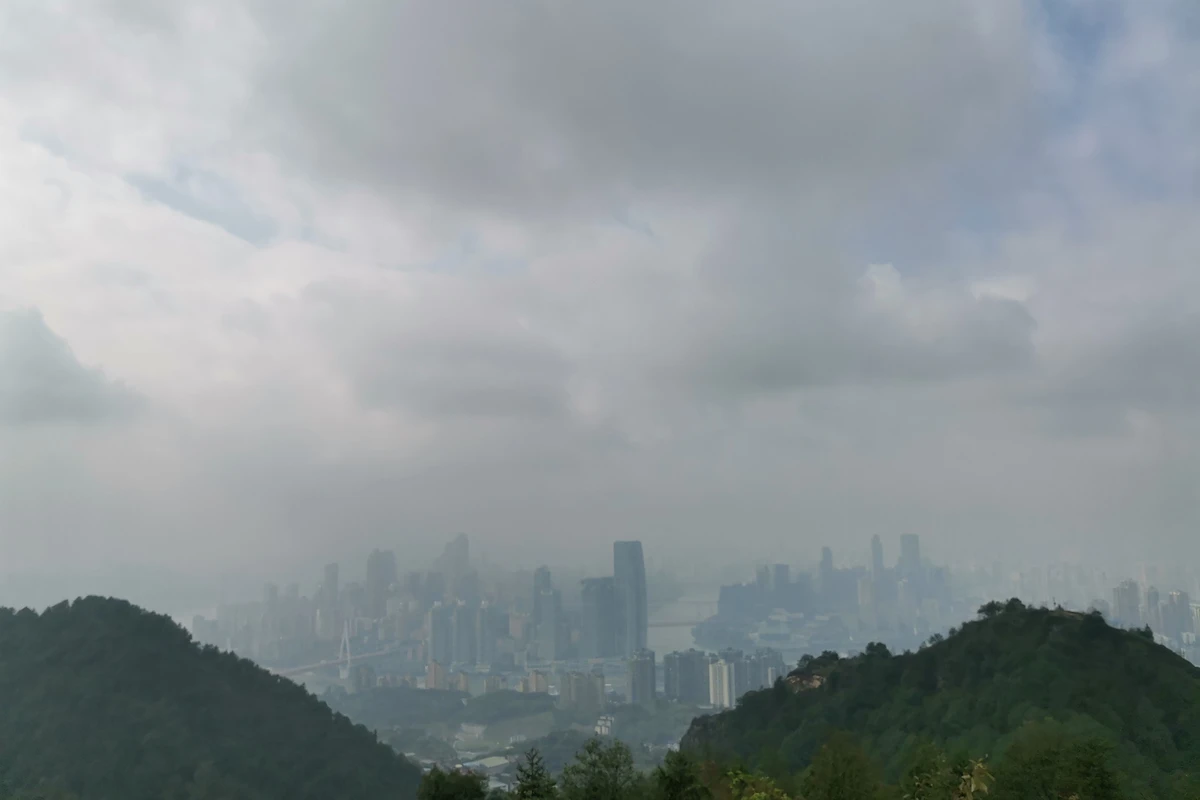
Arriving at Wangjiang Pavilion, despite some haze, the distant view of the mountain city of Chongqing was still clearly visible.
It is said that when Chongqing was bombed by the Japanese, Chiang Kai-shek once stood here with Chennault and others, looking down at the smoke and fire in the Yuzhong Peninsula and pondering countermeasures, leading to the creation of the Flying Tigers. Now, standing at Wangjiang Pavilion, the Jialing and Yangtze Rivers are lined with high-rise buildings, showing the bustling vitality of the mountain city of Chongqing.
Descending the mountain, crossing the Yangtze River, I returned to Yuzhong District to visit the Mountain City Trail.
Entering through the gate of the Mountain City Trail on Zhongxing Road, going up the left slope leads to Shancheng Alley. Originally named Tiandeng Alley, in 1900, French missionaries erected a pole with a lamp at the slope to light the way for pedestrians. At night, the lights looked like twinkling stars from afar, and because the location was high, it seemed like in the sky, hence the name Tiandeng Alley. It was renamed Shancheng Alley in 1972. Walking up the stone steps along the alley, it winds halfway up the cliff, with the Yangtze River on the left and houses on the right. The houses are mostly old buildings and residences, but many have been converted into small shops in an artistic style.
In front is a stone gate called "Changle Yongkang" (Eternal Joy and Health) stone door, said to be a hundred years old. The lintel is engraved with the four characters "Changle Yongkang," now partially weathered and blurred.
Continuing, there is a building with a style reminiscent of Shanghai's Shikumen architecture, named "Hou Lu." It is said to have been the residence of a warlord named Lan Wenbin under Liu Xiang during the war, now a tourist shop.
Further on, there is a ruin by the alley, the site of the Ren'ai Church built by French missionaries. In 1902, French missionaries built the Ren'ai Hospital, church, monastery, and priest quarters there, with some remnants said to remain. But when I looked, it had been completely demolished, apparently for restoration.
Following Shancheng Alley to a fork, continuing uphill leads to the part not facing the river, while the left side, on the cliff overlooking the river, has a suspended plank path—this is the real Mountain City Trail.
Walking along this scenic plank path built on the cliff, I looked to the left at the Yangtze River and the southern bank scenery.
Nearby is Chongqing Yangtze River Bridge, and farther away is Caiyuanba Yangtze River Bridge. A new bridge is being built to the left of Chongqing Yangtze River Bridge.
Below the Chongqing Yangtze River Bridge, the sandbar in the middle of the river is called Coral Dam, which had an airport during the war.
On the right side of the plank path is the cliff. Upon closer inspection, above the cliff is a stone wall, clearly the old city wall of Chongqing.
This Mountain City Trail I walked is the Third Trail, said to be the longest and steepest historic trail in Chongqing, climbing along the old city wall following the mountain terrain. After renovation, it has become a place for citizens to exercise and enjoy the view.
After finishing the plank path, there are stone steps along the cliff, gradually moving away from the river.
Below the ancient city wall on the cliff, there is a plaque introducing this section as the Jintangmen city wall section. The ancient city of Chongqing had about eight kilometers of walls around the Yuzhong Peninsula, with seventeen gates, nine open and eight closed.
Continuing a bit further, the trail begins to descend, probably near the end. It is said to lead to the old Chongqing city gate "Tongyuanmen." Since I thought it might be like Jintangmen with no gate remains, I did not go further and turned back. Later I learned that Tongyuanmen is a visible ancient city gate site in Chongqing, still standing, and it is the only land gate among all the city gates, worth seeing—and I missed it.


