Chongqing's Humanistic Scroll | A Leisurely Walk Along the Daxigou Trails
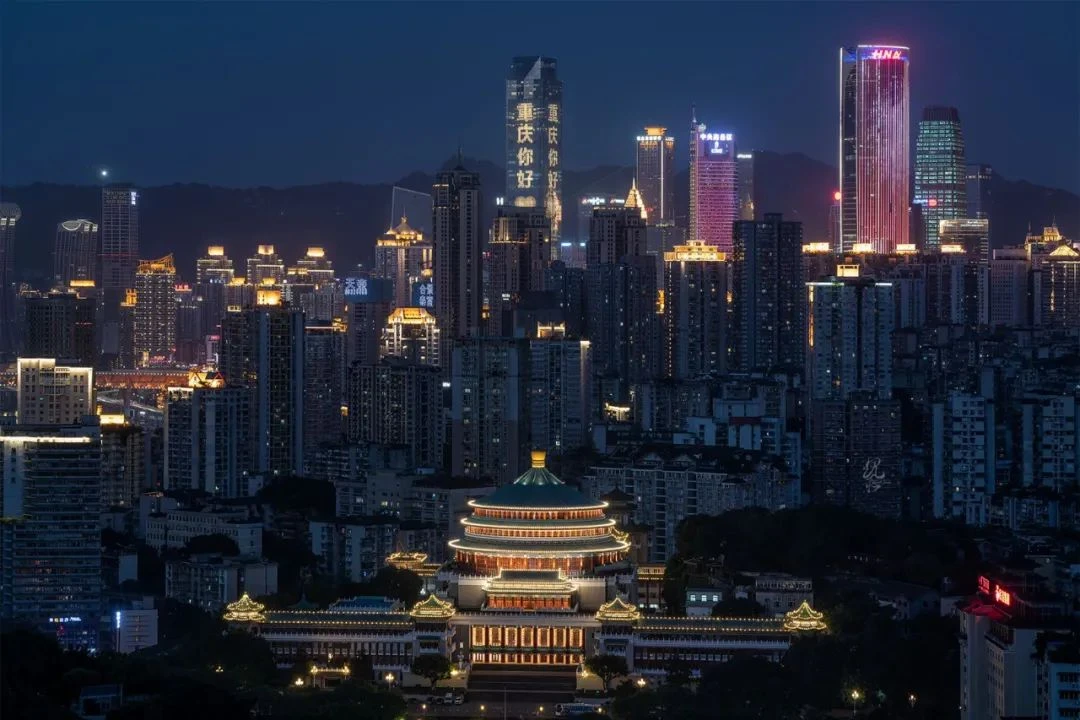
Every first-time visitor to Yuzhong is awestruck by its terrain: skyscrapers rising tier upon tier on the hills along the Jialing and Yangtze Rivers, piercing the clouds; bridges over the rivers and overpasses on land crisscrossing in dizzying yet unique patterns; the light rail at Liziba passing through a building, speeding along the riverside and mountainside with vibrant energy...
This is a city built on mountains, with the city on the hills and the city below them.
The mountains and the city complement each other perfectly.
The builders of the past adapted to the terrain as much as possible, distributing buildings, commerce, transportation, and daily life across different elevations, giving rise to the "Upper City" and "Lower City." Today, this is the origin of Yuzhong's reputation as an "8D city."
The mountain city trails were the essential pathways connecting the upper and lower parts of the city.
If Jiefangbei, Chongqing Raffles City, and Longfor Chongqing Times Paradise Street represent the A-side of Yuzhong, then the trails hidden deep in the urban fabric are its B-side. Only by truly delving into Yuzhong and exploring its cultural heritage and historical memories do you realize that these trails linking the Upper and Lower City are like a magical time capsule that preserves the passage of time.
More importantly, these trails retain their original functions—not just for tourists to see Yuzhong, but as an integral part of the living Yuzhong. Walking along these historic mountain trails, you can truly feel the continuity of time.
For tourists, these are just paths. But for the residents living here, they are a lifetime.
Thus, some regard the mountain trails as the negative of Yuzhong, saying that along these trails, you can see qualities such as resilience, hard work, perseverance, optimism, and an inclusive, lively atmosphere.
The Daxigou subdistrict, located in the north-central part of Yuzhong, hides six mountain trails within its streets and alleys due to its topographical features.
On an early winter afternoon, holding umbrellas and stepping into the drizzle, we set out toward these trails.
We ventured deep into the very essence of Yuzhong.
01 The Scent of Books — Zhangjia Garden Mountain Trail
Location: From Renhe Street extending upward to the Chongqing People's Hospital on Zhongshan 2nd Road.
Descending from the entrance next to the People's Hospital, you enter the Zhangjia Garden trail. As soon as you step onto the trail, a strong scent of books greets you.
The Zhangjia Garden trail is part of the third mountain trail, named after the Zhangjia Garden built during the Republic of China period.
The trail winds and twists, with blue brick walls and white lime pointing, and large stone slabs forming steps that descend into various corners—corners full of surprises, where almost every turn presents a different scene.
This is the most typical residential area of Chongqing. Along both sides of the trail, residential buildings stand tall, their mottled walls and architectural styles silently recording the passage of time in this old community. Occasionally, a small footbridge leads from the trail into a neighboring residential building. Along the walls built beside the trail, a few dark red benches are placed for passersby or residents to rest.
The community environment and living facilities along the entire Zhangjia Garden trail are very well developed. Along the trail, there are kindergartens, nursing homes, vegetable markets, cooked food shops, and even hard-to-find services like cotton fluffing and locksmithing... The residents are calm and unhurried, appearing content with their lot, moving slowly with ease.
This relatively short trail once bore countless familiar names and glories belonging to Chongqing.
The Bashu Kindergarten on the trail was originally the Zhangjia Garden Orphanage, whose board member Li Yiming was the uncle of Jiang Jie (a Red Rock martyr). Jiang Jie received her earliest communist education here.
At No. 65 Zhangjia Garden, the gate built of blue bricks has two traditional Chinese characters above: "棫園" (Yu Garden). This was originally the dormitory of Bashu Middle School, leased in 1938 to the All-China Literary and Art Circles Anti-Japanese Association founded by Zhou Enlai, Sun Ke, and Chen Lifu. From then on, this small place became the center of the national literary and art circles during the War of Resistance.
Through this gate, figures like Lao She in long gowns and Bing Xin in cheongsam came and went, gathering elites such as Mao Dun, Ba Jin, Hu Feng, Zhu Ziqing, Ding Ling, and Tian Han. Today, only a weathered old wooden door remains for posterity to pause and reflect.
At the original site of Bashu Middle School, Lu Zuofu, Kang Xinru, and He Lu established the school motto "Just, Sincere, Simple, and Honest." Premier Zhou Enlai once delivered his famous speech "Nine Questions on the War of Resistance" on the school's playground. The renowned educator Ye Shengtao taught Chinese there, and the school song he composed is still sung today. Lao She, Guo Moruo, Zou Taofen, Tian Han, Hu Feng, Shao Lizi, Shen Junru, and other revolutionary predecessors held dozens of anti-war speeches here. Nearly a century later, Bashu Middle School has moved to a more convenient location to continue its brilliance, but on the original site beside the Zhangjia Garden trail, only the school gate with four white Roman columns and a beam still stands.
On the Zhangjia Garden trail, there is also the site of the "Sino-French School," of great historical significance to the Chinese Communist Party. Founded in 1925 by revolutionary and educator Wu Yuzhang, it was the first cadre training school of the Chinese Communist Party in Chongqing and the birthplace of the earliest party organization in Chongqing—the Chongqing Branch of the Chinese Communist Party.
02 The Light of the City — Zaozi Lanya Zao 1st Alley Trail
Location: North of the Great Hall of the People, connecting Zaozi Lanya Main Street and Zhongshan 2nd Road.
If the Zhangjia Garden mountain trail is dominated by the scholarly tones of cyan and gray, then the Zaozi Lanya Zao 1st Alley trail is colorful and vibrant.
This is a rather steep trail. Although I haven't measured the total drop, the 288-step staircase makes it somewhat daunting to look down from above—if someone were to fall, the nearly 40-degree slope would make the situation quite serious.
Moreover, the trail was originally paved with large blue stones, which in Chongqing's rainy season (often lasting a month in autumn and winter) easily breed moss—a classic slippery pavement. So, the old residents of Zaozi Lanya used to call it the "Devil's Staircase."
To improve the situation, the government renovated Zao 1st Alley trail. Besides using slip-resistant materials for the ground, the risers of the steps and the walls along the trail were decorated with mosaics and colored ceramic tiles. This is not simple color arrangement; it resembles trendy graffiti.
Looking up from the bottom of the Zao 1st Alley trail, the risers form iconic scenic paintings: the bustling Jiefangbei, the rail transit passing through a building, the Yangtze River Cableway like a thread in the sky, the Hongyadong that looks like Spirited Away, and the Chongqing People's Great Hall, a cultural landmark. Every season in Chongqing has its own colors, but the colors of Zao 1st Alley are colorful all year round.
On the wall along one side of the trail, with the theme "In Time," bright ceramic tiles are embedded to incorporate representative symbols of each era since the reform and opening-up into the alley's bricks and tiles: mobile phones, cell phones, Walkmans... Even as times and life change rapidly, people from every era can still find the imprint of time here. Time is the driving force, and the power it radiates is the endless core of the city.
On the other side of the trail are residential buildings. Along the trail, small buildings built in the 1980s and 1990s are hidden among the lush yellow fruit trees (banyan) by the roadside. These trees, with trunks that a person can barely hug and canopies that almost cover the entire trail, show no sign of decline under the autumn-winter drizzle; instead, they are brought to life by the vibrant colors of the whole alley. Perhaps this place will become a new hot spot for Chongqing tourism in the future.
03 The Slowness of Time — Zaozi Lanya Zao 2nd Alley Trail
Location: Hidden among old residential buildings next to Chongqing No. 42 Middle School, connecting Renhe Street and Zaozi Lanya Main Street. The uphill entrance of Zao 2nd Alley trail is next to the Shuxiangyuan community near Huafu Lane, adjacent to No. 42 Middle School. It leads up to the back gate of the Children's Hospital of Chongqing Medical University on Zaozi Lanya Main Street. The trail is about 300 meters long and was once a major route for pedestrians from Renhe Street to Guanyin Rock and the Cultural Palace.
Walking in now, it's hard to imagine what it used to be like. Before renovation, pipelines were disorderly, walls were peeling, and garbage was scattered everywhere...
The renovation of Zao 2nd Alley trail was completed two years ago. But it wasn't just simple repairs; it incorporated features of the mountain city and core cultural elements centered on filial piety and kindness. You can feel this atmosphere as soon as you enter Zao 2nd Alley trail.
The peeling walls have been repaired with blue bricks and white lime pointing, creating a timeless look. Buildings where the walls couldn't be replaced were painted with bright yellow paint. The utility poles along the trail are painted with scenes of old Yuzhong stilted houses or old buildings, and even the distribution boxes are painted with themes like plum, orchid, bamboo, and chrysanthemum. It makes you feel as if you've stepped into a Chinese painting.
The entire Zao 2nd Alley trail feels especially elegant, and with the old gate of Chongqing No. 42 Middle School and the nearby Taoyuan Garden, it exudes the grace of Chongqing's mother city.
At the midpoint, No. 1 Zao 2nd Alley is a courtyard of more than 300 square meters transformed into a filial piety cultural yard. The small yard is equipped with fitness equipment and benches for residents. On the walls are colorful paintings of the "Twenty-Four Filial Exemplars." A three-dimensional sketch of the light rail passing through a building at the corner of the yard is very vivid. Potted plants are placed in a water vat; although the vat is a bit worn, it adds the finishing touch, making the whole mural and paintings come alive.
Life here is particularly pleasant. With blue brick walls and stone steps, several large trees shading the front and back of the houses, an occasional orange fat cat strolling by, raindrops dripping from ivy after the rain, and people walking up the stone steps greeting each other along the way.
It reminds me of Mu Xin's poem "Slowly in the Past": "Remember when I was young / everyone was sincere / one word / is one word / At the clear dawn train station / the long dark street had no pedestrians / The steamed bun shop was steaming / The sun set slowly in the past / Carriages, horses, and letters were all slow / A lifetime was only enough to love one person / Locks were beautiful in the past / Keys were elegantly crafted / You locked it / and others understood."
04 The Depth of Time — The Eighth Mountain Trail
Location: Starting at the 829 bus stop on Renhe Street, extending upward to Hongqiuba Zaozi Lanya, connecting to the Cultural Palace Lane, and ending at the outpatient department of the Children's Hospital on Zhongshan 2nd Road.
The Eighth Mountain Trail is perhaps the most complex trail in Yuzhong. It connects the People's Cultural Palace, Xuetianwan, and Renhe Road in Daxigou, totaling about 1 kilometer in length.
Some out-of-town visitors find themselves completely disoriented when they walk in, unsure which road to take to their desired destination. But for the residents living here, after the renovation of the Eighth Mountain Trail, it has become a well-connected place: "People who don't know the area might think it's out of the way, but if you're familiar with the roads, it's convenient to go anywhere. Zaozi Lanya, Ma'anshan, and the Cultural Palace are just a few minutes' walk away."
The trail is scenic, with quiet paths paved with blue stone slabs, lined with dense tall trees whose branches provide shade even in summer. Compared to other trails, the colors of the Eighth Mountain Trail are particularly striking—red brick walls topped with dark gray tiles, robust yellow fruit trees growing from the roots on both sides of the walls, paired with old Chongqing prints on the walls, creating a sense of time turning back.
On one section, the red brick wall faces green ceramic tiles. Although the colors clash, the clash is extremely retro, adding a classic touch.
The prints on the walls mostly depict scenes of old Chongqing, such as Linjiangmen Wharf and Wanglongmen Cable Car—memories of a generation of Chongqing people. For both the new generation of Chongqing residents and tourists, this is undoubtedly the best material for spreading the culture.
Since this trail runs through an old residential area, most of the people walking here, besides tourists, are acquaintances. Walking slowly, residents greet familiar faces they pass, call out to old friends when passing their doorsteps, startling the sleeping husband dozing in a chair, and make plans for the evening square dance before heading home. Steps are unhurried, emotions calm.
From top to bottom, a trail is only so long. You pass through it on the way to work, on the way home, even when dating and getting married. The walls turned red, the tiles turned blue, the ground became clean and smooth, and the yellow fruit trees grew bigger.
The noise decreased, time became unhurried.
Time records stories here. The years are quiet, just as always.


