Ma'anshan in Yuzhong District: The Awakening of Urban Context and Neighborhood Regeneration
Change is something that happens every moment in the city of Chongqing.
Many times, we even doubt whether the city is alive. Its vitality is composed of the people who live here, the buildings, and the unique cultural temperament that belongs to this city.
These changes are the city growing and evolving.
Now, more than half of the global population lives in cities, while each week nearly one million new people move into urban centers. When a city is well-planned, these become sources of vitality.
Following this logic, let us enter the realm of architecture.
Architecture is living history, a tangible memory of eras. To some extent, a city's character is innate; it is not reflected in monotonous skyscrapers, but in historical buildings of various periods and distinctive styles. These buildings record the changes of the times, embody regional cultural characteristics, and abound with different architectural wisdoms. Preserving these historical buildings is like preserving small historical museums, allowing modern people in a fast-paced life to find a tower from which to discern the warp and weft of history, to enter a garden where the soul can find peace.
For Chongqing, a city with a three-thousand-year history of urban construction, the ancient buildings scattered throughout the city are like the hands of an old man, formed by the superposition of buildings and wrinkles from different eras. When you see them, you can appreciate the spiritual symbols of those times.
In fact, once you sense the awakening of ancient buildings, you will hold the city in awe. Pride and prosperity, or humiliation and decline—all buildings that have witnessed history can evoke admiration or caution in us.
Zaozi Lanya, Ma'anshan·Tangli in Yuzhong District, is precisely such a fold in the city.
It has awakened.
01 A Pearl Covered in Dust
The Ma'anshan·Tangli project is located on the central axis of Chongqing's Yuzhong District, connected by only a few dozen stone steps from the red-hot core attraction, the Chongqing People's Great Hall. In other words, this area, the Great Hall, and the Three Gorges Museum originally formed an organic trinity.
In 1939, before leaving Chongqing, Sa Kongliao took a photo with his fellow members of the National Salvation Association on July 3 in the Liangzhuang courtyard.
During the Anti-Japanese War, Ma'anshan was the residence of Shen Junru, a prominent democratic figure, former member of the Central People's Government, and President of the Supreme People's Court. Fan Changjiang, one of the founders of modern Chinese journalism and former president of People's Daily, also married Shen Junru's daughter here and lived in this area. In 1940, Mao Dun, who briefly stayed in Chongqing, wrote the beloved essay "Scenery Talk" here. Zhou Enlai, Ye Ting, Wang Ruofei, Wang Bingnan, Feng Yuxiang, Yu Youren, Tian Han, Guo Moruo, Sha Qianli, Zhang Shenfu—leaders of the Communist Party and democratic figures—were frequent visitors. Building 28 of Ma'anshan served as the office of the Southern Bureau's Foreign Affairs Group at that time.
After liberation, the area was taken over as municipal public housing and people moved in.
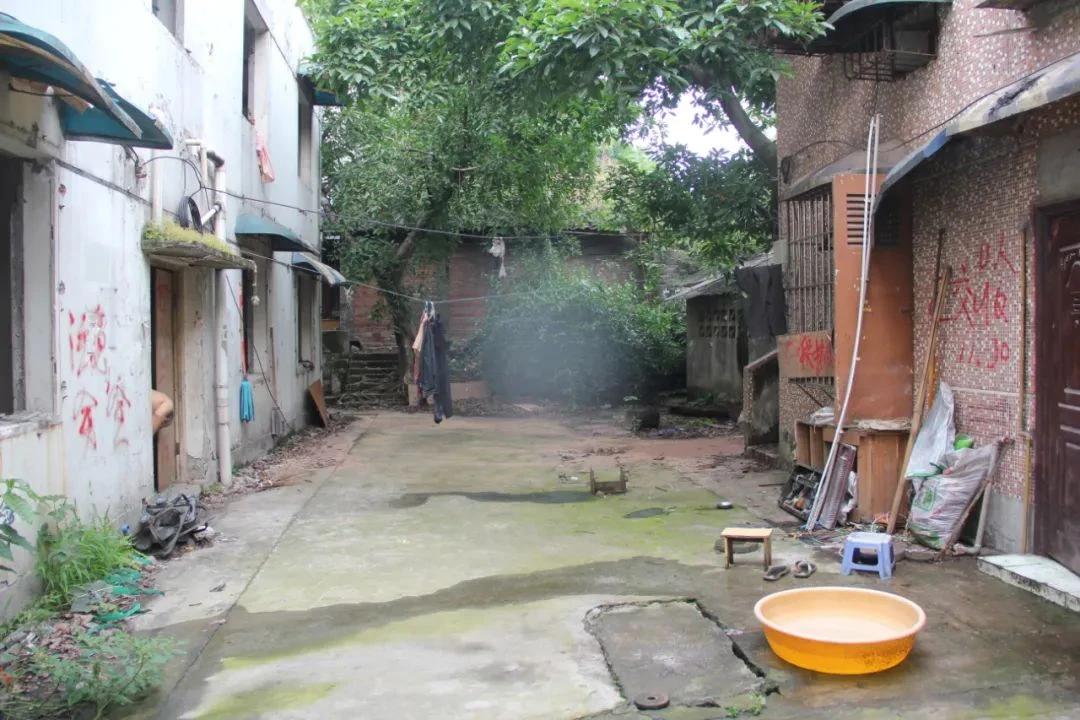
Undoubtedly, the residents who moved in, over several generations, filled these small buildings—rich with the atmosphere of the Republic of China—with too much worldly hustle: besides the dense web of utility wires in the sky and illegal structures haphazardly built on the ground, there was also endless sewage flowing everywhere and garbage with no proper place. Even several of the small buildings had become dilapidated or dangerous due to various reasons.
Yet even so, the area still retained a charm—beyond the humanistic and heritage value of the small buildings, the architecture and overall environment displayed the aesthetic of the Republic of China: green trees casting shade, moss in quiet seclusion, gray bricks and black tiles, stone steps and red walls. Moreover, although located in the bustling city, its unique elevation creates a relatively private and enclosed area on the hill, offering a remarkably tranquil atmosphere amidst the noise.
02 A Challenging Restoration and Renovation
In 2016, the Ma'anshan area was listed as one of Chongqing's 28 traditional style neighborhoods and one of Yuzhong District's 10 traditional style areas as a key project. The Kangxiang Company was responsible for planning and construction, dividing it into eastern and western zones.
Although the total construction volume is only about 28,000 square meters, it is undoubtedly not a small project.
The western zone was built first, which includes the former residence of Shen Junru and several surrounding Republic-era small buildings. Among them are one municipal-level heritage site, six heritage points, one historic building, and two style buildings, forming a unique historical scene together with the environment—totaling about 7,000 square meters.
According to the engineer responsible for surveying the area at the time: "When we first walked in here, our first impression was not the buildings, but the swarms of mosquitoes and garbage scattered everywhere. Those mosquitoes were huge—when they saw us, they attacked like wild beasts seeing food." At that time, Ma'anshan gave the impression of a "forgotten area in the midst of busy streets," with dilapidated buildings, overgrown weeds, rampant mosquitoes, lack of supporting facilities, severe fire hazards, and generally poor living conditions.
What was even more difficult was the countless contradictions that needed to be resolved during the construction process—including the building style, construction scale, and conflicts between building protection and restoration and new business types, contradictions between height control in regulatory plans and functional use, conflicts between construction scale requirements and land ownership, elimination of fire safety hazards, insufficient supporting urban pipelines, and contradictions between protection and restoration and insufficient parking facilities, among other issues.
Making this place a "Chongqing Humanities Reception Hall" was no small challenge.
03 Organic Renewal of the Urban Area
By then, the condition of the buildings in Ma'anshan was already worrisome, with severely aging underground pipelines, basically reduced to a shantytown. Therefore, drawing on excellent practices from advanced domestic regions, urban renewal characterized by "preserve as much as possible" and "micro-renewal" was put on the agenda. In practice, the responsible party, Kangxiang Company, adhered to a work philosophy of "integration of five states (cultural state, ecological state, morphological state, industrial state, and commercial state)" throughout the restoration and protection process.
"The connotation of community building goes beyond merely upgrading urban functions. We focus on inheriting the unique cultural context of this area and preserving the historical sense deposited in the old renovation area," Kangxiang Company said in an interview. In fact, when they took on this project, they considered many renovation ideas, but after repeated thought and struggle, they ultimately decided not to play tricks or sell gimmicks, but to be honest and respect the culture.
Thus, the planning concept for the Ma'anshan·Tangli project is: clearly position the cultural character, truthfully present the cultural appearance, and fully highlight the cultural brand. The inherent elements of Ma'anshan itself constitute its "character"; what is now presented through design and implementation is its "appearance"; the combination, collision, inheritance, and empowerment of old and new jointly create the "brand" of Tangli.
This description is too theoretical. To express it in more direct action language, the strategy is: "heritage restoration, style renovation, environmental improvement, and hazard removal." Different methods are applied to different character elements in specific designs to empower the traditional style area.
Kangxiang Company defines this planning approach as "organic renewal of urban areas based on the protection of traditional style neighborhoods."
04 Faithful to the Old, but Superior to the Old
On July 20, 2017, renovation work on the western zone of the Ma'anshan·Tangli project began.
First was the cleaning of the entire environment. "This is a task of 'protective restoration, removing the false to preserve the true'!" Kangxiang Company believed. Because there were so many illegal structures within the project, distinguishing original buildings from illegal additions was not easy. After demolishing the unauthorized constructions within the area, Kangxiang Company implanted the planning concept of "protect heritage, continue the cultural vein, and inherit culture" into buildings based on their historical value and current quality, restoring the historical and cultural style of "gray bricks, black tiles, green trees, and red walls," preserving the alleyway spaces and architectural features in their original flavor.
In spatial planning, regarding the spatial texture, Kangxiang Company followed the principle of "protect the original, dredge the meridians." Based on original building spacing and spatial scale, they controlled the spacing scale of the entire block, adopting a method of "not lower than plus slightly higher than" for restoration. In fact, this is the basis for restoring the original orderly conditions of the historical scenes to the greatest extent.
When it came to greenery and plants, they followed the principle of "protect the native, present authentically." Except for the ubiquitous weeds that were cleared, most trees remained in place, with only a few undergoing protective transplantation. Facilities such as flower beds, railings, stairways, and retaining walls were restored to their old appearance, recreated in a scene-reproduction manner.
The major changes were actually in the supporting systems. Whether it was the redesign, planning, and installation of underground pipelines, or the construction of facilities for transportation, fire safety, municipal services, and parking, all were aimed at meeting the requirements for building new core appeal—under the premise of protection and restoration—to satisfy the new era, new business types, and new demands.
Faithful to the old, yet superior to the old.
05 From Noise to Tranquility, Just One Flight of Steps Away
To date, the restoration of the western zone of the Ma'anshan·Tangli project is nearly complete. The concept of "presentation of original appearance" that has been defined throughout the implementation has truly been realized. After removing the former illegal structures and flowing sewage, as you walk up the stone steps and enter this neighborhood rich in Anti-Japanese War and united front cultural heritage, and then examine it carefully, you cannot help but exclaim, "What a treasure!"
From the perspective of location and terrain, it is an obvious core downtown area, precisely on the central axis of Yuzhong District, right behind the People's Great Hall. It commands a typical mountain city terrain from a high vantage point, and was once a commanding height between Pipa Mountain and Zengjiayan, offering panoramic views in all directions. According to Chen Shuaifo, chairman of the Chinese Feng Shui Association, regarding the feng shui of Chongqing: Pipa Mountain is the ancestral mountain, and Ma'anshan is the third highest peak, descending from the ancestral mountain along the terrain, winding and rising again. The title "treasure land" is well-deserved.
From a spatial perspective, although Ma'anshan is located in a busy downtown area, its unique elevation creates a relatively private and enclosed area. Coupled with large trees providing shade, it embodies a unique forest ambiance in the city center. Its internal paths and stone steps wind up and down, connecting different levels of platforms, forming alleys that are deeply local and friendly, characteristic of the mountain city.
From an environmental viewpoint, within the Ma'anshan area, there are many large trees with a diameter at breast height exceeding 25 centimeters. The small buildings, full of Republic-era charm, are nestled among lush woods. Everywhere you see original moss-covered and plant-covered railings, retaining walls, stairways, stone steps, and brick walls. Winding paths lead to secluded spots, and the scenery changes with every step—if you climb the steps from the Great Hall, you will inevitably feel as if you have suddenly entered a quiet forest from a bustling world.
From noise to tranquility, just one flight of steps away.
Not to mention the profound history and humanistic accumulation that this place originally carries.
06 Nothing Has Ended Yet
In fact, for Ma'anshan, it is far from over.
If the western zone focuses on the restoration of heritage and historical buildings, and its future business types will tend more toward leisure commerce centered on culture, cultural creativity, and low energy consumption, then the eastern zone will satisfy all business types related to leisure and tourism. For Kangxiang Company, they hope that the future tone and temperament of Ma'anshan will be elegant yet inclusive.
Because of this, in the guidance system for Ma'anshan, they only reinforced signage at a few entrances. Although as the owner, they certainly want to welcome guests from all over, they prefer to create a strong contrast of tranquility within activity. After all, this is not just a simple tourism project; more than that, it is about the dignity and splendor recorded in time and history.
In the mother city of Yuzhong District, there are many places like Ma'anshan. As we wrote earlier in this article, the scattered clusters of ancient buildings are like the spiritual symbols of various eras of this city. The renewal and growth model of the Ma'anshan neighborhood this time also provides rich exploratory experience for the renovation of more such buildings. We cannot describe it as a template, but in a situation where available land for urban planning is limited and the city's borders cannot be expanded further, the inward development of the city, the organic renewal or even iteration of neighborhoods or areas—especially those involving cultural inheritance and even the continuation of the urban context—are undoubtedly demonstrative.
Nothing has ended yet.
Everything has just begun.


