The Story of Shangqing Temple (Part 2): A City's Glory and Epic
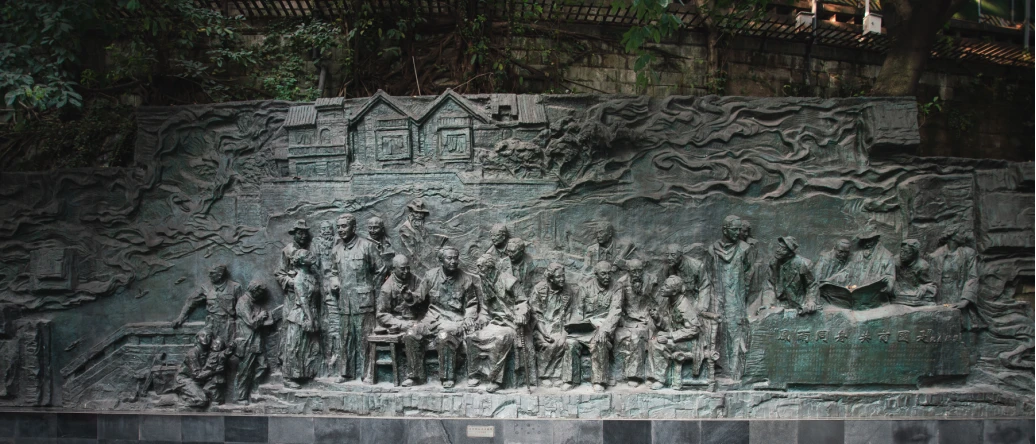
Through storm and stress, we deliberate on national affairs. Image source: You Like.
On September 18, 1931, the Sino-Japanese War began. On July 7, 1937, the Marco Polo Bridge Incident triggered the full-scale outbreak of the war. On November 20, 1937, the Nationalist government issued the "Proclamation on Moving the Capital to Chongqing." Subsequently, Chongqing became the wartime capital. The national government relocated to Chongqing, and the entire Nanjing Nationalist government moved there, with the main government departments concentrated within a two-square-kilometer area centered on Shangqing Temple.
It was from this moment that Shangqing Temple stepped onto the stage of history.
On August 22, 1939, the southern suburbs of Chongqing were bombed by Japanese forces. Amid the thick smoke, civilians scrambled for ferry boats to escape. Image source: Sanlian Life Weekly.
01 The Unyielding Spirit of Shangqing Temple
In that era, Shangqing Temple was unequivocally the national center of the War of Resistance. Countless orders to resist foreign invaders were issued from here. At the same time, it served as the hub of the International Anti-Fascist Allied Forces theater and an important stage for the United Front against Japan.
On September 28, 1939, a formation of Japanese bombers attacking Chongqing. Image source: Sanlian Life Weekly.
For this reason, from February 1938 to August 1943, the Japanese launched a frenzied five-and-a-half-year bombing campaign against Chongqing, with Shangqing Temple as a primary target. The air-raid shelters now located along Liziba were built for that era.
As people living in peacetime, it is hard for us to imagine the brutality and grief of those years. On May 3 and 4, 1939, during two days of Japanese bombing, countless Chongqing civilians were killed or wounded, an event known as the "May 3rd and May 4th" Great Bombing.
The very next day, on May 5, 1939, the Nationalist government at Shangqing Temple declared Chongqing a directly-administered municipality, signaling to the world China's determination to fight the war to the end.
In the 1940s, a national restaurant continued business amid the ruins of Chongqing.
On December 23, 1941, the Sino-British-American Joint Military Conference was held in Shangqing Temple, marking the Allies' shared will to resist the enemy.
On January 2, 1942, the Allied China Theater Command was established in Chongqing, with Qiujing Middle School serving as the Allied headquarters, directing millions of Allied troops in East Asia against Japan.
In February 1942, a telegram titled "To the Officers and Soldiers Entering Burma" was sent from Shangqing Temple, inspiring hundreds of thousands of Expeditionary Force soldiers on the Yunnan-Burma front.
On January 11, 1943, the United States and Britain issued statements renouncing their unequal treaties with China. The Nationalist government signed "new treaties" with these countries at Shangqing Temple, thereby abolishing most of the humiliating treaties imposed on China since the Opium War.
In 1943, Chiang Kai-shek shook hands with General Joseph Stilwell during an inspection of the Chinese Expeditionary Force.
On September 1, 1945, the Nationalist government announced from the Central Radio Station at Shangqing Temple to the world the establishment of the "Taiwan Administrative Office." The first chief executive, Chen Yi, declared nationwide: "From today, Taiwan and the Penghu Islands officially re-enter Chinese territory. I hereby report this historic event to all Chinese compatriots and the world." Image source: CCTV News.
With heartfelt devotion, I pledge my blood to my country.
In times of great change, Shangqing Temple stood unyielding.
02 Weaving the United Front
Only the united front's wall of solidarity could save China, which was retreating on all fronts.
On January 16, 1939, in accordance with the decision of the Sixth Plenary Session of the Sixth Central Committee of the Communist Party of China, the Southern Bureau of the CPC Central Committee, with Comrade Zhou Enlai as its secretary, was formally established in Chongqing. No. 50 Zengjiayan, though rented under the private name of Zhou Enlai (Deputy Minister of the Political Department of the National Military Council), was known as "Zhou's Residence." In fact, it served as the office of the Southern Bureau within the city.
It was here that the comrades of the Southern Bureau spent countless sleepless nights. Ye Jianying, Qiao Guanhua, Gong Peng, and others, all in their prime, were also permanent residents of this building.
The square in front of Zhou's Residence before renovation. Image source: Luo Dawan.
The square after renovation. Image source: Wang Huan.
Especially after the outbreak of the "Southern Anhui Incident" in 1941, cooperation between the Kuomintang and the Communist Party was damaged, and the Anti-Japanese National United Front was in peril. Political parties and individuals outside the two major parties who advocated resistance against Japan urgently sought to unite.
Between 1941 and 1945, the Southern Bureau often held discussions with literary and performing artists at No. 50 Zengjiayan in Shangqing Temple. They organized large-scale performances during Chongqing's foggy season (from October to May of the following year). This public performance series lasted for four sessions, staging more than 100 plays, known in history as the "Fog Season Performances." This not only became a golden age in Chinese theater history but also greatly stabilized the Anti-Japanese National United Front at the time, winning more support for the Communist Party.
The balcony of No. 50 Zengjiayan overlooking the Jialing River.
Near the end of the War of Resistance, Zhou Enlai once said: "Before 1945, only the cultural and educational circles leaned toward us. Now, industrial and commercial circles are also leaning toward us... The united front work can be said to have been very successful."
Throughout the war, high-level negotiations between the Kuomintang and the Communist Party regarding military clashes, cooperation against the enemy, and coalition government took place intermittently in Chongqing every year.
The Southern Bureau mainly bore the responsibility of representing the CPC Central Committee in negotiations. Many negotiation plans, methods, and strategies were studied by the Southern Bureau and approved by the CPC Central Committee. Leaders of the Southern Bureau such as Zhou Enlai, Ye Jianying, and Dong Biwu often directly participated in negotiations, maintaining cooperation within limited boundaries. Shangqing Temple became an important venue for easing relations and bridging differences.
No. 50 Zengjiayan after being bombed by Japanese planes.
On December 8, 1941, the Pacific War broke out. This event changed the world political landscape and balance of power, and had a huge impact on the situation in China at that time.
For this reason, Comrade Zhou Enlai often met with foreign diplomats, aid agency personnel, and journalists at Shangqing Temple, accompanied by leaders and staff of the Southern Bureau. They made many foreign friends and used a large amount of facts and written materials to explain the Communist Party's contributions to the war.
In 1944, influenced by the Southern Bureau, a Chinese and foreign journalist delegation and a U.S. military observation group visited Yan'an. The Communist Party of China had already extended its influence to the international community.
At that time, many prominent figures gathered in Shangqing Temple. One person, known as the "Mengchang" of Chongqing, deserves to be remembered.
Near the Shangqing Temple traffic circle was a residence called "Teyuan," the former home of Xian Ying, a famous patriotic democratic figure during the war. Because Xian Ying's style name was "Tesheng," it was also called "Teyuan."
Monument commemorating the founding of the Comrades' Association of the Three Principles of the People. Note: On October 28, 1945, the Comrades' Association of the Three Principles of the People was established at Teyuan in Shangqing Temple, Chongqing.
At that time, under the political pressure of the Kuomintang, many people were unwilling to have contact with the Communist Party, let alone provide venues for Communist activities. At the end of 1938, Dong Biwu and Zhou Enlai came to Teyuan to visit Xian Ying with some trepidation.
Although Xian Ying was known as "Mengchang," given the circumstances, Zhou Enlai still tested the waters. To his surprise, Xian Ying said frankly: "Tesheng has long had the ambition to serve the country. Today, Mr. Zhou and Mr. Dong have been so sincere. For the sake of national survival, I am willing and unafraid."
Thereafter, Teyuan became an important venue for the Southern Bureau to carry out united front work in Chongqing. Thanks to the efforts of Xian Ying and the Southern Bureau, democratic figures exchanged ideas here, and democratic forces were united.
04 A Home of Democracy for the People
China currently has eight democratic parties. Among them, the China Democratic League and one of the predecessors of the Revolutionary Committee of the Chinese Kuomintang, the Comrades' Association of the Three Principles of the People, both originated in Shangqing Temple. Therefore, Shangqing Temple is known as the cradle of China's democratic parties.
In 1941, the China Democratic Political League was established at Teyuan, later renamed the China Democratic League. When Chairman Mao visited Chongqing for negotiations, he came to Teyuan three times to discuss national affairs with Zhang Lan, a famous patriotic democratic figure and leader of the China Democratic League, and Xian Ying.
(Note: The latest research indicates Mao Zedong visited Teyuan six times, three of which were to meet Zhang Lan. However, for accuracy, it is often said that he visited Teyuan three times to meet Zhang Lan.)
Monument commemorating the founding of the China Democratic League. Note: In March 1941, the China Democratic Political League was secretly established in Shangqing Temple, Chongqing, and was renamed the China Democratic League in September 1944.
It was here that Chairman Mao said with deep feeling: "This is the home of democracy, and I have come home. Today we gather in the 'Home of Democracy.' In the future, let us work together to live in a democratic country."
To commemorate Teyuan's contribution to the revolutionary cause, Dong Biwu proposed honoring Teyuan with the title "Home of Democracy." Later, Feng Yuxiang personally inscribed the plaque "Home of Democracy." When Chairman Mao attended Xian Ying's 60th birthday banquet, he saw the four characters "Home of Democracy" at the entrance of Teyuan and praised: "Named by Mr. Dong, inscribed by General Feng, and presented with a couplet by Mr. Zhang—truly three perfections!"
It is worth mentioning that in the 1960s, Teyuan was unfortunately destroyed by a fire, with almost all buildings burned down. The plaque was saved by Xian Ying's eldest son, Xian Jijian, who rushed into the fire at personal risk. It is now a national first-class cultural relic, stored at the Red Rock Revolution Memorial Hall.
The establishment of the Jiusan Society was influenced by Chairman Mao during the Chongqing negotiations. Chairman Mao met with professors from Central University and Chongqing University, as well as Xu Deheng and his wife Lao Junzhan, at Shangqing Temple. Learning that they had established the Jiusan Forum on September 3, but were concerned about being "few in number and having little influence," Chairman Mao said: "It doesn't matter if you are few; you are all representative figures. By frequently expressing your opinions in newspapers, don't you also have a great propaganda effect?" At the same time, he encouraged them to turn the forum into a permanent political organization.
Inspired and encouraged by Chairman Mao, the Jiusan Society was prepared on January 6, 1946, and officially established on May 4, 1946.
Similarly, the China National Democratic Construction Association, primarily composed of patriotic industrialists and businessmen, was also founded under the influence of the comrades of the CPC Southern Bureau. Premier Zhou Enlai once gave a speech titled "The Current Economic Situation" at a gathering of patriotic industrialists and businessmen.
05 Traditional United Front Education Base
Democracy is not a thing of the past; it is ongoing.
In March 2004, the United Front Work Department of the CPC Central Committee decided to establish the first "Traditional Chinese United Front Education Base" in Chongqing, creating a united front propaganda and education network with the "Teyuan·China Democratic Party History Exhibition Hall" as its flagship.
The project was completed in two phases. On March 12, 2008, the China Democratic Party History Exhibition Hall, relying on the old buildings of Teyuan, officially opened. In March 2011, the second phase, including the new building of the China Democratic Party History Exhibition Hall, was also completed and exhibited.
Inside the Teyuan Memorial Hall, there is a commemorative album that feels especially warm and precious. It originally belonged to Xian Jizhen, a student of Jinling University in Chengdu.
During the war, Xian Jizhen admired these democratic figures deeply. Every time she returned home from school, she would take out this album and ask visiting celebrities to write inscriptions. The album contains autographs of Zhang Lan, Shen Junru, Feng Yuxiang, Guo Moruo, Tao Xingzhi, and others—a testament to democracy's infiltration into people's hearts at that time.
The yearning for democracy stirred the hearts of young people then. And the CPC Southern Bureau at that time was the greatest driving force behind this democratic process.
Today, this is the only comprehensive exhibition hall in China that fully reflects the system of multi-party cooperation and political consultation led by the Communist Party of China. In May 2013, Teyuan was listed as a National Key Cultural Relics Protection Unit. In 2020, Teyuan was designated as the third batch of National-Level Anti-Japanese War Sites.
This suffices to comfort the soul of Xian Ying in heaven.
It continues to contribute energy to the united front and democracy of the Republic.
06 Comrades-in-Arms Came to Shangqing Temple as Well
The war against fascism was a glorious war of justice and unity.
On December 7, 1941, Japan attacked Pearl Harbor, and the Pacific War broke out. Subsequently, the United States declared war on Japan. The Allied nations decided to establish the China Theater, with Chiang Kai-shek as Supreme Commander and Joseph Stilwell as Chief of Staff.
Amid the war, Stilwell came to Chongqing and lived in the residence of the Chief of Staff of the Allied China Theater Command, near the current Shangqing Temple and Liziba light rail station.
Stilwell's former residence. Image source: Luo Dawan.
The residence was built on a hillside, with more than ten rooms of various sizes. Besides living quarters, it was often used as an office. Besides General Stilwell, his adjutant and aides also lived here.
During this time, many Chinese and foreign military and political figures, such as Lord Louis Mountbatten, Supreme Allied Commander of Southeast Asia, and General Brehon Somervell, U.S. Army Chief of Logistics, came here to discuss military matters and sometimes even stayed overnight.
Stilwell Memorial Museum.
The establishment of the China Theater provided a coordination and command center for Allied forces in Burma, Thailand, and India, playing a crucial role in combating the Japanese.
Today, the former residence of General Stilwell has become the only museum in China named after a foreign soldier—the Chongqing Stilwell Museum. It was built to thank General Stilwell for his help to the Chinese people during the War of Resistance.
Another small building on the three-tiered road in Liziba, Shangqing Temple, belonged to the "Flying Tigers," heroes in the hearts of Chongqing people at that time.
Flying Tigers fighter jets taking off.
Rescue medal awarded to Flying Tigers pilots by the Nationalist government.
In 1941, Claire Lee Chennault, entrusted by Chiang Kai-shek, formed the American Volunteer Group to join China's War of Resistance. With support from the Roosevelt administration, Chennault recruited U.S. pilots and mechanics under a private organization, offering high salaries, to fight as civilians.
These were the "Flying Tigers" of the War of Resistance.
On August 1, 1945, when Chennault left Chongqing, the streets were filled with crowds. They were seeing off the hero who had helped them withstand the bombing of Chongqing.
Chongqing citizens bidding farewell to Chennault.
07 The Double Tenth Agreement: A Brief Peace
In 1945, the Chinese people drove out the invaders, but lasting peace had not yet arrived.
On September 3, 1945, in Chongqing, the Japanese formally surrendered to China. U.S. troops stationed in China participated in the victory parade. Chongqing citizens lined up and performed dragon dances to pay tribute to their true allies who had helped them.
Two small buildings in Shangqing Temple bear witness to that distant history, when the nation and its people were in a complex mood of joy and tension.
They were the core area for Kuomintang-Communist negotiations. One is now Building No. 2 of the CPC Chongqing Municipal Committee compound at No. 36 Zhongshan Fourth Road. At that time, it was Chiang Kai-shek's private residence, also known as "Meiling Villa." During the 1945 negotiations, the representatives of the two parties held four meetings here starting from September 27.
At Guiyuan, the two sides signed the famous "Summary of Talks between the Government and the Communist Party Representatives," i.e., the "Double Tenth Agreement."
The second is Guiyuan, now located at No. 65 Zhongshan Fourth Road, Shangqing Temple. Originally the residence of Zhang Zhizhong, during the Chongqing negotiations, Zhang Zhizhong prepared it as Chairman Mao's office and reception venue in the city.
More than ten days later, on October 10, Chairman Mao and Premier Zhou Enlai signed the "Minutes of the Meeting between Representatives of the Kuomintang and the Communist Party" here on behalf of the Communist Party, which became the famous "Double Tenth Agreement" in Chinese revolutionary history.
Guiyuan. Image source: You Like.
Interior of Guiyuan. Image source: Luo Dawan.
Chairman Mao once commented on the agreement: "The first benefit of this agreement is that it was formally signed by both sides on an equal footing, which has never happened in history."
This brought a brief period of peace to a China that had endured so much hardship.


