In the Mountains of Shangqing Temple, Chongqing's Urban Essence and Thousands of Tons of Liquor Are Hidden
This is one of the greatest pains in Chongqing's history.
On September 18, 1931, the Sino-Japanese War began;
On July 7, 1937, the Marco Polo Bridge Incident triggered the full-scale outbreak of the Sino-Japanese War;
On November 20, 1937, the Nationalist government issued the "Declaration on Moving the Capital to Chongqing," and shortly thereafter, Chongqing became the wartime capital.
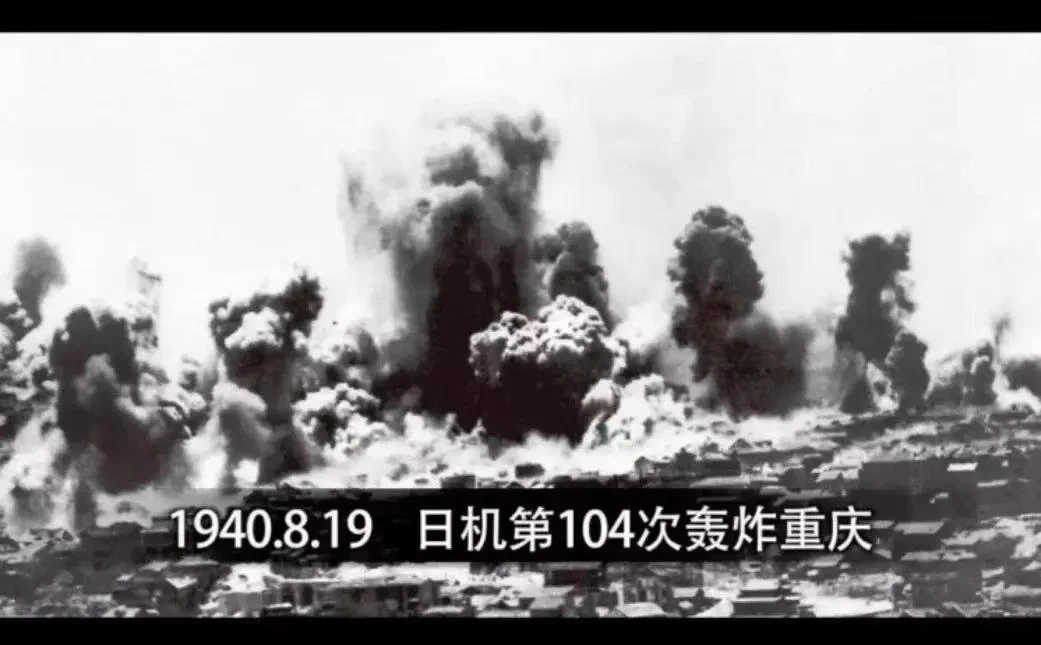
From February 18, 1938, to August 23, 1943, Japan carried out a strategic bombing campaign against Chongqing, the wartime capital of the Republic of China, lasting five and a half years.
According to incomplete statistics, over those five years, Japan bombed Chongqing 218 times, dispatched more than 9,000 aircraft, dropped over 11,500 bombs, caused the deaths of more than 10,000 people, destroyed over 17,600 buildings, and devastated most of the city's prosperous areas.
This is the "Great Bombing of Chongqing," etched into the marrow of every Chongqing native.
Shangqing Temple was the national command center for the War of Resistance during that era. The main departments of the Nationalist government were concentrated within a two-square-kilometer area centered on Shangqing Temple, making it a prime target for Japanese bombers.
And the air-raid shelters, represented by those in the mountains along the Niujiaotou to Liziba area, scattered across Chongqing's map, were the final and most robust barrier protecting all of China. Thanks to the shelter of these air-raid tunnels, the people of Chongqing and China had the confidence to roar that earth-shattering slogan: "The more we are bombed, the stronger we become."
Calvino said that cities do not reveal their past; they hide it like fingerprints, written in the corners of streets, the grilles of windows, the banisters of stairs, the lightning rods and flagpoles—every mark is a trace of scratching, sawing, chiseling, and hammering.
As you drive past, from Liziba to Niujiaotou, you can always see those deep air-raid shelters, built along the northern cliff of the Eling Park mountain, about a dozen or so. Outsiders rush by, perhaps only marveling at the fantasy of the train passing through the building, but they do not know that if they just extend their steps a little to the left or right, they will encounter even more enchanting scenes, mysterious and profound.
They even less know,
That hidden here is the deep memory of Chongqing's past.
And thousands of tons of liquor.
This is because in peacetime, the air-raid shelters have lost their original functionality and have quietly transformed, integrating into the everyday life of Chongqing people. They perfectly blend with the local lifestyle and character: wine cellars, hotpot restaurants, garages, noodle shops, trendy eateries...
Inside the caves lies the most authentic life and raw character of Chongqing people, as well as silent remembrance of the past.
And the air-raid shelters along the Liziba to Niujiaotou line have caught the eye of many liquor merchants, who have turned them into a street of wine cellars—under a two-kilometer-long cliff, cellars line up one after another.
01 The Time Law of Gujiu Cellar
The cellar owner, surnamed Zhao, has a crew cut, large and strong hands, and speaks little. According to him, there are two types of cellars in this area: one is completely enclosed, and the other has a front hall as an experience center, with the deeper parts of the cave hiding large quantities of wine. In his view, the success of cellar-stored liquor depends on two keys: one is the quality of the liquor itself—pure grain brewing and high alcohol content are the foundation; the other is the most mysterious element—time.
Aged liquor is like an old friend, unattainable without the tempering of countless years. Boss Zhao firmly believes this. An old friend is also like aged liquor, quietly waiting there. After a night of clinking glasses, it won't give you a splitting headache, dry mouth, or parched throat. Its softness and mellowness embrace you like the calloused hands of an old friend, silent yet passionate; sometimes, on the turbulent sea of your emotions, it accompanies you as you traverse the world and speak of the universe.
Inside the cellar, there are many sealed small jars, with names and dates written on the tops. These are wines bought by customers, stored for themselves, friends, or family. Boss Zhao proudly says he also has a batch of such wine stored, not for sale. When old friends come, he brings them out; at that point, price is no longer important, and the drinkers understand—they value the bond.
In an era of overflowing friend circles, within the fragrant mist of wine at Shangqing Temple, the friendship of old friends still follows the ancient law of time.
02 The Zen-Like Management of Xiangdi Wine Cellar
About a hundred meters from the "Century-Old Gujiu Cellar" is Xiangdi Wine Cellar, run by Yu Bin—a paradise for red wine.
As soon as you enter the cave, you feel as if you've instantly traveled through time, transported to the rustic cellar of a Burgundy farmer in northeastern France. On the right side inside the cave, a two-tier display stand of brick red extends deep into the shelter, with hundreds of wine bottles arranged in rows at an angle. The dim yellow light evokes a quaint and romantic atmosphere.
But the black-and-white old photos on the cave walls remind us that this is not France, but Chongqing's air-raid shelters with a heavy past. The roar of warplanes streaking across the sky, troops standing solemnly ready, warships sailing on calm seas, the Sichuan-Yunnan Highway like a great snake on the earth, General Stilwell, and those rare innocent smiles... The sounds and emotions of history surge and linger in our minds.
Yu Bin's story brings us back from the depths of history to those distant nights associated with wine.
Twenty years ago, at the turn of the millennium, even the Nine Streets of Guanyin Bridge were not yet in their infancy. At that time, the Deyi World in Jiaochangkou was the only paradise for wine lovers. A young lad, Yu Bin, walked through various nightclubs, selling wine on commission, witnessing the flashing lights and glamour.
Later, as Yu Bin grew older, he rarely went to nightclubs, preferring quiet gatherings with a few friends.
Hotels and group purchases are Yu Bin's main customer base, so the operating hours of Xiangdi Wine Cellar are quite casual, as indicated by the small wooden sign at the entrance: "Opening hours depend on mood." Yu Bin says the place is open five or six days a week, but for short periods, two to three hours, with no fixed time—morning, noon, or night.
All encounters depend on fate. Yu Bin remembers one night two years ago, a female teacher tourist from Guizhou, troubled by family and romantic issues, came to Chongqing for a change of scenery. Perhaps the sight of the monorail passing through the building wasn't enough to dispel her melancholy. She strolled into Xiangdi Wine Cellar, mistaking it for a bar, and began drowning her sorrows, insisting on chatting with Yu Bin.
Wine spread through the night. Yu Bin has seen too many heartbroken people drowning their sorrows, but he knows that wine cannot relieve sorrow; the sad person just needs someone to listen patiently. In the end, the Guizhou tourist drank two bottles of red wine, and Yu Bin quietly listened to her for two full hours.
Then the tears stopped, and she vanished back into the night and the mundane world.
03 The Decade-Long Wait of Jiangshang Mingzhu
Along the line from Niujiaotou Station of Shangqing Temple to Liziba and Fotuguan, Jiangshang Mingzhu is unquestionably the top cellar. Walking along that stretch, their sign appears at cave entrances no fewer than ten times: Wine Cellar No. 1, No. 2, No. 3... And when we entered their largest air-raid shelter wine cellar, the scene was truly that of a pearl rising over the river, with a universe hidden inside the cave.
The cave is not wide—three or four meters at its broadest, two or three at its narrowest. Since it is a completely enclosed cellar shelter, the interior landscape is raw and rugged. At some turns, exposed dark red mountain rock reminds us that we are truly deep beneath the mountain peak. At that moment, imagining our fragile body tightly wrapped by the massive mountain, a feeling of oppression makes the heart race, while also giving rise to a power and exhilaration that tries to break free from constraints.
Except for a straight section at the entrance, the cave winds and twists in all directions, truly reminiscent of the mountain caves where monsters and demons lived in "Journey to the West," like a maze. Hundreds or even thousands of jin (half a ton) wine vats, as tall as a person, line the walls on one or both sides, winding along. The surface of the vats is covered with microbial communities, a sign of a good cellar environment.
The air-raid shelters are almost constantly at a stable temperature and humidity, essential conditions for cellar storage. According to the owner, Mr. Yang, he is a pioneer on this street of cellars along Shangqing Temple. In 2015, he began renting more than a dozen air-raid shelters here for wine storage. From then on, he set a long-term goal: ten years. As the saying goes, "it takes ten years to sharpen a sword." He aims to create a brand of ten-year cellar-aged liquor, hoping to let time endow good wine with mellowness.
The magic of cellar wine lies in hope and waiting. Mr. Yang is currently implementing a project in which he forms long-term partnerships with some wine enthusiasts to store wines aged over ten or twenty years—such as Nü'er Hong (daughter's wine), Zhuangyuan wine (scholar's wine), and birthday wine... The entire process from sealing to opening the jars is recorded on video. For example, recordings might capture parents bringing children to store wine, and later opening it on their wedding day or when they pass the imperial exams. At that moment, time, expectations, and blessings are all contained in a glass of mellow wine—perhaps something that no amount of valuable wine can replace.
Mr. Yang says, like true feelings, if you store and cherish it well, the wine will not spoil, and its value will always be there. So he is willing to wait, to look forward to the arrival of the first decade, and to an infinite future.
04 The Thousand Faces at the Internet-Famous Air-Raid Shelter
Just diagonally below the Liziba monorail passing through the building, there is a cave with a sign reading "Air-Raid Shelter" that is somewhat special. It not only stores wine but also holds the various lives of Old Zhou and many others.
This is a nostalgic snack shop that has become an "internet-famous landmark." Old Zhou is the manager of this shelter, calling himself "the Cave Master."
The decoration of Old Zhou's shelter is quite ingenious. The two walls at the entrance are made into a wish wall, colorful and layered in the distance, immediately lifting the mood and inviting entry. Further in, on the right, there is a fork with a sign reading "Republic of China Textile Factory," briefly indicating the cave's past and present.
Going deeper, three swings inside the cave attract visitors to play. Naturally, these swings cannot swing high, but as a place to idle in the cave, they have a unique charm. Handsome men, beautiful women, the elderly, and children all rush to try them and take photos, everyone enjoying themselves tirelessly.
Not far from the swings, there is a peculiar fork. Looking inside from the fork's entrance, the light is dim, a mix of pink and blue, and the path is narrow, barely enough for two or three people to walk side by side. We eagerly step into it, feeling as if we've accidentally entered a time tunnel. After a turn, we hear the sound of water dripping in the darkness, falling into a small pool, creating a mysterious atmosphere. According to Old Zhou, this is a clever solution to the problem of water seepage inside the shelter—water should be channeled rather than blocked—and incidentally, it creates a small landscape for exploration.
The cave is filled with the taste of old Chongqing and childhood: square wooden tables, floral tablecloths, bubble gum, Zhenzhibang candy, stinky tofu...
Old Zhou spoke enthusiastically about these furnishings. He has reason to be excited. In the first half of his life, he made renderings; although they were three-dimensional and colorful, those scenes were ultimately on paper. Industry pressures forced him to leave his original job, but who knew this would be a leap from paper to a more colorful reality? Seeing people come and go every day, with real stories and emotions released here, he prefers his current life—truly a case of "when one door closes, another opens."
Not long ago, an elderly couple visited the cave. They tenderly stroked the blue stone walls, observing with unusual detail. Through conversation, Old Zhou learned that the couple had participated in the expansion of this air-raid shelter when they were young.
This shelter was built in 1938 and was expanded once in the 1970s. The old couple, revisiting the place and seeing it reborn, were emotionally stirred. Old Zhou cherishes such encounters; he feels that these stories and emotions cannot be read in books. Only in specific time and space can we understand the preciousness and wonder of human encounters.
Conclusion: Caves and Civilization
Emerging from the deep, dark cave, I felt as if I had descended to Earth from a strange planet.
Narrow spaces are both a limitation and a protection. Inside, you can hear your heartbeat thumping in your chest, lively and surging, resonating with the infinite universe.
This reminds me of the period between 1938 and 1943, when countless people, driven by fear, flooded into this alien space, hearing the roar of Zero fighters outside, with榴弹 (projectiles) like grains of rice hitting the ground, smoke rising everywhere, like the end of the world. But once people calmed down a little, they rekindled hope for victory.
Chongqing hides its deepest memories in the dark. And I love its restraint. Like a wise old man, if someone has heard of those times, he is happy to chat with passersby, but only briefly, not being a bore; if someone passes by hurriedly without time to stop, he remains quietly silent, waiting for another opportunity.
When I left in the evening, slightly tipsy, again transferring at Niujiaotou Station of Shangqing Temple, or pausing at Liziba Station, I found myself increasingly in love with the evening sunset, the layered mountains and rivers, and the flowing crowds.
As a hub of urban public transport, on the map, I often use this place as a center to grasp the overall direction, distance, and demeanor of this dizzying city.
It is so important that whenever I go to another city, I always try to find its equivalent of Shangqing Temple's "Niujiaotou," so that I can quickly familiarize myself with that city's orientation and its most unknown, silent face.
In fact, in Chongqing, besides Shangqing Temple and the Liziba area discussed here, there are many such air-raid shelters along Changjiang Road in Yuzhong District and in other districts of the main city. They served as Chongqing's strongest barrier during the War of Resistance, and in peacetime, they quietly transformed and integrated into the everyday life of Chongqing people, perfectly blending with the local lifestyle and character, building the unique joy of this heroic city...
Some have found other uses, while others remain silent and still.
No matter how time changes, it is undeniable that they are the common witnesses of that history, together forming the urban essence of this heroic city.


