A 6-Day Journey Through Sichuan and Chongqing: A Memory to Cherish
July 31 ~ August 8 (No activities on August 8, as it was a morning flight)
Since I traveled in summer, you can refer to my notes if you go in summer.
Total cost (including airfare, accommodation, entrance fees, and miscellaneous expenses) was about 3500~4000 RMB (my math is bad, so I don’t want to calculate it exactly. The main reason is that my outbound flight was expensive—over 1000 RMB—because it was a last-minute decision. Actually, other expenses were quite economical).
**Chengdu Jiaoliao Renwen Boutique Hotel**
The hotel’s architectural style combines movement and stillness. “Movement” is reflected in the intricate details of the hotel’s interior decoration. Birds catch your eye from the moment you enter the corridor, and bird-shaped decorations in the guest rooms echo the hotel’s name—Jiaoliao (a type of wren). “Stillness” is embodied in the antique courtyard with blue bricks and tiles, where every plant and tree is serene, each bamboo and mat exudes elegance. Every guest room has a poetic and picturesque name, as if alive and vivid!
The rooms are mostly decorated with natural wood, fresh and clean, with complete amenities: King Koil Quiet Moments co-branded mattress, Kohler bathroom fixtures, TOTO smart toilets… Various beverages, snacks, fruits, and teas are all available, giving a warm and comfortable feeling. There is also an open-air balcony where you can gaze at the nearby Kuanzhai Alley in the morning, experiencing worldly life while being detached—this is the life I desire. If you want to relax your tired body, professional spa services are available.
Breakfast is also very warm. Upon check-in, the butler asks about your dining time and taste preferences—very considerate. You can choose between Chinese and Western meals, along with fruits, dried fruits, and various pastries, delivered to your room! Full of love.
Staying here truly makes you feel at ease, enjoying this beautiful scenery and the joy of leisure!
**D1: Kuanzhai Alley**
**D2: Wuhou Shrine – Jinli – (Evening) Chunxi Road**
**D3: Qingcheng Mountain (Rear Mountain)**
**D4: Three Natural Bridges**
**D5: Longshui Gorge Ground Fissure – Furong Cave**
**D6: Baigong Mansion – Zhazidong – Ciqikou – Jiefangbei – Yangtze River Cableway – Hongyadong**
**D7: Heishan Valley**
**D8: Chaotianmen**
**D9: Pack up and leave**
**July 31 morning:** We booked a 9:45 flight, but due to air traffic control, it was delayed to 11:00. We arrived at Chengdu Shuangliu International Airport at 13:10. Then we took the airport bus (8 RMB) to Dongfu Square (right next to Line 2), then transferred to the subway (2 RMB) to Dongmen Bridge Station, and walked 10 minutes to the hotel.
Previously, I heard that Chengdu and Chongqing are extremely hot, but when we arrived, it was drizzling and sometimes not raining at all—unusually cool weather, very comfortable!
Around 15:30, we planned to visit Kuanzhai Alley (personally, I think Kuanzhai Alley is better to visit during the day; at night, the lights are too dim). When we went, there were very few people, and it was very relaxing.
**[Tips: The three alleys look like three vertical lines on the map, with a total of six entrances. Remember which entrance you came from, because you’ll need to go back to the same entrance to return.]** We didn’t remember, and later we exited from a different entrance. Since it was getting dark, we didn’t want to go back, so we took a taxi back to the hotel.
In the alley, we found a hotpot restaurant called “Three Ears” with good taste. Accompanied by elegant zither music, we enjoyed a pleasant dinner.
**The next morning:** We slept in a bit and left the hotel around 9:00. We bought breakfast at the supermarket downstairs, and the highlight was having the long-awaited Chengdu yogurt—highly recommended.
We took the bus to Wuhou Shrine. The bus stop was right at the shrine. (The ticket seller didn’t check my student ID! I just said I wanted a student ticket, and they gave it to me—you know what I mean. But of course, it’s best to have a clear conscience. Worst case, if you get checked, it would be embarrassing.)
Fascinated by the Three Kingdoms at Wuhou Shrine.
Around noon, we were hungry, so we went to Jinli Street for lunch. After visiting Wuhou Shrine, you’ll reach a large, wide open space. There are exits on both left and right. Take the right exit, and you’ll see many people. That’s Jinli. As soon as we exited, we turned left and got there—so close, right?
I didn’t even realize it at first. I just thought, “Why are there so many people and so much food?” After walking halfway, I finally understood it was Jinli. I was so silly. But Jinli was incredibly crowded!!!!!!!!!!!
Haha. After leaving Jinli, there was a bus stop right across the street. We were a bit tired from walking, so we went back to the hotel for a nap. Strangely, just a short walk made us tired—that’s not like me; I lack exercise. In the evening, we went to Chunxi Road to eat something and then strolled around. It’s a commercial street, so nothing much to say. End of the day.
**Immortal Scriptures Praise Qingcheng Peak – One-Day Trip to Qingcheng Mountain**
We originally planned to go to Qingcheng Mountain the next day, but the weather forecast predicted rain, so we moved it to the third day. Well, let me complain first: the scenery is really nice, but half a day is definitely not enough, and I’m referring to the rear mountain!!!
**[Tips: If some people want to visit Dujiangyan and Qingcheng Mountain in one day, I suggest going to the front mountain of Qingcheng. For the rear mountain, you need a full day, or it will be extremely rushed and exhausting.]**
In these scenic areas, it’s best to slow down, breathe the fresh air, and take it easy.
You might ask why I keep going to scenic spots. Well, I love mountains and water and being immersed in nature, so I’m not afraid of climbing. Haha, that’s my story of hardship.
Let me explain step by step. First, transportation: The train from Chengdu to Qingcheng Mountain costs 15 RMB each way. We booked the 6:53 train. At first, we thought it was too early, but for our tight schedule, it was the best time. After arriving at Qingcheng Mountain Railway Station, exit (there’s only one exit) and turn left. Bus 101 goes to the front mountain, minibuses go to the rear mountain, and there are also buses to Dujiangyan. All these vehicles are in one area with clear signs—no worries. You’ll also see other people; just follow them. But there will be many private car drivers soliciting—just ignore them. The transportation is very clear and not chaotic at all! Get on the minibus; it leaves when full. 13 RMB per person. If you plan to return to Chengdu the same day, pay attention to the last minibus back to Qingcheng Mountain Railway Station and make sure it connects with your train ticket. After arriving at the rear mountain, buy a ticket. If you want a discounted ticket, they will check your ID.
**[Tips: The key is to book your outbound train ticket a few days in advance (don’t hesitate). Don’t think you can buy it on the day—it will be fully booked, especially the trains between 7:00 and 10:00. Check 12306 and other sites showing remaining tickets regularly to stay informed.]**
During the hike, I entered through Feiquangou, not Wulonggou! After entering the rear mountain gate, the whole scenic area is a loop. The starting and ending points are both Tai’an Ancient Town. On the right is Feiquangou, on the left is Wulonggou—choose whichever you prefer. Personally, I don’t think it’s necessary to reach the summit unless you like being tortured, and there’s nothing much to see. Important: Pay attention to the small map on the ticket or do your homework beforehand. If you don’t want to take the cable car, be sure to look for a black line on the map that goes to Cuiying Lake (by the way, there’s a lake there where you must take a boat—2 RMB per person—it’s quite nice), then find that path to Youyi Village, then go down (toward Wulonggou). Don’t miss that black line—I missed it and ended up climbing higher and higher… and finally had to take the cable car (45 RMB per person). There was nothing to see at the top either. Climbing up was really tiring and steep. If you enter from Feiquangou, the uphill path is very steep! So those entering from Wulonggou and exiting from Feiquangou should be careful. The walking time inside the scenic area is very long… long… long… and we were pressed for time, so it was exhausting. After exiting Wulonggou, we saw a 5 RMB sightseeing car to Tai’an Ancient Town. We got on without a second thought—it was still a bit of a distance, so tired friends can consider it.
**Complaint:** After leaving the rear mountain gate, I had to complain. Our subsequent schedule required us to catch the minibus back to Qingcheng Mountain Railway Station by exactly 12:30, to make the 13:53 train. Originally, it was more than enough time! But unexpectedly, the trip in took 30 minutes, while the return took 1.5 hours!!!!! The traffic was so congested, like a snail. Reason: On a very narrow winding mountain road, many tourist buses were coming in, and we had to yield. Also, there were many farmhouses along the road, and many private cars would stop to ask about them, then back up if they didn’t like it—driving me crazy! No wonder it was so congested!!! Plus, many people drove in the morning and arrived at the scenic area at noon. So we gracefully missed our train.
**[Tips: If you miss the train, it’s okay. You can take a train to Xipu and then transfer to Subway Line 2 (starting from Xipu) to downtown Chengdu. Haha, the total fare is even cheaper than the 15 RMB. At worst, take a 2-hour-plus bus for over 20 RMB back to downtown, or take a train to Dujiangyan and then a bus.]**
Took the 18:58 bullet train to Chongqing, staying at a relative’s place. My classmate had something to do and returned to Shanghai.
**Day 5: Wulong**
Took the earliest K-train at 8:04 from Chongqing Railway Station, arriving at Wulong Railway Station around 10:15 (the last train back to Chongqing seems to be before 5:00 PM—pay attention to the time). Then headed to Wulong Bus Station.
**[Tips: Don’t take a taxi, because taxi drivers won’t take you to the bus station. Don’t believe other people’s online claim that a taxi costs 4 RMB to the bus station—nonsense!! The driver will think it’s too close and won’t bother. Same on the return. So don’t waste time, unless you’re going directly from Wulong Railway Station to Fairy Town—then they’ll take you, and carpooling with many people will be cheaper, about 25 RMB per person. We walked from the railway station to the bus station. I thought it would be far, but it was only about 10 minutes.]**
Then we bought tickets (8 RMB each) to Fairy Town. There are minibuses to Fairy Town (Visitor Center) and directly to Fairy Mountain. So make sure which one you need. The ticket seller will ask you. Many people were waiting in line, and the buses came slowly, so one person can buy tickets while the other queues. We didn’t go to Fairy Mountain this time—reportedly, it was extremely crowded and hotels were fully booked. About half an hour later, we arrived at Fairy Town.
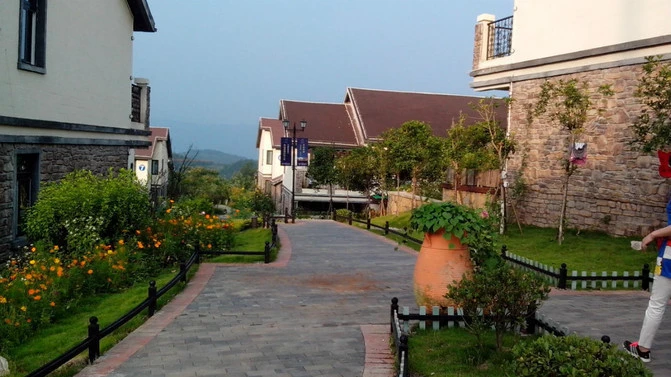
Our hotel was right next to the Visitor Center, super super super close. It was a villa complex, very beautiful, and the best part was its proximity to the center—that’s why I chose it.
There were many restaurants near the villa complex. After arriving at the hotel around noon, we grabbed a quick bite and then went to the Visitor Center to buy tickets for Three Natural Bridges.
This white pointed building is the Visitor Center.
**[Tips: For adults, I suggest booking tickets on Ctrip 3 hours in advance to save about 10 RMB. For students, buy at the counter—it’s convenient, and the seller won’t check your student ID, you know. Haha.]**
After buying tickets (the entrance fee includes the scenic area shuttle), we went downstairs where the shuttle was parked.
**[Tips: Usually, tourists go to Three Natural Bridges in the morning and Longshui Gorge Ground Fissure in the afternoon, since they are close, but that’s super crowded. We went to Three Natural Bridges in the afternoon and the Ground Fissure the next day. I can say it was so comfortable—there was no one in the ground fissure!! Really, hahaha, it felt awesome!]**
The beauty of the scenic spots is beyond words. Among all the places I visited, Wulong’s attractions were my favorite. We finished Three Natural Bridges around 4 PM, taking a leisurely pace. Then we took the free scenic shuttle back to the Visitor Center and returned to the hotel to rest.
The next day we checked out. We prepared to buy tickets for the Ground Fissure. The Visitor Center starts selling tickets at 8 AM sharp, with people already queuing. The earliest shuttle to Three Natural Bridges is at 8 AM, with many people waiting, but fortunately many shuttles. The shuttle to the Ground Fissure was at 8:30, with no queue; we boarded directly and the bus wasn’t even full. Seeing the crowd waiting for the Three Natural Bridges shuttle, I felt a bit smug, haha.
We finished around 11 AM, took the shuttle back to the Visitor Center. Then we planned to go to Furong Cave. The Visitor Center does not have a bus to Furong Cave. We needed to take an 8 RMB minibus back to the bus station first.
**[Tips: Whether you can quickly catch this 8 RMB bus back to the county depends on luck. When we returned to the Visitor Center after Three Natural Bridges at 4:30 PM the previous day, we specifically checked. First, the minibus stop is across the road from the villa complex. We saw a long line of people. When we asked, they had been waiting for 1.5 hours! I was shocked. They added that this stop is not the starting point; the minibus comes from Fairy Mountain above. If there are already passengers on board, only a few can get on, because it’s unlikely to have an empty bus at that time. Then we saw private cars nearby, and they said for ≤7 people, the total fare was 200 RMB to the bus station, or 400 RMB to Furong Cave and back to the bus station. We asked the hotel staff, and they found a private car for 150 RMB for 4 people to the bus station, or 500 RMB for Furong Cave round trip. So if you’re in a hurry to get back to the bus station, carpool.]**
But when we came back around 11 AM, we got lucky—a bus arrived just as we reached the stop, and it was empty! We had it to ourselves, haha. Arriving at the bus station, we took a public bus from Wulong to Jiangkou, paid 9 RMB (which included the fare for the minibus later), got a small ticket, and at the terminal, someone greeted us, stamped the ticket, and led us onto a small minibus (a bit beat-up, and the road was under construction, so we had to walk part of the way and then take the minibus). It took about 1 hour to tour the scenic area. Adjacent to it is Furong River—if you have time and interest, you can visit.
**Return:** Minibus + public bus. There were private cars soliciting outside; ignore them. Rushed back to the railway station to return to Chongqing.
Here’s a clear diagram [applause]!!!
In summary, Wulong in Chongqing—its management, environment, etc.—is top-notch, not chaotic at all. The scenic spots are beautiful and not too tiring to walk. You can finish one attraction in at most 2 hours.
**Day 6: Chongqing City One-Day Tour**
My brother-in-law knows Chongqing like the back of his hand, so I didn’t worry about bus and subway transfers. Haha, so I can’t remember many details. He told me to take bus 210 at Caiyuanba to the terminal (Baigong Mansion Station).
After visiting, he told me to walk to Zhazidong to experience the uphill climb of the mountain city—haha, it wasn’t that far. Seeing Zhazidong, I truly felt how great the people of that time were.
Then we carpooled with others (10 RMB per person) to Ciqikou.
After strolling through the ancient town, we ate Chongqing noodles, Chongqing yogurt, and bought Chongqing Chen Mahua—delicious! Then we took bus 808 to Liziba Station, from which we rode Light Rail Line 2 to see the moment it passes through a building.
The cableway I had been longing for.
**[Tips: Get a transportation card, and the cableway costs only 1.8 RMB!!! Yes, you heard it right!!!! But if you buy a ticket as a tourist, it’s 10 RMB per person.]**
At Jiefangbei, we also visited the food street. The braised meat skewers were delicious, and so were the hot and sour noodles. Too bad we were too focused on eating to take photos.
Dinner: He Wangshi Skewer Hotpot—haha, it was my first time eating in such a grand spread, and it was delicious.
In the evening, we went to Hongyadong. I didn’t go inside; just viewed the river and night scenery.
Oh, and Chongqing’s old-fashioned popsicles are super delicious—I kept thinking about them. I ate at least five, and they weren’t expensive.
**Day 7: Heishan Valley**
Joined a day tour booked on Ctrip, because self-guided and group tour costs were basically the same, so why bother with hassle? Originally, we were supposed to enter from the North Gate, but due to other reasons, the tour group changed to the South Gate—haha, a lucky coincidence!
**[Tips: 1. If you enter from the South Gate, you definitely don’t need to buy the 30 RMB cable car ticket (I was the only one on the bus who didn’t buy it). It’s downhill, super easy. If you enter from the North Gate, consider it—if you get tired, buy it, because it’s uphill, though the path is relatively flat. But the electric cart!!!! You must buy it—the road from the scenic area exit to the North Gate is unimaginably long!!!! 30 RMB.]**
Dinner: Sichuan cuisine.
**Day 8: Chaotianmen**
The square was under construction, so we couldn’t go up. We had to walk down along Chaotianmen Pier for quite a distance. At the end, we saw the clear Jialing River meeting the murky Yangtze River—amazing.
I hope my tips help you a lot!
**Ending:** This wasn’t my first solo trip. I was too lazy to write about my previous trips, and now I’m gradually forgetting them. I’ll add them later when I remember.


