Luxury Tour of the Three Gorges
Called luxury because the itinerary, the cruise part, covers 5A scenic spots: Three Gorges Dam + Lesser Three Gorges, and the boat tour through the essence of the Three Gorges: Shennü Stream + Wu Gorge + Qutang Gorge! Onshore part: [Three Gorges Dam], [White Emperor City], [Zhang Fei Temple], [Yunyang Dragon Tank], [Fengdu Ghost City], one-day tour in Chongqing city, Hongya Cave, thousand-year-old town Ciqikou and other essential attractions all included. Truly luxurious.
On May 4, 2021, we set off. The general itinerary was arranged as follows:
D1: Shanghai bullet train – Yichang. Upon arrival, head to [Three Gorges Dam] and board the ship.
D2: Century Legend Cruise [Transfer to a gaily-painted boat to visit Shennü Stream]; pass through [Wu Gorge] and [Qutang Gorge]; go ashore to visit Fengjie [White Emperor City]; hold a grand Captain's Welcome Reception!
D3: Century Legend Cruise. Go ashore to visit [Zhang Fei Temple]; take a bus to the national geopark [Yunyang Dragon Tank].
D4: Century Legend Cruise. Go ashore to visit [Fengdu Ghost City].
D5: Century Legend Cruise – Disembark at Chongqing Chaotianmen Dock. One-day highlight tour of Chongqing.
D6: Chongqing – take bullet train back to Shanghai.
Early morning of 2021.5.4, we boarded the bullet train to Yichang. After over 7 hours, we arrived in Yichang smoothly. Getting off the train, I headed straight to the Three Gorges Dam.
The Three Gorges Dam is located at Sandouping in Yichang City, Hubei Province, in the middle section of the Xiling Gorge. The Three Gorges Hydropower Station is currently the world's largest hydropower station and clean energy base, and also the largest construction project ever built in China.
The third power transmission channel from the Three Gorges – the Three Gorges to Shanghai 500kV DC transmission project – passes through four provinces: Hubei, Anhui, Jiangsu, and Zhejiang, crossing the Yangtze River and the Han River, from the Three Gorges Power Plant directly to Qingpu District in Shanghai. The line is 1,075 kilometers long. So, part of the electricity consumption shown on Shanghai's monthly electricity bills comes from the current transmitted by the Three Gorges. What a great project!
The Three Gorges Dam is the only 5A scenic spot in China that can be visited for free.
When we see Maogong Mountain, we have arrived at the Three Gorges Dam.
Maogong Mountain is located downstream of the Three Gorges Dam, at the top of Huangniu Mountain in Qipanshan Village, Sandouping Town, Yiling District, Yichang City, Hubei Province. It is named because the mountain shape resembles the sleeping statue of Chairman Mao Zedong. On the top of Huangniu Mountain, known as "the most dangerous in ten thousand miles of river, and no match in a thousand mountains of the Three Gorges," there is a huge reclining statue of Chairman Mao Zedong. The statue is composed of silvery-white stone mountains, facing east with head west, lying peacefully on its back, and its shape is very similar to the head of leader Mao Zedong, with hair, forehead, eyebrows, eyes, nose, and mouth all vividly lifelike.
At the entrance of the Three Gorges Dam, we will take the outdoor escalator to the top.
Take the escalator to the top of the dam, and look at Maogong Mountain in the distance.
Tanziling is named because its top observation deck is shaped like an inverted jar. This scenic area is located at the survey point for dam construction, with an altitude of 262.48 meters. It is the best place to view the full panorama of the Three Gorges Project. Not only can you appreciate the majestic grandeur of the Three Gorges Dam, but you can also see the "Fourth Gorge of the Yangtze River" – the two-way five-stage ship lock with its sheer vertical cliffs.
Foundation stone of the Three Gorges Dam.
The 185 Observation Point is located at the left bank end of the dam crest road. It is named because it is at the same height as the dam crest, both at an altitude of 185 meters.
The Closure Memorial Park is located on the right bank of the Three Gorges Dam. The park uses various means such as engineering site displays, scene performances, holographic imaging, and a large amount of historical materials to comprehensively display the magnificent scene of the Yangtze River closure, vividly recreating the historic moment of the successful closure, revealing the great significance and profound connotation of the closure feat. Unfortunately, we were in a hurry to board the ship and did not visit it in detail.
At the dock, ready to board the ship. The cable car "transported" us onto the ship.
Night fell, and the Captain's Welcome Banquet began!
Boarding briefing, waiting for the fire drill.
Elevator on the cruise ship.
Scenery outside the room balcony.
Service counter on the cruise ship.
Cinema on the cruise ship.
Gym. Eat a lot, need to burn it quickly.
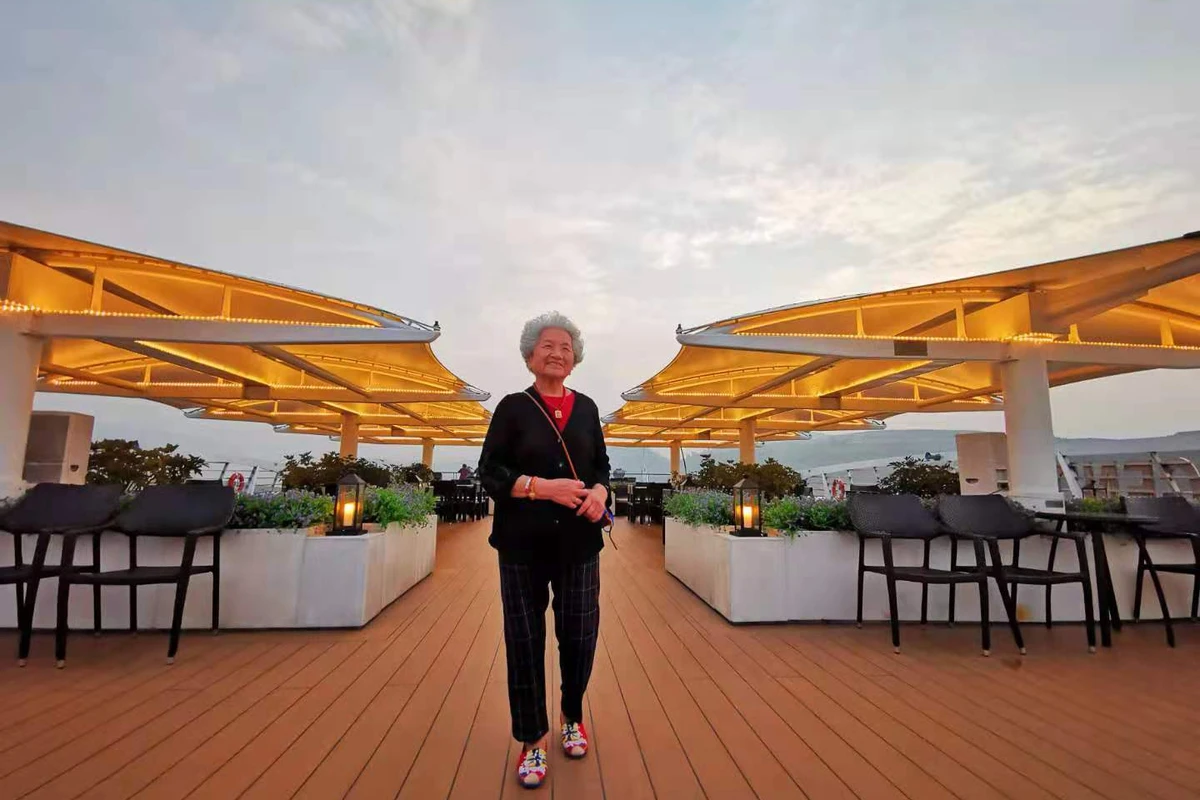
Angel leads the sunset.
Chongqing night market seen from the ship.
Morning exercise every day.
2021.5.5 Pass through [Wu Gorge], [Qutang Gorge], take a gaily-painted boat to visit Shennü Stream.
Shennü Stream, also called "Beauty Stream" by locals, is 15 kilometers long. Due to the swift current and narrow shallow waterway, 10 kilometers of it are an uninhabited primitive valley.
In the middle reaches of Shennü Stream, on the south bank inland is the Rising Peak, and on the northwest is the Cloud-Rising Peak. Peaks are green with overlapping hills, clouds and fog shrouding them, the river winding like a coiled intestine. In many places, "where hills bend, streams wind and the pathway seems lost, in the shade of willows, flowers bright, another village appears" – it is a wonder among gorges, and an unparalleled scenery among scenic spots.
The only household in the Three Gorges area.
Making new friends.
White Emperor City, famous for the poem "Leaving at dawn the White Emperor crowned with cloud, I've sailed a thousand miles through canyons in a day," is located on White Emperor Mountain, ten li east of Fengjie County town, Chongqing.
Board the tour bus, heading to "White Emperor City Scenic Area."
White Emperor City is situated on White Emperor Mountain on the north bank of the Yangtze River at the mouth of Qutang Gorge. It sits majestically at the west entrance of Kuimen, taking advantage of the treacherous mountain terrain and water situation of Kuimen to build the city. Leaning against mountains beside water, controlling the heights, it is a typical city site of the gorge river city type.
White Emperor City Wind and Rain Corridor Bridge.
Porters at the foot of the mountain are a sight along the Three Gorges. They are all descendants of the Three Gorges migrants from the 1980s. The towering Three Gorges Dam rests on the spiritual cornerstone of the selfless dedication of millions of migrants. Migration is a common problem plaguing water conservancy projects worldwide, and the huge relocation project of the Three Gorges is unprecedented in the history of world water conservancy.
More than two hundred steps upward, the charge is about 100 yuan one way.
White Emperor Temple is located on White Emperor Mountain at the mouth of Qutang Gorge. From a distance, green trees are lush, with pavilions and terraces dotted among them.
At the end of the Western Han Dynasty, Gongsun Shu occupied Shu and built a city on the mountain. Because a well in the city often emitted white vapor, like a white dragon, he used this to call himself the White Emperor and named the city White Emperor City. After Gongsun Shu's death, locals built a temple on the mountain with a statue of Gongsun Shu, called "White Emperor Temple."
Two out of four characters are deliberately written incorrectly, hinting at the confusion of people living in that era.
Rubbing characters is also a craft.
Kui (pronounced KUI, second tone).
This place is the location depicted on the back of the fifth series 10-yuan banknote.
After visiting White Emperor City, on the way back to the cruise ship, we could still hear Li Bai chanting in his boat, "The apes on both sides are crying endlessly; My skiff has passed a thousand mountains in one day"; Du Fu sighing on the mountaintop, "Boundless forests shed their leaves shower by shower; The endless Yangtze River rolls on hour by hour"; Liu Yuxi singing to the beat of Bamboo Twig songs, "The sun in the east and rain in the west, you say it's not romantic but it is"; Liu Bei saying, "Do not fail to do good even if it's small; do not engage in evil even if it's small. Only the virtuous and talented can win people's hearts"!
2021.5.6 Go ashore to visit [Zhang Fei Temple]; take a bus to the national geopark [Yunyang Dragon Tank].
The cruise ship arrived at Yunyang.
High tide, the big crowd disembarking. Grateful to the ship staff, who early in the morning, with their legs soaked in cold water, helped each tourist ashore one by one.
Zhang Fei Temple was first built at the end of the Shu Han period, with a history of more than 1,700 years. It was expanded in the Song, Yuan, Ming, and Qing dynasties, with glazed tiles and white walls, resplendent and magnificent. The temple complex is built on the mountain terrain. The temple is rich in steles, calligraphy, and paintings, and is known as "a scenic spot in Bashu, a land of literary splendor."
The current Zhang Fei Temple was relocated from Feifeng Mountain on the opposite bank of the old Yunyang county town, 32 kilometers downstream from this location, in accordance with the principle of "not changing the original state of the cultural relic." Nearly 90% of the existing building components are materials dismantled from the old temple. It still maintains its geographical features of leaning against the mountain, sitting on rock, and facing the river. The relocation of Zhang Fei Temple is the highest-level, farthest-moved, and most influential project among ground cultural relic relocations since the founding of the People's Republic of China.
After about two and a half hours of driving, we arrived at the fairy-tale-like Dragon Tank Scenic Area.
Take the scenic electric cart for about two minutes to reach "The World's First Corridor Bridge."
Internet-famous corridor bridge – Cloud Corridor Bridge, known as the world's first cantilevered glass landscape corridor bridge.
Entirely made of glass, the floor and railings are all transparent. Below your feet is a 700-meter-deep unobstructed canyon. As we stepped onto the corridor bridge, no matter whether we looked forward, backward, left, right, up, or down, there was no visual obstruction, creating a surreal feeling of "floating in the air."
Standing on the glass corridor bridge, on the left side in the distance is the internet-famous swing.
Take the scenic electric cart again for about six minutes to reach Dragon Tank Scenic Area.
Dragon Tank Scenic Area is a ring-shaped tiankeng (giant sinkhole) located in Qingshui. The rim of the tank is elliptical. Below the rim, a natural stone slab about two zhang long extends horizontally inward, about a chi wide, where you can lie on your stomach to peek at the peculiar scenery inside. The upper part of the tank wall is covered with vines and dotted with wildflowers; the lower part is sheer cliff in bluish gray. If you throw a stone into the pit, it takes dozens of seconds to hear the echo. Inside the pit, small animals seem to scurry about; and birds fly back and forth, called flying tigers, with wings as sharp as knives. Legend has it that someone once used a thick hemp rope to descend halfway down the wall, was attacked by flying tigers, and the rope broke, killing him. On the south rim stands a huge rock about five meters high, with a nearly two-meter-long stone slab lying horizontally on top, one end slightly hooked toward the pit, resembling an eagle's beak, hence called "Eagle Beak Rock."
Karst collapse and dissolution are the main causes of the formation of the Dragon Tank tiankeng. This place is located at the intersection of multiple sets of joints and cleavages, where the rock is extremely fractured. Among these rock layers, multi-layered dissolution caves formed by water erosion crisscross. Under the action of natural gravity, rocks in the fractured zone collapse, and the debris is dissolved and carried away by underground rivers. The Dragon Tank gradually formed through this repeated process of dissolution-collapse-dissolution-collapse.
Walk along the plank road, admiring the scenery all the way.
Free small photos taken at the scenic area, ending today's onshore tour.
2021.5.7 Go ashore to visit [Fengdu Ghost City]. Ghost City is famous for its various underworld buildings and sculptures. It is not only a legendary ghost city but also a treasure trove of folk culture and art integrating Confucianism, Taoism, and Buddhism, and one of the most famous cultural landscapes along the Golden Yangtze River Tourism Route.
Cable car up and down costs 30 yuan. Actually, the mountain is not high; young people don't need to take the cable car at all.
After the visit, Fengdu Ghost City is the last onshore visit stop of the cruise. Take a photo to commemorate.
2021.5.8 Disembark at Chongqing Chaotianmen Dock.
Bai Mansion (Bai Gongguan), Zhazidong (Sino-American Cooperation Organization prison). Bai Mansion was originally the villa of Sichuan warlord Bai Ju. In 1939, the Bureau of Investigation and Statistics converted it into a detention center to hold political prisoners.
Red Rock Village (Hongyan Village) was the "Liu Family Garden" operated by Ms. Rao Guomo. During the Anti-Japanese War, Red Rock Village was the command center of the Chinese Communist Party in the Kuomintang-controlled area. After the victory of the Anti-Japanese War, Mao Zedong personally went to Chongqing and stayed in Red Rock Village for 40 days. The Chongqing Negotiations and the Shangdang Campaign – Mao Zedong stationed in Red Rock Village, strategizing and winning battles thousands of miles away – added the most glorious page to the history of Red Rock Village.
Second visit to Hongya Cave. Hongya Cave condenses three thousand years of Chongqing history, integrating the unique Bayu folk culture, mountain dwelling architecture culture, and dock culture, becoming a unique and dazzling city card that attracts worldwide attention.
As lively as Hongya Cave is during the day, it is as brilliant at night. Nighttime Hongya Cave is a must-visit. The "Eight Scenes" – Hongya Drip Green, Confluence of Two Rivers, Stilted Building Complex, Hongya Group Sculptures, City Balcony, Ba Culture Pillar, Riverside Gourmet Street, and Jialing Sunset – we saw them all.
At 6 p.m., when the lights first came on, we deliberately visited Hongya Cave a second time. Today, because the weather was fine, the sun was still reluctant to set. The sunset glow and lights blended into a Hongya Cave as bright as daytime.
Chongqing has no shortage of internet-famous photo spots; even a street has an artistic vibe.
Thus the entire trip ended. Finally, a "group photo."


