Solo Trip to Chongqing Author: Dawn Light
Chongqing is a nationally renowned historical and cultural city, known across the country as the Mountain City, Fog Capital, and Furnace. In Chongqing, buses and light rail sometimes ascend to the sky, sometimes dive underground, appearing and disappearing stealthily. In Chongqing, you might enter a building from the first floor, go down two levels, only to find yourself still on the first floor. In Chongqing, you could be riding in a car on the road, yet you might still be atop someone's building. In Chongqing, you see the end of a road, but as you walk, it vanishes. In Chongqing... Chongqing is fascinating, and more importantly, it boasts beautiful women and hotpot. An opportunity finally came, but unfortunately my family couldn't join me, and I didn't want to contact friends. I hastily packed a few changes of clothes, grabbed my camera, and set off on a solo free trip to Chongqing.
June 2, 2019: Linxia - Lanzhou Station - Chongqing North Station - Yangtze River Cableway - Jiefangbei - Hongya Cave. Sunny.
Woke up at 5:30 AM, had breakfast, brought rice and stir-fry for lunch, shouldered my backpack and camera, took a 'Linxia Taxi' straight to Lanzhou Station at 6:00 AM. I worried about the time all the way, but arrived around 8:00 AM. After boarding the 9:11 bullet train, I checked routes and guides, and unknowingly arrived at Chongqing North Station around 3:50 PM. I couldn't help but marvel at how convenient travel has become. From the train station, I took the subway, transferred, and arrived at the online-booked 7 Days Inn (Chongqing Jiefangbei Haochi Street Branch), right opposite the subway exit. There were several halal restaurants downstairs across the street, and a mosque on the 15th floor of the building, which was called Muslim Building. It felt very nice. I checked in.
After resting until 6:00 PM, I went to experience Chongqing's 'internet-famous landmark'—the Yangtze River Cableway. The cableway starts from Chang'an Temple in Yuzhong District, crosses the Yangtze River to Shangxin Street in Nan'an District. It was the first cableway across the Yangtze and a filming location for many films and TV shows in Chongqing. 'If you haven't ridden the Yangtze River Cableway, you haven't been to Chongqing,' so tourists all want to try it. Because of the crowds, netizens recommend boarding at Shangxin Street station, where the queue is shorter, and going from the south bank to the north bank leads directly to Jiefangbei and Hongya Cave, making the journey smoother. I took the subway for about ten minutes to Shangxin Street station, walked a few minutes from the exit, and found the cableway entrance. A descending staircase had beautiful paintings on the steps and walls, giving a rather artistic feel.
The cable car station wasn't too crowded. One-way fare was 20 yuan per person, round-trip 30 yuan per person. The cable car was a box-shaped gondola with glass all around. On board, I could see the surging Yangtze River, the buildings on both banks, and the surrounding scenery. Although crossing the river only took about five minutes, the experience was quite enjoyable. The Yangtze River Cableway, with its grand name, is essentially just a mode of transport for locals to cross the river. It is said that the night view from the cableway is even more beautiful, but I didn't include it in my itinerary. After alighting, there was a platform where I took a few photos. Exiting the station, indeed there were many more people queuing on this side.
Leaving the cableway station, I walked towards Jiefangbei while admiring the streetscape of Chongqing. It took about ten minutes to arrive. Jiefangbei, originally known as the Monument of Victory in the War of Resistance, is a landmark of Chongqing and the only national monument in China commemorating the victory of the Chinese people in the War of Resistance against Japan. The monument has an eight-sided columnar helmet-shaped structure, eight stories high, surrounded by flower beds at the base, with four large clocks on top facing different directions. Skyscrapers of all kinds stood around, crowded with people. Standing on the base of Jiefangbei, I saw four pedestrian streets radiating east, west, south, and north, bustling with people. According to introductions, Jiefangbei Pedestrian Street is the oldest, busiest, and most prosperous commercial district in Chongqing, lined with high-end malls, hotels, luxury brands, and naturally gathering various Chongqing specialties. It is known as 'China's No. 1 Street in the West.' No wonder it's so crowded and thriving. Of course, it's also a filming location for 'I Belonged to You.'
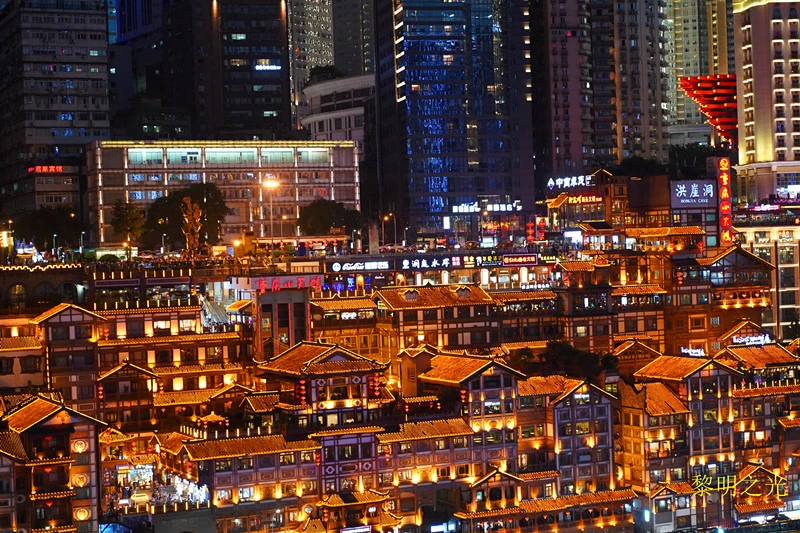
After feeling the lively atmosphere around Jiefangbei and taking photos, I followed the crowd to the next stop, Hongya Cave. Hongya Cave is located on the cliff of the Jialing River in the Jiefangbei Central Business District of Chongqing. It is a magnificent and beautiful world wonder—the Chinese Cliff City—'rising' on a 75-meter-high cliff. Its architectural complex is primarily based on the most characteristic Bayu traditional 'stilted building' style, built along the mountain and cliff, organically integrating dining, entertainment, leisure, and specialty cultural shopping, forming a unique 'three-dimensional elevated pedestrian street,' creating a mountain city feature where exiting from the 11th floor or the 1st floor both lead to a road. It is hailed as Chongqing's city card and the city's banquet hall. On the way, I saw a uniquely shaped, artistically striking building with a red body, bright colors, like a burning 'bonfire' or a sailing ship, very eye-catching and visually impactful. I took many photos and later learned from Baidu that it was the Guotai Art Center.
Arriving at Hongya Cave at 8:00 PM, the lanterns were just lighting up. The road was busy with traffic, the sidewalk crowded with people, and shops bustling with activity—Chongqing's nightlife had begun. Ahead, the Qiansimen Bridge spanned the river like a rainbow, magnificent and majestic under the lights. The Jialing River, illuminated by the lights on both banks, sparkled with colorful ripples. Brightly lit cruise ships shuttled across, full of dynamism. On the opposite bank, skyscrapers displayed myriad colors, and electronic screens flashed various advertisements, dazzling the eyes. Hongya Cave, outlined by the night lights, revealed the layered exterior of stilted buildings, rising high and low in an orderly manner, bright and resplendent. It felt like a palace or a golden fairy-tale world, with a mysterious aura of an otherworldly realm, breathtaking. The night view here is truly beautiful, beyond any words. It was a real-life 'Spirited Away,' living up to its reputation.
I first went up to Qiansimen Bridge to take photos. The crowd below was enormous, but luckily the bridge wasn't too crowded. After taking pictures, I returned the same way. Descending the stairs into Hongya Cave, I saw dense stilted buildings on both sides. Each floor had different offerings: restaurants, snack streets, bars and cafes, as well as shops for local specialties, souvenirs, and a cinema. I didn't stay inside too long. After wandering for a while, I quickly came down to the 1st floor. Yes, I entered Hongya Cave from the ground floor and ended up back on the 1st floor—exiting again onto a main road, haha. Crossing the road, I saw the Jialing River. The night view was beautiful, with many people. From this side, Hongya Cave looked like a dreamy fairy-tale castle. The lights depicted all the layers and details of the stilted buildings, as if gilded, shining with splendor! It was very pleasing, and the feeling was different.
After admiring, I wound my way up the stone steps next to it—Hongya Dicui, featuring a viewing pavilion, small waterfall, and water curtain cave. I kept looking back, appreciating the scenery from different angles. Passing through the water curtain cave, I didn't go into Hongya Cave Commercial Street but continued up the stairs. Soon I reached the 11th floor platform, finding it not far from the earlier entrance.
Tired and thirsty, I bought a drink at a nearby internet-famous yogurt shop, rested for a while, then walked back to the hotel (about twenty minutes). Arrived at 9:50 PM, ate the leftover rice and stir-fry from lunch, made plans for the next day, and rested.
June 3, 2019: Liziba Station - Sichuan Fine Arts Institute - 2nd Factory Cultural and Creative Park - Eling Park. Sunny.
Last night, I made a mistake while renewing the hotel reservation with the wrong name, and I had many thoughts... Could it really be...? Tossing and turning, I had trouble falling asleep. Woke up at around 8:00 AM, ate my own brought guoguo (snacks), drank coffee, went up to the mosque on the 15th floor to learn about the Eid congregation. Around 8:40, I stored my backpack at the front desk and went to experience what netizens call divine transportation: the light rail train passing through a building—the internet-famous Liziba Station. Took Light Rail Line 2 around 9:10 AM to Liziba Station, went down to the viewing platform across the street. Witnessing the light rail passing through the building, flying through the air, was still quite impressive. But hadn't I also ridden the light rail through it? Actually, on the train or inside the station, you don't feel much.
Next to the viewing platform was a long glass observation corridor offering views of the beautiful scenery on both sides of the Jialing River. Around 9:40, I continued on Light Rail Line 2, then transferred to a bus to go to the Huangjueping campus of Sichuan Fine Arts Institute (SCFAI). Getting off the bus, I was on the famous graffiti street of the academy. On the short street, from buildings to shops and campus walls, everything was covered in graffiti, like a giant 3D graffiti gallery.
The campus was shaded by lush trees, with fresh air, deep and artistic atmosphere. Sculptures and installation art of various styles could be seen everywhere: people, animals, and various artistic shapes—some in the woods, some by the roadside, some on door frames. There was also an internet-famous building fully covered in graffiti, as well as works by SCFAI students on roadside walls! Surprises could be found everywhere, and the artistic vibe was palpable. There weren't many people, so I could freely pose for photos. The pictures turned out great, and the place felt very artistic and wonderful.
Near SCFAI, there was also a Transportation Teahouse, which became internet-famous as a filming location for the movie 'Crazy Stone.' It was located on the graffiti street, hidden beneath the steps beside the road. I entered the teahouse at 11:10 AM. Inside, it was a different world: old wooden frame structure, uneven beams, gray-black bricks and mottled walls exuding a unique sense of age. The teahouse was small, not too many people—some drinking tea, some playing chess, chatting about trivial life matters, and tourists coming to experience the life of Chongqing locals. Everything felt leisurely. The teahouse also displayed some old utensils and historical photos. I ordered a bowl of old Tuo tea for 8 yuan, savoring and resting there, experiencing the life of old Chongqing people.
Half an hour later, I left the teahouse, took a bus and then the subway to Lianglukou to experience the Crown Grand Escalator. This was one of Chongqing's unique modes of transportation, connecting Lianglukou and Chongqing Station (also known as Caiyuanba Train Station). It was the longest slope escalator in China (second longest in Asia), known as China's first mountain-climbing escalator, with a total length of 112 meters, height of 52.5 meters, width of 1.3 meters, and a slope of 30 degrees. I entered the escalator entrance at 1:00 PM, one-way ticket costing 2 yuan per person. Riding the escalator felt very long—I couldn't see the end at a glance. Looking down from the escalator gave a slight dizziness. It moved quite fast, taking a little over two minutes for one trip. I rode down once, and that wasn't enough, so I spent another 2 yuan to ride up again. The ride felt novel and fun, with a bit of thrill, and it really conveyed the characteristics of the mountain city of Chongqing, allowing me to experience its unique terrain and transportation.
Leaving the escalator, I walked to the 2nd Factory Cultural and Creative Park. Along the way, I looked left and right, soaking in Chongqing's unique mountain city landscape and its peculiar architecture. After about half an hour of walking and stopping, the map showed I had arrived at the park, but I couldn't find it. Suddenly I saw a few students coming up from a descending staircase. I asked them, and they said they were also going to the park but hadn't found it below. Local residents told them to follow the road around the bend. Haha, that's Chongqing—when the map says you've arrived, it could mean you're above or below; you have to ask, and there might be stairs going up or down. Don't run around and take unnecessary detours.
2nd Factory Creative Park, also known as Eling Second Factory, was formerly Chongqing No. 2 Printing Factory. As times changed, the once roaring machines gradually fell silent, and the factory faded from view. The old factory buildings retained the original look of individual old structures while incorporating modern design aesthetics, transforming into two squares, four streets and lanes, and nearly a dozen factory buildings housing artists' teahouses, designers' general stores, Chongqing locals' coffee shops, and many interesting little stores. This gave the place unique charm, full of artistic atmosphere, popular among young people. The radio station in the movie 'I Belonged to You' was filmed on the rooftop of Building 31 here. It is indeed a great spot for posing—industrial corridor bridges, mottled old walls, light and shadow under tree shades—all make for great artistic photos. Unfortunately, I lacked a beautiful companion, so wandering alone was a bit boring. I stood on the rooftop, enjoyed the views of the two rivers, took a few photos, and then headed to Eling Park.
I reached it in about ten minutes. Eling Park is located on the highest point of the Yuzhong Peninsula in Chongqing, on a narrow mountain ridge flanked by the Yangtze and Jialing Rivers to the north and south. It is the highest point of the peninsula. Main attractions include the Rope Bridge, Art Garden, Kansheng Tower (Victory Viewing Tower), Martyr's Tomb, Lotus Pond Corridor, etc. Kansheng Tower is the highest point in the park, offering an excellent vantage point to overlook the Chongqing city area. Entering Eling Park, the first feeling was the quiet environment and fresh air, filled with greenery and towering trees. Sunlight filtered through the leaves onto the ground, creating dappled shadows everywhere—the scenery was very attractive. Perhaps due to the abundance of plants, it felt cool and comfortable walking inside on a hot day. It was a great place for leisure and escaping the heat.
I walked and stopped in the park for about an hour, leaving at 4:00 PM. In a few minutes, I arrived at the subway station, took the subway to the 7 Days Inn at Jiaochangkou to pick up my stored backpack, ate Chongqing small noodles, and then walked to the 7 Days Inn on Jiefang Road Pedestrian Street to check in. I rested until 6:00 PM, then took the subway back to Eling Park. Arrived at Kansheng Tower at 6:20 PM. It was a seven-story pagoda-style building. I ascended the spiral staircase, with viewing platforms on each floor. Reaching the seventh floor, the 360-degree viewing platform had no obstructions. Leaning on the railing and looking out, the entire Chongqing urban area came into view: lush greenery in front, the two rivers winding in the distance, rainbow-like bridges spanning the rivers, and various high-rise buildings standing on both banks. It felt like a garden adorned with modern engineering, very beautiful.
More and more people gathered, mostly photography enthusiasts who had already set up their telephoto lenses, waiting to capture the sunset over Chongqing. I also chose a spot, waiting and shooting. As the sun was about to set behind the mountains, the sunset dyed the entire sky red, painting the city with makeup—quiet and tender. Indeed, 'the sunset is as beautiful as a painting' only... one by one, the lights counted down the departure of day. When the streetlights came on, the night of Chongqing was outlined into another charming world. Truly beautiful.
Around 9:30 PM, I returned to the hotel to rest.
June 4, 2019: Ciqikou Ancient Town - Hongyan Soul Exhibition Hall - Baigongguan - Zhazidong. Sunny.
Yesterday was too tiring; I got up late today. Had breakfast around 9:00 AM, renewed the hotel booking, and set out. Took Subway Line 1 to visit Ciqikou Ancient Town. Around 10:30, exited the subway station, followed the crowd forward. Within less than five minutes, a huge archway-style gate appeared before my eyes, with the words 'Ciqikou' on it, instantly impressing me with the solemnity and antiquity. Chongqing Ciqikou Ancient Town is a folk culture town with over a thousand years of history. Originally called Longyin Town, it is a microcosm and symbol of ancient Chongqing, rich in Bayu culture. 'One stone road, a thousand years of Ciqikou'—through historical development, it has formed 12 streets and lanes. Most buildings on both sides are in Ming and Qing dynasty styles, paved with stone slabs, and lined with shops. Today, Ciqikou has become an internet-famous check-in spot in Chongqing.
Entering the ancient town, the streets varied in width, rising and falling with stone steps. There were many small alleys, some very narrow. First, you feel the crowd increasing, sometimes squeezed into a cramped space. Besides the flow of people, what catches your eye are numerous shops along the roads, decorating the streets in a cool style. Some streets sell Chongqing local specialties and small commodities, some sell handicrafts, others have quiet bars, tea houses, and calligraphy and painting art galleries. But the most numerous are restaurants, snack shops, and stores selling Chen Changyin Mahua (fried dough twists).
Shopkeepers would stand at their doors, enthusiastically hawking. You'd involuntarily glance into their shops, dazzled by the array of goods. At the same time, you get swept up by the warm atmosphere, either stopping to look, fiddling with items, tasting food, or sipping tea and drinks, experiencing authentic Chongqing life. In short, you can find many unexpected things here: ethnic costumes, antique jade, handmade musical instruments, calligraphy and painting artworks, colorful foods... It truly broadens your horizons and satisfies your taste buds. Even if it's not a holiday, it feels like a festival. Looking at the buildings from the outside, unique ancient structures stand in close order, preserving some traditional architectural archways and stilted building styles, giving a strong sense of old Chongqing. Although most have been rebuilt or renovated, the original appearance is preserved to the greatest extent. Ancient buildings have now become various restaurants and small commodity shops, and the antique flavor makes the place distinctive. The ancient town also has attractions like Baolun Temple and Zhong's Courtyard.
Actually, Ciqikou is a traditional ancient town street, not much different from other ancient towns except for the snacks and architecture. However, walking along the bluestone paths, passing antique shops on both sides, even if you buy nothing, just strolling around, feeling the atmosphere and experiencing Chongqing's customs, is quite pleasant.
I wandered through the alleys of the ancient town, looking here and there, for over 3 hours. Left around 2:00 PM, took a bus to Baigongguan. Got off at Lieshimu (Martyr's Tomb) station, walked uphill for about 10 minutes, and arrived at Hongyan Soul Exhibition Hall. The Hongyan Soul Exhibition Hall was built in 1963, two floors. Its original site was the parade ground of the 'Sino-American Cooperation Organization' (SACO). In 1999, it was renamed 'Hongyan Soul Exhibition Hall.' I visited the 'Hongyan Soul' series of exhibitions, gaining a deeper understanding of 'Records of Geleshan' and 'The Tragedy of Geleshan.' After exiting, I saw the 'Hongyan Soul' square—grand and solemn.
Then I walked along the road, passing Southwest University of Political Science and Law, through the martyr sculpture area, and reached the entrance of Baigongguan in about 20 minutes. Baigongguan was originally the suburban villa of Sichuan warlord Bai Ju. From 1938 onward, it was used by the Kuomintang secret service as a secret prison. Patriotic figures Liao Chengzhi, Communist Party members Song Qiyun, Xu Linxia and their young son 'Little Radish' were imprisoned here. At its peak, over two hundred 'political prisoners' were held here. Entering Baigongguan, it was a two-story villa. On the courtyard wall were slogans like 'When in office, be loyal; when retired, reflect on mistakes.' Rooms displayed exhibitions. From a small door on the side of the first floor, there was a dungeon, torture cave, etc. Exiting Baigongguan, I ascended steps to reach the exhibition room on the lives of Zhang Xueliang and Yang Hucheng. After viewing, I continued to Dai Li's reception room. Returning, I passed the place where 'Little Radish' was killed, descended the mountain, followed the mountain path, passed Meiyuan, and reached Zhazidong.
Zhazidong is located at the foot of Geleshan in Chongqing, in a concealed area. It was originally a small coal mine, named for more slag than coal. It was transformed by the Kuomintang secret service into a secret prison to incarcerate and persecute revolutionaries. The once popular anti-Japanese war films 'Hongyan' and 'Sister Jiang' were based on Zhazidong. Out of reverence for heroes, I visited this site. Zhazidong wasn't very large, about the size of a football field, with two-story gray brick and gray tile buildings. Entering the prison through a small door, there was a large yard for exercise, slogans on the walls, guard towers around, and tight security. Zhazidong was divided into an outer court (guards' offices, torture rooms) and an inner court (cells on the ground and first floors). Now each room had exhibitions displaying the lives of revolutionary martyrs and their relics—very educational.
After receiving patriotic education, I left Zhazidong at around 3:40 PM. Took a bus and then the subway, arriving at the Muslim Building at 5:00 PM. Had stir-fry and rice at a restaurant downstairs, wandered around nearby, then returned to the hotel to rest.
June 5, 2019: People's Great Hall - Three Gorges Museum - Zhongshan Fourth Road - Guiyuan - Zhougong Mansion - Qiansimen Bridge. Light rain turning to sunny.
Woke up at 7:00 AM, ate some self-brought guoguo (snacks). Started walking to the Muslim Building around 7:40. It had rained last night, so the weather was cooler and more comfortable. Arrived at the mosque at 8:00 AM. At 8:10, the mosque held the Eid al-Fitr congregation prayer, which ended around 9:30. The mosque prepared fruits, cookies, guoguo, etc., and I had some.
At 10:20, I ate a bowl of Chongqing small noodles at a restaurant downstairs. The noodles were not as chewy as beef noodles, but smooth and flavorful. The chili oil was fragrant but not as spicy as I imagined, a bit numbing, with scallions and pickled mustard—very tasty. Then I took a bus straight to the Chongqing People's Great Hall to visit. Arrived at People's Square around 11:20. The first thing that caught my eye was the Great Hall—bright in color, with ancient Chinese palace style, magnificent, exquisite. Its appearance seemed familiar, reminiscent of the Hall of Prayer for Good Harvests at the Temple of Heaven in Beijing.
According to introductions, the Chongqing People's Great Hall was designed by famous Chinese architect Zhang Jiade, built from February 1951 to April 1954. It was the first large-scale building in New China with strong ethnic style, integrating traditional Chinese palace architectural style with Western structural features. It is a landmark building of Chongqing and has been recorded in world architectural history for its outstanding architectural achievements. Attracted by its strong Chinese ethnic charm and majestic grandeur, I took a few photos outside, bought a 10-yuan ticket, passed security, and entered the hall for a tour. A spacious circular audience hall with terrazzo steps and floors, stepped seating. The circular hall had four layers, with red chairs distributed on four floors and the ground floor. On the large stage, phoenixes danced among lotuses, cloud columns stood tall. Looking up at the dome, the steel frame and wooden structure were exquisite. The entire building was grand and resplendent, solemn and gorgeous.
After fully enjoying the visual feast of architectural art, I left the Great Hall. Outside was a large square, with green belts on both sides, densely planted with lush trees. Straight ahead was an antique archway, with four columns and three spans, dignified and grand. The archway was mainly orange-red and red, covered with green glazed tiles, inlaid with gold patterns inside and out, inscribed with 'Chongqing People's Hall.'
Passing through the archway, I saw the main building of the Three Gorges Museum across the way, seemingly carved out of a mountain, like a landscape garden picture with mountains and waters. Continuing forward and up the steps, from the platform in front of the museum, I could see a panoramic view of the Great Hall, very beautiful.
Around 12:10, I entered the museum with my ID card. The Three Gorges Museum was large, with imposing architecture. There were tens of thousands of cultural relics inside, showcasing the development history of Chongqing and the Three Gorges. The museum had four floors, each with themed exhibitions. The first floor featured a 360-degree circular screen movie about the Three Gorges, displaying its natural scenery and cultural customs. The second floor showcased Chongqing's cultural roots spanning over 3,000 years. The third floor displayed the history of the Chongqing bombing during the Anti-Japanese War. The fourth floor exhibited ethnic folk cultures of many southwestern regions. I spent three hours today watching the 'Great Three Gorges' circular movie, briefly viewing and savoring the rich exhibits. I learned a lot and gained a certain understanding of Chongqing's history and culture—very rewarding.
Leaving the Chongqing Museum, I walked to a quiet artistic street—Chongqing's Zhongshan Fourth Road, about ten minutes away. Zhongshan Fourth Road is hailed as 'Chongqing's most beautiful street.' There weren't many people on the road. Both sides were lined with layered Ficus virens trees, presenting a tranquil green view at first glance. The weather was nice, and Zhongshan Fourth Road was very quiet. Sunlight filtered through the layered leaves onto the ground, forming patches of light. Stepping on the dappled shadows, I observed the many buildings along the road—green brick and black tile, arched windows and corridors—as if time stood still. My heart truly calmed down, with a feeling of peaceful years. As a historic street, Zhongshan Fourth Road carries many important cultural relics of modern Chinese history. Not long from end to end, both sides featured buildings from the Republic of China era, including Guiyuan, Zhougong Mansion, Dai Gongguan, the former Presidential Palace of the National Government, etc., offering a unique historical atmosphere.
I mainly visited Guiyuan and Zhougong Mansion. Guiyuan was a small two-story building with a compact layout and clever design. It was the site where the Double Tenth Agreement was signed. During the Chongqing Negotiations in 1945, Zhang Zhizhong used this place as Mao Zedong's office and meeting venue in Chongqing. It still retains the original furnishings and displays photos of Mao Zedong and Zhou Enlai's activities during the negotiations. At the end of the street was Zhougong Mansion, a historic building named Zengjiayan No. 50. In the winter of 1938, after the CPC delegation moved from Wuhan to Chongqing, Comrade Zhou Enlai rented this house in his own name to facilitate work, making it a main office of the Southern Bureau of the CPC in the city. The Southern Bureau's military, cultural, women's, foreign affairs, and party groups were all set up here. On the right side of the small building was the mansion of Dai Li, director of the Kuomintang Military Statistics Bureau, and on the left was a police station. Entering Zhougong Mansion, it felt very quiet. Gray brick walls, green plants, simple facilities. The corridor on the second floor was very beautiful, offering a view of the river. After viewing the photo displays, I sat in the study, in contemplation, feeling as if I had traveled through time. In front of the door was a spacious Zengjiayan Square, with a bronze statue of Zhou Enlai walking through wind and rain, busy and diligent. People came here to reminisce about the past and honor the great man. Around 4:30 PM, I took the subway back to the hotel to rest.
At 6:20 PM, I left the hotel and strolled along the extremely popular Bayi Road Delicious Street in the main urban area of Chongqing. On this short street of just over a hundred meters, one side was full of food and shops selling Chongqing specialties, the other side was a shopping mall. The road was crowded with people, and occasionally cars crossed through. Most people stood on the roadside eating delicious food, but unfortunately I couldn't...
Around 7:20 PM, I climbed onto Chongqing's most beautiful bridge—the best place to view night scenery, Qiansimen Bridge, a spot popularized by Douyin (TikTok). The full name of Qiansimen Bridge is Chongqing Qiansimen Jialing River Bridge. It starts in Yuzhong District, crosses the Jialing River, and ends at Jiangbei City in Jiangbei District, facing Hongya Cave directly. It combines road traffic, pedestrian walkways, and rail transit. It was dusk. On the pedestrian walkway of the bridge, many tourists crowded together, some with cameras, some with phones, taking photos or videos, even live streaming. Some sat on the roadside, waiting for nightfall to enjoy the night view of Hongya Cave and the buildings in Yuzhong District.
Looking down at Hongya Cave from the bridge, the entire building seemed to have stepped out of an anime, very similar to the 'spirit town' in 'Spirited Away.' The Jialing River flowed slowly, sparkling with ripples; cruise ships moved leisurely, quiet and peaceful. The buildings on both sides of the river glittered with colorful lights under the illumination, vying for attention, very pleasing. The night view here was indeed beautiful—each angle had its unique charm. Walking slowly on Qiansimen Bridge, when the light rail passed through the bridge, the ground vibrated slightly. In the evening breeze, I felt a bit lightheaded, as if floating in a fairy-tale world. Perhaps this is the important reason why Qiansimen Bridge became an internet-famous spot. Night had fully fallen. I walked, stopped, and photographed all the way across the bridge to the other side. Under the flickering neon lights, Qiansimen Bridge looked like a red dragon spanning the river, imposing. The bridge, high-rises, and Hongya Cave blended together, shining brightly against the river. On the wall of a nearby building, a dazzling light show was playing, intoxicating.
Ascending the bridge from the other side, the view was different again. The Chongqing Grand Theater stood out conspicuously in the night, like a colorful dancer changing colors and patterns. Together with the colorful Jialing River and brightly lit cruise ships, it created a dynamic, colorful picture of the night scene—very beautiful and pleasant.
Around 9:30 PM, I reluctantly left and arrived at the hotel at 10:00 PM to rest.
June 6, 2019: St. Joseph's Church - Mountain City Trail - Pipashan Park - Huguang Guild Hall - Dongshuimen - Chaotianmen. Sunny.
My shoulder hurt a bit yesterday, and I didn't sleep well. Woke up at 7:30, washed up, left the hotel at about 8:20 to go to the Catholic St. Joseph's Church (Ruose Hall). It wasn't far, about 7-8 minutes from the hotel, but somewhat hard to find—completely submerged among the high-rises. Even passing by on the road, you wouldn't notice it; you needed to deliberately look. Entering a small alley beside a building, I saw a beautiful brick structure, European-style church gate, full of age. The characters 'Ruose Hall' were also full of weight. The church door was unattended, free to visit, no security checks. Inside, the church was not very large—there was a church hotel. Few people, quiet. Entering the chapel, two rows of large pillars supported the cream-colored ceiling, with decorative lanterns hanging high, candles flickering. At the center were colored statues of Jesus, the Virgin Mary, and St. Joseph; on the walls were fourteen oil paintings of the stations of the cross. The furnishings were elegant and dignified. The atmosphere inside was solemn and respectful. A few elderly people were talking softly. I moved cautiously, afraid to make any noise that might disturb the tranquility. It was truly a place that calms the soul.
After about 20 minutes, I left St. Joseph's, returned to the hotel, packed my luggage, checked out, and walked to the 7 Days Inn at Jiaochangkou Jiefangbei Haochi Street to check in. Around 10:00, I had dry-tossed noodles downstairs, then walked to the Mountain City Trail (Shancheng Trail), reaching the Zhongxing Road entrance in about 10 minutes. The Mountain City Trail is an old pedestrian-only path in Chongqing, a mark of old Chongqing. Chongqing is a city built on mountains, with many adjacent places having a height difference of dozens of meters. In the past, transportation relied on such upward and downward city paths.
I walked along the trail, ascending the steps. Strolling through the stone-paved alleys, the buildings along the way had a strong old Chongqing flavor. There were several old buildings and many artistic little shops. The walls on both sides of the alleys were covered with graffiti, some depicting old street life, some familiar modern scenes. When I reached the suspended plank road, I could take in the Yangtze River, the Yangtze River Bridge, and the scenery of the south bank. Arriving at Consulate Lane, I felt quiet solemnity. Some alleys were very narrow and winding. Walking forward, passing Consulate Lane, I reached a main road, not far from Tongyuan Gate. I sequentially passed Mountain City Alley - Plank Road Entrance - Suspended Plank Road - Mountain City Alley (Ren'ai Hall) - Consulate Lane, arriving at Tongyuan Gate around 11:10.
Along the way, I experienced the rich local life atmosphere of old Chongqing, felt the most primitive Chongqing style, perceived the charm of the past mountain city, enjoyed a moment of tranquility, appreciated the unique river views of the mountain city. Stopping and walking, taking photos, appreciating, sensing—it was truly comfortable and satisfying. Tongyuan Gate is the only one of Chongqing's nine gates not facing the river, the only land passage to the outside. On both sides of the gate, remnants of ancient city walls remained, with sculptures of attackers and defenders beside the walls. You can climb up the city wall to tour; there were paths both inside and outside the wall and several passages.
Leaving Tongyuan Gate, I walked less than 20 minutes to Pipashan Park. Pipashan (Loquat Mountain) is 345 meters above sea level, one of the highest points in the city center. Pipashan Park is a very beautiful park, built along the mountain, full of loquat trees, with many pavilions, terraces, and towers, very quaint and elegant. Inside, the mountain paths wind, with bamboo and trees providing shade, lush flowers and plants, fresh air. At the top, there was a white marble statue of a pipa-playing woman longing for spring, and a Red Star Pavilion. From the Red Star Pavilion, you could enjoy a panoramic view of the Yangtze River and also see the Chongqing People's Great Hall. There weren't many attractions in the park, but it felt very nice. I rested, observed, contemplated, and took photos there. Left around 12:20.
Took the subway to Huguang Guild Hall, arriving around 1:20 PM. Admission was 30 yuan per person. Chongqing Huguang Guild Hall, located by the river, is the collective name for early Qing dynasty ancient building complexes including Guangdong Institute, Qi'an Institute, and Yu Wang Palace, as well as new antique buildings. It is currently the largest ancient guild hall complex in the urban center of China. The complex was built during the Kangxi reign of the Qing dynasty, nearly 300 years ago, serving as a historical witness to Chongqing's prosperity as a commercial hub in the Qing dynasty. It was also an important symbol of immigration culture, commercial culture, and architectural culture in Chongqing from the early Qing to the early Republic of China. The guild hall was mainly a gathering place for people from Hunan and Hubei provinces in Chongqing, used for ancestor worship, deity veneration, cultural heritage, and comforting homesickness. The buildings inside were grand, with yellow structures extending upward along the mountain slope, giving off a unique cultural atmosphere. Yu Wang Palace was magnificent, Qi'an Institute was delicate, and Guangdong Institute was tall and majestic.
The guild hall consisted of many small courtyards, all interconnected. Each courtyard had its unique charm. Wandering freely through these rows of courtyards, I could see the entire ancient building complex with carved beams and painted rafters, exquisite relief and openwork carvings, lifelike, with many themes such as Journey to the West, The Romance of the Western Chamber, Fengshen Bang, The Twenty-four Filial Exemplars, as well as dragons, phoenixes, animals, and various exotic flowers and plants. In addition to the buildings, there were restored scenes with figures, cultural relic exhibitions, and an opera stage. It was a very worthwhile cultural attraction, with uniquely characteristic architecture, beautiful from every angle. There weren't many people today. I toured in a leisurely manner, slowly viewing, savoring, and listening to the history narrated. It was a great feast for the eyes in architectural art, and I learned a lot—very rewarding.
Leaving Huguang Guild Hall, not far away was the ancient city wall built during the Hongwu reign of the Ming dynasty and the location of Dongshuimen (East Water Gate). Dongshuimen was one of the old water docks of Chongqing, the main east gate among the seventeen ancient city gates. Adjacent to Huguang Guild Hall, it was a stone-arched gate, one of only two remaining old city gates of Chongqing. Descending the stairs, I could see the ancient city wall built of rough large square stones, giving a sense of ancient weight. Travelers who came here stopped their noise and play, unconsciously immersing themselves in the ancient time and space. It made one quiet. Walking slowly through the thick, narrow gate, stepping on the ancient stone steps, I could not see the surrounding bustling world, nor hear the rumbling light rail passing by. I only felt the gently blowing river breeze and my own soft breath merging together, giving a feeling of time travel.
Going down to the street level, there was the archway gate of Huguang Guild Hall, next to the Dongshuimen Old Street, entirely antique buildings with black tiles and white walls, housing traditional and modern restaurants and snacks. Chongqing specialties were all available. Continuing for another ten minutes, I arrived at Chaotianmen Dock.
Chaotianmen was once one of the 17 ancient gates of Chongqing. During the Southern Song dynasty, imperial envoys often delivered imperial edicts via the Yangtze River through this gate, hence the name Chaotianmen (meaning 'facing heaven'). It is the pride of Chongqing and a landmark. When visiting Chongqing, Chaotianmen is a must-see spot for tourists. When I arrived, construction was underway, vehicles couldn't pass, but pedestrians could detour along the dock. Chaotianmen now mainly serves as a transportation dock. Along the river, I saw docks of different companies and various cruise ships and sightseeing boats, but not many tourists. Watching the river scenery and taking photos, I soon reached the confluence of the Yangtze and Jialing Rivers. Standing on the steep long stone steps of the dock, looking at the river, the muddy yellow Yangtze and the emerald green Jialing merged at Chaotianmen, clearly distinct. Looking back, modern buildings stood tall, forming a natural Taiji diagram with the buildings and bridges on both banks—very beautiful. I casually sat on the dock steps, the river breeze blowing, watching the scenery on the opposite banks, enjoying a wonderful moment, daydreaming. It felt quite pleasant.
Around 5:00 PM, I left, took a bus back to the hotel, had potatoes braised with beef and rice at the restaurant downstairs, and rested. It is said that the night view of Chaotianmen is also very beautiful, with lights on, especially pretty, but I didn't go to see it.
June 7, 2019: Nanshan Botanical Garden - Kaixuan Road Elevator. Sunny.
Woke up at 7:30 AM, had hot and sour noodles (suān là fěn). At 9:00, organized my backpack, checked out, moved to the adjacent Aixi Hotel. Left at 9:30, took a bus to Nanshan Botanical Garden. The bus was very crowded. Arrived around 10:40, bought a ticket for 15 yuan each, and entered. Nanshan Botanical Garden is the core scenic area of the Nanshan Nanquan Scenic Area in Chongqing, built in 1995 on the basis of Nanshan Park. The botanical garden has established Rose Garden, Orchid Garden, Plum Garden, Camellia Garden, Bonsai Garden, Central Landscape Garden, Big Golden Eagle Garden, Yikeshu (One Tree) Viewing Garden, and a large exhibition greenhouse. It gathers thousands of famous flowers from home and abroad, with flowers and fragrance in all seasons, earning the reputation of 'Mountain City Flower Crown,' a popular spot for Chongqing citizens for spring outings. The entire garden was lush green. Most flowers were gone—after all, summer had arrived, only the trees were at their most luxuriant. Although most blooms had passed, the landscape design of the botanical garden was very innovative. The garden was clean and well-maintained. Walking inside, the environment was elegant, with a different feeling. There was a very natural scent, besides fresh air, a faint floral fragrance. The plant shapes felt very artistic; the staff had arranged ordinary plants into various models, very lifelike and interesting. The buildings were also very tasteful—celebrity villas, foreign embassies, all built along the mountain, blending Chinese and Western styles or purely Western, small and exquisite, nestled in the scenic tree clusters of Nanshan, well-preserved, low-key, antique, and atmospheric. The park's small bridges, flowing water, rockeries, waterfalls, pavilions, towers, and sculptures were distinctive, very beautiful, and charming.
Strolling through Nanshan Botanical Garden—green mountains, clear waters, birdsong, and floral fragrance—the feeling was indescribable. I leisurely wandered for 5 hours, looking here and there, admiring the beautiful scenery, breathing the fresh air, stopping and resting here and there, fully enjoying the tranquility and the beauty. It was extremely pleasant.
Left around 3:30 PM, took a bus back to the hotel to rest. About an hour and a half later, I went to the downstairs restaurant 'Xiangzhai' to eat spicy chicken with spring water and rice, then walked to experience the Kaixuan Road Elevator, not far away. It was one of Chongqing's oldest elevators and the first urban passenger elevator in China. It was a lift connecting Chuchikou and Jiaochangkou for ascending and descending. It once appeared on CCTV's most popular show 'Zhengda Zongyi' and on Chongqing matchbox covers, becoming a city landmark. Actually, it was just an ordinary elevator, built outdoors for going up and down the mountain, a means of transportation for mountain city residents. I tried it: from a main road into the elevator, exiting the elevator onto another main road. Haha! Chongqing is indeed a magical city—a bit magical and rare. Beside the elevator, there were stairs that looked very long and steep. Probably in the time it took to climb the stairs once, the elevator had already run five or six times. Taking the elevator was definitely much more convenient, solving the problem of ascending and descending tens of meters of steps every day—very meaningful.
I leisurely strolled around the area, enjoyed the river view, watched the beautiful night lights, and returned to the hotel at 9:00 PM.
June 8, 2019: Nanbin Road - Jiangbei Airport - Zhongchuan Airport - Linxia. Light rain turning to sunny.
The weather was hot, plus my shoulder hurt and mosquitoes bit, so I didn't sleep well. Woke up at 8:00 AM, ate my own brought guoguo, organized luggage, and went out to take a bus to Nanbin Road. Nanbin Road is located on the south bank of the Yangtze River in Chongqing, facing the river to the north. Bayu culture, religious culture, port-opening culture, Yu culture, dock culture, and Anti-Japanese War heritage sites are scattered along it like pearls, earning the reputation of 'Chongqing's Bund.' It is an urban sightseeing and leisure landscape avenue combining flood control revetment, urban roads, old city renovation, and dining, entertainment, and leisure.
Upon arriving at Nanbin Road scenic area, I walked upstream along the riverside path, gazing at the row upon row of high-rises, enjoying the river view and the river breeze, very comfortable. Along the way, I passed small parks along the path, bars, BBQ bars, docks, etc. Some people were fishing by the river, some jogging, some sitting in riverside coffee shops working, some walking dogs, and some in wedding dresses holding their beloved ones welcoming the most important moment of life. Everyone seemed very leisurely and content. I looked here and there, walking slowly, trying to feast my eyes. A light rain came and soon stopped, making the scenery even brighter and more vivid, and I felt much more comfortable. It felt so nice that I wanted to shout out loud—too beautiful! Too comfortable! Walking to the magnificent Chongqing Yangtze River Bridge, standing on the bridge, my view suddenly opened up. The scenery was very beautiful; everything felt wonderful. What more could I want?
Around 1:00 PM, I arrived at Xiangzhai restaurant, had mixed noodles, then went to the hotel to pick up my backpack. Took the subway to Chongqing Jiangbei International Airport, checked in, went through security, and arrived at the departure lounge at 3:40 PM.
Boarded at 4:30 PM, arrived at Lanzhou Zhongchuan Airport at 6:30 PM, took the 7:30 PM bus back to Linxia, and arrived home around 10:00 PM.
Summary: Some say traveling alone is lonely—taking trains and planes alone; eating, sleeping, and walking in unfamiliar places; seeing scenery alone, watching sunrise and sunset. Indeed, traveling alone is lonely, but it's comfortable, with an indescribable sense of freedom. No need to consider others' feelings; take things as they come, go when you want, stop when you want, shoot photos without restraint, listen to music, drink milk tea, watch the scenery, sit quietly in a peaceful place and daydream, quietly feel the charm of a strange city, enjoy your own space, experience the joy of being alone. That's also a wonderful thing in life. Sometimes, one should set off on a solo trip to experience the thrill of traveling alone, to change one's thinking, to cleanse one's heart, to broaden one's horizons, and to perfect one's life. This solo trip to Chongqing lasted 7 days. I mainly visited Hongya Cave, Jiefangbei, Ciqikou, and other attractions, tasted Chongqing small noodles, attended Chongqing Muslim congregation prayers. Total expenditure was 2,022 yuan, including 860 yuan for transportation (buses, boats, etc.), 805 yuan for accommodation, 305 yuan for meals, and 52 yuan for attraction tickets. Means of transportation were air and train. Accommodation was chosen for convenience. Tickets and hotel reservations were all done online, paid with mobile phone. Although I brought some cash before departure, I hardly used it. Overall, the trip achieved the expected results, full of happiness, but with a slight regret: I didn't meet any beautiful Chongqing women nor taste authentic Chongqing hotpot, and I didn't fully enjoy some attractions.
Postscript: The solo trip to Chongqing is finally completed. Actually, it's not really a travelogue—just a simple introduction to the places I visited, a record of the time spent, routes, transportation, and accommodation, interspersed with some personal thoughts and feelings. It can only be considered a travel log. The reason I spent so much time and effort writing this is mainly to enhance my travel quality, perfect my travel experience, and combine sensual enjoyment with spiritual satisfaction. On the other hand, doing such a record also provides some simple references for fellow travel enthusiasts. Even if only one person finds it somewhat useful, I will be very gratified.


