Mountain City Travel Notes – Our 10th Anniversary in Chongqing
For our 10th wedding anniversary, Mr. Wang asked me what gift I wanted. I said let's commemorate each decade with a trip. By travel, I mean a trip for just the two of us, not a family trip with kids. In fact, we travel almost every year, but in recent years, we've rarely traveled alone together. Now when we go out, we usually bring the kids and family, or I travel with my best girlfriends. The last time we two traveled far alone was back in 2016. So, taking advantage of our 10th anniversary as an excuse, the trip to the Mountain City was decided. This trip was probably the least planned one ever. Before departure, I still made an itinerary as usual, with a packed schedule every day. But after we actually arrived, we planned day by day, going with the flow, waking up naturally, heading out for a stroll, having lunch, returning to the homestay for a nap, and then going out again around dinner time to find food and play. It was so leisurely that it didn't feel like a trip; it felt like we were locals of the Mountain City.
Itinerary:
D1: Arrival, Liberation Monument, Bayi Good Food Street, Hongya Cave, Qiansimen Bridge
D2: Chongqing Raffles City, Chaodong Road, Chaotianmen Dock, Liziba Light Rail Through Building, Longmenhao Old Street, Danzishi Old Street
D3: Wulong one-day trip to Tiankeng and Difeng, in the evening Chongqing Eye for city night view
D4: Jiaotong Teahouse, Sichuan Fine Arts Institute old campus graffiti street, in the evening continue to Bayi Good Food Street to listen to the Bayi Singing Group
D5: Baixiangju, filming location of The Bad Kids, return trip
Flights: Round trip 1500 RMB per person. It's now considered peak season, so the price is a bit high, but it's said that this Internet-famous city is busy all year round.
Accommodation: Ge Ruibai Homestay. The location is truly excellent, right in the Jiefangbei commercial area, within a ten-minute walk to Hongya Cave, Liberation Monument, and Bayi Good Food Street. Baixiangju and Raffles City are a 15-20 minute walk away, and it's a ten-minute walk to Xiaoshizi and Linjiangmen subway station entrances. Located on the 40th floor with a river view room, you can see the confluence of the Yangtze River and Jialing River. The view is nice. The room has a bathtub, projector, speakers, etc. The hairdryer is a Dyson. The things provided are quite good. The butler service is timely. Overall, I recommend it. Our room was called 'Li' and cost just under 400 RMB.
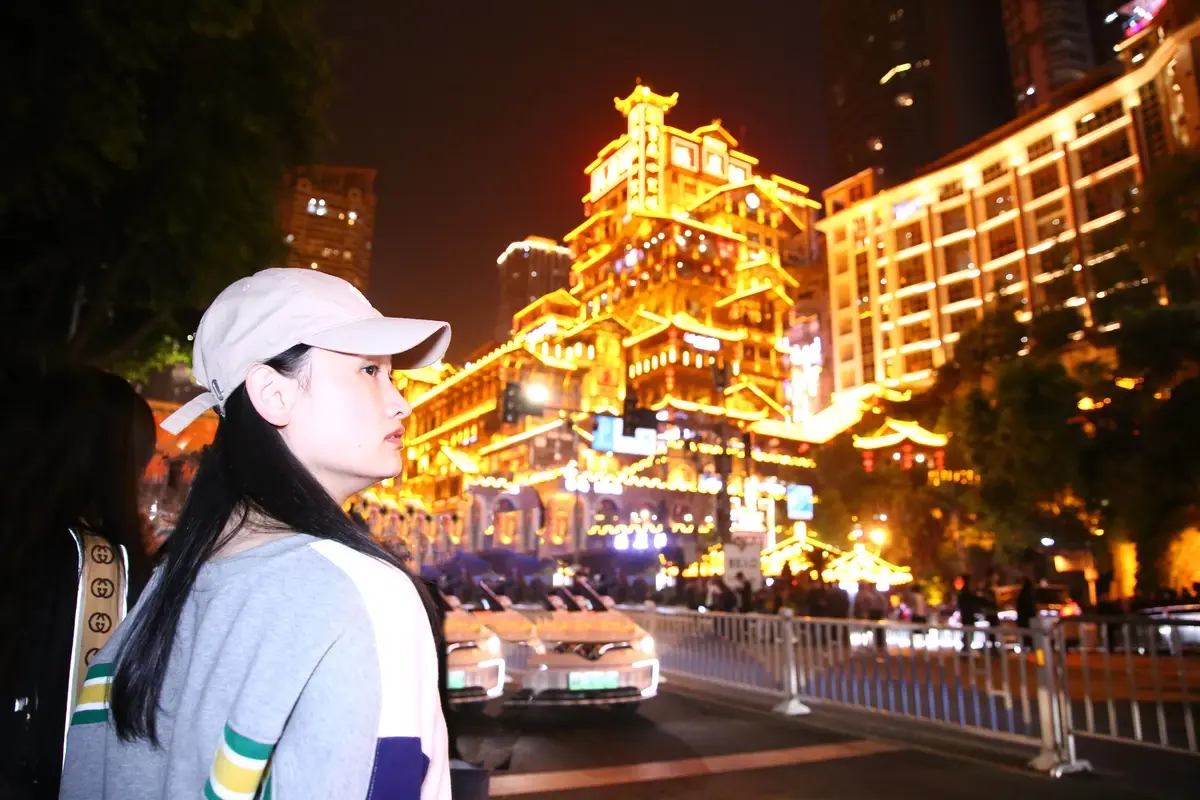
D1: It's such a blessing that there are direct flights from our hometown. We could choose an earlier flight without worrying about missing it. This time, the original plan was to take the 8:00 AM flight, but it was delayed by one hour. We arrived at Chongqing Jiangbei Airport around noon. I booked a pick-up service on Ctrip, and the driver was waiting early. We arrived at the homestay smoothly. After a short rest, we went downstairs to find food. Originally, I planned to go to the Internet-famous restaurant Shancheng Laotangkou Hotpot, but there was still a long queue at 2 PM, so we gave up and chose another restaurant with fewer people called Huogege Chongqing Old Hotpot. It turned out that Chongqing's spiciness is very different from what we are used to in the south. The first meal spiced up Mr. Wang, and he became a bit scared of hotpot afterwards. After eating, we returned to the homestay to rest. We went out to play around 6:30 PM, mainly visiting the Jiefangbei commercial area and Hongya Cave. The Liberation Monument is actually just a landmark building; we took a photo and that was it. Bayi Good Food Street is near Jiefangbei. This Internet-famous city is really crowded, comparable to Nanjing Road in Shanghai. The food street is full of dazzling restaurants. Mr. Wang and I are not very interested in food, so we just strolled around and left. But we happened to come across a singing group performing on the street. The lead singer's performance truly amazed me, so much so that we went back on the last night to listen for a few more hours. Then we walked to Hongya Cave. The Internet-famous spot was packed with people, but the night view was really beautiful, very Spirited Away-like, very dreamy. You think you are on the first floor, but you are actually on the tenth floor. Inside Hongya Cave, there's nothing special, just like a snack street. Actually, looking from a distance on Qiansimen Bridge is more atmospheric. Taking photos at Hongya Cave is easy; there are many young men and women on the street who take photos for tourists for money. You can negotiate a price and they'll take various shots until you are satisfied.
Overlooking Qiansimen Bridge
Bayi Good Food Street singing group performance spot
Qiansimen Bridge night view
D2: Checked in Raffles City, which is also a landmark building of Chongqing. The exterior is quite photogenic, but the inside of the mall is nothing special. On the roof, there is a paid observation deck called Exploration Cabin, a new Internet-famous spot. The ticket is 180 RMB per person, a bit expensive, not recommended for those with acrophobia. I actually recommend Chaodong Road in front of Raffles City. It perfectly combines old residential buildings with the modernism of Raffles City, allowing you to take very Hong Kong-style photos. We had lunch at a Mexican restaurant in Raffles City, then headed to Liziba to see the light rail passing through the building. From Raffles City to Liziba, take Line 1 and transfer to Line 2. The Internet-famous spot was again crowded. We chose Exit A, the common check-in spot, and took a token photo. In the evening, we went to Longmenhao Old Street and Danzishi Old Street. I personally recommend Longmenhao Old Street more. It's on the side of Nanbin Road, under the Dongshuimen Bridge. The old street is built on a hillside, by the river (Yangtze River). The architectural style is Republic of China style, and many buildings have a century of history. I recommend visiting at sunset. Choose a café, watch the sunset light spill over Dongshuimen Bridge, order a latte, sit in an old building and enjoy the city's bustle, very cozy and comfortable. Danzishi Old Street is relatively ordinary. Apart from a tranquil water surface on the observation deck that can reflect the city skyline, there's nothing particularly special.
Raffles City shot from Chaodong Road
Liziba Light Rail Station
D3: One-day trip to Wulong Scenic Area. Originally, Wulong was not in my plan, but because we had already checked off the main attractions in the first two days, I thought we might as well visit the outskirts since we had time. This time, we mainly went to the Tiankeng (Heavenly Pit) and Difeng (Earth Fissure) scenic area in Wulong. The natural scenery is mainly about witnessing the wonders of nature. The landforms are indeed unique. For those who, like us, have plenty of time, it's worth a detour. But if you are short on time, it's better to just stay within Chongqing city. It's quite far from the city center, about six hours round trip. The journey is a bit long, and a day trip is tiring. Staying overnight in Wulong seems unnecessary. In the evening, we went to the Chongqing Eye (Cloud Eye) to see the city night view. There were tons of people. The red escalator for photos had a long queue. Professional photographers were available to take pictures for tourists. The wind on the top helipad was really strong; I felt like I was going to be blown away. We waited in line for too long, so we just took a few casual photos and left. After all, seeing the beautiful scenery with our own eyes is enough; I'm not obsessive about photos. After coming down from Chongqing Eye, we went for dinner (or rather, a late-night snack). We found a place called Peijie Old Hotpot. This meal was probably Mr. Wang's favorite during the whole trip. The big knife pork kidney slices and the dipping sauce were very much to his taste. He kept thinking about it after returning, and later we accidentally discovered that there is one in Ningbo too. He was thrilled.
Chongqing Cloud Eye
D4: Today's itinerary was Sichuan Fine Arts Institute (SFAI) graffiti street and Jiaotong Teahouse. We took the subway to Yangjiaping station, then took a taxi for about ten minutes to get there. This is the old campus of SFAI. Due to the pandemic, the campus is not open to visitors, but the graffiti street is outside. When we went, half of the street was under renovation for exterior walls, so we didn't take many good photos. Let me focus on Jiaotong Teahouse. It's an old teahouse hidden in the bustling city center of Chongqing, retaining the style of the 1970s and 1980s: wooden structure, gray-black bricks and tiles, mottled walls. Half of the people there were trendy young men and women taking photos, and the other half were old Chongqing locals drinking tea, chatting, playing chess, or cards. It seemed like a place forgotten by time, full of everyday hustle and bustle. Mr. Wang loved this teahouse so much that we sat there for three hours, just drinking tea, chatting, observing people, and experiencing the slow life of the Mountain City. Clothing suggestion: wear something in the style of the Republic of China period, like cheongsam or long gown, which will look great in photos. In the evening, we went back to Bayi Good Food Street to listen to music. The lead singer of the singing group is truly the most talented street performer I have ever heard. He sings old songs exceptionally well, especially songs by Jacky Cheung, Wong Ka Kui, and Ronald Cheng. He mentioned that he used to be a backing vocalist for Ronald Cheng, so no wonder his ability is so strong.
D5: On the last day, since we had booked an evening flight, we still had a day to wander. In the morning, we went to Baixiangju, the filming location of The Bad Kids (a TV series). It's about a 15-minute walk from Jiefangbei. Baixiangju is actually an old residential building in Chongqing. Every old, dilapidated building has its history and story. Baixiangju is a 24-story building without an elevator. The old corridors are full of life. It was originally the most ordinary residential area for old Chongqing locals, but it came into the public eye because of a movie. There are many characteristic cafes in the corridors, from which you can overlook the Yangtze River Cableway. If you have enough time, you can sit there for an afternoon watching the trajectory of this unique Chongqing transportation. The old building is very photogenic; every shot has a strong sense of history. Of course, the layout of the old corridors is not as straightforward as modern buildings, so it's easy to get lost. You might go up in Building 3 but come down from Building 5. That's very Chongqing, very magical. Clothing suggestion: don't wear bright colors; black, white, and gray tones are a good choice. In the afternoon, we found a foot massage shop near Jiefangbei. After several days of walking, our feet were wrecked. Getting a foot massage before going home was a wonderful idea. The flight back was also delayed by one hour, but overall the trip went quite smoothly. Thus, the five-day Mountain City journey came to a perfect end.
Travel is serendipity, it's wandering, it's a magnificent adventure, it's never compromising. When everything fades, the treasures of memories still shine. There, the sun is bright, youth never grows old.
From now on, looking forward to the next decade.


