Chongqing Impressions
In mid-May, I returned to Nanjing after traveling through Tibet and Yunnan. While quietly awaiting the birth of my granddaughter, I browsed tour packages for Xinjiang on platforms like Ctrip, planning a trip there in June. Before my wife went to the U.S. to take over childcare duties from our in-laws, I wanted to accompany her on a journey to Ürümqi, Ili, the Altay region, and the Great Sea Road. I selected three products, mapped out the itinerary and how they'd connect, but when I contacted the Ctrip travel consultant, I was told that travelers from Guangdong were temporarily not accepted. After being turned down last July and August, my Xinjiang trip was shelved once again.
Waiting seems like grasping at the years' expectations. Before my granddaughter arrived in this world, my brother-in-law died in a car accident. In the sweltering summer heat, I spent several days shuttling between Jiangning and my hometown, learning the circumstances of the accident and rescue efforts, confirming his workplace injury status, negotiating compensation, keeping vigil for his spirit, and helping with the funeral arrangements. During Spring Festival, he had come to our home in Jiangning to celebrate the New Year—that turned out to be our final farewell. Grief-stricken, I paced along the Qinhuai River for days, unable to shake off the shadow of loss. When my granddaughter was born, sorrow turned into a mix of grief and joy, and travel became my way to console myself.
The pandemic situation in Guangzhou affected all of Guangdong. Many tour products nominally restricted Guangzhou residents, but in reality rejected all travelers from Guangdong. Before retirement, I had visited Chongqing many times, leaving behind a majestic impression summed up by the verse: "No waters are worth seeing after one has been to the sea; no clouds are worthy but those over Mount Wu." In a hurry, I temporarily chose a guaranteed-group tour: Chongqing + Wulong District + Dazu District, an 8-day-7-night 4-diamond package. I first consulted the travel advisor, got approval, then signed up and booked the flights. Once the itinerary was set and payment made, I got a call from the local tour operator. They double-checked our recent travel history and the relationship between our ID card issued location and household registration. Finally, citing scenic-area regulations, they required us to provide a nucleic acid test report from within two days of departure.
The COVID-19 pandemic has lasted over a year, quietly altering lifestyles and habits while affecting every aspect of social interaction and public life. Wearing masks, avoiding gatherings, maintaining social distance—these have become trivialities. Whether entering a hospital, a shopping mall, or a scenic spot, a single security guard is enough to demand your phone number and identity information, disregarding privacy. Like a black swan, the pandemic has triggered many unexpected things. In the face of its ravages, individuals are merely vulnerable. At the airport departure lounge, security staff were fully armored, wearing a pair of gloves, touching every passenger as if they were afraid of the virus while passengers were invincible to it.
With the trip finalized and tickets non-refundable, we had no choice but to get the nucleic acid test as required. The test itself was simple, but because it was the Dragon Boat Festival holiday, we needed to plan ahead. At the testing site of Tongrentang Hospital, we showed our health codes, had our temperature taken, and queued in the emergency department to register, order, and pay—most of the tasks we had to do on the self-service kiosks. Fortunately, we met a very diligent, responsible, and exceptionally kind staff member. Everything went smoothly, and as we left, she even said, "Grandpa, let me follow the hospital's official account for you, so you can check the test results on your phone." My younger brother happened to be on holiday and drove us there. It took half a day and cost 80 yuan per person, but the test report we got was never used once.
Chongqing lies in a valley-and-ridge area parallel to the Yangtze and Jialing rivers, surrounded by mountains. With low elevation, high air density, the thick atmosphere does little to weaken solar radiation but can trap heat from radiating into space. Summers are characterized by high temperatures, high humidity, and small day-night temperature differences, making Chongqing the top of the Yangtze's "Three Great Furnaces." Traveling in Chongqing in summer means enduring the heat test and constantly climbing up and down—a considerable challenge. When choosing the products, besides the 8-day-7-night group tour starting on the 15th, I also booked a 2-day-1-night tour covering Youyang Taohuayuan (Peach Blossom Land) + Gongtan Ancient Town + Wujiang Gallery + Chiyou Jiuli City, and a 3-day-2-night tour of Baidi City + Wushan Small Three Gorges + Zhang Fei Temple + Yunyang Longgang National Geological Park + Changshou Ancient Town. The first two had guaranteed departures; the latter needed a minimum of 30 participants to form a group.
I can't say I was impressed with Chongqing tourism. The 8-day-7-night itinerary was mostly broken into daily independent traveler group-joining arrangements. Each day, we had to wait for the shuttle bus at six or seven in the morning, not departing from the visitor center until after eight. The wasted hour was minor, but mixing tourists who paid thousands of yuan for the package with day-trippers who only paid a hundred-plus yuan a day, and then being subjected to the guide's indoctrination about optional activities, group meals, and onboard souvenir sales—that was unbearable and undignified. On the way to Dazu Rock Carvings, Mr. Deng, a relatively new guide who had switched from nursing, told us they have no base salary or social insurance; they earn only when leading a group, and they have sales quotas to meet. This is the bitter fruit of cutthroat competition for tourists, guides, and the industry as a whole.
Chongqing lies in the upper reaches of the Yangtze River. It was the wartime capital and became a municipality directly under the central government in 1997. Situated on the edge of a basin where the Yangtze and Jialing rivers meet, the city uses rivers as pools and is built against cliffs, with buildings arranged in tiers. The mountains are the city, and the city is the mountains. It is known as a river city, a fog city, and renowned as a mountain city. National 5A-level scenic spots in Chongqing include Dazu Rock Carvings, Wushan Small Three Gorges, Wulong Karst, Youyang Taohuayuan, Wansheng Black Valley, Nanchuan Jinfo Mountain, Jiangjin Simian Mountain, Yunyang Longgang, Pengshui Ayi River, and Qianjiang Zhuoshui. Among these, Jinfo Mountain is a winter sightseeing and skiing destination; Simian Mountain and Ayi River are top choices for summer retreat and rafting. Apart from self-driving trips, there are almost no group tours to these places.
June 14th was the traditional Dragon Boat Festival. We reserved a table at a restaurant near my brother-in-law's home and invited his family and my wife's family to join my mother-in-law for the festival. For us, Dragon Boat Festival holds special meaning each year—it's more about celebrating our daughter's birthday than the festival itself. Even though our daughter is now a mother of two, she remains and always will be our deepest concern. This year's Dragon Boat Festival fell on her lunar zodiac birthday, but because of pandemic restrictions, we couldn't celebrate together with her abroad. So as the family gathered, we ordered a birthday cake to send birthday wishes from afar.
With all arrangements in place, our Chongqing journey began. At 5 a.m. on the 15th, a China Eastern Airlines limousine picked us up to Lukou Airport. After check-in and security, we relaxed in the first-class lounge with tea and breakfast. Flight MU2925 landed at Chongqing Jiangbei Airport after 10 a.m. The travel agency met us and transferred us to the Xiexin Mansion near Jiefangbei. We stayed at the Sweetome Serviced Apartment for nine nights. Every morning, centered around Xiexin Mansion, I jogged in different directions, showered, then had tea and breakfast. We'd head out for the day's itinerary early and return late, and before sleep, I'd binge-watch the TV drama "The Rebel," keeping my usual daily routine.
In total, we traveled thousands of kilometers by car and hiked over three hundred kilometers on foot. We completed the three tour products, covering seven 5A scenic spots, then chartered a car for three days to sweep through the remaining three 5A areas. Besides the ten 5A spots, we also visited Baidi City, which is in the process of becoming a 5A site, and the 4A Chiyou Jiuli City. We checked off the Fantasy Ordovician, the Yangtze River Cableway, WFC Huixianlou Observation Deck, Liziba Monorail Station, Bai Mansion, Zhou Mansion, and Hongyadong Folk Culture Area. We strolled through Ciqikou Ancient Town, Changshou Ancient Town, Yangjiao Ancient Town, Gongtan Ancient Town, Zhuoshui Ancient Town, and Fairy Mountain Town. Combining group tours with chartered car meant we covered all of Chongqing's 5A sights in a single trip—a first in my travels across provinces.
Chongqing's terrain is marked by high mountains, deep valleys, and crisscrossing ravines. The Daba Mountains rise to the north, Wushan to the east, Dalou Mountains to the south, and Wuling Mountains to the southeast. The land descends from north and south toward the Yangtze River valley, higher in the southeast and northeast, lower in the central and western areas. Shaped by this topography and a subtropical monsoon humid climate, Chongqing averages 104 foggy days a year—truly a fog city. The Yunwu Mountain in Bishan District claims an incredible 204 foggy days annually, likely a world record. We departed Nanjing on June 15 and returned from Chongqing to Zhuhai on July 1. In those 17 days, apart from two sunny days in Youyang on the 23rd and Qianjiang on the 24th, it was either persistent rain and overcast or shrouded in clouds and mist—a genuine foggy journey through Chongqing, which I'd call "Misty Yu Travels."
The original city of Chongqing was built on the narrow Yuzhong Peninsula between the Yangtze and Jialing rivers, comprising river valleys, terraces, hills, and low mountains. Since ancient times, many winding hillside paths have been trodden. Unlike the alleyways of most cities, Chongqing's paths are full of steps going up and down, known locally as "ti kan" (staircase slopes). Chongqing is the world's largest mountain city. For many old-city residents, climbing slopes and stairs begins the moment they step out of their housing estate. Just like eating hotpot, going up and down is a life-long companion for Chongqing folks, a love ingrained in their bones. Near the Yangtze River Cableway in Yuzhong District stands a complex of residential buildings called Baixiangju. These 24-story buildings have no elevators, and the courtyard connecting them is not on the ground but mid-air. Residents take it in stride, using the stairs. Even entering from the mid-air north gate, you still have to climb more than ten flights.
A city of mountains and water, Chongqing opens roads up mountains and bridges across rivers, becoming famous for its bridges. It's said that Chongqing has over 13,000 bridges large and small, truly the bridge capital of China. Along the Yangtze River from Shanghai to Yibin, there are 85 bridges, and Chongqing alone boasts 36 cross-river bridges—more than one-third of the total, ranking first in the country. Chongqing has been transformed by these bridges; one after another they rise and leap across rivers. Behind the rapid development of infrastructure lies a generation's perseverance and accumulated strength. It reflects not only the engineers' brilliance and problem-solving efforts but also the Chongqing people's forward-looking spirit and constant pursuit of a better life.
Chongqing's nightscape owes its beauty to the topography: it is embraced by mountains on three sides and a river on the other. The city is built into the slopes, buildings rising in tiers and roads spiraling upward. When evening lights come on, countless homes illuminate the night sky in well-ordered tiers, forming a sea of lights, orderly yet contrasting near and far. On previous visits, a friend drove us to the Yikeshu (One Tree) Observation Deck, located halfway up Nanshan Mountain, facing the Yuzhong Peninsula across the river. The Yuzhong Peninsula is the original city center, embraced by two rivers, which perfectly sets off the mountain-city terrain. As night falls, the lights gradually brighten. Standing high above, leaning on the railing, the Yuzhong Peninsula lies right at your feet.
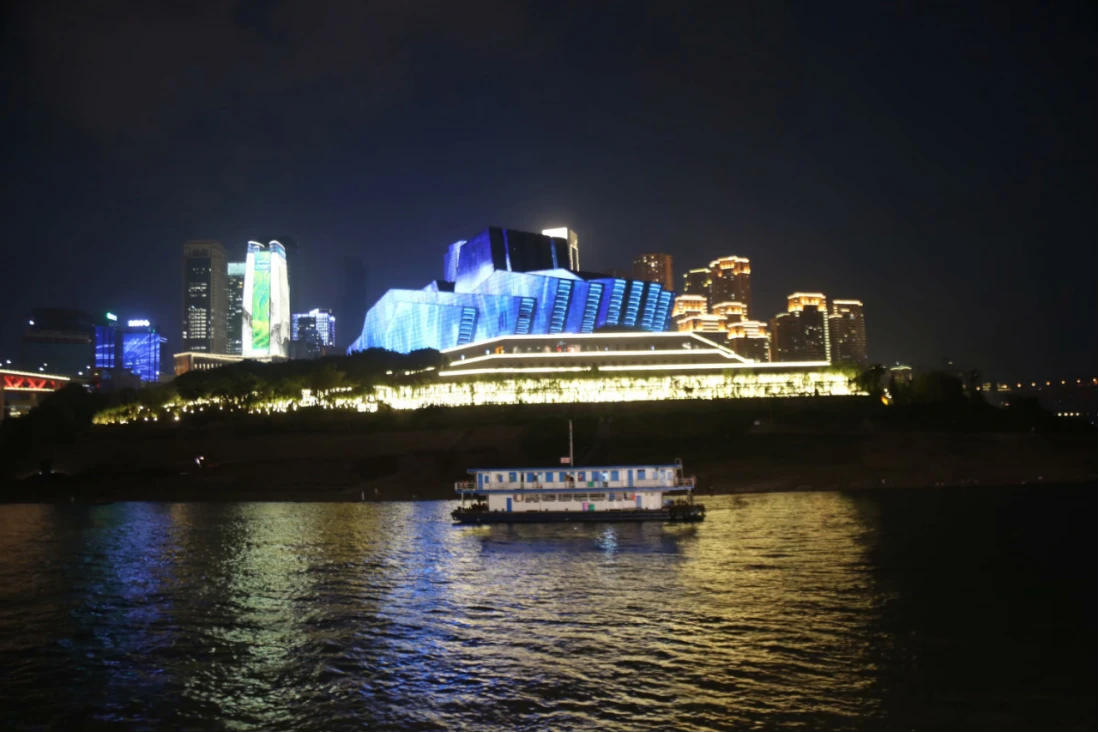
On this trip, our first evening in Chongqing, we boarded a two-river cruise from Chaotianmen Wharf, circling the Yangtze and Jialing rivers, passing under the Chaotianmen Yangtze River Bridge and the Qiansimen Jialing River Bridge. In the soft breeze, we admired the flowing nightscape of the mountain city. Boats vied on the river, glistening with light; the bridges were a riot of color, like winding dragons; on the three banks, myriad lights created a layered splendor, like a starry river, utterly magnificent. After a 40-minute cruise with a 360-degree panorama of the city of mountains and water, we strolled along the Jialing River Binjiang Road. This is where tourists gather most at night; many tour buses drop off groups here, and even more visitors savor the mountain city's evening.
Hongyadong is a cliff-side city standing by the Jialing River, with architecture in the style of traditional Chongqing stilt houses. Under the night sky, the brilliantly lit, multi-tiered buildings form a fantasy scene, as beautiful as the animated world of "Spirited Away." The Qiansimen Bridge glows like jade in the illumination. Lights, buildings, and river waters together paint a mesmerizing picture. Hongyadong faces the Jiangbeizui CBD. Looking across, the Grand Theatre stands like a crystalline gem on the Jialing riverbank, the Jiangbeizui Financial City twinkles with scattered lights, and the riverside road bustles with traffic—dreamlike and ethereal.
Chongqing is animated by its mountains and rivers, and beautiful with its urban fashion. In the early morning, the streets are tranquil. When the first rays of sunlight pierce the thin mist and a gentle morning arrives, jogging along the Jialing Binjiang Road and the Yangtze Binjiang Road, or briskly walking the mountain-city trails, is an utterly refreshing experience. For Chongqing residents, climbing slopes and steps in the city is nothing special, but for visitors who could get lost even with GPS in this mountain city, jogging is no easy feat. The trails are lined with lush trees, the environment quiet, the air fresh. Following these paths, sometimes slowly ascending steps, sometimes quickly descending slopes, you take in the scenery and gain a unique urban experience.
Chongqing people often use "up, down, left, right" for directions rather than cardinal points, so asking for directions here is no easy task. Equally challenging to getting directions is Chongqing's cuisine. Chongqing hotpot is nationally famous; "If you haven't had hotpot in Chongqing, you haven't been to Chongqing" is a saying—so of course we had to try. At Raffles City, the "Tender Spicy Beef Hotpot" was tender and aromatic, but so numbingly hot I barely knew how to eat it; at "Grilled Fish Origin," the Wushan grilled fish was fresh, tasty, and enticingly fragrant; but what we ate most was Chongqing small noodles, chewy and mostly spicy.
(Misty Yu Travels Diary 1: Impressions of Chongqing, written in Zhuhai on July 7, 2021)


