Popular Summer Resort in Chongqing: Average Temperature Only 18°C, Everyone Who's Been There Says It's Beautiful
Summer in Chongqing has a unique magic. The scorching heat makes every pore on your body want to breathe. Everyone knows that Chongqing, along with Wuhan and Nanjing, is known as one of the three 'furnace' cities, which fully illustrates how hot it is. At this time, escaping the heat is the only correct way to spend summer. The average summer temperature on Jinfo Mountain (Golden Buddha Mountain) in Chongqing is only 18°C, and the scenery is picturesque. If you have the chance, be sure to bring your loved one here for a trip and vacation. A romantic and cool travel experience will definitely make your summer more meaningful.
Jinfo Mountain, also called 'Jinshan' (Gold Mountain), was known as 'Jiudi Mountain' in ancient times. It is famous worldwide for three wonders: Karst World Natural Heritage, biodiversity, and Buddhist culture. Although it is a typical karst landform, it lacks the common peak clusters and peak forests, instead sitting like a flat table between heaven and earth. Its high-altitude horizontal cave system contains many formed caves; its long history of saltpeter refining adds mystery upon mystery; its biodiversity and colorful surface karst landscapes all make it a popular tourist destination. In summer, from a distance on Jinfo Mountain, you can see the sea of clouds and sunrise, and up close, you can see the flowers, plants, birds, and trees. With mountains, rivers, forests, and valleys, unique mountain shapes, and a sky so blue it's unbelievable, it feels like autumn has already arrived. Taking the cable car up the mountain, you're isolated from the outside heat by a natural barrier. It offers a unique coolness, making it a great place for a summer retreat. And there are plenty of attractions on the mountain to check out together!
Gufo Cave (Ancient Buddha Cave), the No.1 Buddha Cave Under Heaven
Gufo Cave is located within the Jinfo Mountain scenic area. The cave covers an area of 46,480 square meters. It began forming 3.5 million years before 2021. It is currently the highest-altitude, largest, and oldest high-altitude cave in China. With many visitors coming and going, it is known as the 'No.1 Buddha Cave Under Heaven.'
We wound our way up the mountain path. Although the summer sun was fierce, the dense forest on the mountain provided shade, so it didn't feel too hot. Still, when going out in summer, I remind everyone to take sun protection measures and not end up tanned like me. On the way to Gufo Cave, seeing a patch of wild bamboo forest lifted our spirits. Unlike cultivated bamboo, it was more natural and had a unique, wild beauty. As soon as we reached the cave entrance, we felt a different atmosphere—a cool breeze hit us, instantly switching to cool mode. The guide told us the temperature inside was only about 8°C. This wasn't just escaping the heat; it was like winter. Luckily, I had brought a jacket, and many friends rented jackets nearby, which was very convenient.
Inside Gufo Cave, there are mountains, rivers, and dams; caves within caves. The path started narrow, and at its tightest, only one person could pass at a time. Standing there, you feel an oppressive pressure bearing down on you, as if moving forward against adversity. Fortunately, after not too long, you reach a hall that instantly amazes you with its sight. The widest part is 77 meters, and the highest is 24.6 meters, making it a rare spacious space inside a cave in the world. The 'hall' has a flat floor. Although deep inside the cave, after experiencing that 'dangerous situation,' you now feel as if you're on a flat road. Isn't this like life? First, hardship, and then one day, everything will blossom.
In China, Buddhist temples, Buddha caves, and Buddha grottoes are must-visit places for many Buddhists. Gufo Cave has many Buddha statues worth paying homage to. In the center of the hall is the Dharma throne where Shakyamuni Buddha preaches. From one side, it looks like a single Buddha statue, but actually, unlike ordinary ones, here there are two statues. They sit back-to-back, with identical appearances, clothing, and hand gestures. Both the north and south sides show Shakyamuni Buddha preaching statues. Around the Buddha statues are 1,250 arhats. The guide told us you can choose one arhat that catches your eye, then count your birthday numbers. Which arhat you land on represents your recent fortune. Many friends said they didn't believe it, while others chose to believe. Actually, believing or not believing is a choice in one's heart. When the heart is strong, everything lies within. When the heart is fragile, we always need to choose to believe in something to feel at peace. I think that's the meaning of faith.
Because the cave is 'without seeing the sky or sun,' it's damp everywhere. Every step feels like stepping on water droplets. Especially the 'coffin stone,' with water droplets on it, is quite fitting. 'Coffin, coffin, touch it for promotion and wealth,' the guide said cutely, always having phrases to set the mood. After hearing this, many friends went to touch it, and I did too. But why seek promotion and wealth? In this troubled world, safety is enough…
Following the guide, we walked and stopped. Gradually, the lights dimmed, and daylight came in from outside; we reached the cave entrance. At the entrance, I looked back. In the bright daylight, I couldn't see clearly inside. Everything felt like a dream just now—dreaming of Buddha statues, arhats, and the bright and dim times in the hall…
Yaochi Dam (Medicine Pool Dam), the High-altitude Prairie at Over 2,000 Meters
If the Buddha statues in Gufo Cave were the dim light inside the cave that healed the wounds of the heart, then the medicinal herbs of Yaochi Dam represent the bright light outside, healing the wounds of the body. In Chongqing, there are over 5,800 kinds of Chinese medicinal herbs, and Jinfo Mountain contains 4,000 of them. It can be said that Yaochi Dam on Jinfo Mountain is a Chinese medicine cabinet of Chongqing. 'When people walk on Jinshan, herbs dye their sleeves; when wind passes over Nanchuan, the scent of herbs is smelled.' Yaochi Dam is a treasure trove of Chinese medicinal herbs in Chongqing.
I'm not a professional student of traditional Chinese medicine; I only know a little about various herbs. But I know dandelion, which has the effect of clearing heat and detoxifying. At Yaochi Dam, dandelions are everywhere, along with many other herbs. For example, a plant called thistle, which is covered in sharp spines and looks fierce, is called 'evil hen' by the people of Nanchuan, and it also has the effect of clearing heat and detoxifying.
No matter which herb, as long as it is used correctly for the symptoms, it can produce good effects. At Yaochi Dam, there is also a 'herb' for treating bad moods—the prairie here. The sky is vast, the fields are boundless, and when the wind blows over the grass, all we see are ourselves taking photos. On the endless green prairie, there is a 'Heavenly Pool' with clear water, like a mirror fallen from the sky, reflecting the entire sky in the water. The pool was originally used to store water, and later, herb-gathering farmers used the pool water to wash medicinal materials. I wonder if it's because of the many herbs washed here, but the wind blowing from the pool seems to carry the fragrance of medicinal herbs.
I think no place is more healing than Yaochi Dam. With so many herbs, if you take time to recognize them, you'll eventually know them all. With so many beautiful views, if you feel them with your heart, they will heal your soul.
Jinfo Temple (Golden Buddha Temple), Devoutly Buddhist, Wholeheartedly Doing Good
Friends who believe in Buddhism will definitely find another must-visit place on Jinfo Mountain: Jinfo Temple. From self-healing at Yaochi Dam to healing everyone at Jinfo Temple, it's a journey of healing.
Jinfo Temple on Jinfo Mountain is the largest temple complex in Chongqing and one of the four major temples on Jinfo Mountain. It is known as the site of the Dipankara Buddha (Buddha of the Burning Lamp). Jinfo Temple is located southeast of the mountain-top platform of Jinfo Mountain, first built during the Ming Dynasty, and is the largest temple on Jinfo Mountain. The temple building covers an area of over 1,000 square meters, with spacious halls, purity, and tranquility. It consists of the Heavenly King Hall, the Great Hero Hall, the Ten Thousand Buddha Hall, the Sutra Library, and a Zen hotel.
In contrast to the outside hustle and bustle, this place is very quiet. Between steps, you can hear your own breath. It is also the most famous Buddhist sacred site in the entire Sichuan, Chongqing, and Guizhou region. Can you see? I once devoutly knelt before Jinfo Temple, holding you in my hands, sincerely burning incense, cutting a piece of candlelight, just begging you not to forget the past…
Ecological Stone Forest, Traces of Time
250 million years ago, Jinfo Mountain had already emerged from the ocean and became a synclinal water-collecting basin. Gradually, today's stone forest formed. As we all know, all stone forests are products of karst natural landscapes; each stone is a trace left by time. The Ecological Stone Forest on Jinfo Mountain is the oldest and highest-altitude ecological stone forest in the world. Whether seen in bright or dim light, it seems to have something of time engraved inside.
In the Ecological Stone Forest, although the sun is blazing overhead, touching the stones feels cool. Apart from the inherent nature of Jinfo Mountain, this is also because the trees on the stones shield them from the sun. Plants generally grow in soil, but here, stones and plants coexist. Initially, low-level plants grew on the stone forest. When these plants died, they turned into soil rich in humus. Gradually, some low forests and trees grew together with the stones, forming the unique landscape of 'stones growing trees and trees hugging stones.' This looks like a natural ink painting, like a natural bonsai.
The stones here are very distinctive. Seen from the side, they are ridges; from the front, peaks. From different angles, you get different views. Rows of stone peaks stand neatly like a group of warhorses ready for battle—this is the 'White Horse Formation.' It feels as if, in the next second, the general will give the order, and they will charge into battle. Standing in front of the scenic spot, it almost seems you can hear neighing sounds…
We walked and stopped, looking at this and that, marveling at the wonders of nature. The traces from hundreds of millions of years ago seemed right before our eyes, giving a feeling of 'Ancients did not see the moon we see now, but the moon we see now once shone upon the ancients.' In this world, there is always a reason for us to set out.
Cliffside Walkway to Watch the Sunset, Gorgeous Sunset Glow, Endless Sky Light
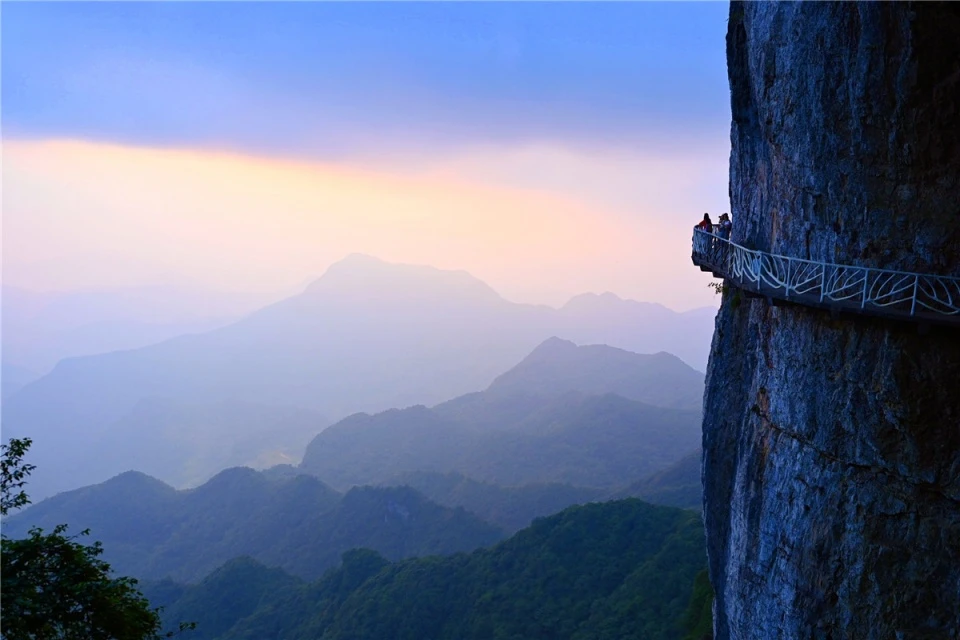
On Jinfo Mountain, early morning offers sunrise and sea of clouds; evening offers gorgeous sunset glow with endless sky light. On Jinfo Mountain, choose the 3,500-meter walkway. On the Jinfo Cliff at an altitude of 2,100 meters, it's like a ribbon hanging. Walking along the walkway, you can cover most of the attractions on Jinfo Mountain. Standing on the walkway, looking down makes your feet feel cold; surrounded by clouds and mist, you can't see clearly what's at the bottom, as if walking in the clouds. The overwhelming unreality makes you forget yourself.
On the walkway, you must walk slowly because here you can see the most beautiful sunset glow in the world. At first, the sun is so bright it dazzles the eyes. By evening, it slowly turns orange. Standing on the walkway, it looks like a big orange hanging at one end of the sky. Gradually, the sun enters the clouds, and golden rays shoot out along the clouds, giving the clouds a golden edge. The light shines on all our faces, gentle as hands lightly touching your face.
As time grows later, the sun is about to set. At this moment, the sky is incredibly beautiful. The clouds are no longer white; they turn orange-yellow. Layers of distant peaks seem to have been dyed with color. Like an ink painting, the clouds above are watercolors, clearly different styles, yet they match perfectly. Everything is just right, making you reluctant to look away.
All the good things in this world are worth collecting. I think the scenery seen from the cliffside walkway at this moment is especially worth collecting. I will imprint this moment in my heart, place it properly, undisturbed by anyone.
Jinfo Mountain on the Tip of the Tongue
Chongqing cuisine is predominantly spicy. A friend of mine was worried that with such spicy dishes in Chongqing, my poor stomach could handle it. Later, I explained that this time on Jinfo Mountain, the food was abundant. Although on the mountain, delicious things were not lacking. There was also medicinal mutton hotpot, made with mutton and natural herbs like Gastrodia, Angelica, Codonopsis, etc., which is appetizing and good for the spleen. It's both tasty and nourishing.
There's also Xiaohe Rice Noodles: 90% high-quality raw rice and 10% cooked rice ground into a slurry. Then 30% chicken and 70% cured meat are shredded and seasoned as toppings. The rice noodles are boiled until they are not mushy or broken. After cooking, add the topping. This way, the soup is flavorful—deserving a five-star rating!
And there are large-bowl dishes. Not every dish is served in a large bowl, but every dish is absolutely delicious. Square bamboo shoots, fish chunks, etc., are all delightful to eat.
Delicious food paired with a good environment—on Jinfo Mountain at an altitude of over 2,000 meters, a gentle breeze blows, giving a sense of stealing a half-day of leisure. After eating and drinking, idling around and chatting casually—this feeling is really relaxing, worth coming again.
Accommodation: Sleep with the Starry Sky
In summer, the increasing light pollution in cities makes summer unbearable. But on Jinfo Mountain, it seems none of this exists. Staying in a hotel on the mountain, you don't need air conditioning; it's at the most comfortable temperature for the human body, extremely pleasant.
If you stay on the mountain, you can go to the 'Golden Turtle Facing the Sun' platform to encounter the starry sky. After the sky darkens, the stars of the Milky Way are twinkling, shimmering in the sky. The wind passes through your hair, instantly making you forget worries and the mortal world. You see only the stars in the sky, one by one, all connected into lines, entwining us as we linger in the human world…


