Chongqing Urban Renewal | Shibati: Reshaping the River and Mountain Years and the Smoke of Human Life
Hand-drawn street view of Shibati pedestrian street by Ouyang Hua, courtesy of Yuzhong District Culture and Tourism Commission.
Shibati is not just a place name. It was once a necessary path of life and a road of time for the people of the Mountain City, the deepest nostalgia of Chongqing locals. Over hundreds of years, it has undergone numerous changes, experiencing times of prosperity and periods of decline.
Here, renowned scholars and dignitaries, diplomats maneuvering, common laborers and peddlers, daily life slowly unfolded, and countless people temporarily settled or lingered.
Shibati before renovation, courtesy of Shibati Company.
Shibati witnessed the century-long warmth and loneliness of Chongqing's mother city, growing stronger despite wars.
It encompasses all the good and bad, joys and sorrows of the human world.
Countless Chongqing locals and outsiders once wandered here, walking down or up the stone steps, then through alleys and back again, casually moving on, touching the most authentic Chongqing, the oldest mother city, for no other purpose.
Shibati before renovation, courtesy of Shibati Company.
The most unchanging thing in the human world is farewell. People miss the neighborly warmth and affection, the noisy yet genuine life, but poor living conditions and safety hazards nearly stripped many of their passion and willingness to stay. Over a decade ago, people finally felt it was time to say goodbye to the declining Shibati.
Reluctantly, Shibati once again set the wheel of history in motion. Piercing through history, painted with sorrow, they used their approval votes to press the forward button that had been stalled for decades.
Shibati before renovation, image from the internet.
Will Shibati regain its prosperity? For now, the answer seems positive.
City and district departments have revised plans multiple times with active planning; Hangzhou Xintiandi Group, with reverence for history and culture, has cultivated this small area for over four years with care, inheriting classics and carrying out the project meticulously.
In September 2021, the Shibati Traditional Style Area will officially reunite with people. Before that day arrives, let us step into the bygone years and stories of Shibati.
Everything feels like yesterday.
Everything feels like a lifetime away.
The bluestone road tells the vicissitudes of Shibati, courtesy of Shibati Company.
Humans settle near water, thus at the confluence of two rivers, the Mountain City of Chongqing was born. So too was Shibati.
According to legend, there was an old well here, exactly eighteen steps away from the residents' homes, hence it gradually came to be called "Shibati" (Eighteen Steps).
This is not just folklore. Years ago, a reporter from the *Chongqing Times* interviewed a centenarian living in the old neighborhood of Houci Street. She recalled her elders mentioning that there was indeed an old well near the original No. 160 Shibati, where people fetched water, washed clothes, and gathered, bustling with activity.
Old Shibati, courtesy of Shibati Company.
The well was indeed eighteen steps from the surrounding residential area, but it later dried up and was abandoned. Eventually, when roads were built, the well was filled in. Li Zhengquan, a well-known Chongqing cultural historian, believes that when Jiefangbei was not yet a commercial district, it was still a forest, and groundwater naturally seeped down to form the well in Shibati. When the upper area was developed into residential zones, the well dried up, which fits the logic.
Old Shibati, courtesy of Shibati Company.
The well origin is the most widely accepted explanation. However, during our research, we also found another perspective. We present it here for your understanding and discussion.
Another theory suggests that during the Ming and Qing dynasties, people built a stone step path here for convenience. Due to the steep slope at both ends, the steps were divided into eighteen sections, each with a platform for passersby to rest, thus giving it the name "Shibati."
One name originates from water, the other from mountains—such is the Shibati of Chongqing, the city of mountains and rivers.
The reason Shibati holds such an important place in the hearts of old Chongqing locals lies in the concept of the Upper and Lower City.
Bounded by the nine open and eight closed city gates and walls, the mother city of Chongqing during the Ming and Qing dynasties was perched at the tip of the Yuzhong Peninsula. Though not large, due to the Huaying Mountain range running through it with a vertical drop of dozens of meters, the city was divided into an Upper and Lower City. The Lower City was around Nanjimen and Jinzimen, while the Upper City was the current Jiaochangkou and Jiefangbei area.
Map of Shibati and surrounding area in the late Qing Dynasty.
During the Ming and Qing dynasties, Chongqing was the gateway to Sichuan, with convenient land and water transportation. Many merchants stopped and transshipped here, so the area from the Lower City to Chaotianmen was prosperous. At that time, the area from Shibati to the Upper City was relatively remote, with a military training ground nearby. The current entrance of Fudan Middle School was the location of the military camp gate.
With booming commerce and population growth, people began to settle in the Upper City. Thus, Shibati's importance as a passage connecting the Upper and Lower Cities became evident. It is worth noting that the current roads connecting the two, such as Zhongxing Road and Kaixuan Road, were only built during the War of Resistance. The significance of Shibati at that time is easy to imagine.
Map of Shibati and surrounding area in the 1940s.
Although Shibati was on a slope, building houses against the mountain was feasible. With a surge in foot traffic, commercial economy and cultural life gradually flourished. After several developments, Shibati was no longer just a passage; wealthy merchants and ordinary people came to buy land and build houses, turning it into a bustling area.
Yongxing Lane in Shibati was named after the famous Yongxing Pawnshop at the time, while Jiaopu Lane got its name from the sedan chairs of the wealthy parked there. As for Huajiezi, a famous place of pleasure in old times, it symbolized the prosperity of commerce then. Later, at No. 35 Fenghuangtai, the former French Consulate became the stage for historical events.
Old illustration of Shibati, image from the internet.
According to historical records, military campaigns inevitably resulted in injuries, leading to a concentration of traditional Chinese medicine clinics in the Shibati area. Additionally, due to the convenience of the docks, it became a drug distribution hub, with medicine merchants coming and going.
Ming and Qing dynasty buildings and archways followed the terrain, layered along the street in an orderly manner. Young ladies of noble families leaned on the "beauty rests" in their pavilions, quietly watching the hustle and bustle below. It seemed like a three-dimensional version of the *Along the River During the Qingming Festival*: sedan chair bearers, boat trackers, laborers, soldiers, vendors, travelers, revolutionaries, foreigners... all gathered here.
Remains of "Daguanping Stone Carving" at the original Huangtupo in Shibati, courtesy of Shibati Company.
This place preserves the most authentic human warmth of Chongqing and the bygone times.
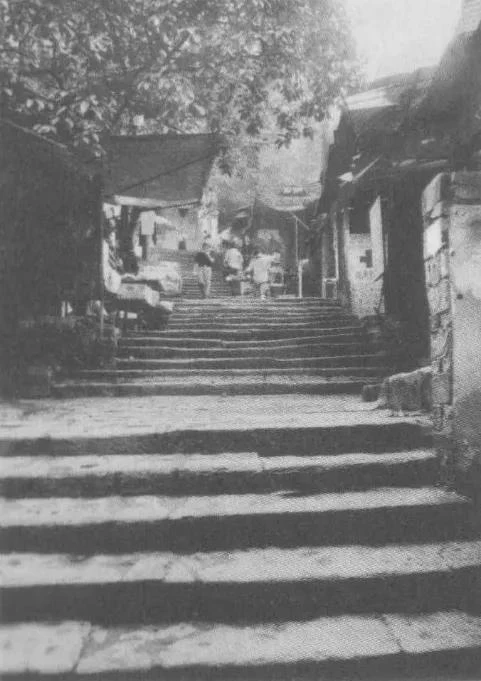
The winding steep stone steps connect the bustling commercial area of the Mountain City with the old riverside neighborhoods, witnessing the real life of old Chongqing people.
This is Chongqing's version of the "Qingming Riverside Scene."
Shibati showcases the mountainous urban form and spatial characteristics of "natural Chongqing," with a road structure of "horizontal streets and vertical lanes" and street spaces of "ups and downs, twists and turns," collectively forming the traditional mountainous residential space, bearing the changes of everyday life and the evolution of time and space. It is a product of regional political, economic, and cultural interactions.
Old Shibati, courtesy of Shibati Company.
No. 171 Shibati is a Republic-era building, originally a salt merchant guild hall. For business, salt merchants would go to Hechuan, and salt peddlers to Wushan to purchase goods. They planned and negotiated prices or shared profits in the guild hall. Once they had salt, they contacted cargo ships or hired modern-day "bangbang" (porters), negotiated wages, and loaded the salt onto ships. After everything was arranged, the salt was transported via the Jialing and Yangtze Rivers to various places.
The salt merchants and peddlers wanted to sell salt at high prices, and the guild hall played a significant role. Various salt merchants came to the hall, drank tea, chatted, and conducted business, with a constant flow of people and thriving trade.
Former salt merchant guild hall at No. 171 Shibati.
At the entrance of the Shibati air-raid shelter was Shanguo Lane. According to historical records, in the late Qing Dynasty, residents of Shanguo Lane voluntarily pooled money to buy oil and light lamps for nighttime passersby, doing good deeds and practicing kindness, believing in good karma. Originally, there was a Guanyin Temple here, the real "Guanyinyan" of Chongqing.
Continuing downward, after the middle section of Shibati is Houci Street, built against the mountain, with the Yangtze River below.
It is said that Houci Street was once the "No. 1 Street of Chongqing," composed of Haochi Street, Jinmasi Street, Shuangweizi, and Taiqian Street. It connects Zhongxing Road, Shibati, Huajiezi, etc.
Old stilted buildings in Shibati, courtesy of Shibati Company.
Some say Houci Street was the transportation hub of the Lower City and its bustling center.
In old times, Houci Street was like a maze, with twists and turns, full of uneven stilted buildings. Every night, food stalls spread through the streets, and tung oil lamps and kerosene lamps lit up the shops.
Under each lamp was a food stall selling braised meats, noodles, fried peanuts, boiled soybeans, cold tofu, etc. After a day's work, dock laborers came to eat and drink. Among the diners were also merchants who had disembarked or stayed at inns, enjoying late-night snacks. Thus, the sounds of drinking games and clamor rose and fell, often lasting until the next morning.
Shibati before renovation, photo by Zhang Song.
Because "Houci" sounds like "haochi" (delicious) in the Chongqing dialect, it was called "Haochi Street." Over time, people found it inelegant, so they renamed it "Haochi Street" using the characters for a large fire-prevention pool. After several changes, it merged with other alleys and took the name "Houci Street."
Since Chongqing opened as a treaty port in 1891, it developed rapidly as an important commercial city. With population growth, expansion and improvement of urban infrastructure became necessary. Chongqing's first mayor, Pan Wenhua, took bold actions, demolishing city walls and building roads, accelerating urban transportation. Modern roads like Nanqu Road and Beiqu Road began to connect Chongqing city. After Zhongxing Road and Kaixuan Road were built, Shibati was no longer the primary passage connecting the Upper and Lower Cities.
However, the real damage to Shibati came from war.
Chongqing during the War of Resistance, image from the internet.
After the outbreak of the War of Resistance Against Japan, Chongqing became the wartime capital, drawing global attention, and Japanese artillery targeted Chongqing. From February 1938 to August 1943, Japanese aircraft frequently raided and bombed Chongqing, sending over 9,000 planes and dropping more than 11,500 bombs.
To break the will of the Chongqing people and cause maximum casualties, the Japanese often dropped incendiary bombs, which were disastrous for wooden and bamboo houses. According to survivors, after the bombings, there were rubble and seas of fire everywhere, a terrible sight.
Chongqing during the War of Resistance, image from the internet.
During this painful period, June 5, 1941, will forever be remembered in history.
The Shibati air-raid shelter at Jiaochangkou was a major shelter in Chongqing. It was 10 meters deep, 2 kilometers long, had three exits, and was 2 meters high, with wooden benches and oil lamps at intervals for lighting. However, the conditions were crude; the Shibati shelter lacked water intake, ventilation, fire protection, and anti-gas facilities.
Jiaochangkou air-raid shelter, image from the internet.
On the evening of June 5, during a Japanese air raid lasting over five hours, a stampede and suffocation tragedy occurred in the shelters at Shibati, Yanwuting, and Shihuishi, resulting in about 2,500 victims. The nation and even the world were shocked.
As we know, since 1998, Chongqing has sounded air-raid sirens every June 5 to commemorate those who died in the shelters and those lost in the Great Bombing of Chongqing, to remember the dead and warn the living.
Chongqing after Japanese bombing, image from the internet.
After reform and opening up, China's economy gradually took off. Chongqing was no exception.
With Jiefangbei Pedestrian Street as a representative, Chongqing's economy and urban construction developed rapidly, while the once-prosperous Shibati gradually fell silent.
Especially in the late 1990s, the establishment of the Nanjimen labor market attracted a large influx of migrant workers who settled in Shibati. Most original residents moved away, and Shibati became shabby and chaotic.
At that time, Shibati was thick with local flavor—cheap inns, teahouses, ear-cleaning stalls, restaurants, cupping clinics, mahjong parlors, and other consumer scenes emerged with these newcomers. In this space seemingly forgotten by time, it exuded a warmth entirely different from the modern city, especially in stark contrast to the fashionable and prosperous Jiefangbei just across the street, showing a precious and warm picture.
Shibati before renovation, image from the internet.
For the residents here, Shibati was their haven and their confidence in living in this city—the low cost of living was undoubtedly warm for them.
From the end of the last century, more and more artists, photographers, and literary youths turned their attention to Shibati. In an era that frequently requires looking back at the past, Shibati became a benchmark and representative of Chongqing. This kind of Shibati was loved by some, not because it was a hidden dragon and crouching tiger, but because it offered a last chance for those barely surviving in the city and preserved the bygone time.
Every day, besides passersby traveling between the Upper and Lower Cities, most visitors were literary "pilgrims" with backpacks and SLR cameras. Some netizens even commented, "If you haven't been to Shibati, you haven't been to Chongqing."
Shibati before renovation, image from the internet.
Green trees shaded the area, wires crisscrossed, the aroma of cooking from the kitchen mixed with the smell of tobacco leaves. The calls of street vendors echoed through the alleys, and the video room played Hong Kong movies, with occasional bursts of laughter—that was the Shibati in memory.
The winding steep stone steps connect the bustling commercial area of the Mountain City with the old riverside neighborhoods, witnessing the real life of old Chongqing people.
Undoubtedly, Shibati attracted so much attention because it preserved a microcosm of old Chongqing life from the 1960s-1970s. Both sides of the street were filled with a strong flavor of life, with small restaurants, barbershops, public video rooms, tailor shops, small tea houses, etc., presenting the authentic old Chongqing life.
Many people feel an instant familiarity with Shibati, probably because all old places are tinged with the nostalgic flavor of time.
Similarly, that is also a reason some left.
Shibati before renovation, courtesy of Shibati Company.
Of course, it was home to the locals, and climatic conditions could be compensated by living conditions. But Shibati's houses were too old: those built before liberation had no living conditions to speak of; after liberation, construction for a long time focused on providing shelter without much consideration for quality of life. Most households had very limited per capita living space, and interior renovations could not keep up, making living quality a serious issue.
Society always progresses, but Shibati's stagnation was not only in environmental construction but also in residents' physical and psychological needs. Despite much reluctance, it was inevitably time to say goodbye.
Shibati before renovation, courtesy of Shibati Company.
With this, the recent decline of Shibati becomes understandable. People's hearts desire change; everyone has the right to pursue comfortable living. Shibati was bound to go through a period of neglect, and urban construction changes accelerated this process.
In 2008, Shibati once again started the wheel of history, with initial work on redeveloping dilapidated housing areas carried out thoroughly.
On June 20, 2010, at 4:30 p.m., at the playground of Xinglin Middle School, with 96.1% approval, the people opened another chapter in Shibati's history.
Report of the voting process by *People's Daily*.
Report of the voting process by *Chongqing Morning Post*.
How to restore Shibati?
No decision is easy.
“Revised multiple times,” said a responsible person from the Yuzhong District authorities. Shibati had gathered too much attention; the reborn Shibati must reflect the true mountain city, the most authentic Chongqing, and be worthy of the city's cultural heritage.
Over the years, the Yuzhong District commissioned multiple design units to prepare the Shibati protection implementation plan and traffic organization plan. It was not until 2016 that the plans passed expert review, officially concluded, and the overall regulatory plan revision was basically completed.
Historical buildings preserved within the Shibati Traditional Style Area, courtesy of Shibati Company.
On May 17, 2015, the fourth meeting of the Chongqing Municipal Planning Committee and the first meeting of the Municipal Historical and Cultural City Protection Committee were held, designating the Shibati Traditional Style Area as one of the 28 traditional style areas in Chongqing. The planned protection area extends east to the Chongqing Daily office, south to Jiefang West Road, west to Zhongxing Road, and north to Jiaochangkou, covering a total area of 18.88 hectares, including a core protection area of 3.89 hectares, construction control area of 7.17 hectares, and style coordination area of 7.82 hectares.
Under the guidance of the *Chongqing Main City Traditional Style Protection and Utilization Plan* and the *Shibati Traditional Style Area Project Construction Detailed Plan* approved by the Chongqing Municipal Government, the Yuzhong District Committee and District Government vigorously promoted protection, restoration, and revitalization.
In May 2017, the Shibati Traditional Style Area project officially started.
Shibati under construction, courtesy of Shibati Company.
The Shibati area encompasses the joys and sorrows of Chongqing people and the essence of life, as well as the "fishbone-shaped" and "ladder-like" traditional mountain neighborhood texture and "traditional Bayu" architectural types and terraced layouts. It includes one national key cultural relic protection unit (the former French Consulate, part of the Allied diplomatic missions in Chongqing), one municipal cultural relic protection unit (the "June 5" Tunnel Tragedy Site of the Chongqing Bombing ruins), five ungraded immovable cultural relics (such as the Daguanping Stone Carving and the Niaoyouyuyun Stone Carving), three excellent historical buildings (No. 35 Shanguo Lane, No. 95 Houci Street, and the former Match Raw Material Factory site), 81 large trees and old trees, and 13 traditional streets and lanes known as "Seven Streets and Six Alleys," along with old stone steps, old retaining walls, and old air-raid shelters—natural and cultural landscapes full of Chongqing flavor. These gather too many historical stories and life atmosphere.
All this is a treasure of time, but also a heavy responsibility.
Shibati under construction, courtesy of Shibati Company.
To treat a piece of land and a group of buildings with heart, in the view of Wang Rui, deputy general manager of the Shibati project, is to see how we treat every plant, every brick and tile. The Shibati Traditional Style Area covers 88 mu (about 5.9 hectares) with a total building area of 170,000 square meters. According to the progress of conventional commercial projects, this scale could be completed in two years, but the project company spent four years cultivating Shibati slowly. The slowness was due to careful preservation of the original flavor.
This planning and construction respects Shibati's "natural Chongqing" mountainous urban form and aims to protect the endowment and temperament of "Old Chongqing" and "True Mountain City": continuing the original street pattern and texture of the Shibati Traditional Style Area; protecting and repairing dilapidated old buildings in their original positions, heights, sizes, and materials; inheriting, implanting, and innovating "Bayu cultural form, architectural form, new special business forms"; and excavating, refining, and creating new formats, new scenery, and new experiences like "Eighteen Items, Eighteen Tastes, Eighteen Views."
Large-scale demolition and construction are not difficult; what is difficult is protecting while building. Huangge trees, bluestone slabs... these have all been preserved. The Shibati Traditional Style Area also continues the basic pattern of "Seven Streets and Six Alleys" traditional streets. During construction, strict protection of the original natural ecological environment and original landforms such as retaining walls and steep slopes was required, which posed considerable challenges.
For example, during construction, plastic boards were installed on the original bluestone roads for protection, and building materials were not transported by vehicles but by traditional manual carrying on shoulders, which, although time-consuming and labor-intensive, effectively protected the centuries-old stone steps from damage.
Shibati under construction, courtesy of Shibati Company.
The essence of mountainous Chongqing lies in its streets and alleys. In the view of cultural historian Li Zhengquan, to understand Chongqing, one must first understand those streets and alleys—one-person lanes, lanes within lanes, cloud-ladder lanes, indoor lanes... Climbing on stone steps and walking through alleys, you gradually come to understand Chongqing.
This is the new world of Shibati.
And also the old life.
People have long been looking forward to the reunion.
The fences around the upper urban balcony of the soon-to-open Shibati Traditional Style Area have been removed, and many citizens and tourists stand there, leaning on the railing to look into the distance.
If you haven't been there for a long time, the scenery is quite different.
Along the mountain, weathered blue stones are piled up, gray bricks and black tiles spread layer by layer, and stilted buildings are scattered in between. Near Fenghuangtai, there are hipped roofs, parapet walls, small black tiles covering the surface, brick pillars and walls... The former China Match Raw Material Factory stands in renewed splendor, showcasing the courage and resilience of "Match King" Liu Hongsheng. Beside it, an old yellow building echoes, the former French Consulate.
We imagine that the prosperity of Shibati during the Ming and Qing dynasties might have looked like this.
Overlooking Shibati, photo by Chen Yunyuan.
According to Wang Rui, the Shibati Traditional Style Area will be divided into five zones according to the historical heritage of seven streets and six alleys, featuring "two experiences and two centers." Looking down from Jiaochangkou, the right side of the main street of Shibati is Zone A and Zone B, the traditional cultural experience area, presenting Bayu traditional culture and folk customs.
Especially the Mountain City Memory Museum in Zone A, a carefully crafted achievement by the Shibati team, houses a large collection of precious books, images, and video materials of old Chongqing, using digital technology to bring the memories, changes, and tastes of old mountain city life back to public view.
The left side of the main street is Zone C, positioned as a national trend cultural and creative experience area. It will focus on traditional handicraft inheritance and innovation, fine development of project-specific products, and incubation of cultural IP derivatives. Regional traditional cuisine from the Southwest will gather here, just as in the days when the Chongqing docks gathered visitors from all directions.
Zone D, around Fenghuangtai and the former French Consulate, is the international exchange center, representing the scene of Sino-Western cultural and business exchanges, connecting Shibati with the world again. Zone E, located at Huajiezi, is a night economy entertainment gathering area, with personalized leisure life and immersive performance venues, developing into a gathering place for trendy youth. The old pleasure district has taken on a new look, but the lively lights remain unchanged.
More details will be woven into the texture of the streets and alleys.
Shanguo Lane will use the space of the original stone steps and retaining walls to display street life; Xiahui Shuigou, originally a famous flea market, will retain its creative and market functions; Yuetai Ba, named after the moon-shaped retaining wall in front of Hu Ziang's residence, will restore the traditional moon-viewing scene by recovering the courtyard and surrounding steps; Jiaopu Lane, following the story of one of Chongqing's "three sedan chair guilds," will develop experience projects like mountain city "sedan chairs"...
"Bayu cultural form, architectural form, new special business forms; eighteen items, eighteen tastes, eighteen views..." Wang Rui believes that the Shibati Traditional Style Area will become a new cultural business card for Chongqing.
People will find Chongqing in the streets and alleys of Shibati.
The lights of Shibati are lit, photo by Zhang Kunkun.
Undoubtedly, Shibati, about to appear in a new look, is Chongqing's landmark urban cultural business card, a characteristic cultural tourism commercial demonstration area, an international cultural display window, and an international cultural tourism destination.
Like many, we worry whether it will lose the original rustic and even dilapidated appearance we loved, those flavors of life and warmth.
I recall Lu Xun's words in "*Tiwei Ding* Draft": "The tripod in the Zhou Dynasty was just like a bowl in modern times—our bowls are never left unwashed for a year. So the tripod at that time must have been clean and shining, in technical terms, not 'serene' but somewhat 'passionate.' This vulgarity has never been shed, changing my criteria for evaluating ancient art. For example, Greek sculptures: I always think that one reason they appear 'only mellow simplicity' now is that they were buried in the ground or exposed to wind and rain for a long time, losing their sharpness and luster. At the time of carving, they must have been brand new, white, and gleaming. So the beauty of Greece we see today is not necessarily what the Greeks considered beauty; we should imagine them as new things."
The mountain city years ascend and descend step by step, as does time.
The light of Shibati, photo by Fu Nanfei.
We wander and drift here, experience pain, cry, love—those stories of growth will eventually be smoothed by time and return to tranquility.
The only constant is that in the ocean of time, we hope to quietly leave behind a few memories of text and images for our city, expressing our infinite love for the city through a bit of personal emotion.
Love for Shibati.
Thanks to Chongqing cultural historian Li Zhengquan for his insights.
Thanks to Wang Rui, Deputy General Manager of Hangzhou Xintiandi Group Chongqing Shibati Company, for accepting the interview.
Thanks to the Yuzhong District Culture and Tourism Commission and the Cultural Relics Management Office for providing graphic materials.
*Chongqing Shibati Air-Raid Shelter Tragedy* by Chen Yu.
*On the Protection and Revitalization of the Shibati Historical District* by Zhang Malu.


