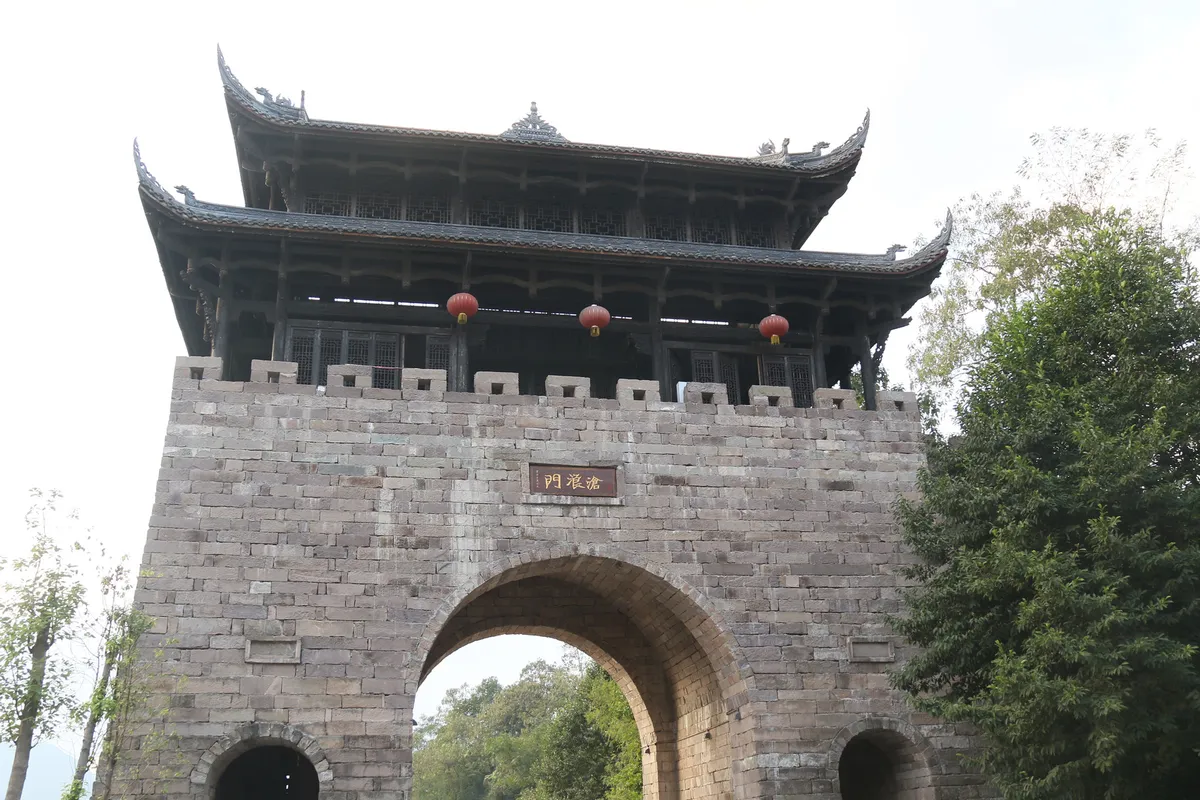
Discovering the Beauty of Zhuoshui Ancient Town and the Puhua Underground River
When the Canglang River is clear, I can wash my tassels; when the Canglang River is muddy, I can wash my feet...
One morning during the National Day holiday in October 2021, we set off from Youyang and took National Highway 319 back to Qianjiang. Also known as the G319 or Gaocheng Line, this highway runs horizontally from Kaohsiung in Taiwan to Chengdu in Sichuan. Passing through cities like Xiamen, Ruijin, Changsha, and Chongqing, it stretches 2,984 kilometers and is hailed as "China's most beautiful national highway." The morning sun was bright and warm; willows, camphor trees, and yellowhorn trees on both sides of the road quietly slipped past. The Apeng River, a major tributary of the Wujiang River, flowed emerald-green on our left—a hue that made you steal a few more glances! We slowed down to savor this rare moment of peace.
Our destination was Zhuoshui Ancient Town in Qianjiang. Like Pengshui, Youyang, and Xiushan, Qianjiang is a multi-ethnic region. Zhuoshui Ancient Town lies in the southeast corner of Qianjiang, 25 kilometers from the city center and Zhoubai Airport. It is a national 5A scenic area, a nationally recognized historic and cultural town, and a characteristic town of China. Originally called "White Crane Dam," it was part of the Youyang Tusi domain during the Yuan and Ming dynasties. Due to its strategic commercial location, it has served as an important courier station and trading port since ancient times. By the late Qing dynasty, it had become a vital junction on the post road, trade route, and salt trail of southeastern Sichuan.
The Apeng River basin, where the ancient town sits, has seen human activity for over 10,000 years. The Apeng River originates in Lichuan, Hubei, and is China’s only inland river that flows from east to west. Together with the Wujiang and Youshui rivers, it has long formed a crucial passageway linking the Three Gorges region with the Jianghan Plain.
We arrived at Zhuoshui Ancient Town. A former schoolmate who works at the local branch of the People's Bank of China had been waiting for us. We dined at a fish restaurant in town, savoring local specialties like Zhuoshui sow shell fish and yellow catfish while chatting about current economic trends and monetary policies—what a delight! Outside the window, the sunshine was brilliant and the scenery was picture-perfect. From our table, we could see the blue sky, white clouds, the stunningly green Apeng River, and the famous Wind and Rain Covered Bridge. Recognized by Guinness World Records, this bridge is celebrated as the "World’s No.1 Wind and Rain Bridge," stretching 658 meters and comprising four sections: Zhuoshui Huaiyuan, Tang Bell Long Melody, Rainbow Subduing Waves, and Puhua Feilong.
This trip had two purposes: to experience the rustic ethnic minority charm of Zhuoshui Ancient Town, and to let the kids play with water. Just beside the town flows the 2-kilometer-long Puhua Underground River, at an elevation of around 420 meters with depths up to over 20 meters. Mainly formed by underground channels, karst caves, and gorges, it is a tributary of the Apeng River and typical of karst landforms.
Thoughtful as ever, my friend arranged a private guide to accompany us to the Puhua Underground River. The guide was adorable, brimming with the warmth and boldness unique to minority ethnic girls. We descended to a spot called "Red Cave," a karst cavern associated with the legendary battle between the Ba tribal leader Linjun and the Salt Water Goddess. Though the tale is both romantic and fierce, what truly captivated us was inside the cave. Apart from stunning natural stalactite formations like Thousand Hill Terraces, Dripping Lotus, Twin Trees of Puhua, and Buddha’s Hand Welcoming Spring, countless "thousand-year cave pearls" lay scattered on the ground—a rare sight even in similar domestic caves.
Children are naturally drawn to water, and when we emerged from Red Cave and spotted the emerald stream, my child was overjoyed, hopping and skipping onto the boat. We put on life vests and settled in. The Puhua Underground River originates from Tianmen Mountain in Zhuoshui, fed by four mountain streams from Santang Gai, Guankou Village, Qianqiutian, and Zhangjia Gai, along with countless cascading waterfalls that accumulate into pools within the dark caves—a profound convergence of waters. As the upstream flow nears the underground river, it is blocked by a giant lotus-shaped boulder, splitting the rushing water into two streams, which then become much calmer, like a demure maiden.
Soon the boat set off. Accompanied by the clear, melodious notes of a bamboo flute, we drifted into the deep gorge and began the "Three Days and Two Nights" passage. This poetic name refers to the experience: entering the cave turns dark (counted as one night), and emerging into daylight counts as one day. Inside the underground river, sheer cliffs towered and water threaded through cave heavens. Above us were the magnificently sculpted natural Three Bridges, before us arrayed a forest of towering stalagmites in strange and wondrous shapes. Two giant sinkholes known as "Heaven’s Eyes" appeared mystically—these are actually skylights. They are formed between the second and third natural bridges, consisting of two oval-shaped funnels, each about 70 meters high. The skylight between the first and second bridges is 52 meters wide, while the one between the second and third bridges is 41 meters wide.
Alas, before we knew it, we had exited the gorge and returned to reality! My child had no choice but to leave the boat, unwilling to let go of the experience.


