My 4-Day, 3-Night Self-Guided Trip to Chongqing
This was my second domestic free trip with my daughter. Time slipped by so fast; our last trip was in 2018, and in between, we experienced my daughter’s college entrance exam and then the COVID-19 pandemic. This year, the Chinese New Year came very early, so that even after the Lantern Festival, the universities hadn’t started yet. Seeing a colleague’s travel photos on Moments, I suddenly had the idea of taking a trip with my daughter. Action speaks louder than words. Because of special airfare deals and other reasons, we quickly chose our destination: Chongqing, from February 13 to 16. In the days before departure, I was busy with work and didn’t do much planning, intending to finalize the itinerary upon arrival. For convenience, I booked a hotel near Jiefangbei in the city center.
On February 13, we got up at 4:30 a.m., left home at 5:30, and the plane took off at 7:40. We arrived around 9:00, took a ride-hailing car from the airport directly to the hotel. On the way, I asked the enthusiastic driver where to have fun in Chongqing. He honestly said that he lived in the city himself and didn’t think any place was particularly fun. I quite agreed; in my own city, I also feel that everywhere is too crowded and not fun, so I’d rather stay home.
The fare from the airport to the hotel was about 40 yuan. After settling in, it was lunchtime. Hearing that Chongqing noodles were excellent, my daughter and I decided to have noodles for lunch. When we went downstairs, we found a huge crowd; many people were using a curved building as a backdrop for photos. Later I learned it was Raffles City, nicknamed “Sails toward the Sky.” The weather was bad and there were too many people. I took a few quick photos of my daughter, but I wasn’t very satisfied. There were many small eateries around the hotel, but we didn’t know which one was good. Finally, we chose a place where the owner warmly invited us in from the door. We ordered two bowls of lamb noodles. The broth was rich, the meat fragrant, the noodles chewy and delicious. The spiciness was acceptable to us. My daughter felt not full enough, so she added a bowl of spicy wontons, which were also very good.
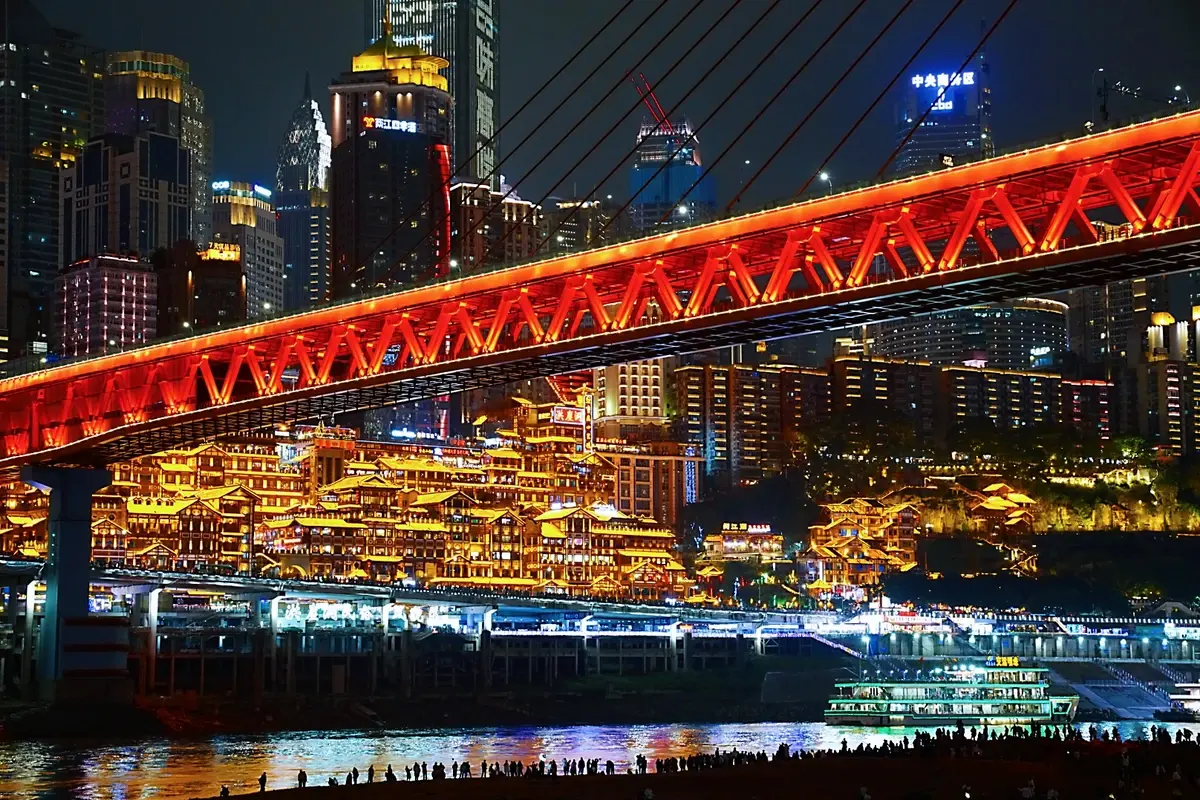
After lunch, we returned to the hotel to rest, sleeping all afternoon. At around 5 p.m., we hurried out. I heard that the night view of Hongya Cave was beautiful, so we planned to visit it tonight. The driver earlier said it looked even better from the opposite side of the Jialing River, so we took a taxi there, setting the drop-off point at the Grand Theatre. I must say, transportation costs in Chongqing are quite affordable; it felt like we drove quite far and were stuck in traffic, yet the fare was only 17 yuan. It wasn’t dark yet, but the lights of Hongya Cave were already on. We took some photos on the platform of the Grand Theatre.
Good thing we took those photos there, because later when we went down to the muddy riverbank, it was packed with people, and the background was full of strangers. As time passed, it got dark, and the lights of Qiansimen Bridge came on, making it even more beautiful.
After taking enough pictures of Hongya Cave on the opposite bank, we turned around to see the Grand Theatre also lit up in a deep sea-blue color, exceptionally beautiful. Later online, I saw it sometimes turned red or yellow, both lovely. We even played with silhouette shots against the wall.
Soon many others imitated us, so we headed towards the river. The muddy riverbank was crowded; it was impossible to take a photo without strangers in the background at any angle. Neither of us liked such crowded places, so we just took a few quick shots.
By then, a steady stream of people was flowing from the Grand Theatre to the riverbank, and it was getting even more crowded. We decided to leave. We walked along the river, thinking there might be an exit ahead, but after walking for a while, we found all exits blocked. So we backtracked along some side paths, only to reach dead ends that were also fenced off—frustrating! “After endless mountains and rivers, no road in sight”—there really was no road ahead! After much twisting and turning, we realized we could only exit through the entrance. It was exasperating. I hope readers of this travel note won’t have to make the same detour; if you enter from one place, you can only exit from there.
Ahead was a blocked exit…
Coming out from the riverbank, we followed the crowd uphill to the foot of Qiansimen Bridge, where we planned to take the light rail back. There were many stairs, no escalators, so our legs felt weak…
We got off at Xiaoshizi Station on Line 2, intending to have hotpot for dinner. When we ate noodles at noon, the noodle shop owner lady recommended “Zhu’s Fat Guy Miserable Hotpot.” When we opened the door, a lady at the entrance stopped us. It was almost 9 p.m., and there was still a queue! We thought: if a restaurant still has a queue this late, it must be very good. So we waited obediently for about half an hour. The restaurant’s environment was decent, bright lights and clean tables. The hotpot was indeed delicious. We ordered tender beef slices, tripe, shrimp paste, goby fish, etc. We ate very well, and the bill was less than 200 yuan—very affordable.
Back at the hotel around 11 p.m., we quickly washed up and went to sleep. Before bed, I checked recommendations and planned to visit the Mountain City Trail tomorrow.
The hotel bed was so comfortable that we didn’t wake up until after 10 a.m. We took our time getting ready and went for lunch—again Chongqing noodles. After lunch, we took a taxi to the Mountain City Trail. Following netizens’ advice, we set the destination as Consulate Lane, so we could walk downhill without climbing stairs.
From Consulate Lane downward, there was a narrow stone-step path flanked by gray walls. On one step, a plaque marked “Best Photography Spot.” I stood on the plaque but didn’t see anything particularly worth photographing. Continuing down, we found a small creative shop. Wanting to take photos with the shop’s scenery, we bought a small folding fan to be polite. The owner enthusiastically told us about the trail’s history and explained why the “best photography spot” seemed unremarkable: it was only at a certain time under sunlight that the light through the tree leaves cast shadows on the wall, creating the best moment. Both days we were there were overcast, no sun—what a pity.
Further ahead were Ren’ai Church and the Bell Tower. Ren’ai Church is over 100 years old, originally built by the French as a church. The bad weather made it impossible to take good photos, which was frustrating.
Further down was the former site of Jinma Temple Primary School. With sunlight, it would surely have been a beautiful photo.
Continuing down, the old houses on both sides of the stone steps had been converted into various shops, very commercialized. This year, “stove tea” is very popular; many such seating areas were placed along the road for tourists to rest and eat.
Soon we reached the entrance of the Mountain City Trail (we started from the exit, so the entrance was our exit). I heard Shibati was nearby, so we decided to check it out.
After walking many sloping roads, we finally reached Shibati. It turned out Shibati was another stone-step path. On both sides, old houses had been renovated into shops, overly commercialized, lacking the flavor of the old town. It felt like Yongqing Fang in Guangzhou. It seems that nationwide, tourism development and old-house renovations all follow the same pattern. It was also packed with people, so we had no desire to take photos and quickly left.
It was still early, but our legs were already weak. Carrying about ten jin (5 kg) of photography equipment, we couldn’t walk anymore. We decided to take the Light Rail Line 2 to see this “8D” city. Liziba Station on Line 2 was China’s first straddle-type monorail elevated station co-built with a commercial-residential building, completed in March 2004. It is located on the 6th–7th floors of the commercial-residential building at 39 Liziba Main Street, beside the Jialing River. It became a world-famous “internet-famous station” because the train “passes through the building.” The station and the building were designed, built, and put into use simultaneously.
When the subway stopped at Liziba Station, we didn’t get off. We saw people taking photos below, and my daughter waved energetically to the tourists. It was rush hour, and the subway was very crowded. We boarded at the starting station and sat at the front, watching the scenery through the window. We couldn’t count how many “D”s this city had—seeing bulldozers by the river, maybe another layer would be added.
Two stops before the terminal, we turned back. My daughter said she wanted to see the interior of Hongya Cave again tonight. A few hundred meters from Hongya Cave, it was already packed. One wrong turn on a side path could lead to a lot of detours to get out. Finally reaching Hongya Cave, we found it was all shops inside, very commercialized. My daughter also thought it was nothing special, so we looked for an exit. That day was Valentine’s Day, extremely crowded, so getting out took a lot of effort—frustrating.
That evening, we had another hotpot at Zhu’s. After a tiring day, at least the delicious food comforted us.
On the third day, I wanted to visit the Dazu Rock Carvings. They are located in Dazu District, Chongqing, carved during the Tang, Five Dynasties, and Song dynasties. They are a World Cultural Heritage site and one of the world’s eight great grottoes, representing the highest level of rock art from the 9th to 13th centuries. I worried that young people wouldn’t like this, but my daughter said she’d heard some people were so moved by the divine carvings that they wept tears of excitement, and she wanted to experience that too. So we decided to go to Dazu Rock Carvings tomorrow.
I booked a premium small group tour on Meituan, including car transfer, tickets, and guide. Early at 7 a.m., the driver picked us up punctually downstairs. We were the second group to board. The next guests lived at Yudu Hotel, formerly the “Fifth Reception House of the Municipal Government.” It was said that previously, it was only for government receptions and ordinary people couldn’t stay there. On the way to Yudu Hotel, we passed many government offices, and the surroundings were beautiful. I thought if I ever came to Chongqing again, maybe I’d stay there. Once everyone was on board, we drove to Dazu Rock Carvings.
First we visited the Beishan Rock Carvings. There weren’t many statues there, so we quickly finished. The driver dropped us off at a central area for lunch. After eating, we still had some time, so we noticed a small village and vegetable fields ahead and walked over with my daughter. On one side of the path were several small houses; from one door came an old man wrapped in a white headscarf, looking at us curiously. A dog at the door barked at the strangers.
That dog looked like it had gotten its eyebrows tattooed—really funny.
First time seeing longan trees.
Continuing forward, we reached a vegetable field. By the field grew unknown little flowers. “A few small flowers among green clusters, alone in a corner, carefree.”
My daughter said that coming to this place away from crowds and noise made her completely relax. I agreed!
Soon it was time to gather. We got back in the car and continued. Along the way, scattered rapeseed flowers bloomed in the fields on both sides. Yellow flowers among green leaves were even more beautiful than a sea of yellow.
We soon arrived at Baodingshan Rock Carvings. The carvings were well-preserved; some Buddhas in the caves were extremely lifelike, with vivid clothing and ornaments, inspiring awe.
Shakyamuni Nirvana Wonder Picture
Following the guide through Baodingshan with explanations, we finished in about an hour. We felt we hadn’t seen enough, so we revisited our favorite Buddha statues. On the way down the mountain, we saw lush moss by the road and dug some to take home and cultivate. In the future, it would be a pot of moss with a story…
I hope readers of this travel note won’t follow my bad example…
On the way down, we passed Shengsheng Temple. We went in to offer incense, light butter lamps, pray, and worship the Buddha. The temple also offered fortune sticks. By the time we finished, it was past the meeting time, so we hurried down the mountain and missed the museum.
We got back to downtown Chongqing around 6 p.m. The driver suggested we visit Guanyinqiao, saying that Jiefangbei area was for tourists, while Guanyinqiao was where locals hang out. We took his advice and got off at Guanyinqiao, only to find it was packed with people—similar to the Tianhe area in Guangzhou. We quickly escaped back to Jiefangbei. That evening, we wanted to try Chongqing local cuisine, but we chose a bad restaurant, so we returned disappointed.
That night, we finally returned to the hotel earlier, around 8 p.m. I went out to the balcony to see the view and was stunned—an unobstructed view of the river. The Grand Theatre we visited on the first night was on the opposite bank, like a blue diamond in the distance, incredibly beautiful.
Through a gap between two buildings to the left of the balcony, I could see a small section of Qiansimen Bridge. Even after 11 p.m., traffic and pedestrians still flowed.
The river view was so beautiful that even though it was a bit cold outdoors, I didn’t want to go back inside. I stood on the balcony, braving the northwest wind to continue looking at the scenery.
My daughter was playing on her phone in the room. After a while, she brought out her laptop and a drink, saying the room’s heating was too strong, and working on the balcony would keep her alert while enjoying the night view. Sharing the hotel we stayed for three nights: Chongqing Tianya Wuxi High-altitude Resort Hotel, Raffles City Jiefangbei branch. Convenient transportation, clean, good facilities, quiet, and excellent view.
On the last day, we had no fixed plan. After waking up, we checked out, stored our luggage, then went to eat and buy local specialties.
Before coming to Chongqing, I heard the food was very spicy, but we hadn’t been overwhelmed by spiciness these days. Was it because we could handle spicy food, or because the dishes themselves weren’t that spicy? So we found a small restaurant run by locals to see if we could really get some heat, but still, it wasn’t too spicy. We asked the owner if he deliberately reduced the spice because we were outsiders. He said he treated everyone equally. So we concluded that we indeed were Guangzhou people who could eat spicy food. At lunch, we had a stir-fry of aged cured pork. The smoky flavor was wonderful; both my daughter and I loved it.
After lunch, we walked to a specialty store. On one side hung pieces of black, smoked aged cured pork. The owner’s beautiful daughter said it was made from their own pigs, cured for three years. I bought a piece of 3-year-old aged cured pork and a piece of fragrant cured pork. At the time, I wasn’t sure if it was good, but after returning home and trying it, both were delicious. The rich, smoky flavor; the mellow cured taste; fatty but not greasy; lean but not tough—indescribably wonderful.
Here’s the fragrant cured pork stir-fried with garlic sprouts and peppers at home—very fragrant and tasty. Personally, the 3-year-old aged cured pork has a stronger meat flavor but also more fat.
Lucky I kept the store owner’s card, so I can buy more when I run out. On Xiaohongshu, they also recommend fried dough twists, Hechuan peach slices, Zhangfei beef, rice cakes, etc. I bought some, but they were just okay—I wouldn’t repurchase. Highly recommend Chongqing aged cured pork; if you can accept the smoky flavor, give it a try. The owner’s daughter complimented me again for looking young, which made me happy.
Store name: Wulong Highland Native Pig Aged Cured Pork Chongqing Wholesale Department, second floor of Mianhua Street United Fresh Market
After buying the specialties, it was time to head back.
This trip to Chongqing: I didn’t do much planning beforehand. The weather was bad, and the city was overcrowded. For someone who prefers quiet places, it wasn’t a good place to relax and unwind. On the first day, seeing the crowds around Jiefangbei, I even had the thought “I still have to stay here for four more days”—I disliked it. Luckily, delicious food comforted me, and I bought very nice Chongqing aged cured pork, so it wasn’t a wasted trip. Because of the crowds, we only visited a few spots (4 days 3 nights: only Hongya Cave, Mountain City Trail, Shibati, Line 2 light rail, Dazu Rock Carvings—quite shameful…). Also due to crowds, taking photos lacked inspiration and patience; I didn’t get any satisfactory shots.
After this trip, I know where I should go in the future. As a friend said, “You just like places with few people…”


