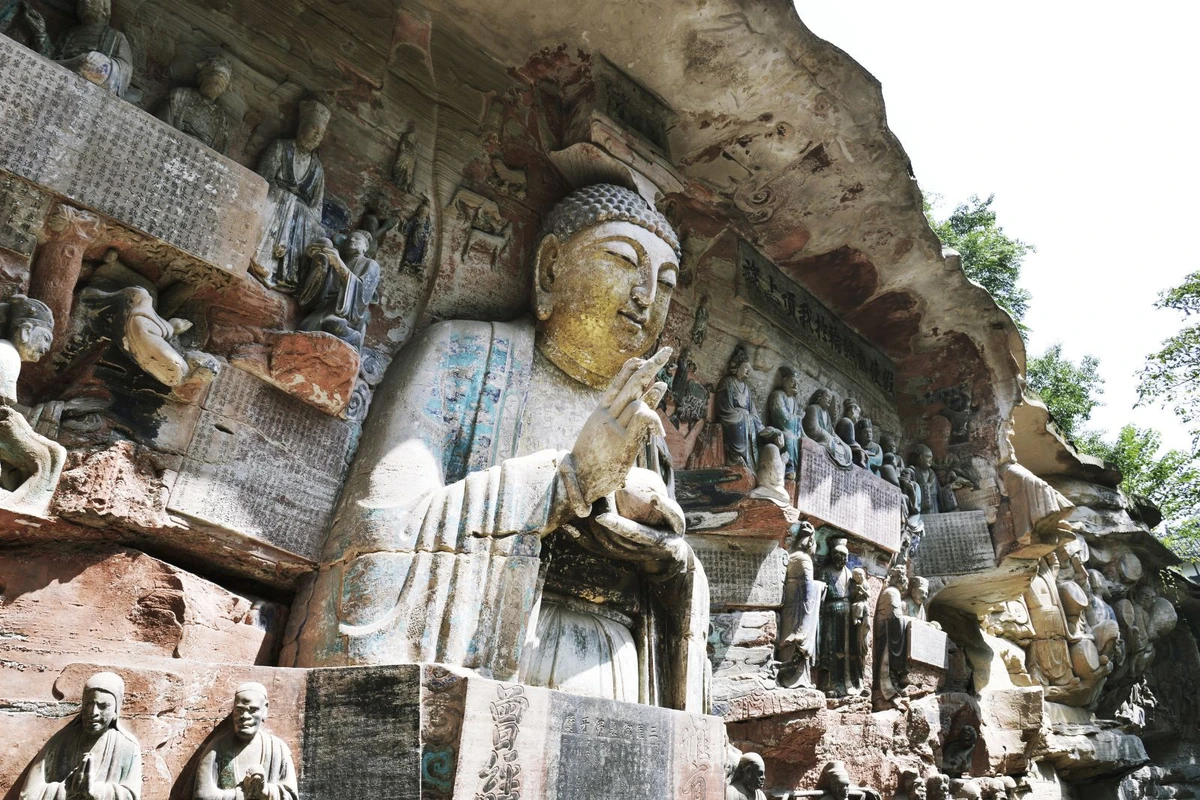
Dazu Rock Carvings
A few white clouds drifted slowly, the blue sky was wiped even more bottomless, deeper and purer. This blue, this purity, makes one daydream endlessly! Is it heaven or another magical world at the deepest part of this blue sky?
I quietly gazed at the deep and pure blue sky, fantastically dreaming of tomorrow, the future, infinity... At this moment, my mind seemed to broaden like the sky, my breathing became freer. There must be a magical world in the deepest part of this blue sky...
Suddenly at this very moment, a ethereal celestial sound seemed to come from the heavens, like a delicate veil, captivating the soul. The heavenly music slowly enveloped me, taking me to this most magical place. Here, heaven and hell are just a stone's throw apart, saints and demons are equally close, and all kinds of immortals and ghosts gather in one place. So there are so many saints and immortals in heaven, and each of the eighteen levels of hell has its own meaning!
There really is such a magical place in the world!
This magical place is the Dazu Rock Carvings in Chongqing!
I first learned of this magical place from a philosophy book.
The philosophy book was put back on the shelf, but the beautiful photos, introductions, and magical stories from the book stayed in my heart, becoming part of my youthful dreams!
Dreams are always so romantic and beautiful. Sometimes I would stare into the deep sky, fantasizing about which immortal might descend from heaven and bring me a bit of good luck!
From then on, another dream was born in my heart: "I must go see the Dazu Rock Carvings!"
As time passed, the exquisite patterns of the Dazu Rock Carvings painted this dream even more brilliantly. The stories within the Dazu Rock Carvings made this place seem increasingly magical, and my dream grew stronger: I must go see the Dazu Rock Carvings!
This time, I arrived in Chengdu, and Chongqing was right next door. This dream finally exploded: I had to make a special trip to Chongqing to properly visit the Dazu Rock Carvings, which had always been on my mind.
The sky was still so azure, so deep. After several hours of travel, we arrived at the magical place in my heart—the Dazu Rock Carvings scenic area.
At the visitor center, we were fortunate to meet Director Qin, a capable professional woman. After learning about my practical difficulties, Director Qin warmly extended a helping hand!
To use a trendy and accurate term, Director Qin is a 'middle-aged girl.' I heard a saying circulating in society: 'Chongqing produces beauties.' No lie—she is as beautiful as the Dazu Rock Carvings! The stories of the Dazu Rock Carvings are deeply etched in her mind; the carvings have become part of her life. When talking about them, she knows them like the back of her hand.
Accompanied by Director Qin’s commentary, the various immortals of the Dazu Rock Carvings slowly emerged from the depths of history, standing before us and narrating their stories.
The Dazu Rock Carvings were first chiseled during the early Tang Dynasty's Yonghui era (650–655 AD), with the earliest grotto being the Jianshanzi cliff carvings. Over the next 200 years, only a few carvings such as those at Shengsheng Temple and Fahua Temple were added. But after Changzhou moved its seat to Dazu in 885 AD, the Dazu Rock Carvings experienced their first peak of statue-making. The military governor Wei Junjing took the lead in carving Buddha statues at Beishan, followed by commoners, monks, and local officials. Over the next 300 years, from the late Tang to the end of the Southern Song, more than 30 groups of Buddhist, Taoist, and 'Confucian-Buddhist-Taoist' carvings were created in Dazu, with Buddhist grottoes making up the largest portion. Represented by Beishan, Baodingshan, Shizhuanshan, Shimenshan, and Nanshan, the Dazu Rock Carvings are grand in scale, exquisite in carving, diverse in subject, and rich in meaning. With their distinct national and everyday characteristics, they became the final monument in Chinese grotto art history, forming a complete history alongside Dunhuang, Yungang, Longmen, and other grottoes, representing the world's highest level of grotto art from the 9th to the 13th centuries.
Although my specialty is neither art nor religion, I love art and have some interest in religion. The exquisite carvings before me were stunning—to be precise, utterly stunning.
Under Director Qin’s captivating narration, history gradually faded away. Figures from the carvings—human, immortal, or demon—came slowly forward. Their robes fluttered, their expressions vivid. We could feel the softness and flow of their garments, the warmth or majestic pressure of divine compassion, and the various ghosts and monsters... They made us forget that what lay before us were rock carvings!
From heaven above to the eighteen levels of hell below, all kinds of deities and countless ghosts lined up winding along the mountain. The six paths of reincarnation, the incomparable beauty of heaven urging people to do good for the sake of their own virtue and their descendants’ blessings, and the miserable screams from hell warning people not to sell their souls to the devil. The statues gaze at the human drama, telling the stories of heaven and hell.
In the midst of the engaging commentary, groups of craftsmen from a thousand years ago came and went, both near and far. The sounds of chiseling the cliff statues also seemed distant yet close. I could almost see the craftsmen’s pious and earnest expressions. They poured their diligence, devotion, and faith into their hammers and chisels, meticulously carving them into these cliff statues. I could hear the tink-tink-tink of hammers chiseling statues all over the mountain. Through these sounds, I seemed to hear the solemn and compassionate recitations of Shakyamuni, the Thousand-Armed Guanyin, and other saints, as well as the heartless, mournful roars of little demons and the pitiful groans of those suffering punishment for their heavy sins!
Perhaps these were the thoughts they wanted to carve into history, the spiritual legacy they wished to leave for generations? Or maybe they thought of nothing at all, only wanting to turn their immense reverence for the divine into supreme piety—seemingly insignificant yet precious piety—carved into this sandstone with their best skills.
The Dazu Rock Carvings have countless stories to tell:
The Three Saints of Huayan: Vairocana Buddha, Samantabhadra Bodhisattva, and Manjushri Bodhisattva.
The so-called 'Three Saints of Huayan' are the three holy beings of the Lotus Storehouse World as described in the Avatamsaka Sutra. The main deity is Vairocana Buddha, with his most important assistants—Manjushri and Samantabhadra—as his left and right attendants. It is said that the Lotus Sutra was transmitted by Manjushri and disseminated by Samantabhadra. Therefore, in temples enshrining Shakyamuni, Manjushri and Samantabhadra often stand on either side of the Buddha as his attendants. This is what Baidu told me.
Vairocana Buddha has a snail-shaped hairdo with two rays of light emanating from it. His left hand forms a mudra, and his right hand extends forward. On the left stands Samantabhadra Bodhisattva, wearing a high flower crown, holding a relic pagoda in his hands at his chest. Manjushri Bodhisattva stands on the right, also wearing a high flower crown, holding a seven-story jeweled pagoda in his left hand at his chest, and supporting it with his right hand. They stand on lotus platforms, their faces compassionate and serene, their eyes looking downward, bestowing grace upon all beings. Behind them are 81 small round niches, each containing a small seated Buddha. It is said that this place can subdue all demons and give rise to a pure mind, turning mountains of swords into jeweled mountains and weapons into lotus flowers. A holy land!
Thousand-Armed Guanyin is an important bodhisattva in Buddhism! There are many statues of Thousand-Armed Guanyin, and one that left a deep impression on me is at the Daxiangguo Temple in Kaifeng, Henan. Carved from a single ginkgo tree, it is resplendent, with a gentle and solemn expression. The thousand arms are neatly and evenly spread, both bearing suffering and dispensing compassion and happiness. This Thousand-Armed Guanyin is reverently enshrined in the temple as its most treasured artifact.
But the Thousand-Armed Guanyin at Baodingshan is a must-visit. This golden, shining Thousand-Armed Guanyin at Baodingshan has a completely different style from others elsewhere. Her thousand arms spread in all directions, and her thousand eyes follow her hands to look in all directions, as if possessing a unique vision and embrace.
This Guanyin statue’s hands were not attached separately; they were slowly carved by the craftsmen according to the stone’s grain and the mountain’s contours. I don’t know how many years the carving took, but the restoration alone took seven or eight years. The golden Thousand-Armed Guanyin before us is truly a national treasure among national treasures.
Leaving the sacred Thousand-Armed Guanyin, we strolled back to the human world. Look at that child standing on the cliff edge, as if about to greet us before eagerly heading off on a long journey. And look at the deep reluctance and helplessness on the faces of his parents behind him—you can almost hear them giving advice to their child!
Is this a thousand-year-old carving? No, right? I feel puzzled. They gaze at you with kind brows and warm eyes, as if you can hear them preaching sutras—gentle yet solemn. In the breeze, their robes are soft and flowing, so close to you that you can almost feel their breath. They are right before us—flesh and blood, with warmth! They are right before us, vividly telling the enduring stories of the human world...
"In fact, Buddhist scriptures are never the creation of a single person or a single era. They often emerge in society anytime, anywhere, in the format of 'Thus have I heard.' Wherever Buddhism spreads, new scriptures appear there." This is said in a history of Buddhism, and I fully agree. Because they are all our own souls.
For thousands of years, we have usually prayed to the gods for happiness, hoping happiness will descend from the sky. But we rarely think deeply about what happiness really is and what the path to it is. We see the world from different perspectives, observe and contemplate, and express our observations and thoughts in different ways.
Today, standing before the Dazu Rock Carvings, I engage in the same contemplation.
The Dazu Rock Carvings are history—the thoughts of the people living on this land about nature and society, a strong expression of their pursuit of a better life. They used the art form of rock carvings to express their thoughts. They embedded their thoughts, their likes and dislikes, their pursuits and rejections, their punishments and praises into these cold cliff stones through stories and religious classics, bringing these lifeless stones to life. From then on, these cold stones gained flesh and blood, the warmth of burning life, and passed that warmth on to every pilgrim who comes.
These fiery carvings vividly reflect the social life of that time, allowing us today to savor the taste of history, to slowly chew over the winds and rains of our journey. They let us quietly ponder our future path...
In my view, all religions are philosophies cloaked in religious garb. They are a way for people, in social life and in their interactions with nature, to ask questions of heaven, earth, and themselves. Using religious and artistic forms, people ask outward to nature and inward to their own hearts. Ultimately, it is a kind of philosophical thought. The people of Dazu invited the great gods of Confucianism, Buddhism, and Taoism all together here. Is this the tolerance of these great gods or the tolerance of the Dazu people? Or is it something else? I don't know. But the Dazu Rock Carvings vividly express the philosophical thoughts of the Dazu people on this land.
Tracing back to the source, from a historical perspective, it is people who created religion, not religion that created people. Of course, in the long course of history, the two interact: people create religion, and religion in turn shapes people. This cycle has promoted the mutual development of religion and people. But at the root, I believe it is people who shape religion. People of different eras shaped the religion of their time, and the religion of different eras in turn promoted the development of society. This development could be advancement or constraint. But from a macroscopic view, from the perspective of the long river of history, this development always moves forward.
If we merely regard the Dazu Rock Carvings as artistic treasures, then the Dazu Rock Carvings might feel a bit aggrieved. The Dazu Rock Carvings are not only treasures in the treasure house of Chinese art but also torches that ignite our thoughts, our spiritual home. The Western philosopher Socrates once said that the purpose of education is not to instill but to ignite. I think the charm of the Dazu Rock Carvings is not just about narrating, but more about igniting! The Dazu Rock Carvings are our spiritual home. They are an unquenchable torch that not only ignites our thoughts but also illuminates the path ahead. Everyone who comes here can find a reflection of their own life and ponder their own life here.
From ancient times to the present, we have been exploring, shaping, and maintaining our spiritual home. In this home, our understanding of truth, goodness, and beauty, our pursuit of combating evil and promoting justice, our sense of responsibility to help the vulnerable, and our attitudes toward injustice and suffering constitute our spiritual world. Whether it is Shakyamuni, the six paths of reincarnation, or Thousand-Armed Guanyin, they are all part of our spiritual home.
The vivid, exquisite rock carvings gaze at you and me. When we endure hardships, we think of Shakyamuni and many other gods, of the six paths of reincarnation, of the compassionate Guanyin Bodhisattva, seeking inner peace and comfort, wisdom and courage. Here, we pray, we doubt, we reflect, we believe...
In the end, we move forward unyieldingly.
For thousands of years, through our own experiences, we have regarded the Dazu Rock Carvings as our spiritual home, and we strive to protect it.
The Dazu Rock Carvings, our spiritual home, are also an unquenchable torch that ignites our thoughts. This, perhaps, is the value of the Dazu Rock Carvings in the past, present, and future.
From the wild, beautiful fantasies of youth to the day-and-night struggles for a beautiful ideal now—filled with joy, pain, smoothness, and twists—we have begun to understand heaven and hell, good and evil. We draw wisdom and strength from history, from our spiritual home. We keep moving forward, keep progressing.
We bid farewell to Director Qin reluctantly. Her enthusiastic explanations and selfless help accompanied us all the way, filling us with warmth.
The sky is still azure, still deep.
Loaded with the joy of a deeper understanding of this magical place, we step lightly toward our next goal, toward a new magical world...


