Time Flies, Chongqing in a Hurry
Although I have been to Chongqing before, I never miss any chance to explore it again; even if just passing through, I try to calm down and visit a few spots. This has become my travel principle: no matter where I go, I must visit one or two attractions! If time is really tight, I still go out for a walk, either early or late, sometimes to a market, sometimes to a temple, sometimes to a square, sometimes to a park, and sometimes even deliberately looking for an old alley to taste local breakfast. Looking at it this way, it seems to have become an obsession. Reflecting on all these years, this deep-rooted feeling has become a part of my life—go and cherish every moment!
This trip started from the newly built high-speed rail station, and it was my first time departing from the local high-speed rail station. I first went to Beijing and Tianjin, then flew to Chongqing.
Chongqing, abbreviated as "Yu," also known as the Mountain City or River City, is located in southwestern China. It is a national historical and cultural city and the birthplace of Bayu culture. With over 3,000 years of history, it has been called "Innate Chongqing" since ancient times.
In 1189, Emperor Zhao Dun of the Southern Song Dynasty was first enfeoffed as Prince Gong, stationed in Gongzhou. Later, when he ascended the throne, he considered it a "double celebration" and ordered Gongzhou to be renamed "Chongqing," a name that has been used to this day.
The Ba Kingdom established its capital here during the Xia and Shang dynasties, and the Daxia Kingdom was founded here at the end of the Yuan Dynasty. In the late Qing Dynasty, Chongqing opened its port as a treaty port, and the Nationalist government moved the capital to Chongqing, making it the political, military, economic, and cultural center of the rear area in modern China, and the birthplace of the Red Rock spirit. In the early years of the People's Republic, it served as the headquarters of the Southwest Region and a municipality, and in 1997 it was restored as a municipality again.
When I visited in 2007, I enjoyed the World Cultural Heritage sites of Dazu Rock Carvings and Ciqikou. At that time, Chaotianmen was still quite old, and the cityscape was immersed in traces full of historical sense.
**First Attraction: Ciqikou**
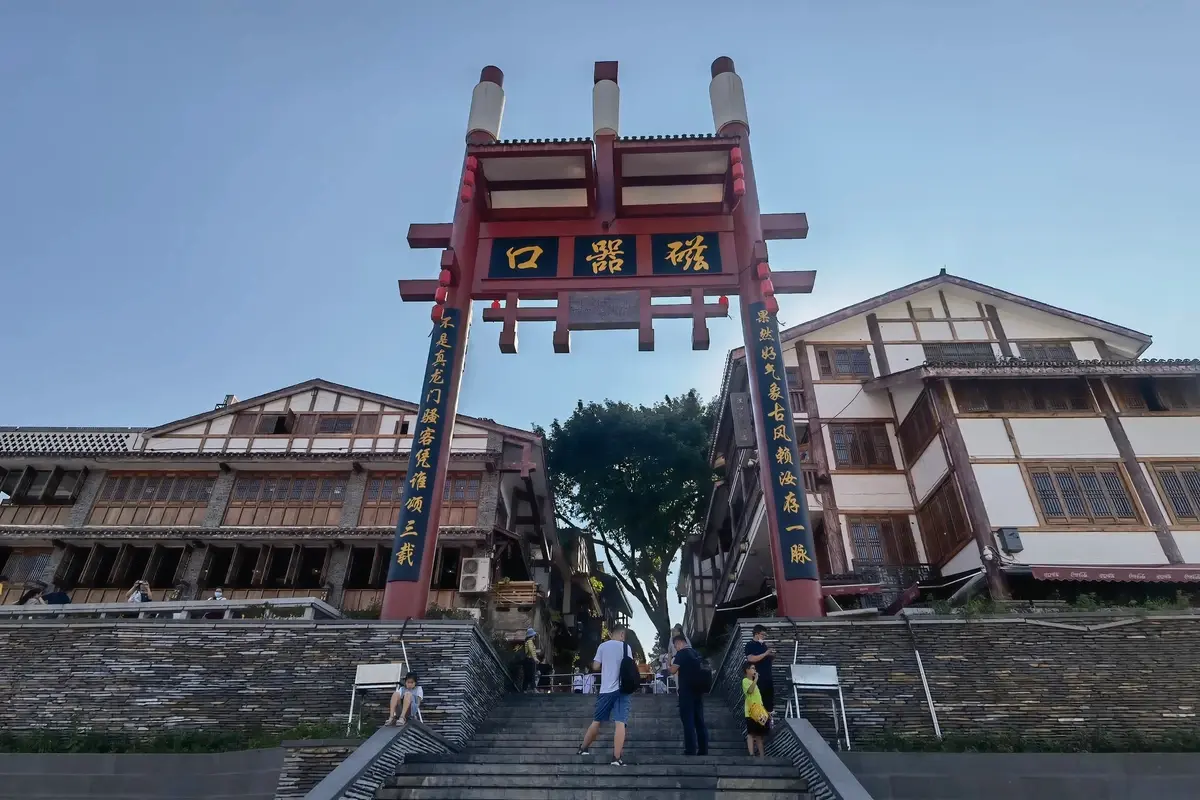
I made my way to Ciqikou in Chongqing.
Ciqikou, originally named Baiyanchang (White Rock Field), originated during the Xianping era of Emperor Zhenzong of the Song Dynasty, named after a white rock temple that once stood there. In the fourth year of Jianwen of the Ming Dynasty (1402), Emperor Jianwen, Zhu Yunwen, was usurped by his uncle Zhu Di. He fled the palace and became a monk. When he wandered to the Bayu area, he hid in Baolun Temple on Baiyan Mountain for four or five years. After the world learned of this, the temple was renamed Longyin Temple (Hidden Dragon Temple) because the true dragon emperor had once lived there in seclusion, and Baiyanchang was also renamed Longyin Town.
In the early Qing Dynasty, porcelain became the main industry of Longyin Town for a long time. During the Republic of China period, Chongqing became the provisional capital. Due to convenient water transportation, Longyin Town became a distribution center for agricultural, sideline, and local products from various prefectures and counties along the upper and middle reaches of the Jialing River and its tributaries. In the early years of the Republic, there were over 70 porcelain workshops, with more than 300 cargo ships (each with a load capacity of 10 tons) entering and leaving the dock daily. There were over 1,670 shops, warehouses, and various workshops, and over 760 vendors. Gradually, these merchants changed the name Longyin Town to Porcelain Mouth (Ciqikou), as it was more fitting and easy to say. Later, because the character "ci" (porcelain) is interchangeable with "ci" (magnet), it became known as Ciqikou (Magnet Mouth).
Like many ancient towns, both sides of the street are lined with shops.
I watched a performance featuring Sichuan opera, face-changing, and other specialty acts.
**Yinglong Gate by the Jialing River**
"Watching dragon dances at White Cliff, enduring without losing the king's spirit; letting sails startle the ancient ferry, still stirring the tides of old. Indeed, a grand atmosphere, ancient charm preserved in one vein; if not a true dragon gate, how could poets praise for three years?"
The Jialing River rushes down from the upper reaches, and after about 15 kilometers, it merges into the Yangtze River at Chaotianmen.
**Second Attraction: Chaotianmen Dock and People's Liberation Monument**
Chaotianmen is located at the confluence of the Jialing River and the Yangtze River. The gate originally bore the inscription "Ancient Yu Xiong Guan" (Old Yu Heroic Pass) and was one of the seventeen ancient city gates of Chongqing. After the Southern Song Dynasty moved its capital to Lin'an (now Hangzhou), imperial envoys would often deliver edicts from the Yangtze River through this gate, giving it the name Chaotianmen (Gate Facing the Sky).
This is the hub of the two rivers and the largest waterway passenger terminal in Chongqing. In May 2016, Chaotianmen was selected as one of the "Top Ten Cultural Symbols of Chongqing."
Dinner was had at Xiaolongkan near the People's Liberation Monument.
The inscription "People's Liberation Monument" on the monument was written by Liu Bocheng.
Boarding a cruise ship at Chaotianmen Pier No. 1 for a night tour of Chongqing.
**Third Attraction: Wulong Three Natural Bridges**
The Three Natural Bridges are located in the southern part of Fairy Mountain, between Fairy Mountain and Wulong County. The three bridges are arranged longitudinally, spanning parallel across the Yangshui River Gorge, connecting the mountains on both sides, forming a unique landscape of "three bridges with two pits," a rare sight in the world and truly the "best group of natural bridges in the world." What makes the three bridges unique is that each bridge has its own distinct scenery, not identical to the others. They combine wonder, danger, and majesty, with imposing momentum, dense forests, and flying waterfalls. They encompass mountains, water, mist, springs, gorges, peaks, streams, and waterfalls, making it a high-quality eco-tourism area.
It is a 5A scenic area and a filming location for "Transformers 4."
After walking for a while, I took an elevator down to the bottom of the pit.
**Tianlong Bridge (Heavenly Dragon Bridge)** – This is the first natural bridge over the Yangshui River Gorge, also known as Toudao Bridge. It is massive and imposing, renowned for its grandeur. The bridge is 235m high, 150m thick, with an average arch height of 96m. The arch span ranges from 20-75m, averaging 34m, and the bridge deck width is 147m.
**Tianfu Official Post** – After passing Tianlong Bridge, at the bottom of the pit, there is a courtyard with green tiles and gray walls, antique in style. The lantern in front of the courtyard reads "Tianfu Guanyi" (Heavenly Blessing Official Post). According to the introduction, this post station was built in the second year of Wude of the Tang Dynasty, located at the important junction between "Zuantianpu" and "Baiguopu." It was an important courier station for official information transmission between Fuzhou and Qianzhou in ancient times. Although the shrubs are verdant, the surrounding rocks are rugged, and located at the bottom of the cliff, it exudes a gloomy and bleak atmosphere.
This is also the filming location for Zhang Yimou's "Curse of the Golden Flower."
**Qinglong Bridge (Azure Dragon Bridge)** – This is the second natural bridge, also known as Zhonglong Bridge. It is named because after rain, waterfalls cascade from the bridge surface into mist, and under sunlight, it forms a rainbow, resembling an azure dragon soaring upward. The bridge deck height is 281m, the highest among the three natural bridges; the average arch height is 103m; the bridge deck thickness is 168m; the arch span ranges from 13-58m, averaging 31m; the bridge deck width is 124m. Qinglong Bridge is famous for its height, reaching 281m, making it the tallest karst natural bridge in the world. Looking up from under the bridge, the arch opening is lofty, with sheer cliffs.
**Heilong Bridge (Black Dragon Bridge)** – This is the lowest natural bridge downstream. Its ancient name comes from the deep and dark arch opening, as if a black dragon is winding along the top of the arch. The bridge deck height is 223m, with an average arch height of 116m, the highest among the three bridges; the bridge thickness is 107m; the arch span ranges from 16-49m; the bridge deck width reaches 193m, also the widest among the three bridges.
From another angle looking up, it resembles a whale.
Walking along the wooden plank path until exiting the scenic area.
**Fourth Attraction: Longshuixia Ground Crack**
The Longshuixia Ground Crack was formed by orogenic movements tens of millions of years ago. It is an important part of the "Wulong Karst" World Natural Heritage site. The canyon is 5 km long, with a tourist route of about 2 km, and a depth of 200-500 meters. It is grand in scale and magnificent in momentum. The scenic area is delicate and beautiful, with graceful scenery. Its features include deep gorges, sheer cliffs, primitive vegetation, flying waterfalls and flowing springs, rapid currents, and deep pools. The high mountains, steep ridges, canyons, and flowing water together form a spectacular and bright landscape painting.
Taking a sightseeing elevator and passing through mountain tunnels, descending!
There are more plank paths below.
Deep, winding, with sheer cliffs thousands of feet high, the sound of water thundering, just like a dragon's roar.
Looking up at the blue sky, peaks towering, clouds surging, along with hanging waterfalls, flowing springs, swaying green bamboos, and rustling lush forests. Strolling in the valley, one can see various geological relics such as cliffs, vortex caves, knickpoints, shoals, collapses, waterfalls, springs, and caves.
Above, a patch of blue sky makes the canyon seem even deeper.
Along the way, ups and downs, accompanied by the tinkling of mountain springs. I feel that the viewing experience here is even better than the Three Natural Bridges.
Ending the tour, heading home.


