8-Day Christmas Holiday in Dubai / Abu Dhabi
D1 Hong Kong – Dubai, landing at 22:50
D2 Dubai Mall – Burj Khalifa – Dubai Creek cruise
D3 Kite Beach – Desert safari with sandboarding,篝火自助餐
D4 Abu Dhabi – Sheikh Zayed Grand Mosque – Shopping at malls and supermarkets
D5 Heritage Village – Presidential Palace – Louvre Abu Dhabi – Evening stroll
D6 Abu Dhabi to Dubai – Dubai Mall Aquarium – Bookstore – La Perle water show
D7 Al Fahidi Historical Neighbourhood (Old Town) – Ferry – Gold Souk – Old Souk
D8 Palm Jumeirah – Souk Madinat Jumeirah (shopping area near Burj Al Arab) – Global Village
D9 Dubai – Hong Kong
It's been half a month since I returned from Dubai and Abu Dhabi. I'd like to share some travel impressions.
Dubai has been making headlines for about a decade—a city of wealth and desert. What attracted me more was the chance to experience the Arab world firsthand, to visit the place where people in white robes and black abayas are often seen on TV, and to see how its traditional culture collides with modernity. Dubai is a traveler-friendly city, safe and convenient, so we planned a week-long Christmas holiday there. The world is vast, and I wanted to see it.
We flew Emirates and arrived around 10 pm. The airport was efficient and clean; the entire Dubai is spotless—every detail, from the roadside to restaurants and restrooms, is impeccably clean. I believe the Muslim emphasis on cleanliness and tidiness is real.
Upon leaving the airport, taxis were orderly and convenient. Our driver was a woman in a black abaya, speeding along the highway towards the glittering Burj Khalifa.
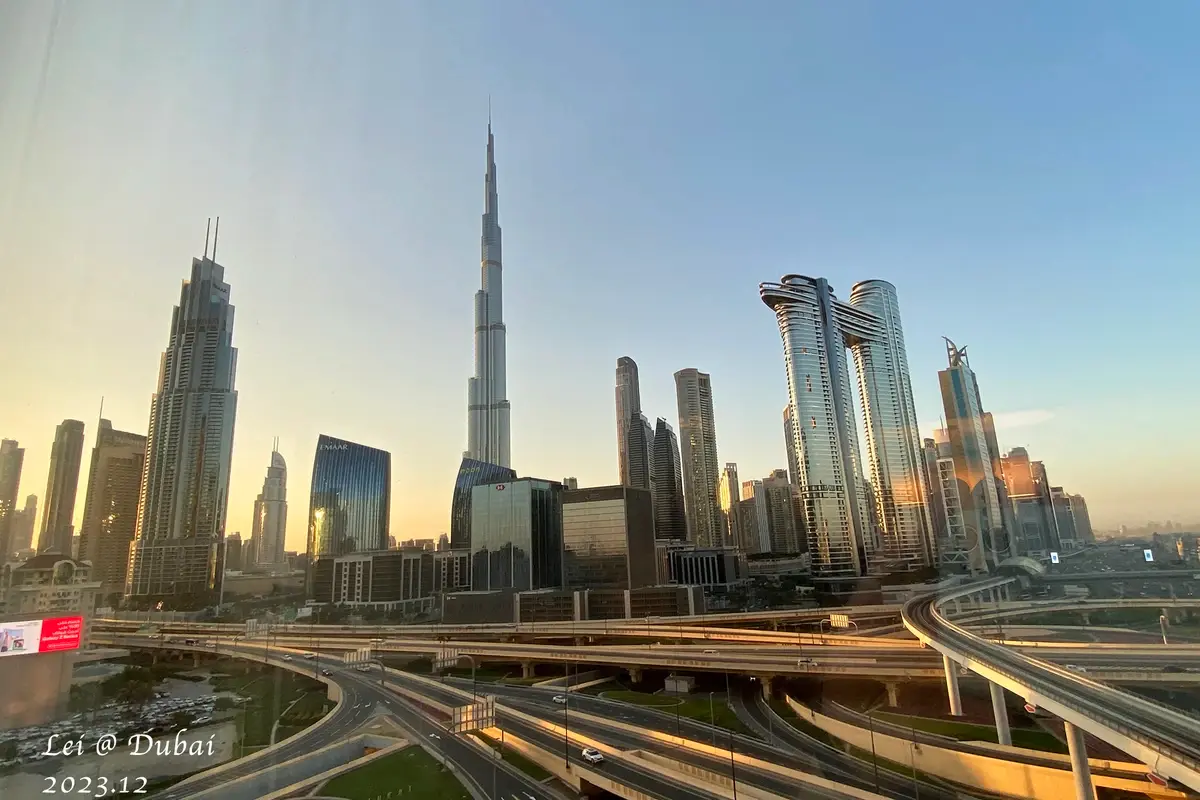
Our hotel was near the Burj Khalifa, just across the road, but crossing that road was extremely circuitous. Dubai's main roads have no traffic lights; they are 16-lane dual carriageways, flowing like highways. Every intersection requires an off-ramp, so crossing the road took about half an hour on foot. Pedestrians are only occasionally seen on side roads. This is a city of cars, assuming everyone rides.
Dubai's cleanliness stems from this: public transport is inconvenient, buses are barely seen, hence no bus stops, and there are no bicycles, scooters, or pedestrians weaving through traffic. Only orderly cars, moving as if at a steady pace.
Everywhere you see the EMAAR logo; DAMAC is a close second. It's as if developers have branded every building they've built; buildings don't have their own names, just EMAAR. Ubiquitous.
On our first full day of sightseeing, we arranged Dubai Mall, Burj Khalifa, and an evening Dubai Creek cruise.
Dubai Mall is the world's largest shopping center—truly massive. We visited it 4 or 5 times and only began to find our way. The signage is poor; the zones are indistinguishable, taxi drop-off points are unclear, and there's no information desk or map system. It has every store and product imaginable, impeccable except for the confusing layout.
So finding the entrance to the Burj Khalifa took us 50 minutes walking around the tower, only to eventually discover it back inside the mall. The tower only goes up to floors 123–124, about 448 meters. Queuing took over half an hour, and we spent about 20 minutes on the observation deck, overlooking the whole of Dubai—desert, sea, and city rising like reinforced concrete sprouting from swirling dust.
In the evening we took a cruise on Dubai Creek. The banks were bustling with commerce, hotels, and restaurants. The buffet on board was decent and cheap. A handsome performer gave a traditional Egyptian whirling dervish dance—my first time seeing it, and I saw it again later at the desert safari buffet. His performance was passionate, igniting the atmosphere on the boat. That's the joy of travel—escaping the mundane and encountering novel sparks. On the way back beyond Palm Jumeirah, we saw drones taking off for a show over Dubai Creek. It was my first drone performance—various formations, including the Chinese characters for Dubai. Being on the boat, we were incredibly close, as if the patterns were within reach. The evening breeze and lights were soothing.
During Christmas, Dubai's weather is pleasant. Except for walking in direct sunlight, it's comfortable and mostly sweat-free, so clothes didn't need daily changes.
The next day we went to Kite Beach, which was very clean. By 10 am the sun was scorching.
In the afternoon we did the desert safari. The guide picked us up, six in the car—the other two were from the Philippines, affluent. Dune buggies cost 350 AED each, large 4x4s 800 AED. My son really wanted to ride a buggy, so we rented two and followed the guide into the desert. We didn't go too far; there was a falcon for photos. Steering the buggy was tough on the arms.
Evening VIP buffet was enjoyable, though too much Middle Eastern food to finish. The climax came when they lit up 'DUBAI' in the desert—indeed, a surprise ending makes everything perfect.
We bounced around in the desert at night, then hit the main road and sped back to the city.
Day three we slept in and then set off for Abu Dhabi. We took an Uber costing about 450 AED; taking a regular taxi would have been cheaper. Earlier, a taxi driver offered to take us for 300 AED, but we feared he might be dishonest. In the end, the return taxi from Abu Dhabi to our Dubai hotel only cost 280 AED.
Abu Dhabi feels like a city built on coastal flats, connected by islands. Its urban landscape has more history and isn't as glossy—more like a second-tier Chinese city, with pedestrians on the streets, giving a more intimate, everyday feel.
In the afternoon we visited Sheikh Zayed Grand Mosque. We didn't know we needed to book in advance, but luckily we managed to register on the spot. Dress code was required. The mosque, built with marble and gold, was solemn, sacred, and beautiful. The management was excellent, roping off the plaza for great photos.
I've been to temples and churches before, but this was my first mosque of this scale. It shares the same basic structure as churches—a solid cross shape with a dome. Human knowledge and culture flow. Since God cannot be represented by anything, there are no statues, only floral and geometric patterns. No human or animal images.
The next day we went to the seaside Heritage Village, a mediocre attraction. We spent time at the back watching people feed seagulls, seeing clear water with fish—big and small—swimming, occasionally a small turtle, and a stray cat trying to catch fish on the rocks.
The scene was very down-to-earth; different ethnic groups spend their Saturday similarly. Human nature is universal despite cultural differences.
Then we visited the Presidential Palace and the Louvre Abu Dhabi. We took taxis both ways; fares were reasonable. The Louvre Abu Dhabi's architecture resembles Shenzhen Airport; the exhibits were not extensive, mixing artifacts from different countries chronologically.
The kids didn't want to go to theme parks (which were far away), so after the day's sightseeing we returned to the hotel and strolled the nearby streets to get a feel for local life. We had an extremely sweet milk tea and ate at a Chinese restaurant run by an Indian. We ordered sautéed greens but got fried vegetables—tasted okay but mind-boggling.
Day three after breakfast we took a taxi back to Dubai. The driver was from Bhutan. Most drivers we met were Pakistani, then Indian, then from Zambia. Asian-looking service staff were mostly Filipino or Malaysian. A hotel waiter from India kept saying, "Our English is very good; many Chinese can't communicate in English." When I asked what Chinese people do here, the driver said many work in agriculture—whether as farmers or employees, I'm not sure. We thought they'd be in infrastructure, but they've returned to their ancestral farming. So learning English well is crucial; it determines your map's size. So many overseas jobs are done by various nationalities all speaking English. The driver said he's been here 8 years and only knows a few Arabic phrases—mostly English. Signs are in Arabic and English; malls sometimes have Chinese. So English is enough to get around the UAE.
90% of the UAE population is foreign. The biggest impression of this trip is that Dubai is a global village of tourists and service staff, all mingling harmoniously. There are many European and American tourists. It's like a meeting point of Europe, Asia, and Africa, where people from everywhere converge.
Back in Dubai, we changed hotels and browsed a bookstore in the mall, had coffee, and in the evening saw La Perle water show. Four tickets cost about 2000 HKD. Honestly, the show felt forced—a blend of acrobatics but not top-tier. The performers were dedicated, but it was average.
Next, we explored Dubai's old town. I love the traditional architecture—sandy flat-roofed houses along the creek. Dubai Creek is actually seawater making a loop through the desert, and the old city lines its banks. There are mosques, Hindu temples, various old souks. Where there's water, there's traffic. For 1 AED, you can take an abra across, evoking Venice's Grand Canal. A fun experience.
We glimpsed the Gold and Spice Souks, then explored the newly built old town areas. We went to Arabian Tea House Restaurant for Arabic milk tea and a traditional breakfast. A huge set for 78 AED—four of us couldn't finish it. Bread was free to refill. Beautiful setting, exquisite food—a wonderful experience.
On the last day, we planned to visit Palm Jumeirah and tried Dubai's rail transit. It was not cost-effective: changing lines meant separate fares. From Dubai Mall to Palm Jumeirah required three tickets, costing 4x8+4x8+30x4=180 AED for the four of us, while a taxi would have been about 80 AED total. Regrettable. For groups, avoid the metro.
From Palm Jumeirah we went to Souk Madinat Jumeirah, near the Burj Al Arab. It's nicely done, but nearby restaurants seemed reluctant to serve us. We tried three places for lunch; even though outdoor seating was available, they said it was full. So we left annoyed.
In the afternoon we visited Global Village—a surprisingly wonderful place. The entrance fee was cheap. Inside, massive pavilions represent countries worldwide, selling everything from food to clothing to souvenirs, plus rides and shows.
It opens after 4 pm and stays open till 1 am. Crowded, like a fantastic carnival. People buy food and sit on the floor, eating various dishes. We had Thai fried rice, Mexican wraps, Indian milk tea, grilled corn, and freshly fried Arabic sweets—delicious. Also grilled beef patties, but we were too full to try them.
It's like a grand melting pot, where people in all kinds of attire showcase their culture while learning about others—truly a global village. We spent our last night there, and it was magical. A place you'd want to revisit.
1. If you want to visit the Museum of the Future, you need to book tickets about three weeks in advance—too late for us.
2. Self-driving should be convenient (haven't considered parking).
3. Do visit Global Village.
1. Global Village—maybe New York is also a global village, but you won't see so many robed Muslims there.
Here it's truly a crossroads of Asia, Africa, and Europe, with all kinds of people.
2. Clean, orderly, smooth, and safe. Seven days without any hassle; everything went as planned.
3. The whole world is developing, not just us.
4. Learn English well, and you can go anywhere.
Dubai has never had abundant oil and gas; now it relies on services, real estate, finance, and tourism, even selling desalinated water as a big business.
Dubai benefits from being the most open Arab country, creating enough hype. When we want a glimpse of the Middle East, we think of Dubai. People come, money follows. A dream city rises from the desert, well-managed. Open-mindedness, prudent investment, and government execution are reasons for Dubai's rise. May this desert pearl keep shining.


