Dubai Solo Travel Notes: Dubai International Financial Centre
1. Heading to the UAE
The plane sped through the sky at an altitude of ten thousand meters.
Inside the cabin, the lights were dim. Half the passengers were resting with their eyes closed, while the other half wore headphones, listening to music or watching movies.
It had been over six hours since we left Guangzhou.
At this moment, beneath the plane lay the Arabian Sea. In another two hours, this "eagle" soaring in the sky would reach its destination—the United Arab Emirates.
Outside the window, the sky was still bright as day. White clouds, like willow catkins, piled together, spreading across the vast, boundless sky.
Meanwhile, back home, it was already pitch-dark night. When the clock there pointed to 8:30 PM, the local time in the UAE was 4:30 PM.
UAE time is four hours behind Beijing time.
When traveling abroad, the first thing to understand is the time difference.
Only after grasping the time at the destination can you arrange your sightseeing itinerary in a reasonable and orderly manner.
2. The Confidence of Solo Travel
The United Arab Emirates, abbreviated as UAE, is a federal state composed of seven emirates: Abu Dhabi, Dubai, Sharjah, Fujairah, Umm Al Quwain, Ajman, and Ras Al Khaimah.
Abu Dhabi is the capital of the UAE, but in terms of fame, Dubai clearly has the upper hand.
We arrived in Dubai at 6:30 PM local time.
Since the UAE offers visa-free travel to Chinese citizens, many Chinese visit here.
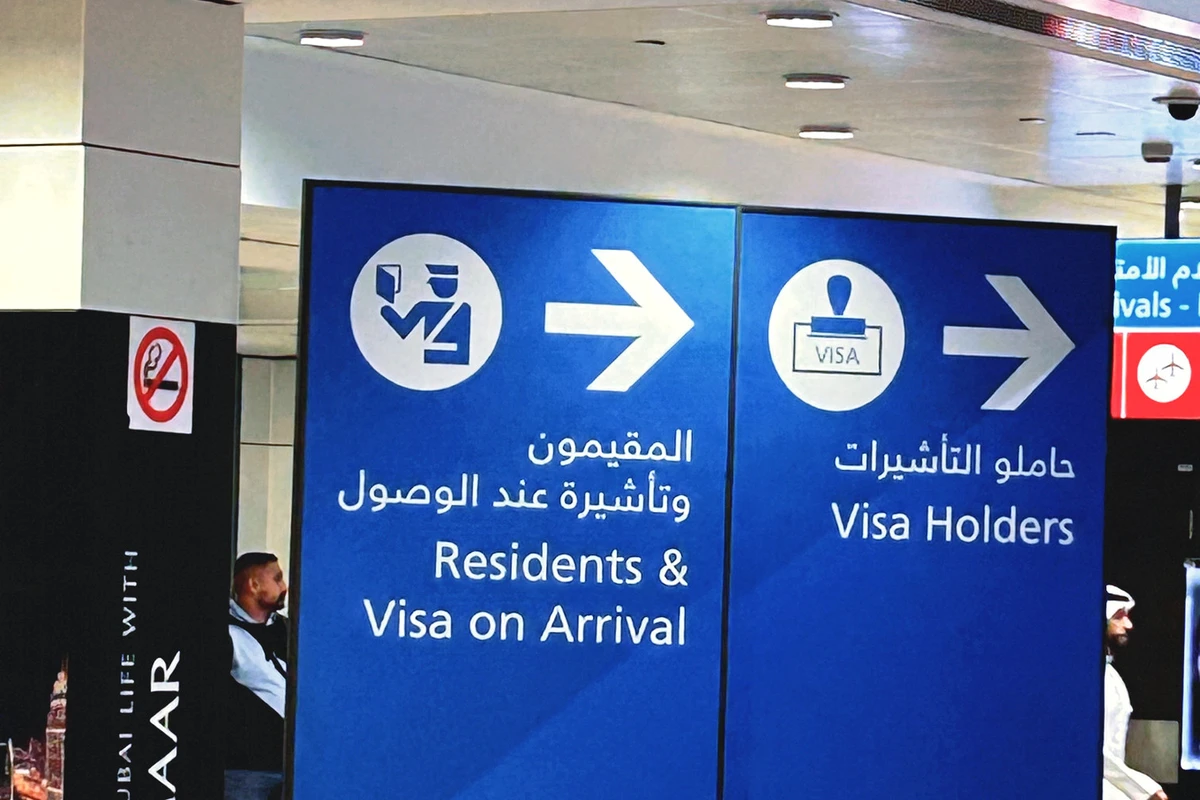
Upon getting off the plane, I followed the crowd to a transfer point. All passengers were taken in batches by shuttle buses to the main terminal for immigration inspection.
After passing through customs, I picked up my luggage from the carousel and hurried to find the person who was supposed to pick me up.
I had already communicated online beforehand; the greeter would hold a sign with my name at the currency exchange center in the airport. However, Dubai Airport has many currency exchange centers, and several of them have identical exterior designs. If you don't ask around, it's easy to get confused.
I came to Dubai without joining a tour group, without accompanying relatives or friends—I ventured here entirely alone.
Some people gave me a thumbs-up: "Your courage is top-notch! Your bravery is outstanding!"
In reality, anyone's courage and bravery need to be supported by experience and capability.
Having studied abroad in Russia before, I had overseas experience. Moreover, the common language in the UAE is English, and my English foundation is fairly solid—enough to handle daily communication. Additionally, I had done extensive research in advance, so I felt quite confident traveling solo.
When I communicated with the greeter in English without any barriers, I couldn't help but recall a saying by Kevin Tsai: "If you think swimming is difficult at 15 and give up, then at 18, when someone you like invites you to swim, you can only say 'I can't.' If you think English is difficult at 18 and give up, then at 28, when a great job that requires English comes along, you can only say 'I can't.' The more you avoid troubles and are lazy to learn in your early life, the more you may miss the people and things that move your heart later, and miss new scenery."
I am very grateful that I once worked hard to study and learn, and worked hard to develop my social skills.
3. Arabian Charm
That night, I stayed in the Al Fahidi Historical District of Dubai.
This area is somewhat like Xi'an's "Tang Paradise," or Wuxi's "Ming-Qing Street," or Chengdu's "Kuanzhai Alley"...
The buildings on both sides of the street are in Arabian style: thick walls, small windows, and built with white coral stone, a material that effectively blocks the scorching desert heat.
Walking along the road and looking up, you can see structures resembling chimneys rising from the rooftops—these are wind towers, which draw in hot air to cool the indoors, essentially an early "Arabian air conditioner."
The hotel I stayed in was on the second floor, a quaint room. After settling my luggage, I opened the wooden-framed window and couldn't help but let out a "wow": just ten meters outside the window lay the Dubai Creek, shimmering under the glow of lights.
Although it's called a creek, it's not actually a creek.
In my hometown, most rivers originate from mountain springs, with water trickling and gradually forming winding streams. Since ancient times, people along the way would crouch down, cup water in their hands, and drink freely when thirsty.
But here in Dubai, if you're thirsty, never drink from the creek.
The water in Dubai Creek is not freshwater—it's seawater. Seawater has a high salt concentration. If you gulp down large amounts, your kidneys will struggle to process the high-salt liquid, leading to dehydration. Additionally, seawater contains bacteria, viruses, and heavy metals, which can harm your health or even be life-threatening.
Dubai is a global business and tourism city. How do people here solve the drinking water problem? With advancing technology, the Dubai government has long implemented seawater desalination projects. Daily drinking water for Dubai's residents is no longer a challenge.
Between Dubai Creek and my accommodation was a street with a thatched-roof canopy, under which people came and went, stopping to take photos.
The next morning, when I went downstairs for a walk, I suddenly realized that right below my hotel was the Starbucks coffee shop known as the "most beautiful Starbucks in the Middle East."
Not only did欧美 girls in denim skirts like taking photos here, but also女生 from the Arab world dressed in black robes and headscarves came to check in for memorable shots.
Generally speaking, women wearing black robes and black headscarves with face veils are married; unmarried women mostly wear black robes and headscarves without face veils. However, in the UAE, which is highly internationalized, many married women no longer wear face veils for convenience.
4. Regret at the Museum of the Future
At noon the next day, I left Al Fahidi Historical District and checked into a hotel on Dubai International Financial Centre Street. After dropping off my luggage and taking a short rest, I walked to the nearby Museum of the Future.
This museum aims to showcase possibilities in various fields of the future, such as space exploration, ecological protection, and medical health.
The overall shape of the Museum of the Future is an elliptical hollow ring. From a distance, it looks like a large reclining number "0."
On the ring of the "0" are densely engraved beautiful Arabic characters. These are poems about Dubai's future written by Sheikh Mohammed bin Rashid Al Maktoum, Vice President and Prime Minister of the UAE and Ruler of Dubai.
In 2021, the museum was listed by National Geographic as one of the 14 most beautiful museums in the world.
Tourists from all over the world come to visit. Since it was crowded that day and the museum had reached capacity, and I hadn't made a reservation in advance, I couldn't enter.
Since I was traveling independently, I had plenty of time. Not getting in this time didn't make me anxious.
Leaving the museum, the sky was clear, the breeze was gentle, and I strolled leisurely. I had checked the map earlier; the Burj Khalifa was not far from here—a ten-minute taxi ride.
I originally planned to take a taxi to the Burj Khalifa, but after walking a hundred meters, I saw a metro station and changed my mind: I had never taken the metro abroad. Why not take the chance to experience it?
Traveling isn't just about taking photos for check-ins; it's more about experiencing.
What's there to experience about taking the metro? Haven't I taken the metro before?
Of course I have—I've taken the metro in China and in Moscow, Russia, but never in Dubai. For me, Dubai is an unfamiliar city, and unfamiliar environments are very character-building. Just imagine: taking the metro in Dubai, first you have to buy a ticket.
You can buy a ticket using the self-service system, or you can go to the counter and buy one from a staff member. Comparing the two, buying from a human more effectively hones one's courage.
Because you have to communicate with the other person. I don't understand Arabic, so I had to use English. By buying a metro ticket in English, I was practically applying the "ticket-buying" English I had learned from textbooks into practice.
Question and answer, all in English, with no barriers—isn't that putting knowledge into practice? Isn't that a manifestation of growing through travel?
What is progress? It's overcoming your own timidity and moving forward just a little bit.
5. Dubai Metro Ride
At the metro station, I communicated with the staff in English to buy a ticket, then took the metro to the Burj Khalifa.
Dubai's metro has a Red Line and a Green Line; the Blue Line is under construction. The Red Line mainly connects commercial areas, passing through the World Trade Centre, Dubai Financial Centre, Burj Khalifa/Dubai Mall, Dubai Marina, and other bustling districts.
The Green Line primarily runs through the old city, passing by many historical and cultural areas, such as the Al Fahidi Historical District where I stayed yesterday, and the old Dubai district and Gold Souk across the creek, all along the Green Line.
I boarded at World Trade Centre station and paid 4 dirhams.
Dirham is the currency of the UAE. At that day's exchange rate, 1 dirham was approximately equal to 2 Chinese yuan.
Dubai metro has Gold Class cars, Standard cars, and Women and Children cars. Gold Class tickets cost twice as much as standard ones, for business travelers or those who prefer quiet; Women and Children cars are only for women and children. If you're a man and you sit there, you'll probably get kicked to the moon by the women and children. Standard cars are open to all passengers.
The Red Line is a very busy line in Dubai, with heavy passenger flow. Especially during rush hours, it's extremely crowded. When returning from the Burj Khalifa, I took the metro to Financial Centre station. Good grief, it was so packed that people nearly squeezed me into a thin leaf.
After getting off the metro, I headed straight to Dubai Mall.
Dubai Mall and the Burj Khalifa are at the same station.
Upon entering Dubai Mall, the first thing that caught my eye was a bustling currency exchange center.
If you want to shop at Dubai Mall but don't have enough cash on hand, don't worry—the currency exchange center can solve it easily. And if you buy a lot of things here but don't know how to take them home, what then?
No problem—look, there's a big advertisement on the wall: "Buy with confidence, we'll ship it home for you!" In the matching promotional photos, people of various skin tones are smiling broadly, holding shopping bags and jumping with joy.
When you come here, you have to guard your pockets carefully and keep chanting a mantra to yourself: "Heaven and earth, evil spirits of consumerism, don't chase me; heaven and earth, the wind of comparison, absolutely not!"
6. Solidified City Symbols
In Dubai Mall, there are some small shops selling various figurines. In Dubai, the two most common figurines are the Burj Khalifa and the Burj Al Arab.
These two buildings have become Dubai's iconic landmarks.
The Burj Khalifa is the world's tallest building, standing at 828 meters. What does that mean? A typical residential building has a floor height of about 2.8 to 3.2 meters. Taking 3 meters as an example, 828 meters is roughly equivalent to the height of 276 ordinary residential floors.
The famous movie "Mission: Impossible – Ghost Protocol" starring Tom Cruise was filmed here. In the film, Tom Cruise's scene climbing the Burj Khalifa with his bare hands became a classic moment in movie history.
The Burj Al Arab's official name is the "Arab Tower Hotel," but because its shape resembles a sailboat, tourists like to call it the "Sailboat Hotel."
The Burj Al Arab was built on a man-made island in the Arabian Sea. To construct the hotel, the Dubai government spent 2.5 years on land reclamation and another 2.5 years on building.
People often refer to the "Sailboat Hotel" as a "seven-star hotel." In fact, according to hotel industry standards, there are only five-star hotels.
The reason people call it a "seven-star hotel" is that a British female journalist, after staying there, was so amazed by its luxurious facilities and impeccable service—if she had known Chinese, she would have covered her mouth with both hands, widened her eyes, and said, "Oh my god! Is this for real?"
After returning home, the journalist wrote an article saying, "I can no longer find words to describe it; I have to rate it as seven stars to show its uniqueness."
And so, the title "seven-star hotel" spread.
You see, writing is truly a powerful skill. By writing that one article, word spread from tens to hundreds, hundreds to thousands, thousands to millions, saving the Burj Al Arab billions in advertising costs.
Apart from these, the most common figurine is the golden "magic lamp" (a long-spouted pot-shaped lamp). This figurine can be found in Dubai, Abu Dhabi, and also in Qatar, the UAE's neighboring country.
Standing in front of the figurines, looking at the dazzling array of "magic lamps" in different sizes, I felt as if I had transformed into Aladdin. Gently stroking the lamp, I imagined that once I lifted the lid, a genie would jump out.
While I was fiddling with a small "magic lamp," I noticed the shopkeeper bending down, searching for something on the floor. The shopkeeper said it was a lamp that I had accidentally knocked over, and the lid had gone missing. The shopkeeper looked a bit anxious, not knowing what to do.
Since it was my fault that it fell, it seemed like fate with this "magic lamp." So I bought it for 20 dirhams.
7. Reflections at the Burj Khalifa
Outside Dubai Mall is a large artificial lake, surrounded by tens of thousands of tourists. They come from all over the world, each holding a mobile phone, constantly clicking photos of the surrounding scenery.
Of course, tourists have traveled thousands of miles not just to photograph the artificial lake, but the Burj Khalifa standing on its shore.
Every evening at 6:30, there is a fountain show on the artificial lake. To the melodious singing in Arabic, the fountain dances gracefully like a beautiful woman in the lake.
People on the shore cheer and jump with joy.
Then, the night spirit slowly draws its curtain, and the lights of the Burj Khalifa become dazzling.
A night breeze blows. People from all over the world lean on the railing, each lost in their own thoughts. Although we don't know each other, I'm sure that at this moment, a thought arises in everyone's heart: How wonderful peace is! How wonderful it is to strive!
After all, many years ago, Dubai was just a small tribe. People had to risk their lives diving deep into the sea to harvest pearl oysters, extract pearls, then process and export them to India and Europe...
If they hadn't been enterprising and worked hard, perhaps it would still be a small tribe today.
Some say Dubai developed because it discovered oil. But Dubai's oil is gradually depleting. If they hadn't been vigilant in times of peace and proactively transformed, wouldn't they have just sat idle and eaten away at their resources? Wouldn't that be waiting for death?
In this world, there are many people who excelled academically during their student years, shining at school with sharp minds and good learning foundations.
But if they stop learning and self-improvement after graduation, as time goes by, their former advantages will be surpassed by their constantly progressing peers, and they will eventually fade into mediocrity...
"Poor but firm, never lose ambition; safe but not forgetting danger, only then can you travel thousands of miles."
Whether it's the development of a city or the growth of an individual, only by holding onto an enterprising spirit and maintaining a sense of urgency can you stand steady at the forefront amidst the changing times and sail toward a bright future.


