Revisiting Guangzhou – Guangzhou Museum in Zhenhai Tower
Travel dates: July 2020
Transport: Flight (Nanjing–Guangzhou), self-drive.
Route: Nanhai God Temple (visit duration: 1.5 hours, ticket: 15 yuan), Lingnan Impression (arrived 16:40, closed at 5pm, couldn't enter), Guangzhou University City Science Museum (exterior view), Beijing Road food hunt.
Accommodation: CityNote Xino Hotel (Guangzhou Beijing Road Dafosi Park Front Subway Station branch), 271 yuan/standard room.
Day 2:
Transport: Walking, taxi.
Route: Lu Xun Memorial Hall (1.5 hours, advance online booking required, free entry), Guangdong Museum (1.5 hours, advance online booking, free), United Bookstore.
Accommodation: Beijing Road Xino Hotel.
Day 3:
Transport: Walking, subway.
Route: Nanyue King Palace Museum (1.5 hours, free), Yuexiu Park (2 hours, advance online booking, free), Guangzhou Museum, Yuehai Lou (food).
Accommodation: Jinzhou Grand Hotel (Guangzhou Yuexiu Park Subway Station branch), 207 yuan/standard room.
Day 4:
Transport: Walking, taxi.
Route: Sun Yat-sen Memorial Hall (free for medical staff), Beijing Road, Tao Tao Ju (food).
Accommodation: Guangzhou Huamao Guangfu Culture Hotel, 151 yuan/standard room.
Day 5:
Transport: Bus, taxi, subway, flight (Guangzhou–Nanjing).
Route: Shangxiajiu Street, Xiguan Old House, Liwan Lake Park, meal at Xin Tai Le.
Guangzhou Museum:
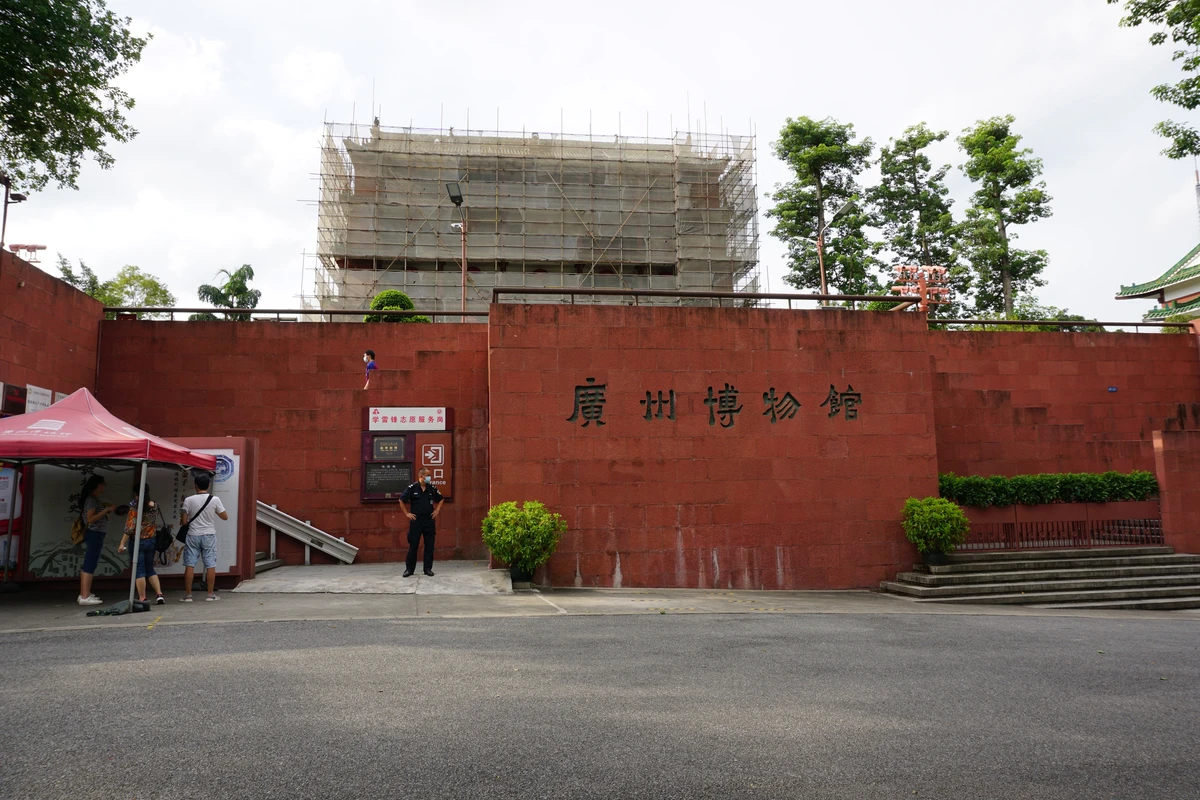
Address: Zhenhai Tower, Yuexiu Park, Yuexiu District, Guangzhou
Ticket: 10 yuan, free for medical staff
Walking along the Ming Dynasty city wall to the Yuexiu Mountain Stadium, I was still marveling at such a huge stadium on a hill when I turned around and unexpectedly discovered the Guangzhou Museum here. This is the beauty of not over-planning your trip—little surprises often appear along the way. I had to go in and have a look.
At the ticket office, I showed my medical worker ID and got free entry. But the staff said there were only twenty minutes until closing and advised me to come back tomorrow. I hesitated for two seconds, then decided to go in anyway. Better to have a quick look now. If it really grabbed my interest, I could come again tomorrow. Passing by without stepping inside would be a pity.
Climbing the stairs, I reached a large platform, and in the center stood the Zhenhai Tower, built in the 13th year of the Hongwu reign of the Ming Dynasty (1380). The tower was built by Zhu Liangzu, the Marquis of Yongjia who guarded Guangzhou, after he merged the three cities of the Song Dynasty—East, West, and Middle—into one, with the city wall traversing Yuexiu Mountain and the tower erected at the highest point. Currently, the exterior of Zhenhai Tower is under scaffolding for renovation, but the interior visits are not affected.
To the left is a stele corridor. On the right, a building with red walls and green tiles serves as a special exhibition hall.
The five-story Zhenhai Tower now houses the Guangzhou Museum and its permanent exhibition "History of Guangzhou." Though the exterior is under repair, the interior is accessible. Since it was near closing time, many exhibition halls were already dark and preparing to shut. To match their schedule, I strode directly to the fifth floor and worked my way down to the first.
The fifth floor covers Guangzhou's modern history, the sixth section of the exhibition. It begins with the impact of the Opium Wars on Guangzhou and introduces how people of ideals actively studied Western science, institutions, and culture in response to Western influence. It highlights how the people of Guangzhou, under the successive leadership of Sun Yat-sen and the Communist Party, finally achieved liberation and victory through the 1911 Revolution and a series of revolutionary explorations and attempts.
A panoramic map of the Pearl River shoreline. Here, multimedia displays show Guangzhou's modern municipal construction, listing many "firsts" in which Guangzhou led the nation.
Looking up from the fifth floor, you can see the red plaque with black characters "Zhenhai Tower" hanging high above.
Descending to the fourth floor via the two-way staircase inside the tower.
The fourth floor showcases Guangzhou during the Ming and Qing dynasties, the fifth part of the exhibition. This section reflects how Guangzhou became a bridge for trade and cultural exchange between China and foreign countries from the mid-Ming period. Through a concentrated display of exquisite Guangzhou-made objects from the Qing dynasty in the museum's collection, it presents how Guangzhou, benefiting from being the only port open to foreign trade, became the center of China's foreign trade and a major handicraft manufacturing hub alongside Beijing and Suzhou.
One display case exhibits heraldic porcelain custom-ordered by European and American merchants in Guangzhou during the 18th and 19th centuries. These pieces feature unique shapes, Western-style forms, and delicate patterns that blend traditional Chinese craftsmanship with refined European decorative styles.
A splendidly ornate gold tripod with chiseled enamel from the Qianlong period of the Qing dynasty.
A celestial globe and an astronomical instrument called the Seven Regulators, developed by Mr. Zou Boqi.
A set of Qing dynasty pith watercolors depicting the life of Guangzhou ladies and Lingnan flowers and butterflies was donated by British friends. These pith paintings have brought an art form that had nearly vanished from its birthplace of Guangzhou back home.
During this period, Guangzhou's city area expanded continuously, the city was enlarged again, and multiple cultures coexisted. After the Ming dynasty, Guangzhou rapidly grew into a world-famous city.
The third floor covers the history from the Three Kingdoms, Two Jins, to the Song and Yuan dynasties—the third and fourth parts of the exhibition. Part three shows Guangzhou's development during the Wei and Jin periods, explaining how the name "Guangzhou" came about and the relative stability and social development during those times. Part four exhibits Guangzhou from the Sui-Tang to Song-Yuan eras, presenting the port city civilization of that period. Through artifacts, it introduces Guangzhou's prosperous maritime trade. Displays and images present famous historical figures from each dynasty.
The second floor exhibits history from the pre-Qin to the Han dynasties. Part one mainly shows prehistoric and pre-Qin civilization, with "Four Great Sites" remnants displaying the production and living conditions of people in the Guangzhou area. Part two shows Guangzhou from the Qin to the Han, focusing on life in the Nanyue Kingdom and the Han dynasty city of "Panyu," highlighting Guangzhou's development as a Lingnan metropolis in production, daily life, and maritime trade. It displays Guangzhou's residential forms, and through artifacts introduces the economic production and food culture. Unique 3D models, various quirky pottery lamp figurines, and excavated Neolithic, Qin-Han, and Three Kingdoms to Southern and Northern Dynasties artifacts (4000 BC–589 AD) are on show. There's a Southern Han dynasty pottery ridge beast, yellow-glazed lotus-pattern floor tiles, an Eastern Han pottery female figurine in long-sleeved dress, and a model of the "Sohar" ship.
In just twenty minutes, I rushed from the fifth floor to the first, traversing Guangzhou's long history. One floor contains thousands of years, with both eyes looking upon past and present. The rough stone tools, mottled bronzes, exquisite ceramics, and yellowed historical documents and photographs left by ancestors gave me a quick understanding of Guangzhou's urban development over two millennia.
Down to the first floor lobby, large reliefs adorn the side walls. Stepping out of Zhenhai Tower, the courtyard is lush with greenery. I walked toward the stele corridor on the west side. In the courtyard, a red sandstone groove is the base of the Ming dynasty stone tablet "Record of Zhenhai Tower." The stele corridor, built in 1964, houses dozens of ancient historical stone inscriptions. The corridor sits on the Ming dynasty city wall of Guangzhou. On the wall, aside from the steles, there are cannon mounts. They hold city defense cannons cast in Guangzhou from the Chongzhen period to the Opium Wars, as well as steel cannons bought from Germany's Krupp factory. At a bend in the wall lies a stone inscription of Sun Yat-sen's will, a stone plaque of "Daxin Street," and the foundation stone of the Kowloon-Guangzhou Railway Station. A big double-pole bus is parked next to Zhenhai Tower. Everything on the city wall, seemingly casually displayed, is actually the history of this city. From the wall, I could see the Sun Yat-sen Monument on a nearby hill and the Yuexiu Stadium right in front.
I timed it perfectly, efficiently visiting the Guangzhou Museum, and was the last visitor to leave. The museum turned out to be an unexpected bonus on this journey! Then I continued wandering in Yuexiu Park...