Guangzhou Revisited: A Walk Through Yuexiu Park
Date: 2020.7
Transport: plane (Nanjing–Guangzhou), self-drive
Route: Nanhai God Temple (visit: 1.5 hours, ticket: 15 yuan), Lingnan Impression (arrived 16:40, closed at 5 pm, couldn't enter), Guangzhou Higher Education Mega Center Science Museum (exterior), snack hunting on Beijing Road
Accommodation: CityNote Xino Hotel (Guangzhou Beijing Road Dafosi Park Qian Metro Station Branch) 271 yuan/standard room
Day 2:
Transport: walking, taxi
Route: Lu Xun Memorial Hall (1.5 hours, online reservation required, free), Guangdong Museum (1.5 hours, online reservation required, free), United Bookstore
Accommodation: Beijing Road Xino Hotel
Day 3:
Transport: walking, metro
Route: Nanyue King Palace Museum (1.5 hours, free), Yuexiu Park (2 hours, online reservation required, free), Guangzhou Museum, meal at Yuehailou
Accommodation: Jinzhou Hotel (Guangzhou Yuexiu Park Metro Station Branch) 207 yuan/standard room
Day 4:
Transport: walking, taxi
Route: Sun Yat-sen Memorial Hall (free for medical staff), Beijing Road, meal at Tao Tao Ju
Accommodation: Guangzhou Huamao Canton Culture Hotel 151 yuan/standard room
Day 5:
Transport: bus, taxi, metro, plane (Guangzhou–Nanjing)
Route: Shangxiajiu Pedestrian Street, Xiguan Dawu (traditional mansions), Liwan Lake Park, meal at Xintaile
From the Nanyue King Palace Museum I walked through Beijing Road back to the hotel, checked out, and moved to the Jinzhou Hotel in Yuexiu District. The hotel is right by the Yuexiu Park metro exit – incredibly convenient. It sits on the west side of Jiefang North Road. Through the glass window, the undulating hills and lush greenery of Yuexiu Hill spread out before me. I could clearly see the amusement rides tucked among the trees; surely the park entrance was very close. I've been to Guangzhou many times, but this was my first time in Yuexiu District. Yuexiu really is the heart of the old city. After all my comings and goings over the years, it's funny that I'm only setting foot here now – travel can be delightfully unpredictable. After a short rest I set off. I asked the hotel staff and learned that the main gate of Yuexiu Park, the one right across from the hotel, was closed due to the pandemic. Now, entry is only through the West Gate. So I walked. Right next door is the Western Han Nanyue King Museum. I didn't go in; I stuck to my plan and headed for Yuexiu Park.
A few hundred meters along Jiefang North Road, I crossed the street to the West Gate. This venerable park, built in the 1950s, is free for the public. You need a reservation, but you can make one on the spot. At the entrance, I studied the map to get my bearings, choose a direction, mark the spots I wanted to see, and confirm my route.
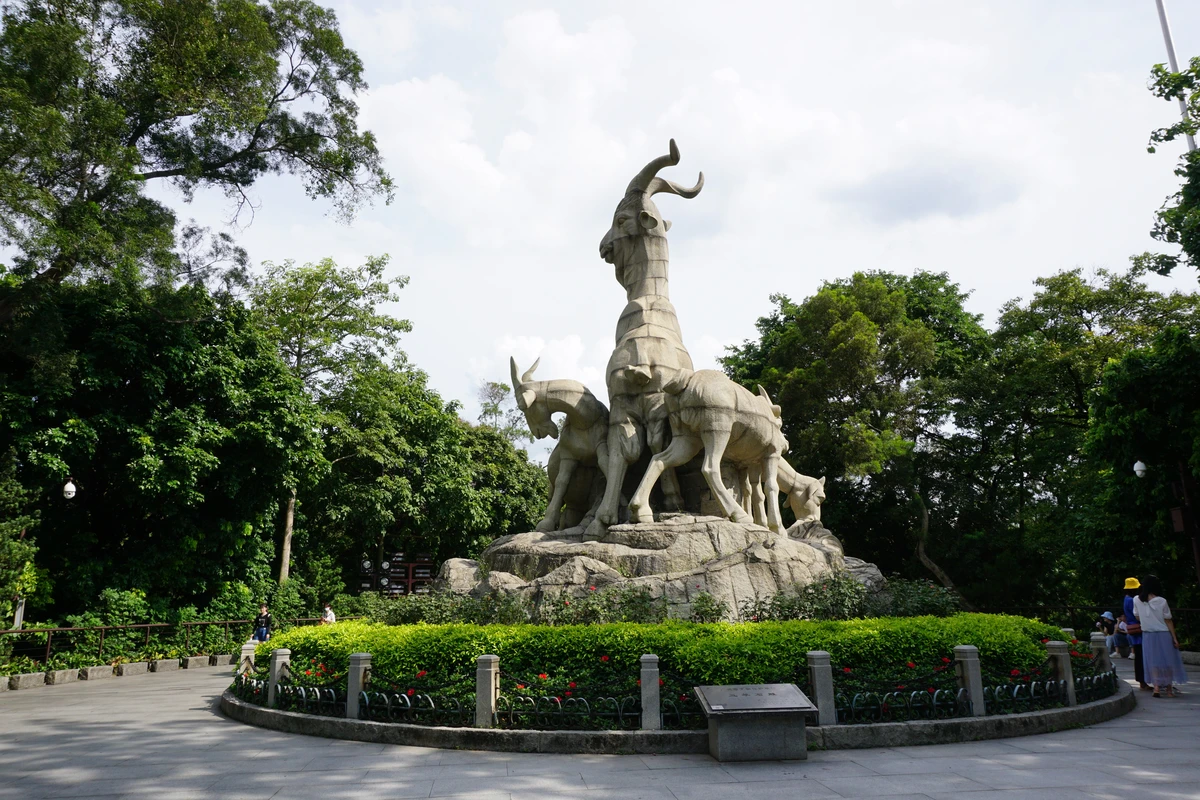
I made a beeline for the Five Goats Statue. Ever since I was little, I've known that the Five Goats Statue is the emblem of Guangzhou. Having come to Guangzhou so many times without ever really seeing it, I'd always felt a bit of regret. So today, I was actually a little fluttery – like meeting a long-admired idol.
After climbing several dozen steps, I finally saw her true face at the top of a small hill.
The sculpture was built in 1959. Carved from 130 blocks of granite, it stands over ten meters tall including the pedestal – you have to crane your neck to see. Filled with joy and a kind of relief, I circled around them several times.
On the hilltop, around the sculpture, there are archways, pavilions, terraces, corridors, steles and other structures.
Having seen the Five Goats, that long-held wish was fulfilled. I chose another path and continued through the hills. Though walking through hills, the slopes are gentle and it's an easy stroll. The rich vegetation blocks the summer heat, and the oxygen released by the greenery made my steps light and cheerful.
Heading east, I followed signs deeper into the hills.
Amid the hills and deep shade, a lake lay hidden. Yuexiu Hill has three man-made lakes, named for their positions – East, South and North Lake. The one I was looking at now was South Lake. Tucked away, it was tranquil and full of quiet meaning.
After circling South Lake, I decided to go south. To my surprise, I came upon a stretch of city wall. Coming from Nanjing, I'm no stranger to city walls; I have a soft spot for them, feeling that a city with walls has real substance.
Reading the introduction, I learned this is a Ming Dynasty city wall, a surviving relic of Guangzhou's ancient fortifications. After the Xinhai Revolution, Guangzhou tore down its walls to build roads, and this is all that remains of a wall that existed for over two thousand years.
On the ancient wall, grass grew lush and green.
Looking up, the towering, crenelated wall snaked away into the distance.
A thick network of roots spread like veins across the wall's face – a scene both desolate and solemn.
On one side, stone steps led up onto the wall.
The wall is built of large grey-blue bricks.
Nearby there is also the Yuexiu Water Tower, but the vegetation is so dense that you can't get a clear view of it from the road anymore, and there's no path to approach through the undergrowth. So I just photographed the introductory sign.
I followed the wall further south.
The wall also marks a historic site of the Guangzhou Uprising – the Guanyin Hill Battle Site.
Yuexiu Hill has seven knolls, so walking through it means climbing up and down from time to time. Here, a hundred steps lead up to the southernmost peak, Yuejing Hill. The Sun Yat-sen Monument stands on the hilltop.
Halfway up, there are two archways. One is the 'Foshan' stone archway, built during the Daoguang period of the Qing Dynasty. It faces south, a four-pillar, three-bay single-story stone structure of granite, simple in style, inscribed with the large characters 'Foshan'.
Above the 'Foshan' archway is the 'Guzhi Chuting' archway, also from the Qing Dynasty. It faces east, a two-pillar, single-bay single-story granite archway with four drum stones at the column bases.
Further up, on a platform amid the thick trees at the summit, stands the Sun Yat-sen Monument. The entire obelisk is made of granite, 37 meters high, rising from a square base to a tapered point. It is one of the key memorials in Yuexiu Park honoring Dr. Sun Yat-sen's revolutionary spirit.
On the front of the monument is a massive granite block about 7 meters long and 4 meters wide, engraved with Sun Yat-sen's will in gilded clerical script – it gleams in the sunlight.
On the sides, the balustrades feature exquisite stone carvings; the upper base has 26 sheep (goat) carvings in the balustrade patterns on all four sides, symbolizing the City of Rams (Guangzhou).
The monument was built in 1929 and designed by the renowned architect Lü Yanzhi.
Descending from the monument, one side opens onto Yuexiu Stadium, a sports ground cradled between the hills.
I assumed it was a modern stadium built to meet contemporary needs. But later, while researching for this travelogue, I learned that Yuexiu Stadium is actually an old venue, built in 1950. It was the People's Stadium, constructed by young people with their own hands at the call of Marshal Ye Jianying, Guangzhou's first mayor. So a city's development is intimately tied to its ideals. The stadium seats 30,000 and has a glorious history, hosting influential domestic events like the men's and women's football tournaments of the 6th and 9th National Games. It also houses a youth amateur sports school that has produced many outstanding athletes.
Behind the maroon facade of the Guangzhou Museum, the building obscured by scaffolds is Zhenhai Tower, a dazzling pearl among Guangzhou's cultural landmarks and acclaimed as Lingnan's finest scenic spot. I will cover it separately in a piece dedicated to the Guangzhou Museum.
I rushed to visit the museum in its final 15 minutes before closing. Afterwards, I continued east. On Xiaopanlong Hill there are two pavilions.
This four-pillar stone pavilion is Guangfu Pavilion.
Guangfu Pavilion was built after the victory of the War of Resistance Against Japan, jointly by people from Guangzhou and Hong Kong, to commemorate the triumph of the Xinhai Revolution and the generous donations made by Hong Kong compatriots in support of the cause.
The pavilion has stone descriptions both inside and out that recount this history.
It has a four-sided pointed roof with green glazed tiles, a square plan, steps on all four sides, and drum stones beside the steps.
A few steps away is the Seamen's Pavilion – a double-eaved octagonal pointed pavilion built to commemorate the victory of the 1922 Hong Kong seamen's strike.
The archway of the Seamen's Pavilion.
Leaving the Seamen's Pavilion area, I had basically seen all the historical relics in this part of the park. The northern section is mostly amusement rides, so I didn't head that way but continued south, planning to exit through the South Gate.
Another stretch of city wall.
How lucky the local residents are, having such a place – with natural scenery and historical sites – to jog or stroll through.
Going up and down the hills, halfway up the slope I came across the Monument of Sun Yat-sen's Reading and Governing Place. It is a pointed, square column. This was the site of the former Yuexiu Tower, where Sun Yat-sen and Soong Ching-ling once lived.
At the foot of the hill, I looked back.
From here, I could see the buildings of the Sun Yat-sen Memorial Hall across the road.
The South Gate of Yuexiu Park.
Right across Yingyuan Road stands the Sun Yat-sen Memorial Hall. It was already closed by this time. Since I was staying nearby, I'd have to come back and visit.
I had finally fulfilled a wish, seeing Guangzhou's most iconic park. There's a happiness called contentment.