Step into Greenery, Embrace Nature: A Forest Bath in Zengcheng
Recently, we've all been living routine lives, commuting between work and home. Nowadays, a healthy lifestyle is encouraged—it encompasses many aspects, from vegetarianism to regular exercise, but at its core, it's about maintaining a balanced routine. No matter how busy work gets, rest and a proper work-life balance are essential. With the May Day holiday approaching, I'm sure everyone is looking for a cozy place to unwind. I have a great suggestion: you don't need to travel far over the holiday. Head to Zengcheng, a suburb of Guangzhou, for a refreshing 'oxygen-renewal' trip.
Zengcheng District lies in the central-eastern part of Guangdong Province, east of Guangzhou. It faces Dongguan across the river to the south, borders Huizhou to the east, and Conghua to the north. Zengcheng is nationally renowned as the Land of Lychees, a famous denim apparel city, and a model eco-tourism zone. Its scenic spots are beautiful and fun, making it the top weekend getaway in the Pearl River Delta.
If you and your family want to enjoy a forest bath, look for an environment like this: First, the forest air is fresh, free of toxins, sterile, and dust-free. Second, it's shaded by lush trees, cool and pleasant. Third, the paths or designated bathing spots have a soft layer of fallen leaves or thick ground cover of grass and foliage. Fourth, there are birdsong and the drone of cicadas, accompanied by the sound of flowing streams, creating a natural, harmonious atmosphere. Fifth, the foliage and tree shapes are beautiful, with stunning scenery.
As a huge oxygen factory, forest air is rich in negative oxygen ions. Like vitamins in food, they are vital for the human body, benefiting the respiratory system, nervous system, and immunity. Zengcheng boasts an annual air quality excellence rate of over 90%; its water area covers 276.7 square kilometers with 100% water quality standards; forest coverage reaches 52.53%, and per capita public green space is 22.5 square meters. Known as the 'Emerald Oasis' in the Pearl River Delta, Zengcheng is a superb choice for a forest bath.
Zengcheng has many forest parks, including the provincial-level Taizikeng Forest Park, the city-level Dafengmen Forest Park, county-level Jiaoshiling Forest Park and Nanxiangshan Forest Park, and town-level parks like Jiufengshan, Siwanggang, He Xiangu, Menghuabu, Wudielin, Dongxi Jing, Houlongshan, Mache, and Dapuwei Forest Parks. Best of all, these forest parks are free—truly natural 'oxygen bars.'
Besides the forest parks mentioned above, the Shuizhai Scenic Area in Paitan Town is a signature attraction of Zengcheng. Covering about 170 km², it is traversed by the Tropic of Cancer and is hailed as a 'resplendent emerald on the Tropic of Cancer.' The area features towering mountains and majestic peaks, with nine peaks exceeding 1,000 meters in altitude. The highest, Niuguzhang, stands at 1,088 meters, with a massive, precipitous silhouette and straight ridges, embodying grandeur, novelty, peril, and beauty.
Baishuizhai Scenic Area boasts virgin forests, shallows, wetlands, and canyon tianchi (heavenly pools) – rare natural resources in Guangdong. Its most stunning feature is the Baishuixian Waterfall, with a drop of 428.5 meters, the tallest waterfall in mainland China. Its graceful shape is like a fairy descending to earth, said to be the incarnation of He Xiangu, one of the Eight Immortals. Baishuizhai is also a natural oxygen bar: the air in the mountain and waterfall area contains up to 112,500 negative ions per cubic centimeter, the highest concentration among Guangdong's scenic spots.
Ascending from the foot to the summit, the hiking trail built along the Baishuizhai ridge is known as the 'First Ladder of Southern China.' Spanning three high mountains and connecting two tianchi, it stretches 6.6 kilometers with a total of 9,999 stone steps. Hikers along this route can visit the fairy-like waterfall scene station by station. Especially at the 2,199th-step Qinpu Pavilion (Waterfall-Affinity Pavilion) or the 3,299th-step Mupu Pavilion (Waterfall-Bath Pavilion), the experience is particularly awe-inspiring.
Strolling along the waterside path beneath the waterfall is an easier way to get close to nature and the fairy waterfall. The entrance connects with the 299th step of the 'First Ladder,' and leads to the waterfall-viewing platform at the 1,299th step. This 666-meter-long natural wooden boardwalk lets visitors admire the elegant beauty of Baishuixian Waterfall while walking, as gurgling water dances and jumps beneath their feet like lively musical notes.
Scenic Spot Layout and Hiking Guide
Hiking and sightseeing can cultivate the mind and strengthen the body, but it is also a test of physical fitness and endurance. So visitors should choose a route that suits their ability.
Friendly tip: In addition to walking, you can take shuttle buses up the mountain. Baishuizhai offers sightseeing vehicles for round-trip service, including eco-friendly cars to the 899th-step waterfall-viewing point and a summit shuttle bus to the source of the waterfall, Xiangu Tianchi (Fairy Pool).
Leisurely Tour: Hiking Trail Start – Seagoing Ship Wood Boardwalk – 1,499th-Step Puming Platform (Waterfall-Roar Platform)
The seagoing ship wood boardwalk meets the start of the hiking trail and leads to the Puming Platform at the 1,499th step. Built right by the water, the boardwalk features several pavilions and viewing decks along the way. As you wander, you can enjoy the waterfall, play in the water, and breathe in the fresh air. At Step 1,499, you reach the first zero-distance waterfall touch point – the Puming Platform – where you can feel the torrential power of the cascade. Then descend the stone steps to the 899th-step sightseeing bus station, where you can choose to ride back and enjoy a truly leisurely experience.
Classic Tour: Hiking Trail Start – Seagoing Ship Wood Boardwalk – 1,499th-Step Puming Platform – 2,199th-Step Qinpu Platform (Waterfall-Embrace Platform)
After reaching the Puming Platform at Step 1,499, if your energy allows, continue along the hiking trail to the Qinpu Platform at Step 2,199. This is the second zero-distance waterfall touch point, where you'll truly appreciate the grandeur of the highest waterfall in mainland China. Then return down the trail.
Challenge Tour: Hiking Trail Start – Seagoing Ship Wood Boardwalk – 1,499th-Step Puming Platform – 3,299th-Step Mupu Platform – Xiangu Tianchi
Those with plenty of stamina will naturally prefer to push on. At Step 3,299, you reach the third zero-distance waterfall touch point – the Mupu Platform. Here, spray from the waterfall rushing down the mountain refreshes your body and soul. At Step 3,699, the Muyun Pavilion offers a sublime feeling of harmony with nature. The 428.5-meter-tall waterfall stands right before you. Then, passing lightly through 'Fairy Valley' (Shenxian Gou), you'll arrive at the source of the waterfall, Xiangu Tianchi, at Step 4,099.
Panoramic Tour: Ascend to the summit Xiangu Tianchi and then descend while sightseeing.
Take the summit shuttle bus to the waterfall's source, Xiangu Tianchi. Then walk down through Fairy Valley, past Muyun Pavilion, Mupu Platform, Qinpu Platform, Puming Platform, and Guanypu Platform (Waterfall Viewing Platform). After crossing Huixian Bridge (Meeting Immortals Bridge), head back up along the Seagoing Ship Wood Boardwalk for more views, reaching the 1,299th-step Guanypu Platform before descending.
1978 Cultural & Creative Town sits on the east bank of the Zengjiang River in Guangzhou. It creatively transformed Zengcheng's former sugar and paper mill, along with surrounding old factories, warehouses, scattered dwellings, and old villages, into a brand-new cultural and creative district brimming with nostalgic elements. It has become Guangzhou's latest Instagram-worthy photo spot.
Must-Visit Photo Spots
The boiler house of the former sugar and paper mill, now listed as a historic building in Guangzhou, has been renovated into a landmark blending industrial and European styles. It looks like a castle, infused with artistic charm.
The former paper rolling department of Zengcheng Paper Mill has been transformed into a Western-style wedding manor, which won the 2016 APIDA Asia Pacific Interior Design Award. Its pure white architecture fulfills every girlish fantasy.
1978 Movie City
The walls are covered with eye-catching revolutionary-themed graffiti, with ironwork and red bricks evoking a strong sense of the era. The red facade paintings tie in with the theme of 1978 Movie Town.
Reform and Opening-Up Avenue
Themed around China's reform and opening up, this avenue uses wall paintings, scene sculptures, and space exhibitions to showcase the changes since then.
1978 Yacht Club
Zengcheng's first and only fully equipped yacht club, built to 'International 5 Gold Anchor' standards. Take a luxurious yacht cruise along the Zengjiang River for one hour and enjoy the beautiful scenery where hills and water meet!
1978 Art Museum
Themed around zisha (purple clay) culture, it integrates collection, exhibition, research, training, and exchange of zisha art and culture, housing many works by national-level zisha masters.
1978 Cultural & Creative Town offers a full range of cultural, entertainment, and leisure experiences – dining, drinking, playing, and lodging – perfectly catering to today's cultural and entertainment consumers. It also aligns well with the future direction where the cultural service industry will become a leading sector. The red-brick factory buildings have become the nostalgic 1978 Movie Town, waiting for you to explore at your leisure.
Zengcheng Food Recommendations
The secret to making authentic, rustic roast chicken: heat a traditional stove with firewood, place a whole local free-range chicken inside, and let it roast away from the flame for 15 minutes. Since it's not directly over charcoal, the skin doesn't burn easily, and there's no charcoal smell—just naturally rich chicken aroma.
Delicacies from the Zengjiang River include dozens of dishes like stir-fried yellow clams in black bean sauce, blanched river shrimp, and steamed sturgeon. Notable fish include grass carp, crucian carp, mountain stream fish, and assorted river fish. Zengjiang river shrimp, though only the size of a pinky finger, are incredibly sweet. 'One fish, three ways' is a signature of Zengjiang river cuisine.
Hei Kee was founded in 1965 by Mr. Liao Xi (known as Uncle Hei), a native of Zengcheng who started it in Hong Kong. Thanks to years of carefully perfected typhoon-shelter-style spicy crab, Hei Kee swept through Hong Kong, landed in Macau, and spread to neighboring regions. There is a Hei Kee right inside the 1978 Cultural & Creative Town.
Zengcheng is home to half locals and half Hakka people, so the Hakka cuisine here is very authentic. They first roll a whole goose in a pot until it's about 60-70% cooked, then add mushrooms and various other ingredients, stewing everything together. The result is a goose dish where the flavors deeply penetrate the meat, making it rich yet not greasy.
Fresh bamboo is cut into sections, each with one end opened as a lid. The food is placed inside, the lid is replaced, and the whole thing is tied with wire before being roasted over an open fire. Seasoning is important for bamboo-tube cuisine, but controlling the heat is even more critical.
Mountain stream snails may be small, but they are exceptionally crunchy. Combined with other flavorful seasonings, a deep suck brings the snail meat and sauce into your mouth together, leaving a lasting aftertaste.
Paitan's tofu is exceptionally tender and smooth, thanks to the excellent local mountain water. Made into Hakka-style pan-fried stuffed tofu, it's superb. You can find Paitan's mountain-water stuffed tofu everywhere in Paitan.
Zengcheng Accommodation Recommendations
In recent years, boutique guesthouses (minsu) have become increasingly popular, combining architectural aesthetics and lifestyle pursuits. In Zengcheng, Guangzhou, soaking in hot springs, staying at a guesthouse, and driving back to nature is a great choice. In addition to guesthouses, Zengcheng also has many hot spring resort hotels worth checking out.
Muji Yunxi Mountain Retreat
Nestled in a small basin called Zhangdongkeng, it is surrounded by lush greenery and babbling streams, seamlessly connected yet distinct from the local traditional dwellings—ideal for travel and living. It currently has 20 guest rooms, along with a restaurant, yoga studio, tea house, meeting room, heritage exhibition hall, sharing hall, and a starlit swimming pool.
Adhering to principles of energy conservation, green building, and symbiosis with nature, construction materials are locally sourced. Grey bricks and dark tiles, creeping vines, crevices filled with moss—weathered old wood and bricks still full of life. Walls are mainly grey brick or stone with a yellow clay finish, using abundant, eco-friendly materials. Roof tiles and old bricks are reclaimed from dilapidated local houses—turning waste into treasure. This approach gives the buildings local cultural character while saving costs and energy. Every brick, tile, and leaf seems reborn through years of careful integration.
Modern architectural design and materials infuse the buildings with contemporary flair to meet aesthetic needs. Units with rich scenic views feature floor-to-ceiling glass so you can take in the beauty. Some roofs have skylights to make full use of natural light. Special-function units use light steel structures with modern minimalist expression, creating a striking contrast with the ancient, weathered Lujiang Hall Hakka walled village, embodying Zen aesthetics.
Golden Leaf Hot Spring Resort Hotel
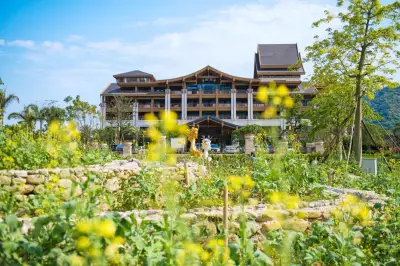
Located in the Baishuizhai Scenic Area of Zengcheng, Guangzhou, this hotel is nestled among mountains with 232 rooms/suites. It is adjacent to the tallest waterfall in mainland China—Baishuixian Waterfall. The second-phase service apartments are now fully open.
Designed with a Balinese theme, the six buildings are only four stories high and feature open floor-to-ceiling windows, letting you connect closely with nature. Lush trees and flowers surround the buildings. The interior is eco-friendly, with each room facing the mountain and pastoral scenery, using primarily wood materials.
The hot spring service center features Japanese-style pools, romantic pools, and stone-slab baths. Facilities include hot springs, hydrotherapy, massage, fitness, locker rooms with steam and sauna rooms, a swimming pool, and over 30 open-air hot spring pools, allowing you to fully relax in comfort, leisure, and romance.
Senlinhai Hot Spring Resort Hotel
Adjacent to the national 4A-rated Baishuizhai Scenic Area, this hotel is surrounded by virgin forest with fresh air and incredibly high negative oxygen ion levels. The front square faces Baishuixian Waterfall directly, encircled by lake and mountain views full of poetic charm. All four directions offer expansive vistas. Built in Southeast Asian style, it is dedicated to providing guests with a 360° all-season water-friendly resort experience in a forest paradise.
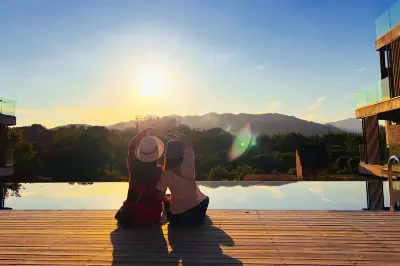
The hotel has 341 lavish rooms, including 118 deluxe rooms, 99 family-themed duplex suites, and 36 water-side villas, all equipped with private indoor hot spring pools connected to outdoor garden swimming pools. Guests can enjoy all-day, zero-distance water enjoyment. Extra-large viewing balconies bring you closer to nature and help relax your body, mind, and soul.
The hot spring area features 58 highly Instagrammable pools with unique functions, such as boathouse hot springs, treehouse aerial hot springs, lantern-shaped pools, and island hot springs. There are also a hot spring spa, stone-slab room, indoor heated pool, and therapy pools. The ingenious garden-style hot spring setting lets you indulge in slow, luxurious living—here, time passes gently and dreams are warm.
Less-Crowded Travel Route Recommendations
Route 1: 'Heart-Clearing, Lung-Cleansing' Green Tour
Route: Dafengmen Scenic Area – Baishuixian Waterfall Scenic Area – Shimalong Wetland Park – Baishuizhai Countryside Eco Park – Xiangjiang Health Valley
Food recommendations: Traditional Baishuizhai roast chicken, steamed reservoir fish head with olives, bamboo-tube steamed meatballs, steamed baby river shrimp with mountain snails, salted late-season Chinese cabbage, steamed arrowroot slices
Route 2: Idyllic Small-Town Tour
Route: Shangjiubei Village – Deng Village – Menghuabu Beautiful Countryside – She Ethnic Folk Village
Food recommendations: Paitan mountain-water tofu, Paitan arrowroot, Paitan white tea, Zhengguo cured meats, Zhengguo Huangtang root mustard, Zhengguo wontons, lai fen (rice noodles)
Route 3: Ethereal Spiritual Tour
Route: He Xiangu Scenic Area (He Xiangu Temple, Xiangu Well, Temple-top Immortal Peach, Millennium Immortal Vine, Xiangu Pagoda, Bell Tower) – Xiaolou Renjia Scenic Area (boating among lotus on Baxian Lake, Shizuxianshan Lychee Garden, Baode Temple)
Food recommendations: Xiaolou winter melon feast, Zengcheng choy sum feast
Route 4: Wellness & Hot Spring Tour
Route: Baishuixian Waterfall Scenic Area – Dafengmen Scenic Area – health hot spring tour (Zengcheng Golden Leaf Hot Spring, Sanying Hot Spring, Xiangjiang Health Valley, Gaotan Hot Spring, etc.)
Food recommendations: Paitan roast chicken, Baishuizhai sweet potato
Route 5: Natural Oxygen Bar Ecological Tour
Route: Menghuabu Village – Jiaoshiling Forest Park – Lihu Lake – Zengjiang Art Gallery – Fengtai Lansheng (Phoenix Terrace Scenic View) – Shitan Dragon Boat Festival scene
Food recommendations: Licheng lychee feast, Shitan clam soup, Shitan whole beef feast
Route 6: Lingnan-Style Leisure Tour
Route: Erlongshan Scenic Area – Zhongxin Cui Grand Tutor Shrine – Kengbei Village Ancient Architectural Complex – Cui Yuzhi Memorial Hall
Food recommendations: Zhucun chicken rice, Zhongxin Hakka baked goose
Route 7: Greenway Cycling Leisurely Tour
Route: Licheng Street section (south) – Paitan Town section (north) – Zengjiang Street section (east)
Food recommendations: Licheng lychee feast, Paitan roast chicken, Licheng lychee feast
Route 8: Charming Zengcheng Cultural Tour
Route: She Ethnic Folk Culture Village – 1978 Movie Town – Zengjiang Art Gallery – Lihu Lake
Food recommendations: She loquat wine, lychees, mountain stream snails
Route 9: Rustic Charm Tour
Route: Baishuixian Waterfall Scenic Area – Shangjiubei Village in Paitan Town – Deng Village in Paitan Town – Xiaolou Renjia Scenic Area
Food recommendations: Xiaolou winter melon feast, Zengcheng choy sum feast
Throughout human evolution, we have had a very close relationship with nature—relying on our senses, intuition, and responses to find food, water, and shelter, all vital for survival. Now, living in cities doesn't mean we should cut off all connections with nature. For modern urbanites who love staying home or are swamped with work, planning regular trips to nature-rich destinations or taking a walk in a large forest near the city is an excellent choice. It's not just about dreams and distant places—it truly benefits your physical and mental health.
A friendly reminder: During the May Day holiday, it's recommended to travel in a decentralized manner. Wear a mask when out, and pay attention to hand hygiene after returning. Avoid large crowds, and maintaining social distance is still very necessary. Finally, wish everyone a happy holiday!