Guangzhou Revisited — Nanhai God Temple, Starting Point of the Maritime Silk Road
Travel period: July 2020
Travel mode: flight (Nanjing – Guangzhou) then self-drive
Route: Nanhai God Temple (visit duration: 1.5 hours, admission: 15 yuan), Lingnan Impression (arrived 16:40, park closed at 5pm, couldn’t enter), Guangzhou University Town Science and Technology Museum (exterior view only), Beijing Road for food
Accommodation: Xinuo Hotel (CityNote, Guangzhou Beijing Road Dafosi Park metro station branch) 271 yuan per standard room
Travel mode: walking, taxi
Route: Lu Xun Memorial Hall (1.5 hours, advance online booking required, free admission), Guangdong Museum (1.5 hours, advance online booking required, free admission), United Bookstore
Accommodation: Xinuo Hotel on Beijing Road
Travel mode: walking, metro
Route: Museum of the Nanyue King’s Palace (1.5 hours, free admission), Yuexiu Park (2 hours, advance online booking required, free admission), Guangzhou Museum, Yuehai Lou for food
Accommodation: Jinzhou International Hotel
Travel mode: walking, taxi
Route: Sun Yat-sen Memorial Hall (free for medical staff), Beijing Road, Tao Tao Ju for food
Accommodation: Huamao Hotel
Travel mode: bus, taxi, metro, flight (Guangzhou – Nanjing)
Route: Shangxiajiu Street, Xiguan Grand Houses, Liwan Lake Park, Xin Tai Le for dinner
It’s become a routine to take a trip with my child every holiday. A foodie, he once again chose Guangzhou, a paradise for culinary delights. So off we went. There are places you return to again and again—for the food, the scenery, or someone special. For me, Guangzhou checks all three boxes.
Fifteen hundred kilometers, we opted to fly. During the pandemic, we took precautions, wearing masks throughout public places. I felt flight delays were much fewer during the pandemic, though I have no statistics to back up that impression. We landed on time at Guangzhou airport, where a friend picked us up in his car. The city under blue sky and white clouds.
Arriving in any city gives me a sense of brightness—leaving the familiar and stepping into a place that isn’t mine, with a touch of curiosity, anticipation, and a little excitement. Guangzhou is familiar to me, yet I still felt that way.
The weather was glorious, with clouds so close you could almost reach up and pluck them from the sky. My friend is cheerful and optimistic, his smile as warm as Guangzhou’s sunny weather. A strange city feels familiar when you have a friend there.
We drove from the airport, setting the navigation to my friend’s workplace. The subtropical scenery stretched along the way.
After a meal near his company, my friend handed over his car to me. After a quick lesson, I drove this electric car toward our destination—Nanhai God Temple. This itinerary was all planned by my child; he wanted to see the starting point of the Maritime Silk Road. Despite visiting Guangzhou so many times, I never knew about this place. Time to fill that gap! Driving an electric car for the first time, I was cautious at the start. Once we left the complicated city streets, I relaxed and enjoyed the drive.
Address: No. 22 Xuri Street, Miaotou Village, Huangpu District, Guangzhou. Following the navigation, we arrived at the parking lot on Dianchang West Road. After parking, we went to the ticket office, scanned the health code, bought tickets (15 yuan each), and then headed into the scenic area.
A lush green stream encircled the site, with canna lilies blooming in vibrant colors along its banks.
A bridge crossed the stream.
At the other end of the grey-stone arch bridge stood the West Gate Archway.
I looked up at the archway against the sky.
Subtropical flowers and plants are always so exuberant.
There was a panoramic guide map and introduction. The southernmost part of the scenic area is the Ming Dynasty Wharf Site. Located south of Zhangqiu Hill, a road built from weathered rock at the foot of the hill once led to the Pearl River, about 125 meters in total, consisting of a landing stage, a reception pavilion, a small bridge, and an official path paved with red sandstone. The Ming wharf site has been backfilled and protected, so what we see now is a ground-level simulation created in 2018 on the original site using red sandstone materials.
A large sloping square featured a row of screen walls displaying the “Complete Map of Boluo.” The map comes from the Qing-dynasty book “Boluo Waiji.” It depicts famous sights along both banks of the Pearl River, from Humen in the east to Yuzhu in the west, during the Qianlong and Jiaqing eras.
Outside the square, green trees wrapped around, with a few small boats resting quietly. Sunlight filtering through the leaves created dappled shadows, lending a dreamy atmosphere.
A tall Boluo tree was laden with fruit. I learned (from Baidu) that Nanhai God Temple is also known as Boluo Temple. It was a place where ancient Chinese people worshipped the sea. It is the only remaining building among the four great sea god temples of ancient China (east, south, west, north). Emperors came here to offer sacrifices to the sea god, and it is an important historical site of ancient China’s foreign trade.
There are many stories about the Boluo tree. According to legend, during the Tang Dynasty, an envoy from the ancient Indian kingdom of Boluo came to the capital to pay tribute and then visited Nanhai God Temple. He planted two Boluo saplings he had brought with him in front of the temple. The trees grew large and extraordinary, so the temple came to be popularly called Boluo Temple. The Boluo trees we see today were planted by city leaders on the opening day of the temple’s restoration in 1986.
In front of the square lay a lake—the manmade Lake in Front of the Temple. Across the lake stood a modern power plant.
Looking around the lake, the subtropical vegetation was lush and verdant; everything was wrapped in varying shades of green.
Past the tall trees, a cable-stayed bridge was visible. I guessed it was the Huangpu Bridge, judging by its location.
On the north side of the lake, nestled among green trees, was Nanhai God Temple.
Pink bougainvillea bloomed brilliantly, like lips holding a smile.
This is the Qing Dynasty Wharf Site. Discovered during the renovation of the south square in 2005, it consists of a landing stage and a road. The landing stage, at the southernmost end, is paved with granite and has nine well-preserved water-facing steps.
The slabstone path extends north to the archway and into the temple. From here, you can see the Fuxu Ancient Wharf Archway by the lake. Nanhai God Temple is located in Fuxu Town at the mouth of the Pearl River, on the north bank, facing the Fuxu River. To the east it connects to Shizi Sea, downstream to Humen, with Guangzhou at its back. It was a crucial maritime gateway in and out of Guangzhou in ancient times; from here ships set sail to reach countries of the South China Sea.
I never expected this was a wharf. It looks like a pond, not connected to any river, let alone the sea. In my imagination, the starting point of the Maritime Silk Road had to be by the seaside. Even if the temple gates didn’t face the South China Sea, they should have faced the Pearl River! But here it was just a pond, a manmade lake, and a huge expanse of high-voltage cables and tall chimneys. Yet none of this can overshadow its history. Records say that the Guangzhou port changed its location four times, and Nanhai God Temple was the earliest port site, a landmark of the Maritime Silk Road. The Qing Dynasty wharf we see now was discovered during the construction of the square in front of the temple, when welcoming the “Götheborg” back to Huangpu. The discovery proves that in Qing times, Pearl River water reached right up to the “Calm Sea” archway, and most people coming to Nanhai God Temple disembarked here.
In the middle of the square stood a gigantic banyan tree.
Among the varied vegetation, an octagonal pavilion with a double-eaved yellow glazed tile roof—the Northern Song Dynasty Kaibao Stele Pavilion—stood out brightly.
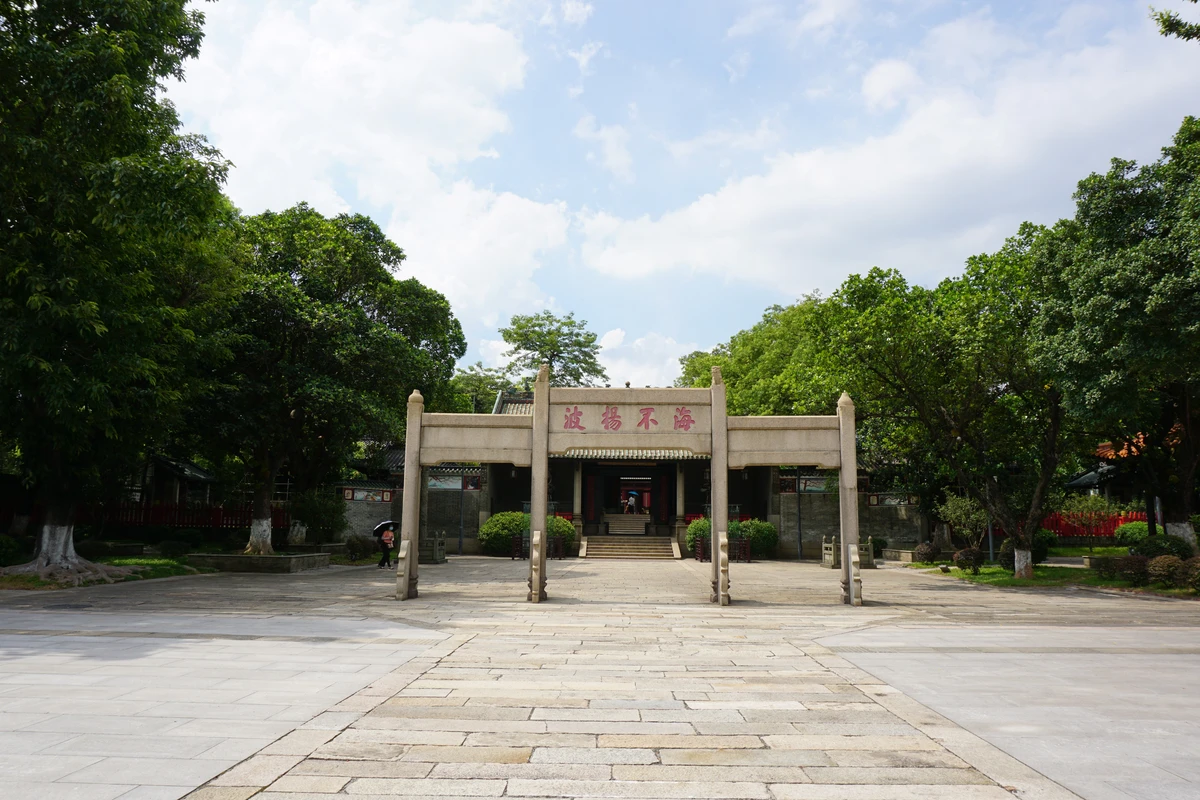
This rugged yet elegant stone archway in the center of the square, inscribed “Calm Sea,” is like the logo of Nanhai God Temple. Before the Ming Dynasty it was a wooden structure; after the Ming it became a stone one. The current stone archway is a Qing Dynasty building, with three bays and four pillars, rough-hewn stone, simple and unsophisticated in typical Qing style. “Calm Sea” means the sea is windless and smooth as a mirror, symbolizing safe sailing and a bountiful return. It was the most earnest wish for a safe voyage among all who passed through this prosperous ancient port.
Beyond the archway lies the courtyard of the Main Gate.
East and west in front of the courtyard sit a pair of stone lions and a pair of bluestone ornamental columns, demonstrating the temple’s majesty and extraordinary presence.
The main gate of Nanhai God Temple was built in the Qing Dynasty, of brick and wood, three bays wide with a flush-gable roof and a ceramic ridge featuring two dragons contesting a pearl. In front stands a pair of red sandstone lions, flanked by splayed screen walls. The gate has raised platforms before and behind. Above the door hangs a gilded horizontal plaque inscribed “Nanhai God Temple.”
On the east and west sides of the front platform are statues of two deities: Wind Accompanying Ear and Thousand-Mile Eye.
For centuries they have guarded the temple without fail.
Standing on the steps of the second entrance, the Ceremonial Gate, I looked back at the main gate and the archway.
The second entrance is the Ceremonial Gate, three bays wide and four bays deep, with a flush-gable roof. On its beams are two coiling dragons in the act of leaping and flying, contending for a pearl. It is flanked by covered corridors. The Ceremonial Gate is literally the “gate of rituals,” with three doors: the middle one reserved for high officials and nobility; others of lower rank or commoners used the side doors.
In the eastern corridor of the Ceremonial Gate, an exhibition called “Old Shadows, New Faces” uses photos and texts to narrate the temple’s changes over time and introduce artifacts unearthed from the temple.
A pair of stone drums sit at the entrance of the Ceremonial Gate.
The western corridor houses an exhibition of “Ancient Chinese Ship Models.”
There are many types, including China’s three famous ancient ships, the main ship types of the ancient Maritime Silk Road, and vessels used on rivers.
The lintel is hung with a plaque reading “Sacred Grace Shared by All,” meaning the emperor’s benevolence is accessible to everyone.
From the courtyard of the Ceremonial Gate to the fourth hall, the Main Hall, there are covered corridors on both east and west sides displaying 45 stele inscriptions from the Tang, Song, Yuan, Ming and Qing dynasties. In addition to the Han Yu Stele at the main gate and the Song Kaibao Stele, other famous ones include the Ming Hongwu Stele and the Qing Kangxi Stele... Many imperial sacrificial steles were left here, along with poetry and prose steles by cultural luminaries, so Nanhai God Temple is also known as the “Forest of Steles in the South.”
Beyond the Ceremonial Gate, through a large courtyard, lies the third hall, the Ritual Pavilion. This was where officials came to worship the South Sea God in ancient times.
The Ritual Pavilion, also called the Worship Pavilion, was originally built in the Ming Dynasty. The current one is a reconstruction imitating the Ming style. It is a wooden structure with a single-eave hip-and-gable roof, three bays wide and deep, open on all sides.
In the west of the courtyard stands the Kangxi Imperial Stele Pavilion.
On the stele, the four large golden characters “万里波澄” (Ten Thousand Miles of Calm Waves) are bold and spirited.
In front of each of two imperial steles grows an ancient kapok tree.
Some parts of the temple were under renovation.
On the east side of the Main Hall is a famous large bronze drum from the Eastern Han Dynasty. It was cast in that period, with six bronze frogs mounted around its rim.
Adjacent to the Ritual Pavilion is the fourth hall and the most important building in the complex—the Main Hall. It is five bays wide and three bays deep, majestic in appearance, simple and dignified. It exemplifies the classic art of ancient Chinese timber-framed palatial architecture. In the center of the hall sits a 3.8-meter-tall statue (including pedestal) of the South Sea God, Zhurong.
The fifth hall, the Zhaoling Hall, also called the Rear Hall, is the residence of the South Sea God’s consort. Its roof features a glazed tile ridge with upside-down aoyu fish and two dragons contending for a pearl.
Behind the Zhaoling Hall, I’d walked the temple’s central axis from south to north, starting from the “Calm Sea” archway and passing through the five main buildings: Main Gate, Ceremonial Gate, Ritual Pavilion, Main Hall, and Zhaoling Hall, each higher than the last. Auxiliary structures are symmetrically arranged around these five halls. The entire complex, embraced by greenery, is a typical traditional Chinese temple ensemble.
In addition to the main buildings, the surrounding gardens are also beautifully landscaped and full of life.
In the western garden of the temple lies a rather large Lingnan Folk Culture Park.
The park displays stone implements from various eras.
A tall terrace made of stone, called the Vermilion Bird Terrace. The South Sea God is Zhurong (the Red Emperor), and the red bird (Zhuque) is the temple emblem, hence this terrace. Each vermilion bird sculpture is exquisitely crafted and lifelike, all facing the same direction.
Here, characteristic Lingnan architectural features are on display: the sliding door (tangmen) and wok-ear walls.
The sliding door is an important type of door in Lingnan architecture, offering good burglary protection. Wok-ear walls, also called horse-head walls or zhuangyuan walls, were commonly used in Qing Dynasty Lingnan dwellings. Besides decoration, they also serve fireproofing and wind-shielding purposes.
This wall is made of oyster shells. Since the Ming Dynasty, in the Pearl River Delta and coastal oyster-producing areas, oyster shells were used instead of bricks for walls, providing insulation and durability with a distinctive look.
The Manchurian window, originally a masterpiece of Manchu architectural art, became widely adopted in Lingnan architecture for its elegance and delicacy.
Brick carving, stone carving, ceramic sculpture, stucco relief, and wood carving are all part of the ancient architectural art of Lingnan.
Wufu Xiangyun (Five Blessings and Auspicious Clouds) shrimp-curved beam.
I walked to the southern end of the folk culture park.
In the garden, clusters of ancient trees form groves.
To the west of Nanhai God Temple is a small hill—Zhangqiu Hillock.
Only over ten meters high, the hill is ascended by stone steps. Ancient trees tower on both sides, and at the foot stand stone deities and guardian beasts.
Atop the hill is the Yuri (Bathing in the Sun) Pavilion, with a glass-covered archaeological site beside it.
The Bathing in the Sun Pavilion has a single-eave hip-and-gable roof and simple beam structure. In the middle stand two ancient steles carved with poems written by Su Dongpo of the Song Dynasty and Chen Xianzhang of the Ming Dynasty after they climbed here to watch the sunrise.
During the Tang and Song dynasties, this spot was surrounded by water on three sides, an ideal place to gaze at the sea and pour out one’s heart. But now tall trees form dense shade, blocking views beyond the hill, let alone watching the sunrise.
Leaving Nanhai God Temple by car, we headed for Lingnan Impression. When we reached the ticket office it was already 4:40 p.m., and the park closes at 5:00, so we couldn’t enter. Our friend, knowing where we were, recommended we check out the nearby Guangdong Science Center, saying it was a very special building.
Guangdong Science Center
Address: Panyu District, Guangzhou
Sprawling by the Pearl River, the Guangdong Science Center is huge and imposing. Its unusual shape, seen from Panyu Bridge overhead, resembles a blooming kapok flower.
We drove in from Kepu Road, but at the parking entrance we were told visiting hours had passed. So we could only walk around and admire the colossus from outside. From one angle, it looked like a giant aircraft carrier.
From another angle, it resembled an eye with a bright pupil.
With scenic spots all closing, we didn’t rush around anymore. We returned the car to our friend; for the next few days in the city, the metro would suffice—driving and parking downtown would be a headache. Our friend dropped us at the metro station, and we took the metro to Gongyuanqian Station, then walked a few hundred meters to our hotel.
Xinuo Hotel (CityNote, Guangzhou Beijing Road Dafosi Park metro station branch)
Address: No. 81 Xihu Road, Guangzhou
The hotel is in a commercial building on Longzang Street. The exterior was under renovation, scaffolded. We took the elevator to the fourth floor lobby to check in. The lobby was small but decorated in a trendy, arty style, with lots of distinctive ornaments.
There was a cozy and atmospheric restaurant/bar offering breakfast and late-night snacks, though the variety was limited.
Our room faced the residential compound, so we weren’t disturbed by the construction at all. Soundproofing was good. The room wasn’t big but was compact and refined, with ample and well-placed lighting. After a short rest, we each headed to Beijing Road to hunt for food.