Memorable Nansha: Encountering the Beauty of Guangzhou's 'South Pole' in Midsummer
You don't know how big Guangzhou is until you come to Nansha. You don't know Guangzhou has a sea until you come to Nansha. You don't know how Guangzhou's wetland parks can enchant like fairyland until you come to Nansha. Indeed, most tourist resources in Nansha District relate to cultural heritage and natural ecology—well worth a three- or four-day trip. And we even enjoyed a wonderful Nansha Bay Area Cruise Music Festival. Follow my lens and words, and let's explore Nansha together!
Change of clothes, an umbrella, a bottle of medicated oil, a pair of sunglasses. A Nikon 50mm prime lens, a Nikon D810 camera, one each of Nikon 24-70mm, Nikon 14-24mm, and Tamron 100-400mm lenses, mobile phone, personal ID, some cash, a bank card, driver's license, sunscreen (very important), sun hat (very important), sun protection clothing, drinking water (very important), etc.
Day 1: Guangzhou city area – Nansha, overnight at Goge Art Hotel.
Day 2: Nansha Tianhou Palace, Huangshanlu Forest Park. Lunch at Six Pots Farmhouse, dinner at Mingliyuan Farmhouse. Stay at Nansha Garden Hotel.
Day 3: Morning visits to Nansha Wetland Park and Nansha Waterbird World Ecological Park; afternoon at Nansha Bay Area Cruise Music Festival. Lunch at Danjia Mei Danjia Restaurant, overnight at Nansha Grand Hotel.
Day 4: Drive to Nansha Million Sunflowers Garden, then visit Nansha Shijiuchong Fisherman's Wharf. Lunch at Million Sunflowers Garden, return in the afternoon.
Self-driving: use the names of scenic spots, hotels, or restaurants for navigation and drive accordingly. By air: the more convenient airports are Guangzhou Baiyun Airport and Shenzhen Bao'an Airport. Baiyun Airport connects to the subway; if you arrive at Shenzhen Airport, you'll need to take a ferry to Nansha first. By high-speed rail: Guangzhou South Railway Station or Humen Station. If you're not taking a taxi, chartering, or driving after arrival, it's better to go to Guangzhou South Station, which has connecting subway services.
Nansha Tianhou Palace: Take Guangzhou Metro Line 4, exit at Nansha Passenger Port Gate A, then walk about 1.2 km to the palace. Before visiting, please check official websites or call to confirm opening hours.
Nansha Wetland Park: Take the metro to Jiaomen Station, then transfer to bus Nansha G1 and alight at Nansha Wetland Park stop. The nearest airport is Shenzhen Bao'an Airport; the nearest high-speed rail stations are Dongguan Humen and Guangzhou South, but overall Guangzhou South is the most convenient.
Nansha Waterbird World: From the bus stop near Jiaomen Metro Station, take bus G1 to Nansha Wetland Park, then walk. If you plan to visit Million Sunflowers Garden at the same time, you can take bus Nansha 25 or Nansha 11 from the "Million Sunflowers Garden" stop outside the scenic area. Opening hours are 9:00-17:00. If you arrive late, it's best to check, as times may change under different circumstances.
Million Sunflowers Garden: Outside Jiaomen Metro Station, take bus G1 to the Million Sunflowers Garden stop. Bus G1 also goes to Nansha Wetland Park.
Nansha Shijiuchong Fisherman's Wharf: From Jiaomen Metro Station, take bus G1 to Shijiuchong. It's advisable to visit before noon, so you can look around and find a place to eat afterwards. If you go in the afternoon and need to take the bus, go early to avoid missing the last bus.
Yilu Nanfeng, an experienced self-media person across the web, certified travel writer on multiple platforms, domestic and international travel experience specialist, hotel experience specialist, and hotel reviewer.
Nansha Tianhou Palace is a landmark of Nansha District and the largest Mazu temple in Guangdong and Southeast Asia. The complex sits on the southern foothills of Dajiao Mountain, facing the vast Lingdingyang estuary of the Pearl River. Built along the mountainside, the palace is majestic, blending architectural styles and grandeur of Beijing's Forbidden City and Nanjing's Sun Yat-sen Mausoleum. Its unique aesthetics are truly admirable. Approaching the palace, the first thing you see is an elegant paifang archway with relief characters "Nansha Tianhou Palace." The four pillars bear couplets, and dragon reliefs adorn the beams.
The iconic sight at Nansha Tianhou Palace is the towering statue of Tianhou (Empress of Heaven) standing in the center of the square. Viewed from any angle—front, back, left, right, or from above—the statue is elegant and imposing. According to records, it stands 14.5 meters tall, exuding benevolence and an ethereal aura. Who is Tianhou? And why are Tianhou temples so common along the southeastern and southern coasts of China, and even in many coastal areas around the world?
The "Tianhou" honored here is actually Mazu, the same goddess worshiped at Meizhou Mazu Temple in Putian, Fujian, at A-Ma Temple in Macau, Shantou Tianhou Palace, and Quanzhou Tianhou Palace. Mazu holds the most titles of any deity in the world; besides Tianhou and Mazu, she is also called Tianfei (Heavenly Princess Consort), Heavenly Holy Mother, Niangma, and many more. It is said that over 300 million people worldwide believe in Mazu. She is a sea goddess, and the widespread Mazu culture along coasts is based on a fundamental need. Her culture also spreads the values of truth, kindness, and beauty, reflecting people's wishes for calm seas and thriving lives.
Mazu's original name was Lin Mo, and her worship began in the Song Dynasty—she is not an ancient deity. Lin Mo came from a prominent family in Putian; her ancestors had served as officials for generations. Her father, Lin Weique, had one son and five daughters. Because shipwrecks were frequent and men faced great danger at sea, her father had long hoped for another son. In 960 AD, Lin Mo was born. Although she was another girl, the sky was filled with auspicious clouds, foretelling her extraordinary life. Even as an infant, she rarely cried or fussed, which is why her parents named her “Mo” (silent). Lin Mo was naturally intelligent, influenced by her parents, and from childhood was kind-hearted and charitable. By age sixteen, she was versed in astronomy and geography and could foresee changes in sea weather—a common thing today, but in an age with virtually no forecasting technology over a thousand years ago, she was regarded as a divine being. Thanks to her predictions, villagers avoided many maritime disasters.
At seventeen, her elder brother tragically died in a shipwreck, which strengthened her resolve to save people from sea disasters. During her lifetime, she helped countless fishermen avoid shipwrecks, keeping many families intact. In 987 AD, Lin Mo ascended the highest peak of Meiyu Island and passed away, leaving this world. The people believed she had achieved spiritual perfection and become an immortal, so they built a temple to worship her on Meizhou Mountain.
Nansha Tianhou Palace is nestled among green woods. Standing in the hills, breathing air rich with negative ions, with a gentle breeze blowing, you'll feel thoroughly refreshed.
Leaving the square and climbing the steps, the first thing you see is a paifang archway before the mountain gate, its style identical to those at the Forbidden City and Imperial Academy in Beijing—a relatively rare sight in southern China.
Passing through the archway, you first see the mountain gate building, guarded by two seated stone lions staring out at the vast sea and the passing visitors—silent yet commanding. Continuing upward, palace-style buildings are distributed symmetrically along the steps, giving you the feeling of wandering through an imperial garden. In layout and detailed style, Nansha Tianhou Palace resembles parts of the Chengde Mountain Resort and Beijing's Summer Palace. The difference is that here you have a superb sea view, which those two sites lack.
Nansha Tianhou Palace was originally built in the Ming Dynasty, evolving from a Tianfei Temple in Lujing Village, Nansha. It was renovated in the Qing Dynasty, destroyed in the mid-20th century, and rebuilt in 1994 on the initiative and with donations from Mr. Huo Yingdong. The current complex comprises the square, halls, and the Nanling Tower.
The main hall sits at the center of the complex, enshrining a gold-leafed statue of Tianhou carved from fragrant sandalwood, as well as a soft-body Tianhou statue for processions invited from the Meizhou Mazu Temple. The grand building features a red and yellow color scheme, closely resembling the great halls of the Forbidden City.
Nanling Tower stands at the highest point of Nansha Tianhou Palace—an eight-story structure 45 meters tall. From there, you can overlook the entire palace complex and the magnificent Pearl River estuary, blending sea views, forests, mangroves, and the palace into one harmonious panorama that inspires poetic feelings. From the tower, you can also spot the nearby Humen Bridge and other Nansha sights like Puzhou Garden, all truly breathtaking.
Huangshanlu Forest Park
In the hot summer, a leisurely walk in a forest park to cool off and breathe fresh air is a great choice. After leaving Nansha Tianhou Palace, our group headed to Huangshanlu Forest Park. This park is the green lung of central Nansha and the largest free forest park in Guangzhou, named after its two main peaks, Huangshan and Lushan. Its main peak, at 295 meters above sea level, is the highest point in Guangzhou and offers a sweeping view of Nansha District. Covered in dense forest, the park has exceptionally high negative ion levels. As we walked along the winding road, tall trees lined both sides, keeping us cool even in midsummer.
Nansha Wetland Park
As the saying goes, you don't know Guangzhou's vastness, its sea, or that its wetland parks can be this enchanting until you visit Nansha. Nansha Wetland Park lies between Shibachong and Shijiuchong in Wanqingsha Town, Nansha District, right in the heart of the Guangdong-Hong Kong-Macao Greater Bay Area.
Nansha Wetland Park is one of China's wetlands closest to the sea, covering about 10,000 mu (approx. 667 hectares). Climb high to enjoy its graceful scenery and the magnificent views of the Pearl River estuary. It is also Guangzhou's largest wetland park, blessed with abundant sunshine, plentiful rain, and fertile soil—ideal for lush plant growth. Thanks to its excellent ecology, many migratory birds come to roost here every year. During our boat ride, we often saw birds flying over the wetlands, enlivening the natural beauty. Our group boarded a boat at the wharf to enjoy the park from the water. As the boat moved slowly, passing open stretches, small rivers, and lotus-filled areas, every unexpected turn brought a different landscape.
Nansha Wetland Park is evergreen all year round, but it's most lush in spring and summer. As the boat glided along, sea breezes blew gently, and the vivid greenery set against blue skies, white clouds, and rippling waves felt like stepping into Alice's green wonderland.
The wetland park has a boat tour area and a wilderness walking area. If possible, experience both, as the views are quite different. The area prioritizes ecological protection over tourism. During the boat ride, the lush mangroves, reed marshes, bird feeding zones, and lotus ponds are all impressive.
Water is the finishing touch at Nansha Wetland Park, complementing the birds and lush vegetation to create a poetic scene. During the roughly half-hour tour, our phones and cameras were constantly snapping. Luckily, the weather cooperated, and with the beautiful natural scenery, every snap was postcard-worthy. The boat continued on; the river widened and narrowed, ran straight and curved, and the view kept changing. First, we admired green islets seeming to float on the water, then we entered a wooded section where trees on both banks arched overhead, blocking direct sunlight. This part lasted about two or three minutes and felt like traveling through a primeval water forest or a winding time tunnel.
Summer is the best season for lotus at Nansha Wetland Park. Across a thousand mu of lotus fields, the blossoms sway in the breeze like graceful dancers, each flower elegant and subtly fragrant. Passing through the lotus fields on the boat, breathing fresh air and watching the lotus beauties twirl in the wind, your spirit lifts. In the past, I enjoyed lotus at Hangzhou's West Lake or Jinan's Daming Lake—delicate scenes—but Nansha's thousand mu of lotus impresses with its detail, grandeur, and perfect harmony with nature.
According to staff, over 30,000 birds reside here all year round, with the number exceeding 100,000 during winter. The birds fly solo or in groups, swooping high and low, skimming the water, then darting into the woods—a lively spectacle.
Near the wetland park, there's an observation tower where you can enjoy a panoramic view of the park and the vast sea at the Pearl River estuary.
The water network cuts the land into islets—some crescent-shaped, some rectangular, some oval, some irregular. Walking at ground level, you see the park's fine details; from above, you realize the park and the sea are almost one. The mighty Pearl River's main and tributary streams converge here before flowing into the ocean. Standing high, gazing at the vast sea and lush wetland, I suddenly felt like singing aloud but didn't dare, for fear of waking the birds. Following the wooden boardwalk, we reached another lotus-viewing spot near the park gate. The boardwalk is lined with various lotus and water lilies, pink and white, in all shapes and postures—the undisputed kings of flowers this summer.
Nansha Waterbird World Ecological Park
This was one of our favorite stops. Nansha Waterbird World Ecological Park is in Wanqingsha Town, Nansha District, next to Nansha Wetland Park. Covering 25 hectares, it's the only waterbird ecological park in the Greater Bay Area and one of the closest to the sea in southern China.
Zoos are everywhere, and waterbirds are common, but a dedicated waterbird-themed eco-park is rare. According to staff, the park is home to nearly 50 species of nationally protected first- and second-class animals. It's not just a park for viewing, but also a science education base, creative park, and waterbird breeding center—perfect for bringing children to broaden their horizons, and adults too can learn a lot.
The park focuses on conservation and research, with tourism as a secondary purpose. Creative works are scattered everywhere. Upon entering, in the first hall, you see a colorful big elephant leading a herd of miniature elephants, evoking the tropical flair of South and Southeast Asia.
Swan Lake is right next to the main entrance, where black and white swans frolic freely on the green water, a heartwarming sight. Staff said the lake covers about 100,000 square meters and harbors mute swans from the Netherlands and black swans; they are inseparable and often cited as paragons of devotion in the animal kingdom.
The waterside platform offers the best view of Swan Lake, accommodating up to 100 people at once. It's also a popular spot for tourist photos; a few clicks and sharing with friends is fun. For photographers, it's an ideal creative base.
Nansha Waterbird World includes six island areas like Rainforest Island, Flower Tree Island, and Treasure Island. As we walked along the paths, crossing bridges and threading through woods, we encountered various rare birds: white pelicans, parrots, peafowl, mandarin ducks, and more. White pelicans breed mainly in southeastern Europe and winter in southwestern Asia and Africa. They have a long beak that opens to clamp food, helping them catch fish. These pelicans seemed quite used to people; our arrival didn't disturb their leisure at all. One even came ashore to interact with us, and several of our group lined up to take photos with it.
The park is home to many peacocks, equally unafraid of visitors. By the water, we saw a mother peahen leading her chicks as they cooled off. Peafowl mainly live in tropical and subtropical regions, favoring open woodlands and grasslands, especially near water.
Further on, Colorful Parrot Valley, Gold-Silver Pond, and White Stork Beach all had their own charms. The striking black crowned cranes caught our eye as they strolled leisurely on the grass, seemingly hunting for treats. The black crowned crane is a resident bird that lives in flocks, usually in open marshland. They measure up to 105 cm long, with black down feathers, the rear body feathers yellow, and a crown of feathers resembling a blooming flower. These birds are so elegant they are often called “peerless beauties” or “reincarnations of Pan An” in the animal world. They are native to West and Central Africa and are the national bird of Nigeria. It was a pleasure to admire their grace here in Nansha.
Staff told us that many of the structures in the park have won awards in competitions. These imaginative works blend seamlessly with nature, displaying refined aesthetic taste and artistry.
These creative pieces are mostly situated near the water; some are symmetrical, others irregular geometric shapes. Looking closely, some resemble birds in nature, no doubt incorporating natural elements into their design.
Nansha Bay Area Cruise Music Festival
In the hot summer, let's get high at the Nansha Bay Area Cruise Music Festival! That was the rallying cry a few friends whispered before our trip.
This year's festival was held at the Guangzhou Nansha International Cruise Terminal, with a main stage and a secondary stage. Between them was a car display area, and all around were stalls selling drinks, alcohol, and boutique items. Stepping in was like entering a music market brimming with artistic atmosphere.
The festival started at 4:10 pm on July 25 and lasted until 9:30 pm, featuring a variety of music styles that each had their moment: heavy metal rock, folk, electronic, rap, pop, and more. The event invited the Roller Coaster vocal group and also featured Xu Zhenzhen, a powerhouse from The Rap of China.
The daytime was a prelude to release, but after nightfall, the crowd's energy fully ignited. People naturally swayed to the rhythm, cheered for their favorite singers and bands, and waved glow sticks. The venue turned into a joyful sea of music.
When Xu Zhenzhen appeared, the atmosphere surged. True to his reputation from The Rap of China, his every move exuded star quality, and on stage, he was nothing short of a shining star.
Million Sunflowers Garden
Many visitors know sunflowers love sunlight, and they can be seen in many parks across China, usually in small patches. In recent years, theme park trips have become trendy, and Guangzhou has developed several popular Instagram-worthy spots, one of which is Million Sunflowers Garden in Xinken Town, Nansha District.
As the name implies, the park boasts a million sunflowers. It is said to be China's first sunflower-themed park, and the sunflower seeds are all imported. Walking in feels like entering a colorful fairy tale world; the buildings, interiors, flowers, and statues are full of vibrant colors and cartoon elements, making it a favorite among families, kids, and young tourists. It is claimed that the garden always has at least 200,000 sunflowers in bloom every day, a world exclusive.
The Sunflower Sea Grove is the park's star attraction, drawing many visitors to take photos amid the flowers. The sunflowers grow vigorously, most standing over two meters tall. I used to wonder why their heads always turn toward the sun; it turns out their stems contain a pigment called lutein oxidation that, together with plant growth hormones, creates this peculiar biological phenomenon.
The sunflowers stand tall, all facing the sun. Walking in the grove feels like wading into a sea of red and yellow. Summer is the best season to admire them because of the many sunny days, with blue skies and white clouds adding grandeur and a dreamy feel.
The park's Four Seasons Rainbow area has a distinctive Furano, Hokkaido feel, with different seasonal flowers blooming in full glory. Behind it stands the Flower Love Hotel, a manor-style building painted in rich colors that, together with the flower fields and sky, create a dreamy, romantic visual. The Four Seasons Rainbow features a colorful train; the designer, Weta Workshop, has won five Oscars for visual effects. Riding the little train through the flower sea feels like a fantastic journey.
Everywhere you look, there are cute cartoon sculptures and small buildings: dwarfs, pink Hello Kitty-style houses, fairy-tale castle models, colorful swans, and more.
Here, women and children are the happiest because the settings are perfect for photos. Several female friends in our group struck various poses, expressing their many charms.
Besides sightseeing and photography, the park has many amusement rides: family roller coaster, pirate ship, bumper cars, spinning teacups, a rotating disco, and Shark Island Battle, among others.
After the tour, we naturally sampled the Sunflower Chicken Feast at the park restaurant. The sunflower-fed chicken features yellow, crispy skin, little fat, high vitamin E, fragrant meat, and tender breast. The plain boiled sunflower chicken had a cooling sensation and left a lasting fragrance; it truly deserves its fame. Other highlights were salt-and-pepper chicken cartilage and stir-fried chicken kidneys with broccoli.
Shijiuchong Fisherman's Wharf
Shijiuchong Fisherman's Wharf is located at the southernmost part of Nansha District's Wanqingsha Town, Xinken Community—the very southern tip of Guangzhou, often called the "South Pole of Guangzhou." Far from the city center, it enjoys its own tranquility. In times of inconvenient transportation, there were almost no tourists, but now with better access, it has become lively. Next to Nansha Wetland Park and Waterbird World, and not far from Million Sunflowers Garden, the synergy of the three attractions is one reason for the crowds, but the real draw is the abundance of delicious food.
Walking through the grand archway and along the seawall, you can see lush greenery in the distance and various fishing boats docked along the shore, with some boat-like vessels moving slowly on the water. This creek connects to Lingdingyang, but the water is not fresh—it's brackish seawater.
Although Shijiuchong is next to the sea, there's no beach—only a stone embankment. According to locals, the area from Yichong (First Creek) to Shijiuchong didn't exist originally; it was created by land reclamation during the sent-down youth era. Today, this is a migratory bird sanctuary and a wholesale market for fresh produce and seafood, famous for bananas and papaya. For modern city dwellers who increasingly value quality of life, a leisure trip here to soak in the bustle of daily life is quite delightful.
Shijiuchong Fisherman's Wharf is not a paid scenic area; anyone can enter for free. The main sightseeing and experience area is connected by a road, along which you'll find seafood markets, a meat-and-vegetable market, and various shops—mostly selling dried seafood, fruits, and local specialties.
As we walked along, we saw fruit stall ladies energetically calling out to customers, with striking red-skinned bananas and red mangoes catching the eye.
As the saying goes, live by the sea and eat from the sea. Here in Shijiuchong's market, you can find virtually every kind of seafood. Many visitors who drive here buy seafood to take home, but even more choose their fresh catch and have it cooked at a nearby restaurant.
Due to time constraints, we didn't buy seafood in Shijiuchong, but we did stroll through the market and saw it was bustling, especially the seafood stalls. The market has electronic price displays, which felt very visitor-friendly and reassuring when purchasing.
Goge Art Hotel
On this Nansha trip, since we were self-driving and wanted to experience different local hotels, we stayed at a new hotel each day. The first night we chose Goge Art Hotel Nansha Bay, located on Shangmao South Second Road, Nansha. It has relatively convenient transportation, contemporary decor, and business-friendly rates, offering great value.
After checking in and resting a bit, we walked to the hotel restaurant for dinner in the evening. That night we savored local Nansha specialties.
Roast goose: crispy skin, tender meat, excellent texture.
Crystal chicken: smooth skin, tender flesh, retaining the natural flavor of the chicken, perfectly cooked.
Garlic spare ribs: intense garlic aroma, very crispy ribs.
Nansha Garden Hotel
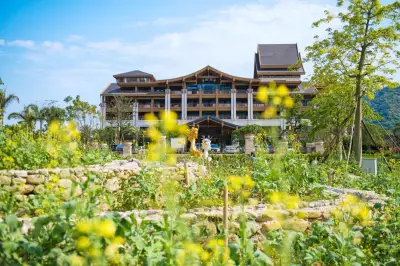
Nansha Garden Hotel is on Haibin Road, inside the Binhai Park, and was our second night's stay. The hotel has a strong sense of design. From the balcony, you can see the sea; even without opening the door, just drawing the curtains in the room reveals beautiful views of the Pearl River estuary and the nearby Humen Bridge. The lobby design is truly a work of art. At its center, over a thousand triangular prisms appear orderly from above but create a different visual effect when looking up. These prisms reflect and refract light as sunlight and artificial light change, and on clear days, if the timing is right, you might even see a rainbow in the lobby.
Surrounded by lush greenery, the hotel sits like a centerpiece of a garden. Gazing at the Pearl River estuary's charm and the surrounding greens put us in a wonderful mood.
Designed by a renowned European creative architect, the hotel's exterior resembles a cruise ship, with elegant lines blending seamlessly into the natural setting. The hotel is said to have 365 luxury rooms with sea and mountain views, nearly 10,000 square meters of secluded private gardens, a 600-meter private greenway, indoor and outdoor heated pools, an all-weather infinity pool, fitness center, tennis courts, and more.
Guangzhou Nansha Grand Hotel
Nansha Grand Hotel is a luxurious five-star hotel; it was here that Kenneth Fok and Guo Jingjing held their wedding in 2012. Located on South Second Road, Trade Avenue in Nansha's new coastal city, it's close to attractions like Nansha Tianhou Palace and Puzhou Garden, and has convenient transport.
Cuisine
What delighted us most on this trip was the abundance of delicious food—we truly hit the jackpot. Six Pots Farmhouse, located beside the Dongjing Village archway on Yingdong Avenue, Nansha, is a very distinctive local farmhouse. Many tourists drive from other cities just to eat here. Braised bone with lotus root and Dianbai rice noodles: an excellent side dish or even a main course; the seasoning was spot-on, and the noodles had a nice chewy texture.
Special plateau rabbit: cooked in a clay pot, locking in the aroma, with a springy, chewy texture.
Delicious marinated platter
Golden garlic Angus beef cubes
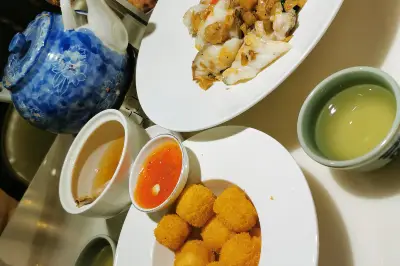
Golden trio platter: featuring shrimp cakes, cuttlefish cakes, and fried milk—all distinctive.
Yikou Ganxiang Huazhou chicken: a classic dish, beautifully presented, looking like a plate of gold under the light. The most special feature is the meat separated from the bone; it tasted fragrant, tender, and smooth, rich but not greasy.
Mingliyuan Farmhouse is located inside the entrance opposite Shengke Kindergarten under the Jinling South Road overpass in Dayong Village, Nansha. We went there in the evening and found the parking lot packed; we had a hard time finding a spot—business was booming.
Braised lotus root in pot: cooked to perfection, tender and slightly powdery, with meat slices that were not greasy at all—fantastic.
Black pepper snowflake beef
Huangge roast pork: a distinctive Nansha specialty, with skin roasted golden and crispy.
Wangmeitou fish: a wild fish with firm texture, deep-fried at low oil temperature (80°C) to achieve a crispy exterior and tender interior.
Soy sauce sea-flying duck: the duck meat was springy and flavorful, with a long-lasting aftertaste.
Lao ji (tossed chicken): a very unique dish, served in a bamboo winnowing basket. Sliced chicken arranged in the shape of a chicken sat in the middle, surrounded by condiments—very impressive-looking. Before eating, staff help toss the ingredients together. The chicken was fragrant, tender, and exceptionally tasty.
Steamed grass carp: grass carp is common, but steaming it perfectly shows true skill. It demands fresh ingredients and precise heat control; Mingliyuan's version was fresh and delicious, truly outstanding.
Wugu Fengdeng Danjia Mei Danjia Restaurant
What is Danjia?
Danjia, also known as boat dwellers, are people who lived on boats. They were once common along the coast but have almost disappeared. Danjia cuisine is a culinary category developed from the daily dishes of the Danjia people.
Danjia Mei Danjia Restaurant is situated on the west side of Nandi, Lingxin Highway, Wanqingsha Town, Nansha. It's one of the more representative Danjia eateries in Nansha, and we naturally wouldn't miss it on our visit.
Pot-boiled shrimp paste: a dish I loved very much—fragrant, with a texture somewhat like crab roe.
Steamed eel with black bean sauce: the meat was springy and delicious, well infused with the sauce.
Claypot rice with mullet roe and dried eel: a signature staple. Cooked with mullet roe and eel, it perfectly blended the umami flavors. Everyone in our group raved about it.
Ginseng steamed wetland chicken (water-bath style): tender and smooth, the meat was succulent, perfectly cooked.
Blanched large prawns: sweet and fresh meat.