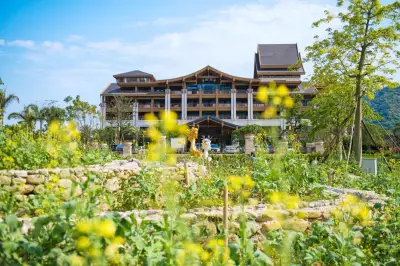
How to Enjoy Your First Trip to Foshan! Taste Shunde’s Fengjian, More Than Just a Land of Fish and Rice (A Complete Eat–Drink–Play–Stay Guide)
For first-time visitors to Guangdong, deciding where to go can be a dilemma, but Foshan simply must be on your list.
“Foshan is a National Historical and Cultural City, once one of China’s four great market towns and four famous ancient towns. It is known as the home of pottery, martial arts and Cantonese opera, the cradle of dragon boat and lion dance culture, the birthplace of Cantonese opera, and the origin, flourishing heart and inheritance ground of Guangfu culture.”
That’s the official definition from Baidu Baike, but in my mind Foshan is a food paradise – the title “Land of Fish and Rice” is no empty boast. Now let my words take you on a cloud tour to Fengjian Water Town in Shunde, Foshan, for a summer escape!
Travel’s trinity “food, lodging, transport” puts eating first, so let’s begin with a taste hunt!
Shunde snacks are famous across Guangdong. People from nearby cities drive all the way to Shunde just to eat – Chencun for Chencun rice rolls, Lunjiao for Lunjiao cakes, Daliang for double-skin milk. And when you come to Fengjian, it’s all about fish!
It’s called the Land of Fish and Rice for good reason. Fish is truly a local highlight – fish skin, dace balls, fish cakes, fish noodles, dried fish – all well worth a try.
Fengjian’s rivers teem with fish, mostly grey-black crucian carp and grass carp. Locals place long fishing nets in the channels and check them when they return home at sunset. If the fish are too small, they’re released; if just right, they’re turned into dried fish. Traditional drying isn’t done by harsh sunlight but by hanging the fish under big trees by the channel to air-dry, which preserves more of the fish’s sweet fragrance. Just thinking about it makes my mouth water.
Locals make fish skin almost every day or every other day. A whole skin is peeled from a dace, cleaned thoroughly until not a single scale remains – any scale would ruin the texture. It’s parboiled in hot water, then plunged into cold water. It sounds simple, but the key lies in the mixing ingredients and process. Fengjian’s fish skin isn’t served on ordinary cucumber and carrot; underneath is pickled sour melon, radish, papaya, pickled ginger, etc. The acetic tang marries perfectly with the fish skin. Crispy peanuts and white sesame are added – not only does it look good, it banishes any fishy smell. It’s exceptionally tasty, crisp and soothing, a real summer pleasure.
How does a fish become a bowl of fish noodles? Fish noodles are beaten from dace flesh. The meat is scraped off, pounded by hand until it turns gluey and finally into a paste, then the paste is put into a piping bag like those used for cakes, and squeezed into noodle strands. The chef’s skill must be exquisite, applying even pressure to extrude a continuous thread. Typically a good bowl of fish noodle consists of just one super-long strand – locals call it “longevity noodles” and eat it on birthdays. This entirely handmade noodle feels a little rustic, not as smooth as northern pulled noodles, but it’s especially resilient, chewy, and rich in fish flavour. The broth is simmered overnight from the finest fish bones to extract every essence. That bowl of fish noodle soup is incredibly sweet and delicious, and packed with nutrition!
This is a homely dish that’s anything but ordinary. Dace meat is minced into a paste, shaped into cakes, and pan-fried on both sides until golden. The secret is that the fish must be fresh and flavorful, and the additions – scallions, water chestnuts – must be just the right amount. Too little, and the fishiness peeks through; too much, and the fish’s sweetness is overwhelmed. While common, achieving the fragrant aroma, crispy exterior, tender interior, and rich deliciousness is no easy task.
In the sweltering Cantonese summer, wax gourd is eaten to dispel heat and cool down. Wax gourd and grass carp are meant for each other – simmered together, they make a soup that is sweet, rich and refreshing. Pepper is also added during cooking, both to remove any fishy smell and to tickle the taste buds and whet the appetite. Every time I have this dish, I polish off not just the fish and gourd but even the soup – I simply cannot stop. I’ve tried several places and all were good, though perhaps those in Jun’an, Foshan, are the most authentic.
Thanks to the food documentary A Bite of China, Jun’an’s whole steamed suckling pig shot to fame. Pork belly with a perfect balance of lean and fat is marinated, roasted, and finally steamed over a firewood fire. The heat is meticulously controlled to lock in the meat’s fresh juices, and with a sprinkling of white sesame it becomes even more fragrant and heavenly. Moreover, the pork used is from young, milk-fed pigs – not yet fully grown – so there’s absolutely no unpleasant muskiness. Absolutely brilliant!
Have you ever tried fried milk? It’s a Shunde specialty snack. Liquid milk is chilled into a jelly-like state, coated with flour, dropped into boiling oil, and fried. The result is a crisp shell and tender interior, bursting with milky fragrance. It’s especially tempting and a kid’s favourite.
Shunde is famous for double-skin milk, but personally I prefer ginger milk curd. To make it, you must use small, pungent yellow ginger with a strong gingery kick to extract the juice. The milk should be water buffalo milk, and the temperature is crucial: boil the milk, turn off the heat, let it cool for about 2–3 minutes, then pour the warm milk sharply into the ginger juice. Let it sit still for a minute and it will set. Done – a bowl of fragrant, silky-smooth ginger milk curd. I sound like I know what I’m talking about, but I’ve never managed to make one successfully myself. The speed of pouring is also key – not easy!
There’s another very popular snack in Fengjian Water Town: hand-ground black sesame paste. Several tiny riverside shops sell nothing but sesame paste, run by one or two elderly folks grinding and selling on the spot. Because it’s handmade, it’s wonderfully thick and rich, with pure natural sesame aroma and no additives – not too sweet, not too heavy, just the right deliciousness.
While wandering the water town, I was drawn to the fragrance of sesame wafting from the back alley. A lady about 60 was serving a bowl of sesame paste to a young man. I spotted a basin of black sesame and a grinding pestle under a big tree by the canal. I went up, eager to try, and started pounding the sesame and peanuts with the pestle. The lady came over and said, that’s not how you grind sesame – brute force will destroy the fragrance. You have to use gentle, persistent circular motions to draw out the aroma while preserving the original scent.
Fengjian village has been featured by CCTV, and Nicholas Tse (Xie Tingfeng) once recorded a programme here, so nearly every shop proudly displays its moment of glory. That sometimes makes choosing difficult, so let me recommend a few!
In the centre of the water town stands a Jinshi (imperial scholar) Memorial Arch. Behind it is a snack street, barely 300 metres long but boasting over 20 eateries. The first restaurant at the alley entrance is called 【Old Neighborhood】 (Lao Jie Fang). Unlike others, what’s hung here aren’t CCTV pictures but photos showing Hong Kong star “Fourth Brother” Xie Xian (Nicholas Tse’s father) bringing friends to eat. That’s how I ended up walking in.
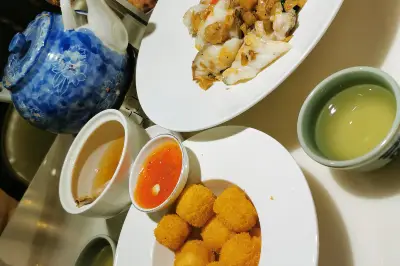
【Old Neighborhood】 is relatively bright and spacious. Every table has those big teapots from my childhood, giving it a very homey feel. The four big characters “Taste Shunde” are prominently displayed – exactly what I was looking for.
The food didn’t disappoint either, especially the tossed crisp fish skin and the mixed fried milk platter – super delicious. I’d recommend you try them next time.
~~~~~~~~~~~~~~~~~~~~~~~~~~~~~~~~~~~~~
Address: No. 34 Fengjian Straight Street, Fengjian Water Town, Xingtan Town, Shunde District (next to the Jinshi Memorial Arch)
Average spend: 30 yuan
Recommended dishes: Tossed fish skin, Jun’an pork, mixed fried milk platter
~~~~~~~~~~~~~~~~~~~~~~~~~~~~~~~~~~~~~
Actually, I’ve been to Fengjian several times, each time trying a different restaurant, hoping for a delightful surprise. But this one, 【Huang Chu】, I almost always eat at, all because of one dish: wax gourd and grass carp soup!
This restaurant isn’t inside the scenic area, just a hundred metres away. It’s not some internet-famous place hyped by media, so it gets fewer tourists and is mainly patronised by locals. The restaurant looks unremarkable, but at mealtimes customers pour in wave after wave. Need I say more? The food here is not to be underestimated.
~~~~~~~~~~~~~~~~~~~~~~~~~~~~~~~~~~~~~~
Address: Unit 2, Ground Floor, No. 27 Fengyuan Road, Fengjian Village Committee, Xingtan Town
Average spend: 50 yuan
Recommended dishes: Fragrant wax gourd boneless grass carp soup, tossed fish skin, cheese prawns, tossed white-cut chicken
~~~~~~~~~~~~~~~~~~~~~~~~~~~~~~~~~~~~~~
Another snack shop is called 【Shuangqiao Food Shop】 (Twin Bridges Food Shop), perched beside Jin’ao Bridge. The modest storefront is where Nicholas Tse visited while filming a food programme. Their signature is hand-ground sesame paste. Every morning the owner brings out a large tray of black sesame seeds, grinds them in a stone mill and the fragrance drifts a long way – utterly tempting. But I hear from locals that the ginger milk curd here is even better!
~~~~~~~~~~~~~~~~~~~~~~~~~~~~~~~~~~~~~~
【Shuangqiao Food Shop】
Address: No. 1, Lane 1, Cungen Street, Fengjian Water Town (turn right at the main gate of Fengjian Primary School)
Average spend: 15 yuan
Recommended dishes: Sesame paste, ginger milk curd, nougat
~~~~~~~~~~~~~~~~~~~~~~~~~~~~~~~~~~~~~~~
Fengjian is one of the oldest water towns in Shunde. When the local government decided to revitalise villages in 2010, Fengjian was among the first, with an investment of 150 million yuan. However, the renovation didn’t alter the original appearance – no widening of canals, no new bridges. They repaired the granite slab paths, preserved and refreshed old buildings, and added a few bronze statues to narrate Fengjian’s history and character. The town’s makeover naturally attracted outside investors, and boutique guesthouses blossomed like flowers.
Inside the water town there are quite a few guesthouses, mostly in a faux-antique style. But often the décor is a jarring mishmash, like “Dongshi imitating a beauty’s frown”, which killed my desire to stay. On all my previous visits to Fengjian I’d come and go in a single day.
Perhaps it was fate. I planned this girly water town trip with my besties because we’d all been a bit vexed lately and wanted to escape the clamorous city for a while. By chance, I contacted the owner of this guesthouse, 【Runlan Elegant Residence】. The name alone sounded graceful and extraordinary. Looking at the photos, the whole guesthouse was deeply vintage – really lovely.
The host was exceptionally kind. Four of us intended to squeeze into a twin room, but he said if there weren’t many guests that night, he’d arrange two rooms for us so we’d be more comfortable – since the rooms would be empty anyway. I was instantly touched, and so we decided to stay here!
As it turned out, we were the only four guests that night. The host put us up in one room called “Zhuangyuan” (Top Scholar) and another called “Bangyan” (Second Top Scholar) – pretty lucky.
With no other guests for two days, the inn was tranquil. I even got to chat with the owner. His family name is Liu, given name Xinchao, which you can see from the calligraphy hanging on the parlour wall. Mr Liu is a native Foshanese, with rather traditional values and habits akin to ancient literati. He gave himself a courtesy name, “Runlan”, meaning “moist breeze below the mountain, moistening the earth,” full of poetic charm. He happens to specialise in architectural design and construction, with a deep knowledge of antique buildings and restoration. He’d long dreamed of building a genuine historic structure from scratch, so he bought a plot of land in Fengjian and built this Runlan Elegant Residence. The entire building faithfully follows the Qing-dynasty blue-brick wok-ear house design. The front door is an old-style tanglong door, the roof beams carved with orchids, swallows, grapes and other Lingnan motifs. Inside, the wooden furniture is richly carved, reflecting the Qing era’s highly developed carving techniques. The Manchus loved elaborate, ornate decoration, so the furniture of the time was similarly adorned. Walking through the house, you truly feel as if you’ve time-travelled to an ancient world.
Every detail of this guesthouse is spot-on – the tea sets, the staircase, the doors and windows. What amazed me most were the two large opium couches placed on either side of the ground-floor parlour. Can you imagine late Qing opium dens? People lying on these couches, puffing away, lost in a haze, half-dead, half-ecstatic – a quintessential Qing scene.
The parlour has a very high ceiling, which easily draws a natural draft, so it stays quite cool even in summer. The ceiling fan is also vintage and functional – my favourite style. The guesthouse has three floors: the ground floor is the parlour and owner’s living quarters; the second floor has three rooms; the third floor another three – only six rooms in total. The owner said he originally built the house for himself, hence so few rooms. Later, friends told him his house so strongly evoked the old Lingnan ambience that others should have the chance to stay and experience this authentic cultural atmosphere. So despite his family’s objections, he turned it into a guesthouse.
The six rooms are named “Zhuangyuan” to “Jinshi”, representing the Qing imperial examination system – staying there gives you a subtle feeling of stepping into those old tales. My room was “Zhuangyuan”. The tables, chairs, bed, wardrobe and shelving are all carved wooden pieces. The bed is an antique wooden one with four posts and a mosquito net canopy; the windows have colourful lattice work; the hanging lamp is also antique. Such a thoroughly realised guesthouse is truly rare. This room is probably the largest in the house, with a small side hall. A round marble table holds aromatic incense – light it and blue smoke curls up, so atmospheric.
Locals love to sit in the cool courtyard of an evening, sipping tea, eating Lingnan fruits, cracking melon seeds, chatting in the soft breeze – so relaxed. This must be the living portrait of leisurely Lingnan people. In today’s fast-paced life, such a slow, indulgent day is a real treasure!
Mosquito-phobic, we instead sat in the side hall of my room, drinking modern beverages and munching on local century-old snacks – Bengsha (crispy rice flakes) and Cow Ear Cookies – that was quite agreeable. A friendly reminder though: when buying drinks and food in the village, check carefully – lots of copycat products look nearly identical. We grabbed the wrong bottles a couple of times and regretted it!
If you, too, fancy being a carefree Lingnan person for a while, I recommend checking out this guesthouse.
~~~~~~~~~~~~~~~~~~~~~~~~~~~~~~~~~~~~~
【Shunde Runlan Elegant Residence, Foshan】
Address: No. 1 Qingyun Lane, Fengjian Water Town, Shunde District, Foshan, Guangdong
Price: around 700 yuan on weekdays, around 1,000 yuan on weekends and holidays, no meals included
Tips: The inn isn’t directly beside the canal but just a couple of steps away, so it’s very convenient to enter the water town. On regular days only the owner’s mother, an elderly lady, minds the shop, so no meals are provided. But the moment you step out there’s food, and takeaways are possible. The guesthouse also provides free Qing dynasty costumes for photos – I didn’t dress up, but if you have time, wearing them makes for even more evocative pictures.
~~~~~~~~~~~~~~~~~~~~~~~~~~~~~~~~~~~~~~~
Jiangnan water town canals are straighter – at a glance, bridges overlap in layers of black, white and grey, like an ink-wash scroll. By contrast, Lingnan water towns are more lushly green. The water is jadeite, rippling along winding, meandering routes that suggest infinity. Fengjian is one of the oldest villages, but it has perfectly preserved the ancient village layout: over a hundred old houses, ancient trees everywhere, granite slab paths, crisscrossing ancient lanes, green trees shading both banks, birdsong and fragrant flowers – a different kind of poetic charm.
Strolling through the water town, there’s a bridge every hundred steps. Most bridges are simple – you could even call them crude. A few flagstones laid across are the bridge deck; a few wooden posts for a railing. Yet even this simplicity carries deep historical weight.
【Jin’ao Bridge】 is one of the oldest bridges here, built in the Qing dynasty from red glutenite, a single-arch beam-type stone bridge. On the horizontal railings, one side is carved “Jin’ao”, the other “Yudong” – two names for one bridge, a rarity. It is said that a local jinshi named Liu modelled this after the Jin’ao Jade Belt Bridge in the imperial garden of the capital. Though it looks nothing special today, its historical significance to Fengjian is still immense.
【Juji Bridge】 stands right in front of the Jinshi Memorial Arch, arguably one of the most important bridges in the water town. Built during the Song dynasty, it is so old that after numerous restorations it no longer bears traces of the Song, Yuan or Ming, only the small stone lions from the Qing remain clearly visible. As I climbed the steps and touched the exquisite floral patterns on the stone railings with my hand, I could still feel the weight of history and the patina of time.
【Mingyuan Bridge】 is one of the three historic bridges, alongside Jin’ao and Juji Bridges, and one of the earliest recorded three-arch bridges in Chinese documentation. Ancient bridges customarily had stone lions carved on the baluster heads. Weathered by time, the lions are now hard to discern, but you can still faintly make out that each has a different form. Maybe you can learn the bridge’s story, but some traces of the past – who can truly grasp them?
Not far from the village entrance stands 【Shishi Lane Bridge】, barely five metres long, with a wooden plank deck and only one side rail. It looks plain and rudimentary, but a closer look at the wall plaque reveals it’s an 800-year-old lane bridge. According to records, crisscrossed by rivers and channels, Fengjian flourished in commerce during the Southern Song. To facilitate travel and trade, villagers piled stones and erected wooden planks, built the bridge, and placed a guardian stone lion at its head, naming it “Shishi Lane Bridge” (Stone Lion Lane Bridge). The single-side railing was because villagers used shoulder poles to carry goods – a railing on that side would risk collision. Through nearly a millennium, the stone lion is barely recognisable, yet it still stands vigil at the bridgehead, guarding this beautiful water town.
Fengjian’s waterways are unobstructed, leading to bustling trade and the gradual formation of a thriving market. Markets on bridges are a hallmark of Lingnan water towns. Fengjian has a village covenant that stipulates: “On the bridge surface, no clutter is allowed that might obstruct traffic; those who violate will be strictly punished.” Thus villagers scrupulously follow the rule, setting up stalls only on the approaches on either side, leaving the bridge solely for passage. For villagers, the bridge is a convenient shortcut; for visitors, it’s an indispensable piece of scenery.
Fengjian village is not big. In its most prosperous times there were 78 ancestral halls; even today over 20 remain. Clearly this is a multi-surname settlement – each clan set up an ancestral hall for its forebears, so the ancient halls stand in profusion. Unable to see them all, I stepped into a few to experience them in person.
The surname Liang predominates in Fengjian, but Li, Chen, Huang, Guo and many others are also present, showing how prosperous the village once was, attracting merchants and commoners from all over. I passed by 【Guo Clan Ancestral Hall】 – square and upright, its façade rendered in red mud plaster, which is quite rare.
The hall isn’t large; on the floor lay many bamboo-woven fishing implements – intricately crafted, durable and sturdy. Bamboo weaving is one of humanity’s oldest crafts, and in the land of fish and rice, Shunde, it was further refined. Traditional weaving was enhanced with openwork, insertion, piercing, paring, locking, nailing, binding, linking techniques, producing exquisite variety in patterns – a method called warp-and-weft weaving. It was widely used for fishing gear, enabling bamboo craft to thrive and be passed down. Common items include fish baskets, fish sieves, bamboo screens, shrimp traps, eel cages, mud cages, bamboo baskets, bamboo trays – if you haven’t thought of it or seen it, Fengjian people have probably made it.
By the hall entrance stood a manual winnowing machine. My daughter saw one for the first time and was intensely curious about how it worked. I gave a simple explanation and she half-understood as she turned the handle. Maybe some day I’ll take her to see a real one in the countryside.
【Liu Clan Ancestral Hall】 faces the water, serene and profound. As a major surname in Fengjian, the Liu clan had settled here as early as the thirteenth year of Yongle in the Ming (1415), making it one of the larger ancestral halls. Its location is called “Cungen” – “root of the village” – underscoring the hall’s deep antiquity and deep-rooted foundations. The architecture is simple yet dignified, every aspect exuding the authority of a great family. Inside, there’s an introduction to the water-town people’s “rustic warmth,” summed up in sixteen characters: “Step onto a boat, farm diligently and study hard, worship devoutly, content and at ease.” These few words capture the life wisdom of Fengjian people – dragon boats, water farming, Buddhist worship, simplicity – these are primal, mysterious cultural codes brimming with vitality and a distinctive water-town humanistic spirit.
A few steps from the Liu Clan Hall is 【Li Clan Ancestral Hall】. This hall inherits the Lingnan water town’s tradition of water weddings, with several statues on the theme in the courtyard. The water wedding custom originated from the rite of families singing in antiphonal courtship, taking shape in the early Qing, blending Cantonese and Hakka cultural elements. From preparing the wedding feast to fetching the bride, bowing to the elders, and hosting singing friends, everything uses boats as transport and salt-water songs throughout the wedding process – truly a unique flavour.
【Song Dynasty Canzheng Li Gong Ci】 is a village history museum. Here you can not only appreciate the distinctive architectural style of Li Canzheng Ancestral Hall in Fengjian, but also delve into the profound historical and cultural heritage of Fengjian. Through exhibitions of old objects, you can further experience the unique charm of Fengjian’s ancient customs and legacies, including displays highlighting Wing Chun, human dragon dance, dragon boat chanting, Eight-Tone gong and drum racks, and dragon boat racing – an absolute feast for the eyes.
In the centre of the village is the 【Jinshi Memorial Arch】, also called 【Liang Clan Jinshi Arch】. Fengjian is a place of deep history, talented people and thriving culture. It has always respected Confucianism and education, revered martial arts and virtue. This tiny village produced many jinshi and juren (scholars). There was a remarkable period when the Feng family produced eight xiucai in one generation, and the Liang family had three brothers as Hanlin scholars. Among them, Ming dynasty jinshi Liang Qiaosheng earned the greatest fame. To honour this Fengjian scholar, the emperor decreed the construction of a jinshi archway, also called “Enrong Lou” (Gracious Glory Tower). The original was destroyed in the 1960s–70s, but through the efforts of villagers and the local government, it was rebuilt on the original site according to the original design. Today it has become a landmark of Fengjian, and a beautiful scenic sight.
Dragon boats are a hugely important element in Lingnan culture, embodying water-town character and a spirit of collective unity. What makes Shunde dragon boats different from others is that besides racing “sai long”, there are also ornamental “you long” – larger boats with gorgeous decorations. During the Dragon Boat Festival, these boats wind along the village canals, and the crew sprinkle water on residents on both banks, symbolising a wish that they may be as comfortable as a fish in water, that their families enjoy peace and prosperity!
Nowadays, except during the festival, dragon boats are rarely seen; instead, black-awning boats have taken their place. Visitors can ride these boats to deeply experience the water-town culture. The black-awning boat is the standard prop of water towns, whether in Jiangnan or Lingnan, an indispensable element and a favourite of tourists. To truly savour the beauty of the water town, you must sit in one of these hand-rowed little boats and drift for a while on the canals. I saw many Foshan locals also bringing their families during holidays to enjoy the experience. Unfortunately, my daughter is afraid of water and wouldn’t board, so I had to forego it. Standing on the bank, watching the black-awning boats glide under one bridge after another, villagers chatting under the shade while fanning themselves with water-weed fans and tasting lychees, I couldn’t help but recall Su Dongpo’s famous lines: “Three hundred lychees a day, I wouldn’t mind being a Lingnan native forever.”
~~~~~~~~~~~~~~~~~~~~~~~~~~~~~~
【Water Town Boat Ride】
Address: Fengjian Pier (near Mingyuan Bridge)
Ride duration and distance: about 35 minutes, 4 km
Price: Small boat seats 3–4 (including children), 150 yuan per boat; large boat seats 5–6 (including children), 250 yuan per boat.
Tips: Fewer tourists in the morning, so even fewer boat riders – you can bargain the small boat down to 100 yuan.
~~~~~~~~~~~~~~~~~~~~~~~~~~~~~
In the afternoon, I strolled through tranquil Fengjian and noticed that many trees by the river are hollow-heart grapes. You may not be familiar with this fruit, but for someone born in the 80s like me, it’s a childhood memory. Thirty years ago, the canals of Guangzhou were mostly planted with these hollow-heart grapes. Pick one, shake it – the big seed inside rattles around. No need to peel; just rub it on your clothes and take a big bite – so refreshingly sweet. But today’s Guangzhou is too polluted. Hollow-heart grapes need clean river water to grow, and they’ve practically vanished from the city, replaced by hardier mango trees. Coming across them again in Fengjian brought back a flood of long-sealed memories.
I love Fengjian – simple, unadorned, yet leisurely and free.
~~~~~~~~~~~~~~~~~~~~~~~~~~~~~~~~~
【Fengjian Water Town】
Address: Northern Xingtan Town, Shunde District, Foshan City, Guangdong Province
By car: 65 km from Guangzhou city centre. From Fangcun, Guangzhou, take the Guangzhu West Expressway, exit at the 105 National Road exit, follow the 105 National Road straight, watch for signs to Fengjian Water Town and turn right into the village. Free parking.
Public transport: Take the Guangzhou-Zhuhai intercity railway to Ronggui Station, then a special shuttle bus to Tianyou City, transfer to bus 277 to Xingtan Town; or take bus 378 from Shunde Coach Terminal to Xingtan Town Government Station (3 yuan), then transfer to bus 383 to Fengjian Market Station (2 yuan).
Opening hours: All day; a full day’s visit possible.
Tips: Compared to public transport, driving is far more convenient. Fewer visitors in the morning make parking easier. Shops gradually open from 10:30 onward; the crowd starts to build from 1 pm; peace returns after 5 pm.
~~~~~~~~~~~~~~~~~~~~~~~~~~~~~~~~~~
Travelogue Contents
1. 【Food Guide】
2. Restaurant Recommendations
3. 【Accommodation Guide】
4. 【Sightseeing Guide】
5. Conclusion
Travel Information
Hotel Index
Guide Index
Flight Index
Website Navigation
Travel Index
Cruise Index
Corporate Travel Index
Partnerships & Cooperation
Distribution Alliance
Friendship Links
Corporate Gift Card Procurement
Insurance Agent Cooperation
Hotel Partnership
Destination & Scenic Area Cooperation
More Partnership Cooperation
About Ctrip
About Ctrip
Ctrip Hot Topics
Contact Us
Recruitment
User Agreement
Privacy Policy
Business License
Security Center
Ctrip Content Center
Intellectual Property
Trip.com Group Algorithm Publication