Hello, Nansha! Nice to Meet You
Guangzhou is a household name, a city I've visited countless times—whether for business, leisure, or just a layover—and it always scores full marks for likeability. Yet, this is only my second visit to Nansha District, which belongs to Guangzhou, and I adore it just as much.
If Guangzhou is a city of development, then you absolutely must visit the Greater Bay Area in Nansha. This is the demonstration zone for comprehensive cooperation among Guangdong, Hong Kong, and Macao, a world-class city core area.
If Guangzhou is a city of culture, then the Tianhou Palace in Nansha is a must-see—it's the largest Mazu temple in all of Southeast Asia.
If Guangzhou is a city of history, then don't miss the Humen Bridge in Nansha, a single span bridging east and west, turning a natural chasm into a thoroughfare.
If Guangzhou is a city of cuisine, then you must try Nansha's local specialties like Wang Meitou, Sunflower Chicken, and more.
If Guangzhou is a global metropolis, then come to Nansha to see the world—it's home to "Provence of France" and "Bali of Southeast Asia."
Day 1: Arrive one day ahead. Check in at the Gorgeous Gaya Hotel. For dinner, keep it simple and dine at the hotel. After a busy day, you can rest well.
Day 2: Nansha Tianhou Palace (the largest Mazu temple in Southeast Asia) – Liuge Bao Farmhouse (specialty lunch) – Huangshanlu Forest Park (lush greenery perfectly complements the hot summer) – Ming Liyuan Farm (the most recommended authentic Nansha cuisine) – Nansha Garden Hotel (the only five-star hotel in Guangzhou where you can see the ocean).
Day 3: Nansha Wetland Park (take a boat to get up close with nature and become part of the landscape) – Danjiamei Restaurant (a place where seafood is absolutely superb) – Nansha Waterbird World Eco Park (pretend you're in Bali) – Dinner at Nansha Grand Hotel – Nansha Cruise Music Festival (a sizzling summer night with music igniting the scene).
Day 4: Million Sunflower Garden (a floral paradise straight out of a fairy tale) – Flower Love Restaurant (don't miss the Sunflower Chicken) – Nineteen Creeks (see the sea at the "Antarctic").
The entire itinerary is relaxed, not too tight. Every trip is about immersing yourself in each place, feeling their true charm, not just skimming the surface. If possible, I'd love to revisit Nansha again soon.
This was my first stop on the Nansha journey, and it left quite an impression. I'd heard many people come here to pray, and the incense is very strong.
Nansha Tianhou Palace, also known as Mazu Temple, is the largest of its kind in Southeast Asia. It consists mainly of the Tianhou Hall and a complex of palatial buildings, blending the style of Beijing's Forbidden City with the majestic pavilions of Nanjing's Sun Yat-sen Mausoleum.
My first impression upon arrival was how huge it is! From the gate to the steps, it takes about 3 to 5 minutes.
In the middle stands the largest Mazu statue in Southeast Asia. The Tianhou Hall sits halfway up the mountain, and from its hall you can overlook the Lingding Ocean, reminiscent of Mount Putuo in Xiamen. The highest point in the complex is Nanling Pagoda, from which you can gaze across the entire Tianhou Palace.
At the mountain gate, stand at the entrance and have your photographer shoot from below, capturing your back or a side profile—it makes your legs look long and slender.
After exiting Tianhou Palace, next to it is Binhai Park. Stand under a tree with your back to the sea, and have the photographer shoot from across the road—very Japanese-style, evoking a little Kamakura vibe.
Transport: Take Metro Line 4 to Nansha Passenger Station, Exit B, then walk about 300 meters.
Visiting order: Main gate – Mountain gate – Dedication hall – Main hall – Sleeping hall
Other tips: Incense burning is now prohibited, so remember not to bring any!
This is the largest forest park in Guangzhou, and it's free to enter. It's also the ecological green heart of Nansha's central urban area, truly a forest oxygen bar.
Stepping in here, my first impression is an overwhelming green—lush and vibrant, very soothing. Some might find it boring, but actually there are plenty of ways to enjoy it.
Photography comes in two forms: aerial and conventional.
For aerial shots, it's more for pros who can capture the full panorama of the forest park. A winding road through the woods—if you could drive along it, the video would be quite atmospheric.
Conventional shooting is for everyone else. On a sunny day, let the light filter through dappled leaves onto you. Standing there, the story of light and trees unfolds, and every shot is stunning.
This forest park has not only rich flora but also many precious wildlife. Nature lovers can enjoy opportunities to observe them, learn their habits, and capture their adorable moments. But be sure not to disturb them, and never try to catch them. There are also lakes, historical sites, and other cultural landscapes.
Hiking route: Follow signs along the road; it's a bit steep, so take your time. At the top, you'll see the Opium War fort ruins and the Pearl River's inlet. The whole walk takes about 40 minutes to an hour.
Lakeside route: This one is easier, with flat paths. You'll come across large flower fields and keep going until you reach Baishui Lake.
Entrances: The park has two gates, East and West. Bus No. Nansha 3 goes to Jiuwang Temple Station (near the East Gate); Bus 61 stops near the West Gate.
Food: There's really nothing inside the park, so definitely bring your own water and snacks.
Attire: If you're not hiking, dress nicely for photos. If climbing, prioritize comfort—it's not an easy hike.
To me, wetland parks usually aren't much fun, but Nansha Wetland Park is the second one that changed my mind (the first being Tengchong Beihai Wetland Park in Yunnan).
First off, Nansha Wetland Park is huge, the largest in Guangzhou. What I love most is its long, tree-lined avenue—it takes at least 40 minutes to an hour just to walk back and forth.
Towering trees intertwine, light filtering through branches and scattering down. If you're good at photography, this mood is incredibly beautiful.
At the end lies the riverside, where you can enjoy the breeze. Nearby there's an observation deck where you can climb up and take in the entire wetland, river views, and Nansha Port—you can smell the sea.
Second, within the wetland park, you can rent a bike or simply walk. To reach the core wetland area, buy a boat ticket. You'll not only see vast reed marshes and mangrove forests but also many migratory birds. In summer, there are huge expanses of lotus flowers.
Ticket: Adult ticket 50 yuan; booking online on various platforms may be cheaper—check for yourself.
Transport: Driving from downtown Guangzhou takes 1–1.5 hours. Or take Metro Line 4 to Jiaomen Station, then transfer to Bus 23.
Food: During the pandemic, it's safest to bring your own water and snacks.
Other: There are lots of woods and reeds here, so don't forget insect repellent, or you might get bitten.
Many people hear "Nansha Waterbird World" and think of it as a zoo. Indeed, there are over a hundred species of migratory birds to see, peacocks everywhere, and pelicans that greet guests daily (they're a bit cheeky and might peck you, but it doesn't hurt—girls in skirts, watch out!), plus swans and more.
Also, the environment is lovely and off the beaten path, with not too many tourists. The entire eco park is enveloped in greenery. Plant lovers can come here for a botanical education.
Walking through, many would think they've arrived in Southeast Asia. Lots of buildings are Southeast Asian in style, actually designed by Southeast Asian friends, with bamboo culture as the main theme. In Guangdong, it's dubbed "Bali"—it really feels that way! Super photo-friendly, and any casual shot makes it look like you're abroad.
Opening hours: 9:00–17:00. A typical visit takes 1–2 hours; if you're taking photos and strolling leisurely, allow at least 3 hours.
Things to bring: With lots of greenery, spray mosquito repellent to avoid bug bites.
Tickets: Adults 80 yuan; children under 1.2m free; medical staff currently free with valid ID.
Kid-friendly? If you have a baby stroller, it might not be ideal. Older kids will love it—they can feed swans and interact closely with animals.
Food: Not much to eat inside, so BYO. But mind the trash—don't litter, protecting the environment is everyone's duty!
How long has it been since you listened to live music? How long since your last music festival? On July 25th, the Guangzhou Nansha Bay Cruise Music Festival kicked off! This was my first music festival heard this summer.
There are two stage areas. The main stage features hip-hop bands. I saw many young acts, the most famous being Xu Zhenzhen, a top-32 contestant on "The Rap of China" and a local Guangzhou singer. Listening to some hometown-style music in Nansha felt very fitting. Many of Xu Zhenzhen's fans showed up, endlessly shouting "Encore! Encore!"
Even if you don't know any hip-hop or rap artists, the electrifying atmosphere sweeps you up. Your hands will wave along involuntarily with the rhythm—maybe that's the truth that music knows no borders. This summer, my music festival has begun; when will yours?
The opposite stage features a lighter, more mellow musical style—completely different. You can sit on the ground, quietly listening and enjoying, without making a sound.
The whole festival runs from 4:00 p.m. to 9:30 p.m., a full five hours of revelry, and the vibe is off the charts.
Besides music, there's also a food and creative market, including this year's hottest trend—street stalls. You'll find accessories, drinks, specialty clothing, and more. I did a couple of rounds and picked up some cute little knick-knacks.
As the name suggests, Million Sunflower Garden has myriad sunflowers, but that's not all—there are also vast lavender fields. If the pandemic prevents a trip to France, come here for some French flair. The architecture is very European, fairy-tale-like, with vibrant colors. Against blue skies and white clouds, a casual snap looks like a scene from a painting.
Inside the garden, there are various amusement options: a Ferris wheel (so romantic!), a suspended rainbow walkway called "Step by Step Stunning" (better not wear a skirt—visitors walk below), a "Frozen" ice-skating area, a horse-riding club, roller coaster, carousel, and more. Perfect for families or couples; you could easily spend a whole day here.
Transport: Take bus Nansha G1 to Million Sunflower Garden station, about an hour's ride. Driving is most convenient if possible.
In the park: You can walk or rent an electric cart (great for those with young kids).
Nineteen Creeks is near Million Sunflower Garden, about a 2-hour drive from downtown Guangzhou. It's a very famous seafood market in Nansha. Though it's a seafood market, there's also plenty of fruit—comparable to Thailand, super cheap and varied, a foodie's paradise. I bought a bunch of apple bananas for only 20 yuan; back in Suzhou, they'd cost at least 40.
Parking: Plenty of free spaces, though it gets crowded during holidays, so better to arrive early or avoid peak times.
Buying seafood: There's loads of it—don't rush. Browse around first, compare prices, and haggle. Also, the earlier you buy, the better, as morning seafood is freshest. The locals can guide you, but it's best if you can judge for yourself—well, you know what I mean!
Restaurants for cooking: Choose where to have your seafood prepared carefully. Different dishes have different preparation methods and processing fees, some charged per person, though blanching is usually free.
Guangzhou is a renowned food city, and Nansha District abounds in culinary delights. Have you tried all of these? This exploratory trip to Nansha once again deepened my love for Cantonese cuisine!
Ming Liyuan Farm's greatest specialty is their fish. They have their own fish pond right behind the restaurant, ensuring every fish served is the freshest.
Wang Meitou: The restaurant's highlight and one of Nansha's signature dishes, also called Golden Fish. With few bones, you won't worry about choking. It's coated in breadcrumbs, deep-fried to golden perfection—crispy outside, tender inside, incredibly aromatic.
Feng Sheng Shui Qi Shredded Chicken: I've had a similar dish in Foshan, though with different ingredients; the method is the same, and the refreshing taste is equally delightful. I especially love the shredded chicken.
Iced Bitter Melon: Bitter gourd, a great summer appetizer, its icy texture especially cooling. Having had memorable cuttlefish rice in Spain, I was thrilled to try one of the restaurant's signature staples here—cuttlefish ink fried rice, with a subtle cuttlefish aroma that lingers delightfully.
This restaurant's other must-tries include ground rice flour, chicken soup with wild mushrooms, and steamed grass carp from mountain streams—all distinctive farmhouse dishes.
An unassuming rustic eatery, simply decorated, yet it boasts unique Nansha flavors.
Braised Pork Ribs with Lotus Root: The meat falls off the bone, combined with soft, sweet lotus root and the rich broth—you can't help but eat more.
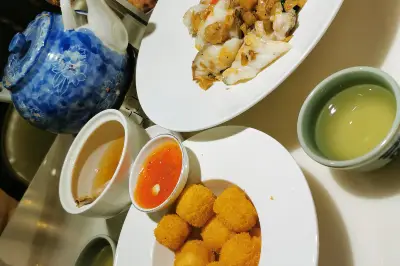
Golden Trio Platter: Shrimp cakes, cuttlefish cakes, and fried milk. The first two are common in many places, but fried milk I first tasted in Guangdong; I love it (not sure if it's served as a main dish elsewhere, maybe found in snack streets).
Yikou Ganxiang Huazhou Chicken: All bones removed, a dish that offers two tastes in one—deep-fried chicken patties and chewy tendon chicken. I thought my dental braces would prevent me from eating it, but surprisingly I could, and it had a pleasant chew.
Secret Highland Rabbit: I don't eat rabbit, so I can't comment on taste, but the color looked enticing.
Braised Platter: Although I couldn't gnaw the duck wings, I finished all the gizzards and meat—lightly salted and perfectly seasoned.
Pan-fried Fish: Crispy outside, tender inside, very fragrant.
Special Stir-fried Gai Lan: "Special" because of the whitebait and purple perilla leaves—my first time having them fried. The gai lan was simply stir-fried but not too hard.
Crunchy Yam with Fresh Scallops: A refreshing combination; I loved the scallops the most, which I normally use in congee.
Yipin Nourishing Pot: I must say, Cantonese love their pots—almost every meal features one, and that truly highlights the region's character.
This restaurant embodies the flavors that Chen Xiaoqing, chief director of "A Bite of China," can't forget: Danjia cuisine. Danjia people in Nansha live by the sea, fishing year-round, and they harvest uniquely flavored ingredients from the brackish waters, cooking them with time-honored family techniques to create authentic Danjia dishes.
Moreover, Danjiamei excels at using seasonal ingredients to craft the most delicious dishes of the moment.
Banana Blossom Congee: Banana blossoms are the flowers of the banana plant (many banana varieties grow in Nansha, a local specialty fruit), an edible medicinal ingredient. The congee, made with blossoms, is fragrant, sweet, rich in protein, and soothes the stomach. This bowl also contains pork bones, taro, and water chestnuts—absolutely superb. I love this kind of congee so much that even on a diet, I forgot myself.
Steamed Young Crab and Boiled Large Tiger Prawns: Both prepared in the simplest way—blanching—to preserve their original flavors.
Mackerel Roe and Eel Claypot Rice: The restaurant's signature staple. I've had many claypot rice dishes, but this was the first with eel and roe steamed together. Once mixed at the table, the aroma bursts forth, the rice infused with the scent of seafood. Be sure to order it.
Steamed Dragon Eel with Black Bean Sauce: The thick eel coils, laid on a lotus leaf, steamed with black bean sauce. When served, ask the staff to snip the backbone with scissors—the meat is springy and the sauce deeply flavorful!
Pan-fried Worm Dish: By the time it's served, you can't tell it's worms; they're coated in egg and fried, shaped into triangles, tender and aromatic—completely unlike their original form!
Danjiamei also offers many other incredible delicacies—like shrimps with shrimp paste and steamed wetland chicken with ginseng.
This is Million Sunflower Garden's own restaurant, with private dining rooms and a buffet. My last visit was 4 or 5 years ago, and I clearly remember the Sunflower Chicken at the buffet—so delicious.
This time, we chose a private room on the second floor, with a princess-like setting, especially visible in the chairs. Again, we ordered the famous Sunflower Chicken; most dishes revolved around chicken.
Sunflower Chicken is the star here and a Nansha specialty. The name comes not from a new breed of chicken, but from its unique diet. It's raised on fresh sunflower heads, leaves, and stalks, and even drinks sunflower stalk juice. Hence, the chicken has golden skin, brittle bones, and sweet, tender meat, with a rich sunflower seed aroma in the marrow. Its nutritional value is high, with vitamin E content 8 to 10 times that of ordinary chicken.
Sunflower Chicken can be prepared three ways: stewed, in snowflake style, or plain poached. The plain poached (baqie) is the ultimate—no coloring or sauces, preserving the chicken's fragrance. The skin turns a translucent gold, like a sunflower's hue, and it's the most popular.
We also ordered plenty of other dishes: braised pork with pointed peppers (I adore these peppers), salt-and-pepper chicken cartilage (if my teeth were better, I'd polish off the whole plate!), stir-fried chicken kidneys with broccoli (true to Sunflower Chicken's spirit, every part is used to create a delicacy), and kelp in rich broth (so compatible with the refreshing soup).
Nansha lies at the southernmost tip of Guangzhou, and transportation is fairly convenient. If you're from outside Guangdong, you can fly into Shenzhen or Guangzhou—both airports have good connectivity. This trip proved that Shenzhen might be more convenient. From either airport, you can take a taxi or high-speed train to Guangzhou South Station, then head onward. From Guangzhou Airport, it's about a 2-hour drive via expressway.
In every city, accommodation options abound—apartments, hotels, B&Bs. This time in Nansha, I checked out two: the trendy Nansha Garden Hotel and the classic Nansha Grand Hotel.
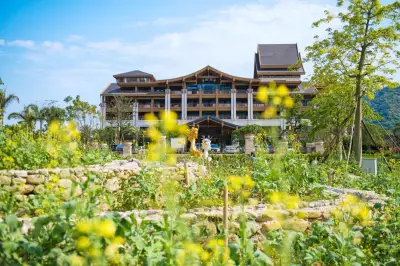
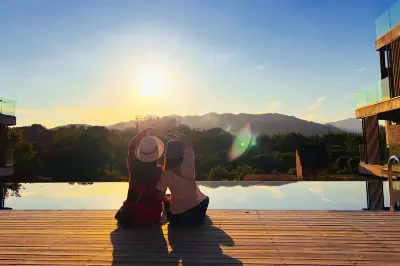
Nansha Garden Hotel is a relatively new resort hotel, reminiscent of Sanya: beachfront, with its own pool and lounges, plus some Instagram-worthy spots not found in Sanya—and at much lower prices.
There are 12 designated photo spots marked around the hotel. If you can't find one, ask staff. And if your photography skills aren't great, no worries—just copy the compositions, and the shots will still look amazing (especially perfect for portraits).
Here, you can play with sunlight: the lobby ceiling is transparent glass, and through decorative prisms, it scatters rainbows. When rainbows fall across the floor, it lifts your mood.
At sunset, take a leisurely stroll in the hotel's back garden, soaking up the warm glow of the setting sun.
Feel free to wander—everywhere from the lobby, to the spiral staircase leading to the ground floor, to the guest rooms, makes for great photos.
If you can (with a drone), shoot the hotel from above—its butterfly shape (a bit like a bone-shaped biscuit) is quite beautiful in my opinion.
The rooms are spacious, with balconies facing the sea, and standard five-star amenities: a standalone bathtub and dressing room.
If you rise early, you can watch the sunrise from the hotel. On a clear day, enjoy the stunning sunset right from your sea-view room. My favorite scene, captured from a drone, is the sunset spilling over the rooftops.
Nansha Grand Hotel is a time-honored establishment in the scenic Guangzhou Nansha Binhai Garden New Town. It's well-known not only as a five-star hotel but also because it belongs to tycoon Henry Fok's family and hosted the wedding of Kenneth Fok and Guo Jingjing.
You can choose rooms with mountain or sea views. Facilities are complete: indoor and outdoor pools, gym, chess room, table tennis—everything except the spa is free.
Transport: Nearby is Nansha Passenger Station, served by Metro Line 4. It's about an hour's drive from Hong Kong, Macao, Guangzhou, and other places. Overall, transportation is very convenient. We stayed here because the cruise music festival ended late, and it was within walking distance.
Travel Tips:
1. If you visit in July, sun protection is a must—it's extremely hot.
2. Due to the pandemic, confirm in advance which attractions are open and which aren't, to avoid wasted trips.
3. At Waterbird World Eco Park, Million Sunflower Garden, Tianhou Palace, and Nansha Garden Hotel, you can capture stunning portrait photos.
4. Transport: Self-driving is most convenient. Try to avoid weekends, or you'll hit heavy traffic on the way back.
5. Food: In my opinion, portions here are generous. Order accordingly—start with less and add more if needed, to avoid waste.
Travelogue Contents:
1. First Impressions of Nansha: The Encounter
2. 4-Day, 3-Night Itinerary
3. In Nansha, Be a Carefree, Joyful Child
4. Nansha Tianhou Palace: Southeast Asia's Largest Mazu Temple
5. Huangshanlu Forest Park: Nature's Splendor
6. Activity 1: Photography
7. Activity 2: Exploring Nature
8. Activity 3: Hiking or Lakeside Strolls
9. Nansha Wetland Park: A Green Wonderland by the Sea Breeze
10. Nansha Waterbird World Eco Park: Pretending to Be in Bali
11. Nansha Bay Cruise Music Festival: Igniting the Summer
12. Million Sunflower Garden: A Fairytale Flower Sea
13. Nineteen Creeks Fisherman's Wharf: A Foodie's Must-Visit
14. In Nansha, Be a Happy Foodie
15. Ming Liyuan Farm: A Must-Visit Institution
16. Liuge Bao Farmhouse: Authentic Local Country Cuisine
17. Danjiamei: Seasonal, Fresh, and Nothing Less
18. Flower Love Restaurant: Where Floral Beauty Meets Culinary Delight
19. How to Get to Nansha
20. In Nansha, Staying at a Hotel Is Also a Joy
21. Instagram-Worthy Hotel – Nansha Garden Hotel
22. Classic Hotel – Nansha Grand Hotel
23. Nansha Travel Tips
Travel Information
Hotel Index
Guide Index
Flight Ticket Index
Website Navigation
Travel Index
Cruise Index
Corporate Travel Index
Partnership & Distribution
Affiliate Program
Corporate Gift Card Procurement
Insurance Agency
Agent Cooperation
Hotel Partnership
Destination & Scenic Spot Cooperation
More Partnership Opportunities
About Ctrip
About Ctrip
Ctrip Hot Topics
Contact Us
Careers
User Agreement
Privacy Policy
Business License
Safety Center
Ctrip Content Center
Intellectual Property
Trip.com Group Algorithm Disclosure