【Self-Drive】When the Corner King Meets Zengcheng: Green Mountains, Clear Waters, and Ancient Towns
Green mountains and clear waters are always a longed-for place. The city is bustling and noisy; leaving it, even for just a day, is a joyful thing. Actually, in Guangzhou, you don’t need to go far to find green mountains and clear waters, to find beautiful scenery. Starting from Guangzhou, it takes just over an hour to reach Zengcheng, a place worth visiting on a little weekend to stroll, see, and relax your mind.
Zengcheng Baishui Zhai is located in Paitan Town, Zengcheng. Starting from Guangzhou, take the Ring Expressway and then the Guanghe Expressway, and it takes just over an hour to arrive.
Choosing self-driving was mainly because Baishui Zhai has many mountain roads, and the scenery along the mountain roads is beautiful. Driving yourself allows you to better appreciate the natural beauty.
Mazda Atenza
Therefore, when selecting a vehicle for this self-drive trip, sporty handling was the top consideration. After all, on mountain roads, both climbing and cornering test a car’s performance. After comprehensive consideration, I chose the Mazda Atenza, known as the 'King of Corner Handling'.
The new Mazda Atenza, with its streamlined lines full of power, looks very sporty. But once you get behind the wheel, you’ll find it’s not just sporty in appearance, but even more so to drive. The Atenza is equipped with a 2.5L naturally aspirated engine; its strong heart delivers smooth power without delay, whether facing climbs or mountain curves, it performs excellently. What satisfied me most was the Atenza’s delicate and smooth steering feel on mountain curves and its ultra-stable chassis—I felt no hesitation on any curve. Additionally, the new Atenza’s safety features are outstanding; if the vehicle gets too close to the roadside or obstacles, a safety warning will appear, ensuring safety even on narrow mountain roads and curves.
Vehicle too close to roadside or obstacles, a safety prompt will appear, guaranteeing 100% safety. If you plan to self-drive to Baishui Zhai, it’s recommended to choose a vehicle with stronger power to ensure a safe journey.
1. Bring along all documents like driving license and ID card.
2. The journey is long with many mountain roads, so check your vehicle condition and fuel level.
3. There are many insects in the mountains, so bringing insect repellent is a good choice.
4. Baishui Zhai allows water play and wading, so bringing slippers or water shoes will give you a better experience.
D1: Guangzhou — Baishui Zhai — Jinyezi Hot Spring
D2: Nankun Mountain Range — Taohuayuan B&B
D3: Fengjian Water Town — Guangzhou
From Guangzhou city center to Zengcheng, it’s mostly highways. On a small weekend, just hop in your beloved car and go—it’s quite convenient. The Atenza’s acceleration and overtaking ability on the highway also made the not-too-long journey more fun, and the in-car entertainment system plus good sound quality made the trip even more enjoyable.
From the city to Baishui Zhai, it’s mainly the Ring Expressway transferring to the Guanghe Expressway, plus a short stretch from the Guangshen Expressway.
According to legend, Baishui Zhai is the incarnation of the mythological figure He Xiangu. Although the elusive myth cannot be verified, the waterfall with a drop of over 400 meters is the highest waterfall in the country. Baishui Zhai in Paitan Town had its landscape restored in the 1990s and has since become a countryside spot that countless Guangzhou residents visit on weekends.
Covering approximately 170 square kilometers, Baishui Zhai has a white waterfall cascading from the mountain top, a wondrous sight visible from quite a distance, which gives Baishui Zhai its name (White Water Village).
The entrance of Baishui Zhai is at the foot of the mountain. Entering the scenic area, there are different zones to explore. The Waterside Plank Trail: water flowing down from the mountain converges here, forming small streams.
Walking along the stream, looking at the waterfall rushing down the mountain, surrounded by green mountains and clear waters, the trees seem to block the scorching sun, and the stream water seems to wash away the summer heat, making it very cool.
The plank trail is made of wooden boards; walking on it gives an ancient feeling. Or, instead of the plank trail, the exposed stones in the water also allow walking. Walking on stones feels like an adventure into secluded places, even more interesting. Quirky Water Valley: in Baishui Zhai, various streams converge in the valley to form this fun water valley. The valley is crisscrossed with streams, and even the deepest parts barely reach the knees; playing in the cool stream water is very safe.
The First Stairway under the Southern Sky: Baishui Zhai has a high elevation, and there are a total of 9,999 steps from the foot to the top of the mountain. Along the mountain path, climbing the 9,999 steps, you can see the Baishui Zhai waterfall from different angles and heights.
Climbing the steps gives you the feeling of being able to touch the waterfall directly. This long stairway is also known as the 'First Stairway under the Southern Sky.' Both sides of the steps are lush with green trees, shading you from the sun, so there’s no summer scorching; walking here becomes a very enjoyable experience.
1. The First Stairway under the Southern Sky at Baishui Zhai takes quite some time to complete; if you plan to climb to the top, make sure to allow enough time.
2. Since Baishui Zhai has natural streams, if you want to fully enjoy water play, it’s best to bring water shoes to protect your feet.
3. Booking tickets at least one day in advance offers a discount.
In Zengcheng, because it lies in the Nankun Mountain range, there are countless natural hot springs. The most famous one here is perhaps Jinyezi Hot Spring.
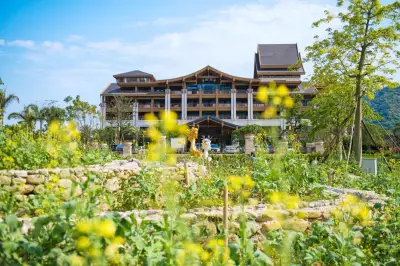
Besides the high-quality spring water, Jinyezi Hot Spring is also extremely popular for its unique architectural design. Built along the mountain, Jinyezi Hot Spring is tiered and imposing, earning it the nickname 'The Potala Palace of Guangdong.' From Baishui Zhai to Jinyezi Hot Spring, it’s only about a 10-minute drive, very convenient.
Arriving at Jinyezi Hot Spring, the process walking from the lobby to your room is fascinating. The buildings rise tier by tier up the mountain slope, with little paths interwoven, and electric carts can pass through, making it very convenient.
The rooms at Jinyezi Hot Spring are very comfortable; from the room, you can directly see the layered mountain scenery and the green hills of Baishui Zhai, truly beautiful. The room’s amenities do not disappoint either: a large balcony plus a private hot spring pool means you can enjoy the natural hot spring right in your room and feel the comfort. Moreover, staying in the mountains where the air is full of negative oxygen ions makes for an especially sweet sleep.
The hot spring area is quite large with many different zones. There’s a children’s water play area suitable for kids, and hot spring pools of various temperatures, meeting different needs.
Of course, my favorite is the herbal bath area. Soaking in hot springs has been a custom in China since ancient times. Ancient records mention hot spring bathing for health preservation. Bai Juyi’s 'Song of Everlasting Regret' describes Yang Guifei bathing in Huaqing Pool, a line that has become an eternal classic. In fact, hot springs are rich in minerals like sulfur, which can treat skin conditions, rheumatism, and other ailments. The warm water also promotes blood circulation and relieves fatigue.
Adding different materials and herbs to the hot spring gives it more varied benefits. Soaking in them, besides comfort, brings various health benefits. Breathing fresh air amid these green mountains, gazing at the starry sky—such a night is always especially blissful.
Actually, both Baishui Zhai and Jinyezi Hot Spring are located in the Nankun Mountain range. On the second morning, of course, you’d want to experience the beauty of Nankun Mountain. Nankun Mountain lies at the intersection of Longmen Town in Huizhou, Zengcheng in Guangzhou, and Conghua. The rolling mountain range has long been known as the backyard garden of the Pearl River Delta. As a national 4A-level tourist attraction, it boasts countless beautiful scenes. Along the winding mountain roads, you’ll always see various breathtaking views.
Dafengmen is a forest park within the Nankun Mountain range.
Dafengmen is not widely known, somewhat like a beauty kept in a boudoir unknown to others. But legends about Dafengmen date back to the Tang Dynasty. It is said that He Xiangu was born in Xiaolou, Zengcheng, and was enlightened by Lü Dongbin to become an immortal. After joining the ranks of immortals, she descended with celestial friends and traveled through Dafengmen. The celestial friends, seeing the picturesque scenery, sealed off the area as He Xiangu’s bathing spot, hence the name Dafengmen (Great Sealed Gate).
After bathing, He Xiangu wrote a poem titled 'Leaving Home': 'Magu blames me for lingering in worldly clamor, / One separated from immortals, the road is far. / Go, go to Cangzhou to play with the bright moon, / Ride a yellow crane backward, listening to phoenix flute.'
A place praised by immortals naturally has extraordinary scenery. In Dafengmen, there is an immense variety of vegetation, from pine to camphor trees; the lush greenery fills the area with vibrant life. The rivers and streams from Nankun Mountain converge here, forming a jade-like beautiful landscape.
At the very center of Dafengmen is its reservoir. The water in Dafengmen Reservoir is crystal clear; sourced from the Nankun Mountain range, the water seems to carry a greenish, limpid quality. The dam allows vehicles and pedestrians to pass. Standing on the dam, looking at the beauty of Nankun Mountain, beside the emerald lake, feeling the coolness and comfort—this journey is equally wonderful and moving.
1. Nankun Mountain is vast, and viewpoints are relatively scattered. Wandering around the mountain can lead to little surprises.
2. The best way to explore Nankun Mountain is by self-driving.
3. The mountain roads are two-way; if you want to stop for scenery, be sure to mind safety and avoid parking after a curve.
4. Nearby restaurants are mostly farmhouse-style, with free-range chicken, mountain pit snails, mountain pit fish, reservoir fish, and other local delicacies to enjoy.
For the evening accommodation, I booked the Taohuayuan Hotel in Foshan. Taohuayuan Hotel is located next to Nanfeng Guzao (Ancient Nanfeng Kiln) in Foshan. Nanfeng Guzao was once where Foshan, the porcelain capital, fired exquisite ceramics. Today, Nanfeng Guzao still burns and has become a place showcasing ceramic art and offering pottery experiences.
The hotel here also adopted the beautiful name 'Taohuayuan' (Pottery Garden)—a homophone for 'Peach Blossom Spring,' adding even more anticipation for everything here.
Entering Taohuayuan Hotel, the first thing you see is the scenery of Nanfeng Guzao. Red-brick walls and a giant chimney still exude an antique charm; the red bricks seem etched with the traces of history.
Even more convenient, each room at Taohuayuan Hotel has its own private parking space. After getting your room card at the entrance, you can drive right to your room’s garage. Super convenient and also very private. Taohuayuan has rooms with various themes. This time I chose an ocean-themed room to savor the flavor of the sea.
Entering the room, there is first a small foyer where you can place luggage, change shoes, etc.
Stepping into the room proper, I was genuinely impressed by the size. The room is over 60 square meters, which is breathtaking. The decoration mainly uses blue tones, fitting the ocean theme, giving a sense of the sea’s mystery and tranquility.
The room is lavishly decorated, with crystal chandeliers and various sparkling tiles, giving a luxurious feel without being tacky. The room also includes a sofa, a desk, and other furniture, making it convenient whether you want to lie quietly on the sofa, brew a cup of tea to relax, or simply handle some work.
Of course, the most surprising part of Taohuayuan Hotel is the bathroom. The bathroom features a wet-dry separation design, and the toilet is equipped with a smart toilet seat, very considerate. But what’s even more surprising is the huge bathtub—it’s more like a small jacuzzi swimming pool.
Fill the giant tub with warm water, turn on the massage function, and enjoy the sensation of a jacuzzi in your room—it’s a great way to wash away the fatigue of the journey. Watching the swirling water is also a very blissful thing.
The room’s details are also delightful. There’s a small teapot for making tea, as well as various drinks and small snacks, all provided for free. Even if you just stay in the room, you won’t have to worry about not having snacks.
Lingnan has always been a land of fish and rice, and water towns are not uncommon in the Pearl River Delta.
Crisscrossed with rivers, the water towns nurture the unique gentle charm of the Pearl River Delta, and Fengjian Water Town is a rather famous one among them. Located on the banks of the Jinli River in Xingtan Town, Shunde, Fengjian Water Town is one of the earliest settlements in Shunde, with history tracing back to the Western Han Dynasty. Through the Tang, Song, and Yuan dynasties, some buildings here still survive today, having withstood the passage of time.
As its name implies, Fengjian Water Town is indeed dense with waterways. Among the buildings of Fengjian Water Town, countless channels flow densely. The river water might not be crystal clear, but local boats gliding on the green water, passing under stone arch bridges, moving slowly in the shade of trees—this is the tranquil scene of a water town.
Of course, besides taking a boat, you can also explore the beauty of Fengjian Water Town on foot, to feel its charm. The paths in Fengjian are paved with blue stone slabs. Walking on the stone-paved roads, with a thousand-year-old river flowing beside you and lush green trees—it’s a place where you can sense the water town’s serenity.
In water towns, there are always countless stone arch bridges linking the two banks of narrow canals. These small stone bridges are elegantly shaped, with semi-circular arches and small sculptures on the bridges, all exuding the unique elegance and refinement of Lingnan.
The ancestral halls of Fengjian Water Town are also worth a visit. In traditional Chinese culture, the ancestral hall is always the most important building in a village. For a village, the ancestral hall records the rise and fall of the settlement and its clans, as well as its culture and prosperity.
The same is true for the ancestral halls in Fengjian Water Town. The architecture is quite exquisite, with wall sculptures and window carvings that display the delicacy distinctive to Lingnan. Moreover, the halls contain many historical records about the village. The dragon boats and drums used every year, and the ritual objects once used in village ceremonies, are displayed here. Walking through the halls and reading the stories of the village, you can feel the authentic flavor of the community.
In the village, there are also many small stalls selling local specialty snacks. These snacks may not be sophisticated or expensive, but those simple, tasty foods carry a rustic flavor and a special warmth that touches the heart.
1. There are several parking lots near Fengjian Water Town, but it’s best to go in the morning; parking spaces become scarce in the afternoon.
2. Outside vehicles are not allowed into the village, so there are few cars inside, making it ideal for strolling.
3. Exploring Fengjian Water Town can be done by small boat or on foot. There’s no admission fee, but boat rides cost extra.
4. The village is not very large; walking through it slowly takes only about 2–3 hours.
Three days, with green mountains and clear waters, and ancient towns and water towns. Leaving the hustle and bustle of Guangzhou for a few days to recharge—it’s always a blissful thing.