Huangpu Ancient Port and Ancient Village – The Starting Point of the Maritime Silk Road
Location: Huangpu Ancient Port and Ancient Village, Guangzhou
Date: September 6, 2020
Getting there: Metro Line 4 to Wanshengwei Station, then transfer to Bus Tourist Line 3 or Bus 229 to the terminus, Huangpu Ancient Port
Route: Ancient Village → Ancient Port
Highlights: This was the only customs house and wharf in modern China open to foreign trade, yet it boasts a history of international exchange and human culture spanning over a thousand years. It consists of ancient wharf relics, an old village, and a commercial street. The relevant sites, museums, and real-life settings can transport us back in time, where trade—an indispensable human activity—unfolds the past and present of the ancient village and port.
1. Ancient Village Cultural Area (Huangpu Village Archway, Beidi Temple, Gupo House, Japanese Building)
2. Ancient Commercial and Ancestral Hall Street (Hanyan Paper-cutting, Yinqintang, Guqiu Ju, Yidetang)
3. Huangpu Park Area (Huangpu Village Human History Museum, Three-Eyed Well, Qingyuan Yaxuan, Shangshan Muyun, Roadside Shiduo Shop, Guqinghuai Xiaowu Postcard Shop)
4. Ancient Port Food Zone (Nai Po Jiang Zhuang Nai, Mao Ji Ting Zai Zhou, Shiji Guye, Gubao Renjia)
5. Memorial Exhibition Area (Gubao Legacy, Yuehai First Pass, Gubao Pier)
6. The blend of the ancient wharf and surrounding modern skyscrapers
In 1757, the Qing government announced the closure of all foreign trade windows and implemented a "single-port trade" policy, meaning all foreign trade with China had to pass through the Guangzhou Customs House. In 1757, only 9 foreign ships came to Guangzhou, but by 1836 the number had soared to 199, marking the heyday of Guangzhou's overseas trade from the 17th to the 19th century, the "golden age of China trade" that modern Western merchants loved to talk about. Besides Sweden's "Gothenburg," Huangpu Ancient Port also welcomed the American "Empress of China," Russia's "Nadezhda" and "Neva," Australia's "Hastings," and many other foreign merchant vessels.
Guangzhou's foreign trade can be traced back to the Warring States period in historical records. From the 230s onward, it became the main port of the Maritime Silk Road, the largest port in China during the Tang and Song dynasties, and during the Ming and Qing dynasties, it was China's sole major foreign trade port. It is the only port in the world's maritime history that has flourished for over 2,000 years without decline, earning it the title "the enduring Eastern birthplace of the Maritime Silk Road." Around 770 AD, more than 4,000 foreign ships visited Guangzhou each year. According to the "Haiguo Tuzhi" (Illustrated Gazetteer of the Maritime Countries), statistics from 1837 show that the value of exported goods was 35.095 million yuan, imported goods 20.149 million yuan, resulting in a trade surplus of 14.945 million yuan.
If you want to understand Guangzhou, its development and prosperity—whether ancient or modern—the location of Huangpu Ancient Village and Ancient Port is a place you must visit. Situated east of Guangzhou, it lies at the confluence of the Pearl River's estuary and the land. After Guangzhou's eastward expansion following reform and opening up, its northwest side is now the city's CBD, Zhujiang New Town. Standing at the ancient port, you can gaze into the distance and see Guangzhou's tallest buildings clustered together, with the Pazhou Exhibition Center right next door. Perhaps this is a prime feng shui spot. For over a thousand years, Guangzhou has used this place as a starting point, extending the Maritime Silk Road outward for tens of thousands of miles. Back then, when ships arrived at the dock, people were housed in designated areas. Near what is now Guangta Road, there was a "Fanfang" (foreign quarter); "Huaiyuan Post" was located on present-day Xiguan Shibafu Road, with 120 houses built for foreign residents. Near today's Beijing South Road and Gaodi Street, there were the Shibo Pavilion and Haishan Tower for managing sea vessels and hosting foreign merchants. Crew members would head to Changzhou and Shenjing islands on the opposite bank south of the ancient port; Shenjing Village still has a place called Fangui Gang, the burial ground for foreigners who came to Guangzhou over the centuries. Goods continued westward along the Pearl River and were traded at the "Thirteen Hongs"—the trade houses in Liwan District in the city center. Today's Canton Fair is held at the Pazhou Exhibition Center near Huangpu Ancient Port, twice a year, uninterrupted since 1957.
This uninterrupted history and the "single-port trade" share a curious coincidence. Through the ages, Guangzhou's doors have always been open to the world. Is it a testament to Guangzhou's geographical advantage? Or proof of the importance of trade to the nation? As time passes, Guangzhou people have left the world with this impression: flip-flops and shorts, making it hard to tell rich from poor. Perhaps it's a casualness born from being unfazed by much, a broad-mindedness toward the vicissitudes of life, and an inclusiveness in dealing with others? Even the most elderly grannies and grandpas in the ancient port and village can speak a few words of foreign languages and Mandarin. Everyone, including visitors, feels as if they've come back to their own hometown, free to eat, drink, and have fun as they please.
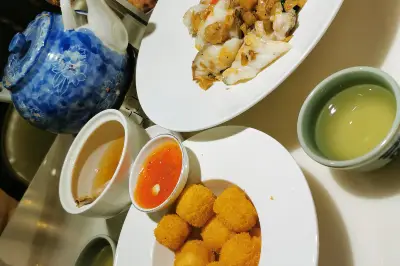
In the afternoon, stepping out of the ancient port, we found a long food street—perfect for a rest. I recalled someone recommending the boat congee in a travel guide, but it wasn't quite mealtime yet, so an afternoon snack seemed a better choice. Right next door was a shop called Nai Po Jiang Zhuang Nai, and we went in. We found a round table and sat down, but no one came to take our order, so we had to go to the counter ourselves, place the order, then wait for our number to be called and pick up the food—a real self-service place. Soon our number was called. First came the red bean double-skin milk. A layer of red beans sat atop the double-skin custard. I scooped a spoonful; the soft, tender red beans melted in the mouth, perfectly sweet. The base of the double-skin milk was white, made from milk and egg white, with a hint of yellow peeking through, resembling fresh milk. The consistency was just right, matching the red beans seamlessly—no sense of discord at all—and we finished it in just a few bites. Just then, the milk maker brought over a cup of steaming hot milk and poured it into a small bowl filled with ginger juice. After a few minutes, the liquid ginger-milk mixture solidified into a paste-like texture. This was ginger milk curd. The pungent, spicy aroma of ginger assailed the nose and awakened the mind, while the fresh, creamy flavor of milk danced on the taste buds. Instantly, sight, smell, taste, and all senses were stirred; it was a bit exciting and the flavor was spot on. No wonder so many people recommend it. All kinds of Cantonese snacks were available here. We also ordered a mugwort zongzi, made of glutinous rice flour stuffed with a mix of ingredients, wrapped in mugwort leaves. To my surprise, this snack was made with the same care and ingredients as any full dish. The filling had a slight saltiness, the characteristic taste of Cantonese dim sum—subtle and lingering, tantalizing the diner's palate so you can't forget it.
Total: 29 yuan
Rating: 5 stars
Well-fed and satisfied, we then strolled to Huangpu Ancient Village, only to find that the sun was setting and the museum built in the Liang Family Ancestral Hall had already closed. We should have visited the village first and then seen the ancient port at sunset. We hurriedly circled the village: ancient streets, ancestral halls, temples, clusters of wok-ear rooftops, broad banana plants in the courtyards, fiery blossoms, and crowds of kids making a racket on the stage. It felt as if we had traveled back to the only foreign trade customs house of modern China—Guangzhou Customs—its hustle and bustle etched into every brick, tile, flower, and blade of grass. The area is well managed, blending modernity and antiquity into an integrated whole. It still looks like an ancient village: tall, spacious courtyards; two- or three-story houses with small yards; and rows of attached dwellings; you rarely see the crude, poor single-room low houses. As a foreign trade port with a two-thousand-year heritage, I believe the villagers here would never let go of such a unique opportunity. Sure enough, the moment you step through the archway, you enter a several-hundred-meter-long commercial alley. The streets connecting the village and the port are also lined with shops, one after another.
We searched for a long time but couldn't find the legendary roast chicken. Finally, near the archway exit, we spotted a roasted meats stall—an outlet of Pinsheng Hotel, offering goose, duck, and chicken. It wasn't roast chicken but soy sauce chicken. We bought half for 39 yuan. Since it wasn't yet dinner time, we took it home to eat. The first bite didn't taste like much, but as I chewed slowly, the flavor emerged. The fragrance was the original taste of the chicken—I hadn't tasted such authentic chicken in a long time. It must have been a genuine free-range chicken: firm, delicate, and springy. A slight hint of fermented soybean sauce touched the tip of my tongue, coaxing the meat fibers apart. Strand by strand, the meat wrapped the savory aroma in my mouth. It was a bit pricey, but worth it.
Rating: 5 stars