Annual Family Trip Across Zhejiang, Fujian, and Guangdong (Part 2) — Guangdong Edition (Guangzhou, Chaozhou, Foshan)
I've rambled on to the final installment. Finally setting foot in Guangdong Province for the first time, I was full of anticipation and curiosity. Our three days in Guangdong were the most leisurely of the entire journey—idle strolling and food occupied all our time. With my health recovering, this travelogue will see me vengefully sampling the authentic Cantonese cuisine and dim sum I've long coveted, spiced up with healthy exercise, of course. Please read on. (For Part 1, please visit https://you.ctrip.com/travels/yandangshan217/3983295.html, and Part 2 at https://you.ctrip.com/travels/xiamen21/3984409.html)
【Itinerary】
DAY 1: Drive to Chaozhou, Paifang Street, Guangji Bridge; then drive to Guangzhou, Canton Tower.
DAY 2: Downtown Guangzhou, Shunde in Foshan.
DAY 3: Metro to Foshan, return to Beijing.
【Chaozhou, 4 Hours Left Wanting More】
Inspired by President Xi, we made Chaozhou our first stop in Guangdong Province. Although we only spent four hours in the Paifang Street and Guangji Bridge area, it became the city we most regretted not having more time in during the Guangdong leg—and it even sparked the idea of making a dedicated return trip.
Paifang Street, said to date back to the Tang and Song dynasties, was mainly used to commemorate those with outstanding achievements in integrity, merit, and imperial exams in the city and countryside. The 22 restored ancient memorial archways, combined with arcade-style commercial streets featuring Southeast Asian architecture, form a unique historical and cultural district with distinct local characteristics.
Arcade buildings in Southeast Asian style.
At a glance, countless archways stretch into the distance—truly awe-inspiring.
Local residents told us with immense pride that it was at this very spot that the General Secretary had close contact with the people and delivered a speech, and they were witnesses.
Strolling along the clean, quiet streets, we soaked in the daily life of the locals.
Although most shops on Paifang Street open quite late and we couldn't sample many delicacies one by one, we still sought out the specialties in the few little eateries that were open.
I had always thought of chang fen (rice noodle rolls) as thick-skinned, with bland fillings and little flavor. But after tasting Chaozhou's chang fen, it completely opened up a new world for me—I had misunderstood it so badly.
At an inconspicuous little shop, we sat at the small tables and chairs outside and enjoyed an incredibly delicious chang fen.
A perfectly runny egg, abundant fillings paired with a rich sauce... Writing this, I'm already missing it.
Licorice fruit—probably found in both Fujian and Guangdong—was something I tried for the first time on Paifang Street. Various tropical fruits and local pickled preserves are mixed with a thick licorice sauce; I devoured a big portion all by myself.
Xian shui guo, a snack found only in Chaozhou: small bowl-shaped rice cakes topped with oil-fried dried radish, offering a soft, savory-sweet and slightly chewy texture.
At exactly ten o'clock, we entered Guangji Bridge right as it opened. By chance, we caught the most distinctive and unusual moment at the scenic area.
Guangji Bridge, anciently known as Xiangzi Bridge, spans the Han River. Because "the midstream is especially deep and turbulent, making piers impossible," apart from the stone beam bridges at the east and west ends, the middle section had to be formed by 18 shuttle boats lined up side by side and chained together to create a floating bridge. Every morning, the boats are aligned for pedestrians to cross; in the evening, they are towed away to allow large vessels to pass through. This practice continues to this day. Each day, staff demonstrate the entire process of connecting and disconnecting the floating bridge, and this is the essence of a visit to Guangji Bridge.
A tugboat brings three shuttle boats side by side to the connection point.
Once connected, the floating bridge is ready for pedestrians. We really didn't expect a bridge made of boats to be so stable.
When you come to Chaozhou, you must visit Guangji Bridge to experience this ancient mode of passage, watch the flow of people, and feel the glorious history it embodies.
【Guangzhou, I've Finally Arrived】
I can't believe I've lived this long without ever visiting Guangzhou—isn't that a bit shameful?! My constant nagging in my husband's ear finally paid off, and Guangzhou became the last stop of this trip. Come to think of it, Guangzhou didn't really have any particular draws for me—the hustle and bustle of a metropolis or theme parks aren't my thing. I simply wanted to experience the vibe of a major southern city. So our Guangzhou itinerary was fairly simple: ascend Canton Tower, go for a morning run along the Pearl River, explore two nearby areas, and most importantly, taste authentic Cantonese cuisine and morning tea!
I have to give major props to my husband for booking a tower-view room at a hotel along the Pearl River. Although the hotel was a bit dated, the tower view truly lived up to its name—the "Little Waist" (Canton Tower) stood right before my eyes, allowing me to admire day views, night views, full panoramas anytime... If we hadn't gone up the tower, we could have simply enjoyed the tower-watching from our room!
Day and night views from our room.
Canton Tower isn't just about climbing high for panoramic city views; on top of the three observation decks at different heights, they've added a Ferris wheel and a freefall ride (though the three heights differ by only a few dozen meters and are barely distinguishable). Being old bones, we sensibly opted for the Ferris wheel package.
The height display inside the elevator.
The tower top is open-air, and it was surprisingly cold at night. Staff were all bundled up in down jackets; even though we wore jackets, we couldn't quite fend off the biting cold wind.
The Ferris wheel set against a backdrop of towering buildings was quite distinctive.
Taking night shots from the cable car felt like looking down from an airplane, with scattered pinpricks of light.
The highest point of Canton Tower houses the freefall ride, but there were no takers.
The morning run along the Pearl River was the longest run of the entire trip. Starting from the hotel, we crossed the Haiyin Bridge to the opposite bank, then returned via Liede Bridge—a total distance of just under 13 kilometers. Despite the gloomy weather, we could still admire the scenery as we ran and soak in the early morning atmosphere of Guangzhou.
We said "two nearby areas," but it was actually just one—Foshan. Shunde is a district of Foshan, but since its reputation is so great, I count it as two separate excursions.
Renowned for its cuisine, that's the main reason we chose Shunde. Of course, in between strolling and eating, we also visited some of the local representative sights.
One was Fengjian Water Town, a small village similar to the water towns of Jiangnan.
Jun'an steamed pork seemed to be a local specialty; the fragrance of pork drifted through the alleys.
The second was Qinghui Garden, a representative of ancient southern gardens.
The pavilions, terraces, rockeries, and stone grottoes were artfully arranged, with scenes shifting at every step, revealing hidden wonders. Adorned with distinctive decorations, such an exquisite garden is, in my heart, in no way inferior to the famous gardens of Jiangnan.
The third was Huagai Road, a pedestrian street combining Southeast Asian architecture and cuisine.
To form the "Guangzhou-Foshan Metropolitan Area" together with Guangzhou and promote urban integration, we had already purchased high-speed train tickets to Foshan, but then we discovered there was actually a metro line connecting the two cities! Although it took a bit longer, the Foshan metro station exit was conveniently located, and the timing was more flexible than the train, so we promptly refunded the train tickets and took the Guangfo Line instead.
Foshan is the main birthplace of southern-style martial arts. Martial arts masters like Wong Fei-hung, Ip Man, and even Bruce Lee have their ancestral roots or learned their skills here. As for famous sites like the Wong Fei-hung Memorial Hall and Ancestral Temple, we... checked in at the gates and took photos.
Wong Fei-hung Memorial Hall.
This is a themed area—Lingnan Tiandi—that blends the ancient and the modern, combining a cluster of old Foshan residential buildings with cuisine and trendy shops. Although most buildings have been later renovated, the style of restoring the old as old still exudes a strong sense of art, culture, and historical vicissitudes.
Even though I'd never been to Guangdong, I'd had my share of morning tea. As well-known brands from Guangzhou have sprung up nationwide and become absolute internet sensations, morning tea has been embraced by many young people as a fashion, a trend. But it was only after actually arriving in Guangdong that I truly understood what the morning tea culture is: it's not about queuing for hours to get that basket of shrimp dumplings; nor is it about the pretty photos you post on social media. It's an ordinary breakfast; it's part of everyday life. All sorts of tea houses are dotted throughout the streets and alleys, and no matter how big or small, they're always full of diners, mostly older folks on weekdays. Some come with a couple of close friends, some for family gatherings, some for business meetings, and some even enjoy it alone. Brewing a pot of tea and ordering three or four dim sum dishes—a beautiful day begins with this sense of ritual. It's not just about the taste or texture of the food, because every tea house serves pretty good fare; it's about nurturing friendship, strengthening family ties, facilitating business, and most importantly, keeping up a habit that's been preserved for years...
We deliberately avoided the nationwide chains to better experience the atmosphere of how old Cantonese start their day with morning tea.
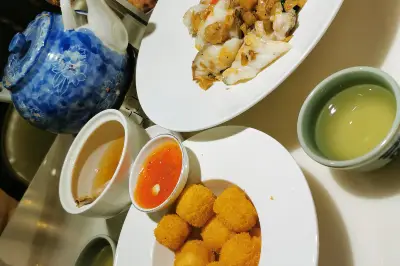
Morning tea of every level starts with a pot of Gongfu tea...
Here's a group photo. The specific dim sum isn't the point—they all tasted great.
Foshan's Wong Fei-hung Tea House was a random find on Dianping. It had the grandeur of a wedding banquet hall, similarly bustling with people, and equally meticulous cuisine.
Giant youtiao (dough sticks) as thick as a man's arm!
For the only proper meal in Guangzhou, it had to be Cantonese cuisine! Among China's eight great culinary traditions, Cantonese cuisine is considered quite high-end. From the restaurant's design and décor to the choice of ingredients and the flavors of the cooking, everything reflects refinement and meticulousness. Naturally, the prices are on the higher side, but you'll feel it's worth every penny.
A huge signature pineapple bun: crisp and flaky crust, soft bread, and a pineapple jam filling with just the right sweetness. One bite delivers infinite satisfaction.
【Local Delicacies】
Here, I've mainly listed some of Shunde's specialty snacks. Depending on your taste, you can choose to seek them out.
A time-honored dessert shop—Minxin Laopu, most famous for its double-skin milk pudding.
Yusheng (raw fish): one fish prepared four ways—raw fish slices, cold-dressed fish skin, pan-fried fish bones, and the head and tail simmered into congee. A perfect way to enjoy every part of the fish. This is a unique delicacy of Shunde, and especially at this Fei Guang Yu Sheng, with no signboard, it still draws countless diners.
The raw fish slices are the star: first seasoned with oil and soy sauce, then topped with sliced pickled mustard tuber, sesame seeds, carrots, onions, ginger shreds, and other garnishes. After a quick toss, finish with a few stalks of lemongrass for that extra kick. The tender, savory-sweet fish combined with the sides creates an explosion of texture—absolutely amazing!
Claypot rice originated in Shunde, so you must try it when you're here. Just pick any random spot on the street; the cooking and flavors are all superb.
【Final Thoughts】
~ The happiness index in smaller cities is steadily rising. In recent years, development across the country has advanced in parallel. Big cities like Beijing, Shanghai, Guangzhou, and Shenzhen no longer have a monopoly on growth; second- and third-tier, even fourth- and fifth-tier cities have seen construction and development beyond imagination, and the gaps are continually narrowing. People are settling down happily in their hometowns, and confident smiles are a true reflection of how they enjoy life every day.
~ Interpersonal relations in southern cities can feel a bit cold. There's a higher level of wariness toward strangers. On the metro, we hardly saw anyone giving up seats for the elderly. When my husband asked a young person blocking the door if they were getting off—a perfectly normal question—the young person looked startled and guarded, not even caring about what was asked but simply shocked that a stranger would speak to them.
~ More and more people are embracing a healthy lifestyle. Sports facilities and running routes have become a key point of interest when we plan our trips. To our surprise, no matter the size of the city, finding a scenic running route was generally easy. We were delighted to see that those fitness trails and sports facilities are not just for show or a waste of resources—they genuinely serve as places for local residents to relax and exercise. More and more people are truly realizing the importance of health and making physical fitness an essential part of life.
I want to say that although this year's annual trip has come to an end, the meaning of travel for me goes far beyond simply feasting my eyes on boundless beauty and experiencing local culture. More importantly, throughout the journey, the bond between husband and wife became more harmonious and understanding, relatives grew closer and more empathetic, and life itself was elevated!