Heading All the Way South to Southern Yue — Last Trip of 2020
I originally planned a trip to Henan in November, but work delayed my vacation until late December. Heading north at that time seemed a bit cold, so I looked at southern provinces I hadn't visited yet—only Guangxi and Fujian remained. Plus, I wanted to eat my way through Guangzhou, so I settled on this 9-day trip to Liuzhou, Nanning, and Guangzhou.
I traveled with my parents, a family of three. The trip cost around 5,500 yuan, with transportation being the biggest expense. We mainly used high-speed trains and regular trains, plus city buses and the metro, totaling about 2,800 yuan. Next came hotels—we stayed at the same chain brand, around 1,800 yuan. The rest went to food.
Day 1, December 19: Anshun to Liuzhou
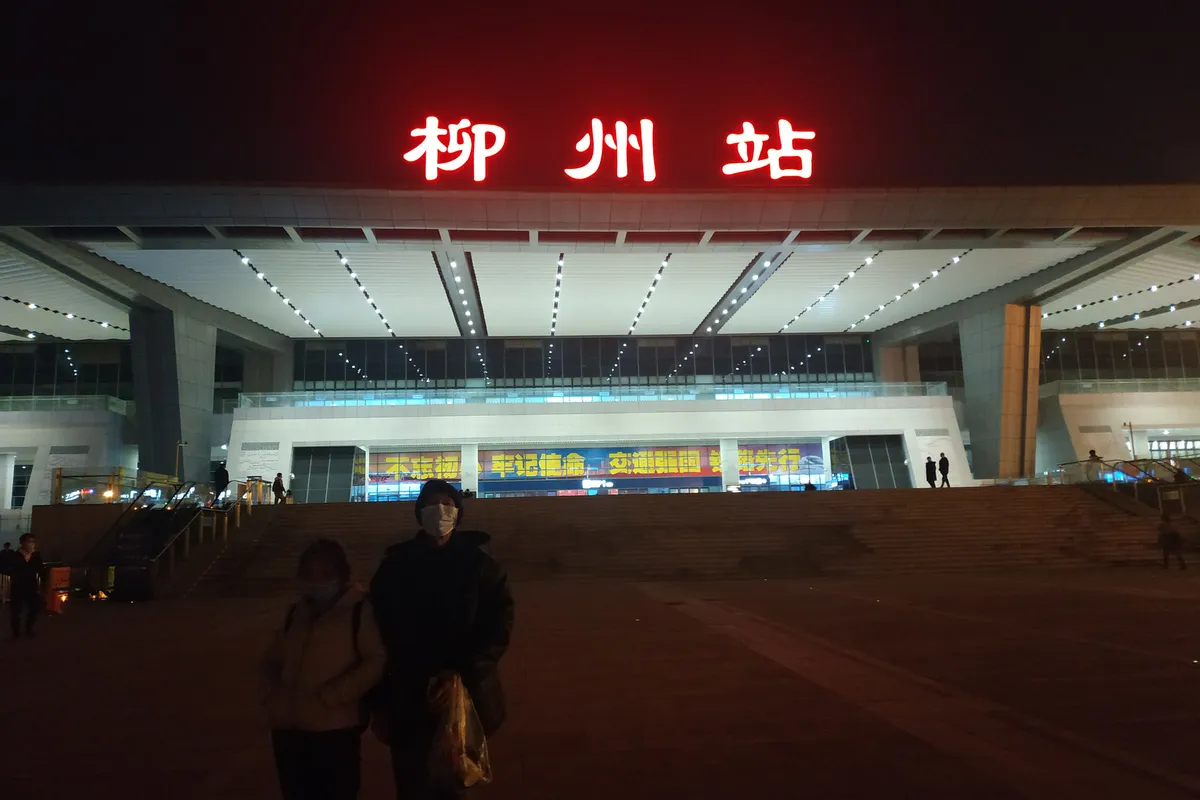
There's no direct train from Anshun to Liuzhou, so we had to transfer at Guiyang North, and there's only one high-speed train a day. We took train G1422 from Anshun West to Guiyang North, then transferred to D3567, departing Guiyang North at 4:03 p.m. and arriving at Liuzhou Station at 8:09 p.m. From there, we walked to the east square of Liuzhou Station and took express bus route 9 to Ma'anshan stop, then checked into the pre-booked Hanting Youjia Hotel Liuzhou Jiangbin Park branch.
Day 2, December 20: Liuzhou Bailian Cave Museum, Liuzhou Industrial Museum, Yaobu Ancient Town
Liuzhou, also known as Pot City or Dragon City, is bisected by the Liu River. It's a national historical and cultural city, the birthplace of the "Liujiang Man"—one of China's earliest prehistoric humans—and has over 2,100 years of recorded history. It's the second-largest city in Guangxi Zhuang Autonomous Region and its largest industrial hub; all five major Chinese auto brands have production here.
We got up early, ordered takeaway breakfast, then took a bus to the Liuzhou Bailian Cave Site Museum. The museum is in the Bailian District, quite far from downtown—about an hour's ride.
The museum is built around the Paleolithic Bailian Cave cultural site and features both outdoor and indoor displays. The indoor exhibition has two parts: "Earth's Past" and "Cave Home." The cave tour route stretches 1,870 meters, but unfortunately, cave visits were closed due to pandemic control measures when we were there.
Leaving the Bailian Cave Museum, we headed to the Liuzhou Industrial Museum next. This museum combines industrial history exhibits, industrial heritage conservation, science education, and leisure tourism. It covers nearly 110,000 square meters in total area, with over 60,000 square meters of floor space. It houses themed galleries like the Industrial History Hall and the Eco-Livable City Hall, showcasing various industrial machinery and the development of industry from the 1950s–60s to the present.
Across from the Industrial Museum is Yaobu Ancient Town. It's billed as an ancient town, but it's actually a replica commercial complex with faux-old architecture—still, it's a nice spot for photos.
Day 3, December 21: Longtan Park, Jiangbin Park
It was Monday, and indoor venues were closed, so we opted for parks.
Longtan Park is a national key park in Liuzhou, one of only two in Guangxi; the other is Liuhou Park, which we visited the next day.
Longtan Park spans about 544 hectares and is a large scenic area blending karst natural landscapes, southern Chinese minority cultural displays, subtropical cave plant landscapes, and inscribed stone art. Due to time, we didn't cover the entire park—we just wandered, snapped photos, sat and rested here and there. It was very pleasant.
After Longtan Park, since it was the winter solstice, we ate Harbin-style dumplings and then strolled nearby Jiangbin Park. Well, wherever there's a river or sea, you'll find a Riverside Park or Seaside Park of some sort.
We followed the riverbank to Wenhui Bridge, crossed it, and took a bus back to the hotel to rest.
Day 4, December 22: Dongmen Gate Tower, Liuhou Park, Liuzhou Museum
On the way to Dongmen Gate Tower, we passed Ho Chi Minh's former residence and the former site of the Republic of Korea's Liuzhou Exhibition Hall.
Dongmen Gate Tower, commonly called "Donglou" or "Dongmen Lou," is located in the middle section of Shuguang East Road in Chengzhong District. It connects to Luochi Road East First Alley to the north and faces the Liu River to the south. Built in the 12th year of the Hongwu reign of the Ming Dynasty (1379 AD), it's over 600 years old. As one of the best-preserved Ming Dynasty gate towers in Guangxi, it has undergone repairs through the ages. Inside, there's an exhibition called "Chronicles of the Old City."
Next to the gate tower is the Liuzhou Post and Telecommunications Museum, but it was closed.
We had planned to visit the former site of the Liuzhou Lianhua Printing Factory and the old site of the Guangxi–Liuzhou District Working Committee of the CPC, but time was short, so we skipped them and headed to Liuhou Park.
Liuhou Park was established in the first year of the Xuantong reign of the Qing Dynasty (1909) to commemorate Liu Zongyuan, a great Tang Dynasty writer and former governor of Liuzhou. The park houses the nationally protected Liuhou Shrine.
After the park, we had rice noodles, then visited the Liuzhou Museum, our last stop in Liuzhou.
Originally founded in 1959, the Liuzhou Museum sits east of Liuzhou People's Square. Its galleries include "Journey of Life" (a paleontology fossil hall), Liuzhou Historical Culture Hall, Liuzhou Ethnic Culture Hall, Ancient Fan and Painting Art Hall, Ancient Bronze Art Hall, Ancient Inscriptions Art Display, and the Longbi Liuyan Hall. As a city-level museum, it's well-organized and worth a visit.
From the museum, we took a bus to Liuzhou Station to head to our second stop: Nanning. We booked train Z285, which departed over an hour late, but in the end, we arrived only half an hour behind schedule. We exited the station, took the metro to our pre-booked Hanting Youjia Hotel Nanning Jiangnan Wanda branch, and went straight to bed.
Day 5, December 23: Guangxi Anthropology Museum, Qingxiu Mountain Scenic Area
Since the Guangxi Zhuang Autonomous Region Museum was under renovation, we chose the Anthropology Museum instead. Located in Qingxiu District, it required one bus transfer. The main building's shape is inspired by the bronze drum, a distinctive Guangxi symbol. Inside, exhibitions cover the scripts, customs, cultures, and arts of Guangxi's 12 indigenous minority groups. The permanent displays include "Rhythms Through Time—Bronze Drum Culture" and "Colorful Bagui—Guangxi Ethnic Cultures," plus other thematic shows.
Outside the museum is the Guangxi Ethnic Village, an open-air display of traditional vernacular architecture.
Our next stop was Qingxiu Mountain Scenic Area, Nanning's only 5A-rated attraction. The normal ticket price is 20 yuan. Unaware that the south gate was closed due to pandemic measures, we got off at the south gate bus stop and had to walk over 2 kilometers to enter through the west gate.
Qingxiu Mountain is huge, with over 90% green coverage. During our visit, there was a chrysanthemum exhibition. We spent most of the day there but only covered the western part of the park. You could easily pack a lunch and spend a full day here.
Afterwards, we went to Zhongshan Road Food Street, but the night market stalls hadn't opened yet. We wandered around the pedestrian street, and when a light rain started, we had dinner and headed back to rest.
Day 6, December 24: Deng Yingchao Memorial Hall, Sanjie Liangxiang (Three Streets and Two Lanes), Nanhu Park, and off to Guangzhou
We got up early, grabbed our luggage, and started the day. Our first stop was the Deng Yingchao Memorial Hall. The hall is located in the Sanjie Liangxiang historical and cultural block in Nanning. It's a courtyard-style building with three entrances and two internal courtyards, covering 1,273 square meters with 1,000 square meters of exhibition space. The galleries are divided into six sections: Yongcheng Memories, Revolutionary Journey, Women's Pioneer, Devoted Couple, Public Servant's Character, and Ties to Guangxi. Through artifacts, photos, reconstructed scenes, and multimedia, it comprehensively presents the extraordinary life of Deng Yingchao, "Daughter of Nanning."
Then we casually strolled around Sanjie Liangxiang, which features arcade-style architecture. Next, we visited the Nanning Administrative History Museum next door to get a glimpse of the city's historical evolution.
Finally, we went to Nanhu Park. Well, it was just a city park to pass the time.
When it was time, we took the metro to Nanning East Station, boarded train D207 to Guangzhou South Station, and checked into our pre-booked Hanting Hotel Tianpingjia Metro Station branch. It was Christmas Eve, and the hotel even gave us three apples.