Revisiting Guangzhou: Atop the Clock Tower, the Guangzhou Lu Xun Memorial Hall
Travel time: July 2020
Travel mode: Flight (Nanjing – Guangzhou) then self-drive
Route: Nanhai God Temple (visit duration: 1.5 hours, entrance fee: 15 yuan), Lingnan Impression (arrived 16:40, closed at 5 pm, couldn't enter), Guangzhou University City Science Museum (exterior view), food hunt on Beijing Road
Accommodation: CityNote Xinuo Hotel (Guangzhou Beijing Road Dafo Temple Park Front Metro Station) 271 yuan per twin room
Travel mode: Walking, taxi
Route: Lu Xun Memorial Hall (1.5 hours, advance online reservation required, free admission), Guangdong Museum (1.5 hours, advance online reservation required, free admission), United Bookstore
Accommodation: Beijing Road Xinuo Hotel
Travel mode: Walking, metro
Route: Museum of the Nanyue King Palace (1.5 hours, free admission), Yuexiu Park (2 hours, advance online reservation required, free admission), Guangzhou Museum, food hunt at Yuehai Lou
Accommodation: Jinzhou International Hotel
Travel mode: Walking, taxi
Route: Sun Yat-sen Memorial Hall (free for medical staff), Beijing Road, food hunt at Taotaoju
Accommodation: Huamao Hotel
Travel mode: Bus, taxi, metro, flight (Guangzhou – Nanjing)
Route: Shangxiajiu Street, Xiguan Dawu, Liwan Lake Park, dining at Xintaile
CityNote Xinuo Hotel is tucked away on Longzang Street. A short stroll brings you to Xihu Road, where this place called Dagefan serves authentic Cantonese cuisine. Over two days staying here, I saw long queues waiting for a table every single day. I was dying to try it, but I ran out of patience. Guess I'm not much of a foodie after all!
A few steps east, I stumbled upon the massive Guangzhou Dafo Temple. From the outside, its halls mimic the style of official temples in the capital, while incorporating Lingnan regional touches. The ancient temple covers 1,200 square meters, still holding the crown in Lingnan for its size. Its gable roof is covered with plain tiles, drip-tiles, and bamboo-dragon and peony ornaments on the grey-plastered ridge.
In front of the temple, an information board explains its etiquette and culture. I only admired its brilliant exterior from a distance and didn’t go inside.
We walked 1.5 kilometres towards today’s destination – the Guangzhou Lu Xun Memorial Hall. We strolled along Xihu Road, Beijing Road, and Wenming Road, a few of the most quintessential streets in old Guangzhou. Wandering through the old town is the perfect way to uncover a historic and cultural city. To truly experience authentic Guangzhou, just stretch your legs and weave through the old neighbourhoods.
All along the way, we were accompanied by qilou buildings. Guangzhou’s qilou are a distinctive type of shophouse found in southern China, introduced from Southeast Asia to South China. With shops on the ground floor and residences above, these arcaded buildings shielded pedestrians from sun and rain without hampering trade. They became all the rage in Guangzhou in the 1920s and gradually became the defining architecture along the city’s commercial streets.
The qilou on Beijing Road and Wenming Road have a century-old history. That was Guangzhou’s economic golden age, when qilou construction boomed. In just 10 years, nearly 40 kilometres of qilou streets were built in the city. These arcades are concentrated in the area we walked today, the so-called "old town," where the total length of qilou streets reaches 25,500 metres – over 60% of the city’s entire qilou network.
Structurally, a qilou roughly divides into three sections: the ground-floor colonnade, the middle-floor living area, and the top-floor cornice or pediment. The street-facing walls below windowsills, or the cornice and window lintels, often feature rich decorative motifs or shallow reliefs.
The hallmark of Guangzhou’s qilou is the expansion of the porch into a continuous arcade along the street. Above the arcade is the residential floor, while below it opens to the street on one side and to shopfronts on the other. Customers can browse freely under the covered passage, while the residents live upstairs.
Shops within the qilou can borrow the colonnade space, making it convenient to open up their storefronts and display goods to attract customers.
On a morning when the streets are still relatively quiet, the dense alleys, friendly neighbourhoods, and everyday eats exude a strong sense of human warmth, letting you feel the most genuine flavour of Guangfu life anytime, anywhere.
Even today, walking under the qilou, you can still sense Guangzhou people’s love for them and the lively, down-to-earth street atmosphere. The crowded roads and distinctive qilou all showcase the unique charm of old Guangzhou.
Guangzhou Lu Xun Memorial Hall
Address: 215 Wenming Road, Guangzhou
Tickets: Free with advance online reservation
Everything in the old town made us curious, and before we knew it, we had arrived at 215 Wenming Road. This place now holds three identities.
Above the central archway reads: "Guangdong Provincial Sun Yat-sen Library." On the left: "Guangzhou Lu Xun Memorial Hall." On the right: "Site of the First National Congress of the Chinese Kuomintang."
The triple identity gives the spot an air of mystery. After showing our reservation code, health code, and getting a temperature check, we entered.
The view opened up before us: a square embraced by tall buildings, a carpet of lush green grass. A dazzlingly green lawn, framed by ancient trees full of history.
This square has real history – it’s the former Revolutionary Square, built in the late Qing Dynasty as the sports field of the Liangguang Higher Normal School. In 1924, National Guangzhou University added running tracks here, creating Guangzhou’s first standard sports ground. Provincial sports meets and large Guangzhou gatherings were held here one after another. In 1924, Sun Yat-sen gave a speech on this square. In 1926, the National Revolutionary Army swore an oath here before the Northern Expedition. Thus, the square was named "Revolutionary Square."
This was once the Guangdong Examination Hall of the Qing Dynasty, built in 1684 as the venue for Guangdong provincial civil service exams and one of China’s four great examination halls in the late Qing. In 1906, when the imperial examination system was abolished, the hall was converted into the Liangguang Higher Normal School. During the Republic of China era, it served as the campus for the National Guangdong Higher Normal School, later National Guangdong University and others. In 1986, the new building of the Guangdong Provincial Sun Yat-sen Library was erected on the old examination hall site.
The three-story milk-yellow building with a green glazed-tile roof is the Guangdong Provincial Sun Yat-sen Library.
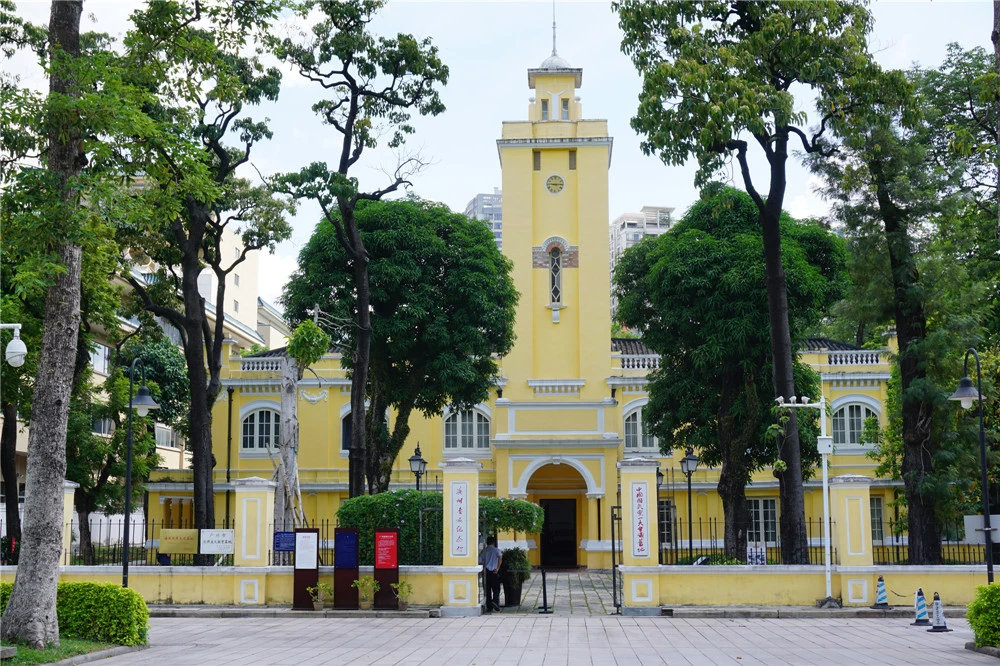
From the entrance, a straight, ten-metre-wide cobblestone road leads directly to a small courtyard enclosed by yellow columns and iron railings. Here, you need to show your reservation code again to enter. The yellow building facing south was originally the clock tower of the Guangdong Higher Normal School. Built in the 31st year of the Guangxu reign (1905), it got its name from the four-faced clock mounted on top. It has a brick-and-wood structure, and its layout resembles the Chinese character for "mountain" (山). In the centre rises the five-storey clock tower, with clocks and elongated oval glass windows on all sides, topped by a flagpole. The main entrance features an arched colonnade.
Looking back from the courtyard gate, the city unfolds behind you: trees under azure sky and white clouds support the variegated silhouettes of high-rises.
Text along the perimeter wall gives an overview of the Guangzhou Lu Xun Memorial Hall.
Inside, ancient trees layer upon layer, full of stories.
Century-old banyan figs, kapok trees, silver oaks, and cedars... this place brims with dripping emerald green.
In January 1927, Lu Xun was invited to Zhongshan University as the head of the Literature Department and dean of academic affairs, and lived on the second floor of the clock tower. Hence, the clock tower was turned into the Lu Xun Memorial Hall. Established in 1957 and housed in the clock tower, it is one of six Lu Xun memorial halls nationwide.
The main entrance of the historic site features an arched colonnade with a platform above and a foyer below.
Entering the porch, you see an identity plaque hanging on each side of the door: on the right, "Lu Xun Memorial Hall"; on the left, "Exhibition Hall of the First KMT-CPC Cooperation." Clearly, this clock tower has witnessed plenty of history.
Stepping inside, a long corridor stretches ahead with a strong sense of depth. Signs on the walls guide us to different exhibition areas.
Immediately on the right after entering is the visitor service area, while the left side holds two exhibition sections that we’ll explore slowly later.
The narrow yet spacious visitor centre is lined with floor-to-ceiling bookshelves arranged in a U-shape.
A long table provides a spot for visitors to rest or read.
By the window, a slender table offers various commemorative stamps for visitors to keep as souvenirs.
Distinctive souvenir stamps.
On a blackboard, a chalk-written excerpt from an essay by Lu Xun.
Back to the corridor, we continue our visit to the left.
This is one of the memorial hall’s exhibitions – "Bell Sound: 1924 – The First National Congress of the Chinese Kuomintang and the First KMT-CPC Cooperation History Exhibition."
Part One: Frustration and Gestation. This section traces Sun Yat-sen’s arduous democratic revolution leading the Kuomintang, the evolution of the KMT organization, and Sun’s historic choice to reorganize the KMT and ally with Russia and the Communists.
A recreation of the meeting between Sun Yat-sen and Li Dazhao.
Part Two: Convention and Cooperation. This section re-enacts the historic scene of the First National Congress of the KMT, its key decisions, major achievements, and the re-establishment of KMT organizations at all levels under the first KMT-CPC cooperation.
Photos of KMT committee members at various levels.
The KMT’s development across different regions.
Part Three: Upsurge and Influence. With the joint efforts of both parties, a civil university (Guangdong University) and a military academy (Whampoa Military Academy) were founded, nurturing revolutionary military talents.
A model of the Zhongshan warship.
The National Revolution surged rapidly, Guangdong was unified, and the Northern Expedition progressed smoothly.
Uniforms of the Northern Expeditionary Army.
Following the three parts of the exhibition, we gained an understanding of the history of the KMT’s First National Congress and the first KMT-CPC cooperation.
This exhibition hall – "Atop the Clock Tower: Lu Xun and Guangdong." Naturally, since it’s the Lu Xun Memorial Hall, his life story forms the core.
This theme is divided into five parts, sketching a chapter of the past. "The Path of Life – A Glimpse of Lu Xun’s Life" uses text and photos to review the extraordinary life of this great modern Chinese thinker and cultural figure, and his profound impact on modern Chinese society and culture.
"A Dream Southward – Lu Xun’s Days in Guangzhou" shows his busy work and life after he arrived in Guangzhou in January 1927 as head of the Literature Department and dean of academic affairs at Zhongshan University.
On 29 March 1927, after resigning from his post, Lu Xun moved from the clock tower to Baiyun Tower on Baiyun Road.
Lu Xun then devoted himself wholeheartedly to literary creation, while also compiling old writings and translating foreign works.
In Guangzhou, besides teaching and writing, Lu Xun also enjoyed the leisurely life of an ordinary man. With old photos as backdrops and reconstructed scenes, this part recreates the restaurants, bookstores, and teahouses he frequented, showing his experience of life in Guangzhou.
A photo of Lu Xun and Xu Guangping at Yanfang Photo Studio;
Lu Xun gave speeches, went on outings, shopped, dined, drank tea, and watched movies in Guangzhou, leaving behind many impressions and memories of the city. His real street-life in Guangzhou is presented before us through text and images.
In early 1927, in order to give young people in Guangzhou access to more revolutionary literature and expand the influence of the Weiming Society’s books and the magazine "Wilderness," and to nurture new literary talents in the south, Lu Xun decided to open a bookstore – the Beixin Bookshop. This was Lu Xun’s one and only experience as a business owner.
"Friendships with the Famous – Lu Xun and Notable Figures from Guangdong" showcases the Guangdong personalities who interacted with Lu Xun – some were brief, chance acquaintances, some lifelong friends, and some mentors and friends spanning generations.
The unique spirit of Cantonese people collided and blended with Lu Xun’s thought, creating a distinctive cultural landscape.
"The Path of Youth – Lu Xun and Young Woodcut Artists from Guangdong": As a pioneer of China’s modern woodcut movement, Lu Xun devoted himself to nurturing woodcut creation, and in the process, guided and trained a group of young Cantonese artists, deeply influencing the rise and development of modern woodcut in Guangdong.
"The Love of Fengzi – Lu Xun and Xu Guangping" displays the story of their acquaintance, deep understanding, love, and building a family together, sharing weal and woe.
These texts were once excerpts from the letters between Lu Xun and Xu Guangping. Letter-writing was always an important way of communication between them. Their correspondence evolved from discussions on student movements and social issues to banter about family and meals. The letters vividly and truthfully record their journey from teacher-student to lovers, and then to family, "the truth they experienced."
A mailbox and postbox in the corridor.
Here is a scene replica of Lu Xun’s bedroom-cum-study in his Shanghai residence. On 11 April 1933, Lu Xun moved to No. 9, Dalu New Village, Shanghai, and lived there until his death. In this room on the second floor, he wrote selflessly until the last moment of his life.
Evaluations of Lu Xun from various sectors.
A corridor wedged between buildings.
In 2014, during renovations of the KMT’s First Congress site, construction workers carrying out foundation reinforcement found artificial structures in the auditorium. Archaeologists confirmed these were the foundation remains of the Guangdong Examination Hall’s cell rows. In 2015, during courtyard construction at the site, a stone path next to the cells and an old well from the examination hall were discovered. To present the historical scenes of Guangdong’s imperial examinations and restore a glimpse of the hall’s original appearance, this miniature display was launched on the original site.
The right pathway of the Guangdong Examination Hall’s cell rows.
The clock tower auditorium was first built in the 32nd year of the Guangxu reign (1906). This is the ground-floor auditorium of the former Guangdong Higher Normal School’s clock tower.
In January 1924, Sun Yat-sen convened the First National Congress of the Chinese Kuomintang here, attended by Communist Party members. At the congress, Sun re-interpreted the Three Principles of the People and articulated the ideology of KMT-CPC cooperation. The auditorium has now been restored to its original layout for that historic congress, with a long red carpet leading all the way to the rostrum.
On the rostrum hang the flag of the Republic of China and the flag of the Chinese Kuomintang, while a multitude of national flags are displayed in the middle of the hall.
We climb the stairs to continue our visit.
On the second floor of the auditorium stands a statue of Sun Yat-sen.
In the hall, a recording of Sun Yat-sen’s speech “Policy for National Salvation” plays on loop, delivered in his Minnan accent.
The second floor of the auditorium has a platform, with dozens of benches arranged around it.
Looking down from the second floor at the main hall.
Looking down at the corridor from the second floor.
The second floor houses the exhibition "Gentlemen of Guangdong – The Elegance of Republic-era Guangdong Scholars."
Guangdong’s scholarly community shines brightly. This exhibition selects 13 scholars born in Guangdong, reviewing and appreciating them to commemorate these gentlemen, promote Lingnan culture, and strengthen cultural confidence.
Here, a small room is specially dedicated to Xiao Hong, from the Hulan River to the Milky Way. Through detailed text and images, it recounts Xiao Hong’s tumultuous and resilient life. A vivid character emerges before my eyes – the unique stubbornness and admirable courage of a woman of the Republic era deeply move me.
In her life and creative career, Lu Xun gave Xiao Hong much support, encouragement, and tangible help. In 1935, with his support, she published her famous work "The Field of Life and Death."
"A Mountain – Ouyang Shan’s Literary Journey and Document Display." In 1927, it was here that Ouyang Shan became a student of Lu Xun, who became his lifelong spiritual mentor. In 2017, Ouyang Shan’s display room became a neighbour to Lu Xun’s former residence. A story from the literary world continues a new chapter of Guangdong literature.
Round archways and a long, distant corridor on the second floor.
The corridor exhibits boards displaying Lu Xun’s essay "Atop the Clock Tower," which records his first impressions of Guangzhou.
On the left is the Zhongshan University meeting room; on the right, Lu Xun’s living quarters.
On 18 January 1927, Lu Xun came to Guangzhou at the invitation of Zhongshan University and became head of its Literature Department. From January to March 1927, he worked and lived here. He later moved to Baiyun Tower on Baiyun Road.
The Zhongshan University meeting room: during his tenure as dean of academic affairs, Lu Xun chaired seven academic council meetings here.
Looking out from the second-floor window.
Diverse colours and rich layers.
Downstairs, a colonnaded walkway surrounds the building. The front half of the clock tower has two storeys, while the rear half has one. The front building’s outer eaves are topped with a parapet railing. Small turret-like wall sections punctuate the corners. The upper floor has arched windows, with coupled columns between them.
After the visit, we lingered for a while in this lush, green courtyard. Benches in the courtyard bear the names of Lu Xun’s well-known works. Resting here, looking at the clock tower before us. The clock tower, Lu Xun, and Guangdong are bound by an indissoluble bond. Lu Xun had a little over eight months of intersection with Guangdong in 1927. This period was so short that it’s often overlooked, yet the Lu Xun Memorial Hall brings us closer to Lu Xun, lets us touch history, and connects yesterday, today, and tomorrow.
There are six Lu Xun memorial halls nationwide. To commemorate this great modern Chinese writer, thinker, and revolutionary, memorial halls were established in cities where he once worked and lived. We have visited three – Shanghai, Shaoxing, and Guangzhou. Although they are all Lu Xun memorial halls, each has its own character. The Guangzhou Lu Xun Memorial Hall features not only Lu Xun but also the site of the First National Congress of the Chinese Kuomintang. Its content is even richer.