Must-Visit Places in Guangzhou to Experience Like a Local!
Savor traditional Cantonese delicacies or step into a tavern with a martial-arts feel, wander through Guangzhou's most unique creative parks, and sip afternoon tea in revitalized villages while experiencing the Lingnan water town charm. This is the most authentic Guangzhou.
Besides the charming old Xiguan, there are also very classical churches within the city.
Many of the old houses have been converted into creative parks, adding another kind of beauty to Guangzhou.
Of course, when you come to Guangzhou, you must not miss the local cuisine, which will definitely make your mouth water.
Day1: Dawen Village - Huangpu Ancient Port - Xiyue Lou
Day2: Yuyin Shanfang - Chimelong Safari Park - Songyue Ziman Restaurant - Zhujiang New Town
Panyu's Dawen Village is known as Guangzhou's official sightseeing and leisure agriculture demonstration village, hailed as the most beautiful eco-village. This lovely village was formed by former fishermen who moved ashore, and the villagers still preserve typical Danjia living customs with simple, honest folkways.
Panyu's Dawen Village is dubbed a leisure agriculture demonstration village. When I first heard this title, I didn't think much of it, wondering if there could be a more beautiful village than Xiaozhou Village or Huangpu Ancient Port in Guangzhou. Taking advantage of the May Day holiday, I took Metro Line 4 to Dongchong Station, then transferred to bus No. 35, chatting with friends until we arrived at the legendary Dawen Village. After getting off the bus at the village entrance, I saw a service station offering bicycle rentals. Considering the many interesting spots in the village, the price of 10 yuan per hour was quite reasonable.
A kindergarten, the homeowner even creatively painted cow spots under the stairs.
When I arrived at the service station, my first thought wasn't about bikes but why the station's murals were so gorgeous! Not only were there lotus-and-carp designs over the door lintels, orchids blooming in corners, but even the pillars had peacocks painted on them! These colorful murals weren't just on one building; walking around the village, I spotted many residences with murals. These beautiful colors, now weathered and mottled on the walls, have been there for years, exuding an elegant charm. At first sight, I thought this house was a kindergarten; its low roof was covered with plants, and the hanging roots in the picture belong to a plant called 'A Dream of Curtain'.
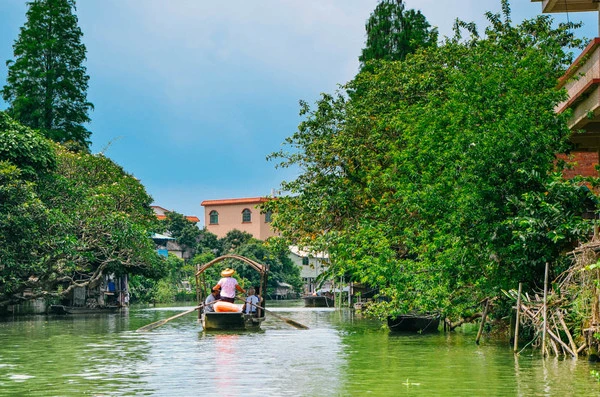
Houses by the water all have a small door right next to the water's edge, convenient for taking boats. According to villagers, the village waterways can lead all the way to the Pearl River outside. For 10 yuan, a boat can carry six people, and you can leisurely drift on the water for a long time while a local rows for you. From the boat, you can see the scenery of villages on both banks, with many ducks and fat geese feeding by the water, a hen and chicks strolling on a house roof, puppies running after villagers along the shore, and the boatman occasionally greeting the waterside locals!
Coming to Dawen Village, you absolutely cannot miss the water greenway here. Unlike some villages in the city proper, Dawen Village boasts particularly good water quality, so much so that besides many crabs, there are also amazing mudskippers.
Some of the village's dwarf bananas are already ripe, while others still hang on the trees. You can buy plenty of farm produce at the entrance stalls. Now comes the most sacred moment of the day: food time and photos!! Braised pork stomach with bean curd sticks, plus delicious river fish!
Are you drooling with envy and jealousy now? To spare you from too much temptation, I won't post more food photos. After lunch at a restaurant by the bridge at the village entrance, let's continue our journey! Outside the village, there are vast open green spaces, and volunteers from neighboring villages who patiently and meticulously give directions to tourists.
Along the road outside the village, there are large sugarcane fields and ornamental plant nurseries. On the other side of the village, there are indeed many ornamental plants, and the roadside outside the village is practically lined with crops, a sea of lush green. When I visited, the sugarcane had just sprouted; in a while, the roadside will be filled with tall sugarcanes, a spectacular sight! It all depends on whether you have the luck to see and taste them~
Walking out from Jixiang Road and strolling slowly towards the road by the cultural center, after a while you can leave the village and arrive at the Dachong water town scenic area, which is also quite nice. Dawen Village has very complete road signs, so there's absolutely no worry about getting lost. Approaching the urban area, there are newer buildings that also make a good photo spot; if you feel tired, you can take a bus there. I recommend taking boat rides and eating within the village, because Dawen Village offers boundless scenery and even more outstanding cuisine.
Dawen Village is very conveniently accessible, not to mention its simple and honest village atmosphere and super pristine natural scenery. Take a day off on the weekend, and Dawen Village will definitely live up to your good time!
Huangpu Ancient Port, a quiet haven beyond the bustling city
Besides Dawen Village, there is an even more convenient option: Huangpu Ancient Port. It happens to be on the same Metro Line 4, so you can visit Huangpu directly after Dawen Village. These two villages will give you completely different experiences. Getting to Huangpu Ancient Port is very easy; you can take a tourist bus or the sightseeing metro. Entering the village, the first thing that catches your eye is a very ordinary farmers' market, not chaotic or noisy, with fresh fruits, vegetables, and other produce neatly arranged on both sides. Many visitors choose to stop here after sightseeing, either to browse or to buy groceries. Past the road with produce, you'll see a memorial archway, which not only represents Huangpu Ancient Port's long history but also lifts the curtain on your journey here, marking the beginning of your exploration.
Huangpu Ancient Port ruins
At Huangpu Ancient Port, you often see ponds of various sizes, and beside them, you'll inevitably find towering old banyan trees and ancient ancestral halls. Trees lean over the water, ancestral halls nestle against the trees—this is like an ink-wash painting, a Lingnan landscape composition, not monotonous, full of life. Follow the water's edge and quietly venture into the deep lanes to explore.
Huangpu Ancient Port ruins
The ginger milk curd and grilled oysters in the village are, in my opinion, the most delicious snacks! Now many ginger milk curd shops have opened, always bustling with customers. The elderly ladies enjoying the ginger milk curd have faces brimming with pure happiness. They may be old, but memories remain, and the taste is just the same. To taste more old Guangzhou flavors in the village, you should head towards the big banyan tree at the village entrance. There is a particularly large water area at the entrance, with a great view overlooking the high-rises on the south bank of the Pearl River. Boats dock and depart here. At the ancient port's pier, you can also take a boat to the opposite shore for more sightseeing, to see the remnants of the port's former prosperity.
Perhaps you'll wander to a café where flowers are blooming just right at the doorstep. Perhaps you'll spot that Japanese-style residence hidden among other houses—it's not open to the public yet. Behind that Western-influenced building from post-Meiji Restoration, there's even a love story between China and Japan.
The first thing you'll see is the Liang Ancestral Hall, which I consider the ancestral hall in Huangpu Village that preserves the most historical culture. In front of the hall is a pond, its surface as smooth as a mirror, with clusters of gently swaying dark green waterweeds beneath, and various exquisite flowers and trees planted around it. Fragrance wafts into your nose, and layers of beauty greet your eyes. Two large red lanterns hang beside the gate of the ancestral hall, and a pair of awe-inspiring door gods still faithfully guard this ancient hall on the wooden doors. Inside, besides the unique layout typical of Lingnan ancestral halls, there are exquisite painted reliefs on the wall eaves and lifelike wood carvings on the pillars. All these ancient yet vibrant objects bring the hall to life, truly alive.
Continuing forward, you'll see the Huangpu Village Museum, which houses precious artifacts from the Maritime Silk Road of that time, some of which you won't even find in the provincial museum. Door ornaments, eave tiles, and brick carvings—various details of Lingnan architecture can all be seen in the museum. Next to the museum stand two old kapok trees; when they bloom in spring, you'll see a brilliant splash of red. Standing under the trees and touching the textured, striped trunks, you can still feel the scene of those days when flowers were in full bloom, people came and went, and boats and carts never ceased.
Walking further, you'll come to a fork, but don't worry—all paths lead to enchanting spots. Even a casual stroll will reveal various types of Lingnan architecture. Some haven't been renovated, with plants growing from the brick cracks, offering a surprising splash of green. What you feel is the ancient flavor of bygone eras, a three-dimensional sensation brought by time.
Some ancestral halls and mansions in the ancient village have recently been renovated and now sell cultural and creative products. Unlike elsewhere, the products here are all related to Guangzhou's traditional culture, and you can buy many exquisite items at very low prices, giving you a little sense of satisfaction. Legend has it that in ancient times, a pair of phoenixes flew here, and ever since, the population thrived and harvests were abundant. The village is situated on a small island; the waterside area is called 'pu' and the land in water 'zhou', so the village was named 'Huangzhou' or 'Fengpu', which later evolved into the name 'Huangpu'.
No wonder I found a dusty phoenix embroidery in one of the ancestral halls. The moment I wiped away the dust, I was amazed by the exquisite embroidery. Now these beautiful ancestral halls have become display platforms for artworks, where the pieces and the architecture complement each other. The beauty of the ancient port lies not only in authentic Guangzhou cuisine and traditional Lingnan architecture, but more so in that nostalgic sentiment we keep longing for. In this gentle Lingnan water town, what you leave behind is not just your footsteps, but also a city dweller's attachment to the village.
And what Guangzhou people are even more attached to is delicious 'soup'.
'Soup' holds half the importance in Guangdong culinary culture and is deeply integrated into the daily lives of Cantonese people. Guangdong folks love soup, love fine soup, and especially like having a bowl before a meal. One mouthful of delicious fine soup is enough to sweep away a day's fatigue. Today, I recommend you come to Xiyue Lou to savor some fine soup.
Xiyue Lou originated in Fuzhou, and upon its debut, it quickly dominated the hot pot scene there, with queues lasting until 2 a.m. It has won numerous authoritative awards in the catering industry and attracted several celebrities who came specifically to try it, besides gaining recognition from gourmands. Karen Mok, Eva Huang, Vincent Zhao... and other celebrities, a total of eleven stars, have all visited Xiyue Lou, and the must-order dish is Xiyue Lou's signature fish maw free-range chicken.
The signature soup base, 'Gold Medal Fish Maw Free-Range Chicken', along with premium seafood and ingredients from around the world, soothes the discerning palates of every honored guest.
[Fresh Ingredients]
Xiyue Lou's fish maw free-range chicken features a thick, rich soup base, golden in color and intensely fragrant, with the collagen getting thicker as you drink...
[Fresh Ingredients]
Who knows how many diners have traveled far just for this bowl of collagen-rich fish maw chicken soup.
Xiyue Lou uses free-range Qingyuan chickens raised in natural, free-range conditions. The Qingyuan chickens run about 20,000 steps a day for a full 240 days.
They are fed only corn and whole grains, drink mountain spring water, and have no excess fat. The meat is firm, the skin thin and crisp, with an intense chicken flavor.
From ingredients to the choice of technique,
every process at Xiyue Lou is strictly controlled,
just like how Cantonese people are particular about their soup.
Even the condiment dishes look fresh and cute, and you can mix various flavors according to your preference.
Soup-loving Cantonese people and the meticulous Xiyue Lou meet like old friends at first sight, regretting not having met sooner! Wouldn't you also like to come and taste it?
Yuyin Shanfang is a private garden built by Wu Bin, a Qing-dynasty juren (a successful candidate in the imperial examinations), and is one of the four great gardens of Guangdong. It is also the most exquisite one. After several restorations following a tornado attack, it now finally reveals its beautiful side to visitors again.
I used to live on the opposite bank of Yuyin Shanfang; to visit, we could take a ferry across. The simple ferry moved slowly, allowing us to see a different face of the Pearl River. In the morning, a light mist would linger here, giving a sense of seclusion that made one forget they were in a big city like Guangzhou.
Today I'm fortunate to visit Yuyin Shanfang again; everything here fills me with nostalgia.
Yuyin Shanfang, also known as Yuyin Garden, is located on Beidajie Street in the southeast corner of Nancun Town, Panyu District, Guangzhou, about 17 kilometers from the city center. Built as the private garden of Qing-dynasty juren Wu Bin in the third year of the Tongzhi reign (1864 AD), it has a history of over 150 years. Covering a total area of about 1,598 square meters, it is known for its petite and intricate design and exquisite layout, fully showcasing the unique style of ancient garden architecture and superb gardening artistry.
The layout of Yuyin Shanfang is very ingenious. Pavilions, terraces, halls, chambers, bridges, corridors, embankments, and water features are all contained within a mere three hundred paces, fully reflecting the cultural characteristic of harmony between man and nature, expressing a cosmological view of unity between humankind and nature.
Now that the metro reaches Yuyin Shanfang, it's even more convenient to visit, and the admission remains cheap. If you want your journey not to be a rushed one, you should explore more of such Lingnan architecture and enjoy the beauty brought by traditional culture.
I love the artificial mountain and water features most. Sitting quietly in the pavilion, you can listen to the crisp sound of water cascading down the waterfall, which is truly refreshing. The 'Exquisite Waterside Pavilion' was originally a place for composing poetry and drinking wine, reciting verses about the wind and moon. It features eight charming scenes: 'Sweet Osmanthus Greeting the Morning Sun', 'Willow Terrace in Green', 'Winter Plum in Full Bloom', 'Miniature Rockery at Hand', 'Rainbow Bridge Reflecting Sunshine', 'Lying Gourd Listening to the Zither', 'Orchid Path through Fruit Altar', and 'Peacock Spreading its Tail'.
The layout of Yuyin Shanfang is very ingenious. Pavilions, terraces, halls, chambers, bridges, corridors, embankments, and mountains and waters are all compacted within three hundred paces. The garden's brick carvings, wood carvings, stucco carvings, and stone carvings are rich and varied, fully displaying the classical elegance of a famous garden. There are also ancient trees reaching into the sky and dazzling exotic flowers that brighten the whole garden. The four great wonders of the garden—'Bamboo Greenery in the Wall Gap', 'Rainbow Bridge Reflecting the Moon', 'Deep Willows Hiding Treasure', and 'Double Greenery Welcoming Spring'—open visitors' eyes and make them forget to leave.
Su Dongpo once said, 'I would rather go without meat than live without bamboo.' But how can bamboo be grown on a plot of less than three mu? The garden owner eventually thought of a solution: planting green bamboo between walls. This way, it doesn't occupy garden space, its growth can be controlled, and it can block dust from outside—truly three benefits in one. After crossing the Rainbow Bridge, walking forward brings you to the 'Deep Willow Hall'.
The garden's original owner, Wu Bin, courtesy name Yantian, was a Qing-dynasty juren who served as a secretary in the Ministry of Justice, a seventh-rank official. What's even more remarkable is that both his sons also became juren, hence the saying 'three juren in one family, father and sons passing the exams together.' Later, seeing through the ways of the world, he retired from office and returned to his hometown, living in seclusion and building this garden. To commemorate the blessings of his ancestors, he chose 'Yuyin' (remaining shade) as the garden's name, while also hoping that his descendants would forever benefit from the ancestral blessings.
Adjacent to the south of Yuyin Shanfang is a slightly smaller garden called Yu Garden. Yu Garden is a residential courtyard built in 1922 by Wu Zhongyu, the fourth-generation descendant of the original owner. The ground floor has a boat hall with a small square pond outside, and the second floor has a glass hall that overlooks the scenery of Shanfang's courtyard. It now belongs to Yuyin Shanfang, and the two gardens are combined, complementing each other.
Twenty years after Yuyin Shanfang was completed, the garden owner's nephew Wu Zhongyu added 'Yu Garden' to entertain relatives and friends from afar, but legend has it that his eldest and second daughters stayed there on the eve of their weddings, hence it is also called the 'Young Ladies' Building'.
On a moonlit night with a gentle breeze, the reflections of the moon, bridge, and people intertwine in the lotus pond, creating a captivating picture.
Opening the windows one by one and looking down at the small pond below, the stone bridge hugging the wall brings the scene to life, and it doesn't feel cramped at all.
Compared to the delicate elegance of Suzhou gardens, Lingnan gardens possess a more expansive and rustic charm. One is like a graceful young lady, the other like a burly man with many stories. The artificial mountains are planted with various flora, and you can even walk up to the oddly shaped rocks to experience the beauty of being in nature.
Pavilions, chambers, corridors, mountains, rivers, and trees
are all hidden in each step.
It embodies the Chinese spirit of embracing all things like the ocean.
That's why some describe this garden as 'condensing a dragon into an inch'.
Every step brings a new surprise.
From a bird's-eye view, lush trees and vegetation cover the entire park, providing a comfortable living space for the animals. Looking down over the park, you'll see a magical animal world. First, we arrive above the 'East African Savannah', a harmonious and leisurely animal scene.
If you're traveling with family, I also recommend Chimelong Safari Park in Guangzhou. Be sure to take their aerial cable car; each car has voice navigation that tells you where you are and which animals are below as you look down. Listening to the audio guide and looking down, you'll see herds of antelopes and wildebeests leisurely walking on the grassland, grazing on green grass. When they spot a keeper, they rush over—it's feeding time.
There are also the 'tall, rich, and handsome' giraffes on the East African Savannah, with their long necks and long legs. Their slender limbs and leisurely gait keep them ever elegant. Because they're so tall, they generally don't lower their heads to eat; the giraffes here mostly stick out their long tongues to lick leaves from the treetops. Inside Chimelong Safari Park, their food is hung high on branches for them to reach easily.
The Asian elephant is the largest animal at Chimelong Safari Park, weighing up to 3-4 tons. Their massive bodies are visible from the cable car. Asian elephants enjoy playing and frolicking by the pond, sometimes running in for a bath and covering themselves in mud.
Moving on, we can see lakes scattered amidst the forest, providing open water environments for various waterfowl. White swans and black swans glide gracefully on the lakes; pelicans with their big beaks, upon seeing a keeper bringing their favorite little fish, flock over and stuff their 'big mouths' full.
Many tourists, upon seeing white and black swans swimming by, stop in their tracks, rush to the water's edge to feed them, and seize the chance to raise their cameras and snap photos of these elegant spirits on the lake.
Of course, some storks and other waterfowl choose to stand on branches by the water or on bamboo rafts, posing as quiet and handsome gentlemen, unmoved by wind or rain, seemingly unfazed and composed.
They say 'food is in Guangzhou', so today I'll first recommend Songyue cuisine at the Pearl River City Tower. 'Songyue Ziman Restaurant' offers Japanese elegance and warmth, specializing in sashimi, hand rolls, grilled items, and premium dishes.
'Songyue Ziman Restaurant' originated in Fujian, and now, bringing its pride and authenticity, it has landed in Guangzhou, presenting pure culinary culture.
Upon arriving at Songyue, you'll see its warm and minimalist environment. The restaurant is a 'dust-free restaurant' where you need to remove your shoes to enter. Japanese-style murals, tables and chairs exuding the scent of pine, eco-friendly walls made of diatomaceous earth, simple and elegant tableware... all together create a Japanese elegance and warmth.
At the entrance, kimonos are provided, so coming for Japanese cuisine naturally means dressing up with a sense of ceremony.
The interior is brimming with Japanese atmosphere, dotted with cherry blossom trees that lift your spirits at the sight! In this clean, bright, and finely decorated setting, even the service staff's voices are pleasingly soothing, and the dining space is tranquil yet lively.
[Super Tender Beef, So Delightful to Eat]
Besides the beef here, you must try their salmon, which is super fresh and tender.
Songyue receives fresh imports by air every 48 hours, so sashimi and sushi are indispensable choices. It's said that the nigiri sushi changes its ingredients based on the day's air shipment, adding a touch of mystery before you eat.
New Zealand salmon, compared to other salmon, has finer fat marbling, a subtle creamy flavor, and richer nutritional value, making it very popular among gourmets, and many renowned Michelin restaurants also use it in their dishes.
The Japanese-style salad is exceptionally vibrant, with well-handled color coordination. The head chef at Songyue carefully checks ingredient quality at every step, rejecting those that are not aesthetically pleasing or plump enough. The chef scrutinizes ingredients with an artist's eye. Only 70% of ingredients make it to the Songyue table, achieving 100% visual appeal on the plate.
After savoring the delicacies, stepping out of Pearl River City Tower contentedly, the bustling scene before you will surely amaze you~ In fact, since the Qin Dynasty, Guangzhou has been the administrative center for commanderies, prefectures, and provinces, undergoing over 2,000 years of change, and today it remains highly attractive! Whether day or night, you can stroll around nearby commercial buildings to feel Guangzhou's modern vibe, or head to the old streets of Dongshankou to discover beautiful architectural clusters and taste authentic Guangzhou cuisine. After enjoying the meal at Songyue, we can check into the Mehood Hotel near Wuyangcun, which is just one metro stop from Zhujiang New Town, making transportation very convenient.
The hotel's check-in and check-out system can be handled self-service without going to the front desk. Moreover, when checking out, you can leave without a room inspection and no deposit is required, which is very convenient.
In addition to creating a relaxing and entertaining experience, Mehood also pays special attention to your safety during your stay. The hotel is equipped with a high-end intelligent surveillance system that provides zero-blind-spot monitoring in public areas, and there are separate access control systems at each floor entrance, ensuring that every guest enjoys an ultimate sense of security.
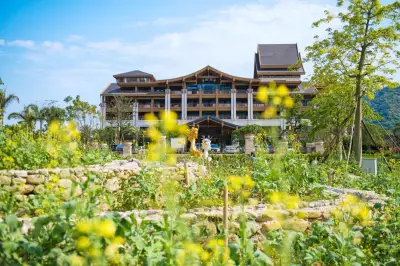
The Mehood Hotel Lizhi series focuses on mid-to-high-end style, with luxury, refinement, elegance, and romance in its exterior, renovation, and interior decoration.
The elevator back wall features wooden grid decoration, looking particularly trendy. Let's step into the room and experience the essence of Mehood Hotel.
Having stayed in many hotels, most have warm yellow lighting, but Mehood is equipped with bright yet not glaring desk lamps, allowing comfortable work.
The ultra-high-definition projection equipment can even project 4K videos, making in-room movie watching a top-notch enjoyment. The smart, internet-connected playback system let me watch the latest TV series on the huge projection screen. Coupled with internationally renowned brand speakers in all four corners of the room and a huge subwoofer, it's an absolutely cinema-surpassing experience!
[Hotel Exterior View]
Although located in the city center, the living environment at Mehood Hotel remains private and quiet. The hotel rooms feature various themed styles, decorated according to guests' preferences. The interior spaces are spacious and come with all essential living necessities, carrying the flavor of home—familiar and warm!
The main tone is natural wood.
Grey brick walls, cement floors, natural wooden base, complemented by rattan birdcage beds, swing chairs... Nostalgic retro vibes, rustic and fresh styles—these all seem to inadvertently stir up those unforgettable memories of bygone days during your trip or business sojourn.