Guangzhou Again – Guangdong Provincial Museum
Travel time: 2020.7
Travel mode: flight (Nanjing – Guangzhou), self-driving
Route: Nanhai God Temple (visit duration: 1.5 hours, ticket: RMB 15) – Lingnan Impression (arrived at 16:40, closed at 5 pm, couldn't enter) – Guangzhou University City Science Museum (exterior) – Beijing Road food hunt
Accommodation: CityNote Hotel (Guangzhou Beijing Road Dafo Temple Park Subway Station) RMB 271/standard room
Travel mode: walking, taxi
Route: Lu Xun Memorial Hall (1.5 hours, online reservation required, free entry), Guangdong Provincial Museum (1.5 hours, online reservation required, free entry), United Bookstore
Accommodation: CityNote Hotel on Beijing Road
Travel mode: walking, metro
Route: Museum of the Nanyue King's Palace (1.5 hours, free entry), Yuexiu Park (2 hours, online reservation required, free entry), Guangzhou Museum, restaurant hunting at Yuehai Lou
Accommodation: Jinzhou International Hotel
Travel mode: walking, taxi
Route: Sun Yat-sen Memorial Hall (free for medical staff), Beijing Road, dining at Tao Tao Ju
Accommodation: Huamao Hotel
Travel mode: bus, taxi, metro, flight (Guangzhou – Nanjing)
Route: Shangxiajiu Pedestrian Street, Xiguan Dawu, Liwan Lake Park, dining at Xin Tai Le
Guangdong Provincial Museum:
Address: No. 2 Zhujiang East Road, Tianhe District, Guangzhou
Ticket: free, online reservation required in advance
After leaving Lu Xun Memorial Hall, I took a taxi to the Guangdong Provincial Museum. Interestingly, today's two destinations share a special connection. The Guangdong Provincial Museum we're heading to is a province-level comprehensive museum. Its old site began preparation in 1957 and was located right where we just left – No. 215 Wenming Road. That site was once the imperial examination hall of Guangzhou in the Qing Dynasty, later became a major national protected cultural relic site – the site of the First National Congress of the Kuomintang (including the revolutionary square), and the provincial protected cultural relic sites of the Red Building and the Sun Yat-sen University Observatory. It wasn't until 2003 that the new Guangdong Provincial Museum was built in Guangzhou's Zhujiang New Town. The car dropped us at the museum's east gate, which was closed, so we had to walk around to the west gate.
The museum's new building is located in the ultra-modern and trendy Zhujiang New Town. This area is home to several landmark buildings such as the Guangzhou Opera House, Guangzhou Library, Guangzhou Children's Palace, as well as important public facilities like Huacheng Square and Haixinsha Civic Square.
Across the Pearl River from the museum stands Guangzhou's iconic Xiaomanyao.
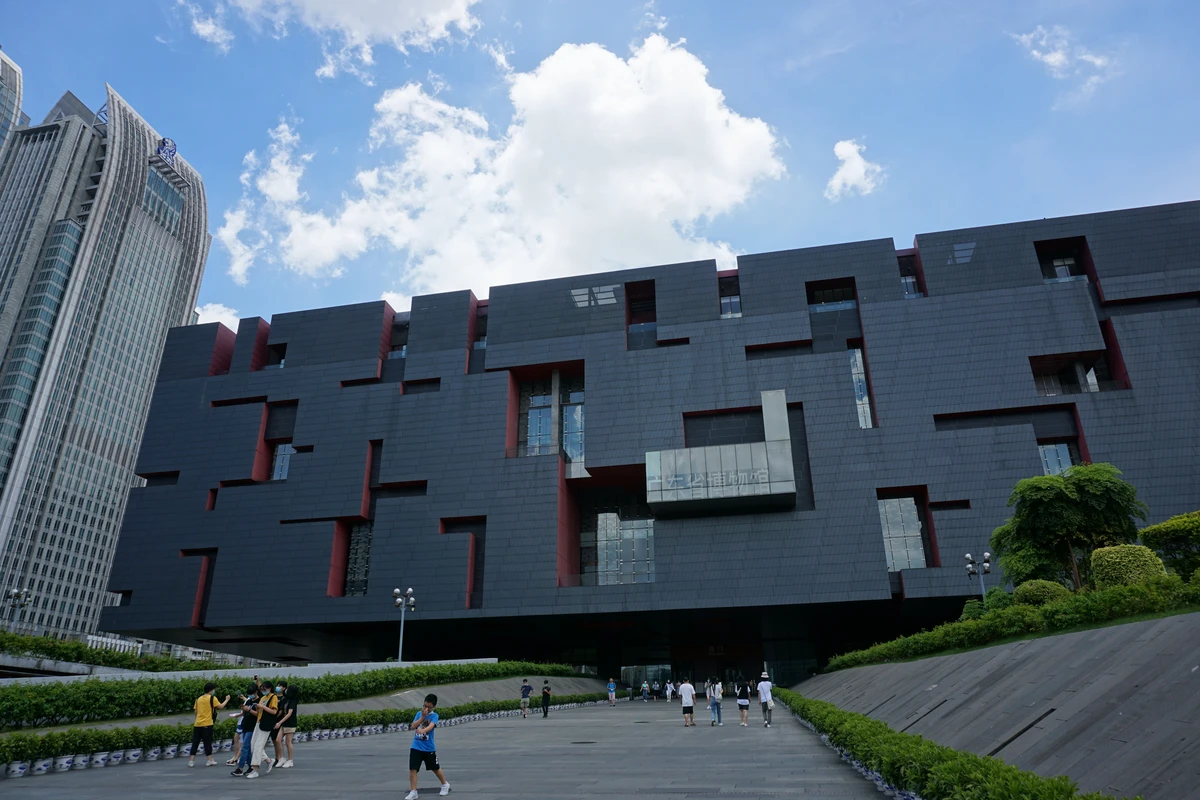
The museum's main building is shaped like a square, exquisite box, with a bold and magical design.
We had made online reservations separately a couple of days earlier. When I showed my reservation code, I realized that my child's reservation hadn't gone through. I pleaded with the staff, explaining that we were mother and son, hoping for some leniency to enter together. The Guangdong Museum staff, however, were impeccably trained and resolutely refused. Left with no choice, I had to enter alone with my code. My child went off exploring elsewhere, and we agreed to meet at the entrance a few hours later. The museum's architecture resembles a carved treasure box, with an extra-wide passage leading into this magical labyrinth.
Entering from the west gate, the visitor center is on the right, and the audio guide reservation area on the left. In the middle is a spacious atrium that rises from the entrance hall all the way to the top floor, where natural light streams down through a glass skylight. Serving as the main public space, the atrium is surrounded by ramps, stairs, and escalators connecting the corridors on different floors, guiding visitors to the various exhibition halls. In keeping with the 'treasure box' openwork design, the corridors are separated from the atrium by perforated metal panels, creating a subtle, layered effect.
Standing here, I checked the layout of each floor. The museum is a national first-class museum, divided into permanent and temporary exhibition areas. I roughly got my bearings and started my tour.
Exhibition Hall 1 was hosting the 'Buddhist Light of Weitang' exhibition, which I didn't enter.
Some temporary halls were under construction.
On the southwest side of the third floor was the 'Lacquerwood Splendor – Chaozhou Woodcarving Art Exhibition'.
The introduction explained Chaozhou lacquer woodwork.
Here was a map of Chaozhou Prefecture during the Qing Dynasty.
Upon entering the hall, the sight was dazzlingly magnificent. Chaozhou woodcarvings have a long history, with distinctive local characteristics, unique compositions, and a wide range of subjects. Most themes are drawn from popular folk stories, myths and legends, rare birds and auspicious animals, flowers and fruits, and marine life. The exhibits included grand, exquisitely detailed gold-painted lacquer panels; intricately carved, life-like openwork crab baskets; and uniquely shaped, finely carved shrines, deity pavilions, deity palanquins, incense holders, food boxes, sweets racks, paper-twist holders... a dazzling and colorful array.
The exhibition was divided into sections: Origins, Craftsmanship, Artistry, Utensils, and Appreciation.
The Origins section introduced the beginnings and development of this woodcarving tradition.
The Craftsmanship section showed how woodcarving developed its own characteristics in materials, tools, and techniques. Carvers choose suitable wood, meticulously plan their designs, and use a variety of tools combined with unique techniques like sunken carving, relief carving, openwork carving, and circular carving to create exquisite pieces.
Chaozhou woodcarving is lush and intricate, delicate and refined, exquisitely transparent, and resplendent with gold.
The most prominent carving technique is multi-layered openwork carving, which can concentrate complex storylines onto a single panel, leaving viewers in awe.
The hall also makes full use of its tall, spacious dimensions to faithfully recreate traditional Chaoshan household scenes – living rooms, bedrooms, studies – vividly demonstrating how woodcarvings were used in everyday Chaoshan folk life.
This Yongqing Hall was reconstructed based on the Lin family of Chaozhou during the Republican era. This magnificent hall is a model of Chaoshan residential architecture. The main hall is the focal point of woodcarving decoration. Beautifully varied screens, plaques, tables, chairs, and other furnishings are all adorned with gold-lacquer woodcarvings, exuding opulence and making the entire room glow.
This is the master bedroom. In a wealthy family's home, the bedroom features exquisitely carved canopy beds, dressing tables, wardrobes, side tables, and other Chaozhou-style furniture. The meticulous workmanship, lifelike carvings, and the luxurious, gleaming gold-lacquer technique vividly showcase the customs and lifestyle of the Chaoshan people, with a unique charm and captivating elegance!
Looking out from the museum window, the modern Zhujiang New Town under fluffy white clouds was uniquely beautiful.
There was also a ceramics hall here. No matter the size of the city, every museum seems to have a ceramics section, perhaps because China is the 'land of porcelain.' The development of ceramics reflects, in a way, the development of a city.
The collection comprehensively covers products from major kilns across the country, with rich decorative techniques and vessel shapes. Items from the Ming and Qing dynasties, especially Jingdezhen porcelain of various types, as well as locally distinctive Shiwan pottery and Guangdong-style painted porcelain, are particularly abundant and exquisite.
This was an exquisite Guangcai figure-patterned punch bowl from the Daoguang period.
A diorama showed the development of the porcelain industry. Since my hometown is Jingdezhen, I didn't spend much time in this hall, just breezed through.
Climbing the stairs, the fourth floor houses the permanent exhibitions. On the west side is the Guangdong History and Culture Hall.
Upon entering, a stunning Guangdong Sea and Land Map greeted me. On a wall based on a satellite map, various elements representing Guangdong's history and culture faintly emerged across the land and vast South China Sea, majestic and grand.
The exhibition follows a chronological order, divided into four sections: Origins of Nanyue, Sailing the World, Forging Ahead, and Beacon Fires of Guangdong. The first section, 'Origins of Nanyue,' traces the sources of Guangdong's people, the process of ethnic integration, and the formation of the three main ethnic groups, along with their folk cultures. Display cases held the Maba Man skull, double-shouldered stone tools...
The Meiguan Pass, located in today's Shaoguan, has been a vital route connecting Lingnan with the Central Plains since the Qin and Han dynasties.
This 41-meter-long Panyu dragon boat, also known as the Liede dragon boat, is painted all over with lychees, longans, and star fruits, earning it the name 'Flower Dragon.'
This dragon boat won the championship in the traditional dragon boat category at the 2004 Guangzhou International Dragon Boat Invitational.
Teahouses occupy a pivotal place in Cantonese food culture.
Chaoshan 'gongfu tea' stands out in the art of Chinese tea. Tea culture permeates every aspect of life for Chaoshan people; no matter the occasion – weddings, funerals, banquets, or business – gongfu tea is indispensable.
This display case uses clay figurines to illustrate the life customs and rituals of Cantonese people.
They are exquisitely detailed and lively.
A wedding feast scene.
Oil paintings and physical objects depict the Hakka living environment of 'eight mountains, one water, one farmland.'
Using simple tools, they toil diligently on the land, thriving through generations.
Through various formats, we get a vivid, three-dimensional impression of South Guangdong.
This archway looked so familiar – it was the 'Calm Sea' archway we saw yesterday at the Nanhai God Temple. From here begins the second section: 'Sailing the World.'
Han dynasty tower ships, Tang and Song peony boats, Ming and Qing Cantonese ships – they carried Cantonese people all over the world, writing the legend of Guangdong as the eastern center of global maritime trade.
These ships of the Maritime Silk Road laden with porcelain, the Thirteen Hongs brimming with exotic foreign goods, exquisite Guangdong enamel, Guangdong carvings, and once-popular export paintings...
Starting in the Ming dynasty, Italian missionaries arrived in Guangdong, ushering in the era of Western learning spreading eastward. European religion, science, technology, and ideas continuously flowed into Guangdong.
A brass barometer-thermometer clock. Here, through texts, images, and artifacts, visitors experience the splendid history of Guangdong's opening up and exchanges. The blend of Chinese and Western styles everywhere speaks to Guangdong's openness and inclusiveness.
As China's window and conduit for external exchange, Guangdong's culture displays diversity and international characteristics.
Overseas Chinatowns.
On display were original historical documents like overseas Chinese identity cards and passports.
Introductions of overseas Chinese schools and community organizations.
Overseas Chinese who made their fortunes abroad actively supported the development of their hometowns. They returned to establish public utilities, schools, and invest in factories. I visited the Kaiping Diaolou in 2019; most were built with overseas Chinese investment.
This third section, 'Forging Ahead,' is introduced with photos, texts, and a group of modern celebrity sculptures. The pioneers of Guangdong together staged the dramatic modern history that changed the course of China. Patriots resisting British aggression, advocates of the Self-Strengthening Movement, leaders of the Hundred Days' Reform, forerunners of the Xinhai Revolution, founding figures of Kuomintang-Communist cooperation, pioneers of national industry and commerce... countless heroes and pillars turned into stars, shining brilliantly across the land of South Guangdong.
The fourth section, 'Beacon Fires of Guangdong,' recounts the epic anti-Japanese war fought by Guangdong's soldiers and civilians in blood and fire. It especially covers historical wars in modern times, including the unequal treaties China was forced to sign. Many, many war photos are displayed, reminding us to remember history and never forget our national humiliation.
Black-and-white historical images showcase the indomitable revolutionary spirit of South Guangdong's sons and daughters.
The exhibition concludes with a view of the boundless South China Sea. This azure sea echoes the blue sea-and-land map in the prologue, symbolizing Guangdong's inclusive spirit that embraces all, its relentless forward march, and its people's hopeful stride into the world and the future.
The history gallery provides a multifaceted view of Guangdong's historical and cultural evolution, from the Maba people to the founding of New China. Stepping out of the history hall and gazing through the central corridor window, modern Guangzhou unfolded splendidly.
The windows were treated this way, perhaps to prevent the museum from becoming a sightseeing spot? Viewing the beauty of new Guangzhou through this hazy filter had its own charm.
On the east side of the fourth floor was 'Beautiful Mountains and Waters, Abundant Lingnan – Guangdong Natural Resources Exhibition.'
The prologue hall was quite interesting, using sets of square hanging panels as decorative elements throughout the exhibition. Through arrangement and lighting effects, these panels formed sheets, lines, or nets. At the start, they rose from the floor toward the ceiling, guiding visitors into a space filled with natural elements.
'Our Treasures – Mineral Resources Hall.'
The exhibition used mineral specimens, mine photographs, fun models, and comics to introduce Guangdong's unique mineral resources and their important uses.
In the corridor between halls, you could always gaze out at the view.
'Spirits of Stone – Gemstone Hall.'
This exhibition made my eyes sparkle; the array of unheard-of minerals and strange stones left me utterly fascinated. The display paired gemstone roughs, cut gems, jade carvings, and related artifacts to introduce gemstones, jades, organic gemstones, artificial gemstones, and scholar's stones, while also highlighting Guangdong's leading role in gemstone production, processing, and trade.
A student group happened to be there with a teacher giving explanations, so I followed along to learn. While admiring the beautiful gems, I gained knowledge about relevant minerals.
An exquisite ivory carving, 'Five Rams Immortals Celebrate Eight Scenes.'
Guangning jade carving 'Roc Spreading Its Wings.'
As one of China's main producing areas for traditional Chinese medicinal herbs, Guangdong boasts authentic Lingnan herbs and folk remedies. 'Lingnan Herbs – Chinese Herbal Medicine Hall' gave us a detailed look.
The exhibition used various types of specimens to introduce us to unique 'southern medicines' like fleeceflower root, morinda root, eaglewood, spring amomum fruit, Guangdong tangerine peel, Guangdong finger citron, Guangdong patchouli, and heartleaf houttuynia.
A recreated Baicaotang scene illustrated Guangdong's distinctive herbal medicine culture. It's precisely because of this rich abundance of medicinal herbs that herbal tea shops can be found on every street in Guangzhou, making one feel that Cantonese people never need to go to the hospital—just a bowl of the right herbal tea from a shop will cure you.
From here, you could look straight down to the souvenir shop on the second floor.
The exhibition also incorporated knowledge windows, fun corners, and interactive quizzes to engage visitors and impart various bits of information.
Guangdong is home to rich and distinctly Lingnan terrestrial wildlife. The 'Terrestrial Animal Residents – Terrestrial Wildlife Hall' took us to see them.
First, it showcased Guangdong's complex and diverse natural environments. Such environmental diversity gives rise to a wealth of species.
The hall featured model-built landscapes: mountain forest ecological scenes, shrubland, farmland, grassland scenes, and wetland scenes.
Each section used numerous specimens set in corresponding ecological contexts, helping us understand the relationship between environments and species.
A large space created a vast, deep ocean environment – 'Marine Animal World – Ocean Hall.' With lighting effects, various marine animal models seemed to swim in a blue sea, almost within our reach.
Guangdong has the longest coastline in the country and thus rich marine animal resources. The exhibition selected several large marine mammals, over 30 species of marine bony fish, over 20 species of marine cartilaginous fish, plus many marine reptiles and invertebrates—the most representative types. Using taxidermy specimens, skeletal specimens, comics, photos, and multimedia, it transported us into a vivid marine animal world.
In the giant space below the Ocean Hall, astonishing dinosaur skeletons seemed to take us back to the primeval wilderness millions of years ago. This was 'Exploring Lost Life – Paleontology Hall.' Following major events in the evolutionary process, it used representative fossils from various geological periods and large ancient vertebrate skeletons, especially dinosaurs, combined with reconstruction illustrations, popular science comics, and multimedia, to detail the long evolution and development of life on Earth, including humans, from nothing to something, from the sea to the land.
The richly informative natural resources exhibition made full use of the lofty space (8 to 22 meters high) to show Guangdong's abundant natural resources, important geological features, distinctive mineral resources, exquisite jewelry, mysterious prehistoric creatures, miraculous medicinal plants, and dazzling marine life... giving a comprehensive view of Guangdong's natural resources and related scientific knowledge. The Ocean Hall and Paleontology Hall were situated in a large open void, so by the time we finished, we had naturally descended from the fourth floor to the cultural and creative product shop on the second floor.
The creative souvenirs here were closely linked to the exhibitions – various gemstone jewelry, animal plush toys, butterfly specimens...
The central hall on the second floor had a floor paved with marine life specimens. Very creative!
As my child was finishing up elsewhere, I had to leave immediately to meet him. The museum had a lot to offer; luckily, I was selective and visited a few halls, so the timing matched perfectly. Stepping out of the museum, the world outside felt even bigger.
A long corridor here was where people had lined up earlier to show reservation codes and health codes.
I took one last look around at the modern architecture.
This is the southern part of Zhujiang New Town's central area, on the east side of the new city axis. The museum, together with the Guangzhou Opera House to the west, the central boulevard, and the riverside green belt, forms the Guangzhou Culture and Art Plaza.
On the plaza, I held up this little rooster figurine against the blue sky to take a photo. This was the cute little thing I fell for at first sight in the museum. Adorable, isn't it?
Two museums in one day. Through museums, you can quickly get to know a city – its history, culture, resources, development...